140 days after Lin Junyang's departure, Qwen 3.8 returns to open source. Can Alibaba's large models still maintain strong competitiveness?
On the evening of July 19, two days after Kimi K3 topped the benchmark rankings, Alibaba Cloud released the Qwen3.8-Max preview version. It is a "semi-finished product" that promises continuous evolution on a daily basis, marking the debut of a flagship model with a "preview + daily update" mode.
In contrast to Kimi K3's record-high pricing, the Qwen3.8 preview version launched with a "steep discount" strategy: daytime calls cost only 10% of the standard price, while nighttime rates drop as low as 2%. Some users have found that the model appears to get noticeably smarter each passing day. However, other users argue that they pay for reliable task execution, not to test an unstable model.
The Qwen3 series is the large model led by Lin Junyang during his tenure, and Qwen3.5 was the final version he released before leaving the company. Yet this version shows a clear performance gap compared to Qwen3-Max Preview, which had previously ranked among the top three in the LMArena large model blind test leaderboard last September. According to LatePost reports, senior Alibaba executives were dissatisfied with this model released on Chinese New Year's Eve, even describing it as a "semi-finished product".
Lin Junyang insisted on open-sourcing the models before departing amid Alibaba's organizational restructuring, a move that sparked widespread industry discussion. The question of whether the Qwen series can sustain performance improvements has become a major focus of public attention.
In terms of parameters, Qwen3.8-Max has a total parameter count of 2.4 trillion, adopts a MoE architecture, and is Alibaba's first native multimodal model to break the trillion-parameter threshold. Official data shows that in the two core scenarios of coding and collaborative office work, the preview version outperforms its predecessor Qwen3.7-Max by 22.8% and 44.4% respectively.
140 days after Lin Junyang's departure, Qwen3.8-Max will return to the open-source path. Alibaba may have finally realized that when its model capabilities still lag behind the top closed-source leaders by a certain margin, open-sourcing is the optimal choice for the company to maintain its reputation and ecosystem.
01
The daily-updating Qwen3.8-Max preview version falls short of its promotional claims
According to official introductions, compared to the previous flagship model Qwen3.7-Max, the new model delivers significant improvements in core capabilities such as code engineering and professional office work, demonstrates globally leading comprehensive performance in complex long-horizon tasks including full-stack development, data analysis, and Office workflow processing, and remains in a state of continuous evolution.
To test the performance of Qwen3.8-Max preview version in office scenarios, we provided it with a document titled *Embodied Intelligence Development Report (2025)*, and asked it to answer three questions: list the main technical implementation paths for embodied intelligence mentioned in the report and briefly explain their core characteristics respectively; analyze the investment and financing features in the embodied intelligence field in 2025 based on the report data; design 3-5 most suitable data visualization schemes for PPT charts using the data from the report.
For all three questions, the Qwen3.8-Max preview version took roughly 10 seconds of thinking time, produced clear answers, and supplemented them with supporting tables.
On the X platform, an independent developer named "Lonely" used the Qwen 3.8-Max preview version to generate a stunning video. On his first attempt, he only provided vague requirements, resulting in a mediocre and uncreative output. On the second try, he clearly outlined the functional modules, interaction logic, image rules, and page structure.
The final generated insect visuals are as realistic as the footage captured in BBC documentaries. Compared to the cartoon-style output of the first version, the website presents higher professionalism. Meanwhile, each insect comes with a learning card that supports users to self-test their learning progress.
After hands-on experience, he found that even when facing ultra-long prompts and multi-page construction tasks, the entire generation process of Qwen 3.8 Max preview version remains smooth, taking only 17 minutes to complete, compared to 52 minutes required by Kimi K3, which greatly reduces waiting time. In long-horizon task execution, Qwen 3.8 Max preview version performs excellently, with the final output basically realizing all the added interaction details and module decompositions.
To test the front-end generation capability of Qwen3.8-Max, I requested it to create an interactive HTML page introducing cosmic galaxies, with the following specific requirements:
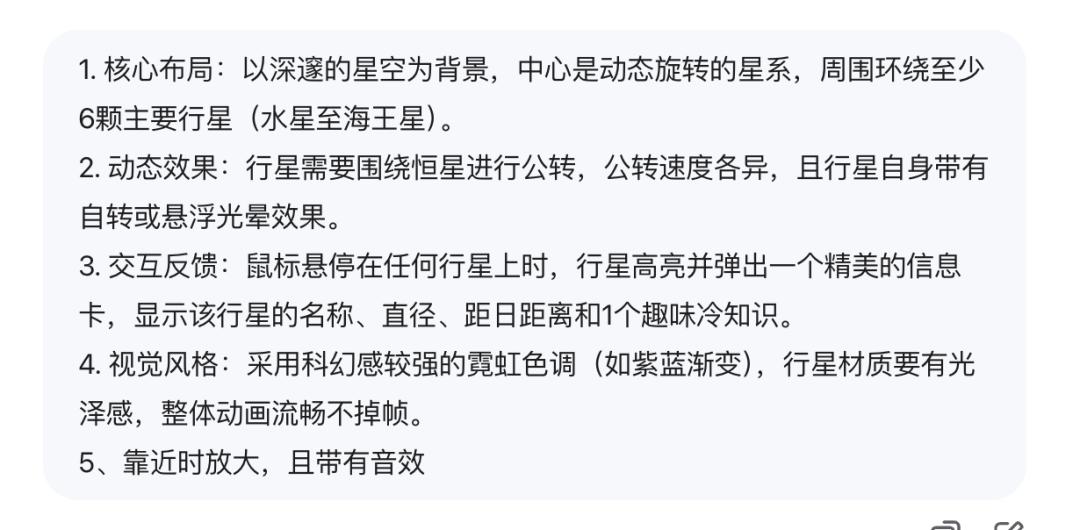
Superficially, the model meets our basic requirements, but it contains a common-sense error: the main planets orbit the sun at the same speed, and their relative positions never change. In reality, their relative positions are constantly shifting, and their orbital speeds are completely different.
Based on user feedback across social platforms, Qwen3.8-Max preview version still has noticeable shortcomings in non-standard tasks such as creative programming, 3D interaction, and complex narrative. Some people even describe the Qwen3.8-Max release as a "naked launch" — it has parameters but no sufficient supporting data, slogans but no solid evidence. Alibaba chose to use the combined strategy of "daily updates" and "limited-time 10% discount" to obtain large-scale real user feedback and complete the final polishing process. This strategy is nearly identical to the one Alibaba adopted for its previously released video generation model HappyHorse: first build maximum public attention, then gradually improve capabilities later, using market focus to secure a window period for product iteration.
However, referring to the performance improvement of Tencent's Hunyuan hy3 official version over its preview iteration, the official Qwen3.8 version is likely to see further capability enhancements.
An independent game developer shared his user experience with Tech Planet. He develops game prototypes daily using the Godot engine and Blender, whose workflow has high requirements for response speed and iteration efficiency. In practical use, the Qwen3.8-Max preview version's performance in complex logic generation and long-context tasks has not yet reached the first tier, but its output efficiency per unit time in short-cycle, high-frequency interaction scenarios is even better than GPT-5.6 Sol, delivering truly competitive cost-effectiveness. Nevertheless, when the task extends to 30-minute level continuous reasoning or large-scale code generation, the Qwen3.8-Max preview version shows obvious insufficient stamina and unsatisfactory stability.
In terms of specific capability dimensions, his evaluation suggests that currently, in game function code generation and tool invocation control based on the MCP protocol, GPT-5.6 Sol is firmly in the first tier; Kimi K3 and GLM 5.2 belong to the second tier; Qwen3.8-Max preview version drops another tier, with its core competitive advantages lying in the comprehensive balance of context window capacity, per-call cost, and response latency. It is suitable for high-frequency auxiliary development scenarios, but still has clear shortcomings in the precision and depth of complex tasks.
More than the model itself, the "limited-time 10% discount" pricing has led many developers to choose the Qwen series as an additional option alongside their primary daily-used large models. One developer told Tech Planet that he switched to the Qwen series temporarily after exhausting his monthly Kimi K3 quota, and only then learned about the latest version. The iteration speed of large models is extremely fast, and he wants to try every new version released, but he may not continue using it if Qwen3.8 returns to its original price.
02
Why is Alibaba in a rush to launch Qwen3.8-Max?
After Lin Junyang's departure, Alibaba's large model team entered a delicate adjustment period.
In the week following Lin Junyang's exit, Alibaba consecutively released three models between March 30 and April 2 this year: Qwen3.5-Omni, Wan2.7-Image, and Qwen3.6-Plus. The difference is that all three models are completely closed-source, meaning developers cannot download the weights for local deployment and can only call the APIs through the Alibaba Cloud Bailian platform. This stands in stark contrast to the "open-source first" tradition the Qwen series has maintained over the past two years.
However, looking at the large model release rhythm, from the end of 2025 to mid-2026, over the span of six months, Claude, Gemini, and Llama have all been vigorously promoting their "4-series" or even "4.5-series" flagship models. During this same period, Qwen's major version number has remained stagnant at Qwen3, with a relatively restrained update pace.
Over the past year, Alibaba has not launched a cross-generation base model such as Qwen4, and has mainly focused on fine-tuning reasoning performance and optimizing long-text capabilities, with partial improvements integrated into minor version updates. In comparison, Claude completed the leap from 3.5 to 4.0 then to 4.5 within a single year, an astonishing pace. Gemini released three generations over the past year: the 1.5 improved version, 2.0, and 2.5, with an extremely high iteration density of roughly one major version every 3-4 months. Llama advanced from version 3.3 to 4.1 in less than a year, while consistently remaining open-source, maintaining an extremely fast rhythm.
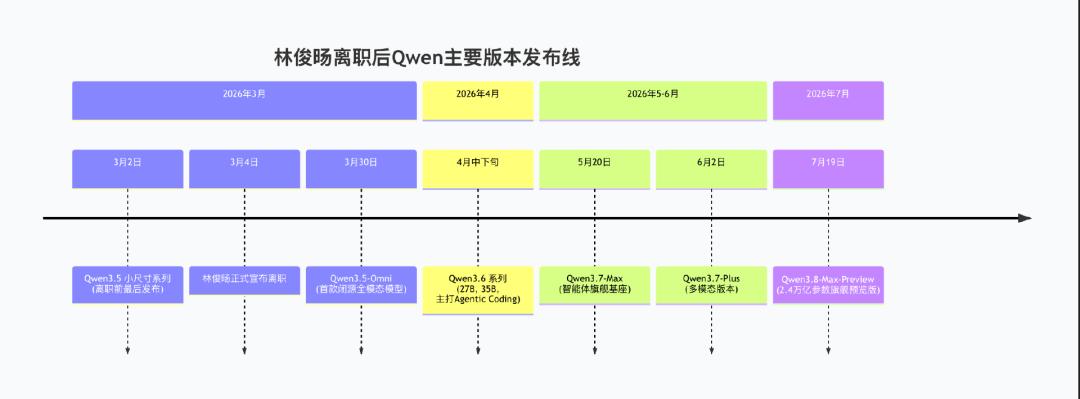
Alibaba's annual report for the 2026 fiscal year (ending March 31, 2026) and its Q4 earnings report delivered the first quantifiable AI commercialization results. This quarter, AI-related products accounted for over 30% of Alibaba Cloud's external revenue for the first time, reaching 8.971 billion yuan, with an annual recurring revenue (ARR) exceeding 35.8 billion yuan — the vast majority of which comes from API service revenue on the Bailian MaaS platform, namely the token fees enterprise clients pay for model inference calls.
Alibaba Group CEO Wu Yongming has repeatedly emphasized a judgment on earnings calls that AI has moved beyond its initial investment phase and entered a commercial return cycle. Over the next five years, Alibaba's investment in AI infrastructure will far exceed the previously promised 380 billion yuan over three years.
The cost pressure from such massive investments dictates that Alibaba must identify a reliable large-scale revenue stream from AI commercialization, rather than just focusing on technical influence and open-source reputation. When "selling tokens" becomes the largest revenue source, a structural contradiction emerges: an open-source flagship model essentially creates a free alternative outside the API paywall, and every developer who can deploy Qwen locally naturally reduces their demand for paid API calls. In other words, the more Alibaba embraces the open-source ecosystem, the more likely it is to cultivate competitors for itself on the path to commercial monetization.
As a result, the scope of Alibaba's closed-source large models continues to expand, and the dual-track model of "open-source small and medium-sized models, closed-source large flagship models" has gradually taken shape.
However, the market has not left much time for Alibaba's large model adjustments. Entering July, the global large AI model industry entered a dense release window period, with top players almost simultaneously showcasing their new products.
On July 16, Moonshot AI released Kimi K3 with 2.8 trillion parameters, focusing on long-horizon programming and complex reasoning, with multiple code evaluation metrics surpassing GPT-5.6 Sol. DeepSeek V4 is also advancing in parallel, entering the market with an extreme cost-performance strategy. The competition dimension has evolved from single-capacity competition to a multi-dimensional game covering performance, cost, and iteration efficiency.
Overseas markets also witnessed an "AI battle royale" in July. On July 9, OpenAI officially launched the GPT-5.6 series (including the flagship Sol version), setting a new record for coding capabilities; xAI released Grok 4.5, which focuses on cost-effectiveness; Meta launched Muse Spark 1.1 with enhanced tool invocation capabilities. Meanwhile, Google's Gemini 3.5 Pro is scheduled to go online in mid-July. Overseas releases are highly concentrated on coding, tool invocation, and AI Agent capabilities.
When large model development enters a weekly iteration speed race, under the dual pressure from Kimi K3 and DeepSeek V4, Alibaba must sprint ahead. Just three days after Kimi K3's release, Alibaba quickly launched the Qwen3.8-Max preview version, which is widely regarded as a critical move to seize the release window and maintain its influence in the global AI competition.
To seize this window, the release of Qwen3.8-Max bears multiple traces of "rushing": the post-training phase has not yet been fully completed. In external promotion, the English version explicitly claims to be "second only to Fable 5", while the Chinese version adds the word "possible" before the statement. Moreover, it explicitly commits to open-sourcing, marking the return of Alibaba's flagship large model to the open-source strategy.
02
After Lin Junyang's departure, does Qwen3.8-Max make a return to open-source?
Following Lin Junyang's exit, the Tongyi Laboratory underwent three organizational restructuring adjustments.
In March, Alibaba established the ATH (Alibaba Token Hub) business group to consolidate all AI-related businesses under a unified framework, led directly by Wu Yongming, establishing the core strategy of "token production, distribution, and monetization". In April, the group established a technical committee with Wu Yongming as its chairman and Zhou Jingren as the chief AI architect, while upgrading the Tongyi Laboratory to the Tongyi Large Model Division. In June, the Tongyi Large Model Division and the Future Life Laboratory were merged to form the Token Foundry Division, still under Wu Yongming's direct leadership, while Zhou Jingren transferred to the position of group chief scientist to lead the AI Future Research Institute.
The core thread running through these three adjustments is the gradual transformation of the AI business from a "technology-driven" organizational structure to a "commercialization-driven" token factory.
One of the direct triggers for Lin Junyang's resignation was that the Tongyi Laboratory planned to split the Qwen team, which had previously operated under a "vertical integration" system, into horizontally divided teams dedicated to pre-training, post-training, text processing, and multimodal work respectively. After the split, the post-training division was taken over by Zhou Hao from Google DeepMind, while the heads of the pre-training and multimodal divisions have not been publicly announced to date.
Lin Junyang's resignation largely reflected the phased game between Alibaba's "open-source belief" and its demand for "commercial returns". Now, with the launch of Qwen3.8 Max preview version, Alibaba has chosen to renew its open-source commitment.
From the perspective of the time node, the balance of power between open-source and closed-source in the global market is undergoing fundamental changes. The *State of Open Source AI Report* released by Mozilla shows that the average performance gap between open-source and closed-source models has shrunk to 3.3%, with their core capabilities in coding and instruction execution now largely on par.
Meanwhile, data from OpenRouter shows that the share of tokens processed by open-source models has soared from 34% in January 2026 to 65% in June, and the top five global API call volumes are all occupied by open-source models. Chinese large models have led the global call volume rankings for 11 consecutive weeks, with open-source models accounting for 41% of total downloads.
In terms of the open-source ecosystem, on July 22, the official WeChat account "Alibaba Cloud Developers" was officially renamed "Qwen AI Platform", signifying that Alibaba has formally transferred the Qwen developer ecosystem — shifting the open-source interactions previously maintained by Lin Junyang's personal charisma to a unified platform directly operated by Alibaba's official team, which provides standardized services.
Overall, the choice to return to open-source after the official release of Qwen3.8-Max is not a simple route rollback. It represents Alibaba's commercial decision made after re-recognizing its own advantages amid fierce current market competition, following the internal divergence over development paths.