You can tell if it's a mule or a horse as soon as you put it to the test.
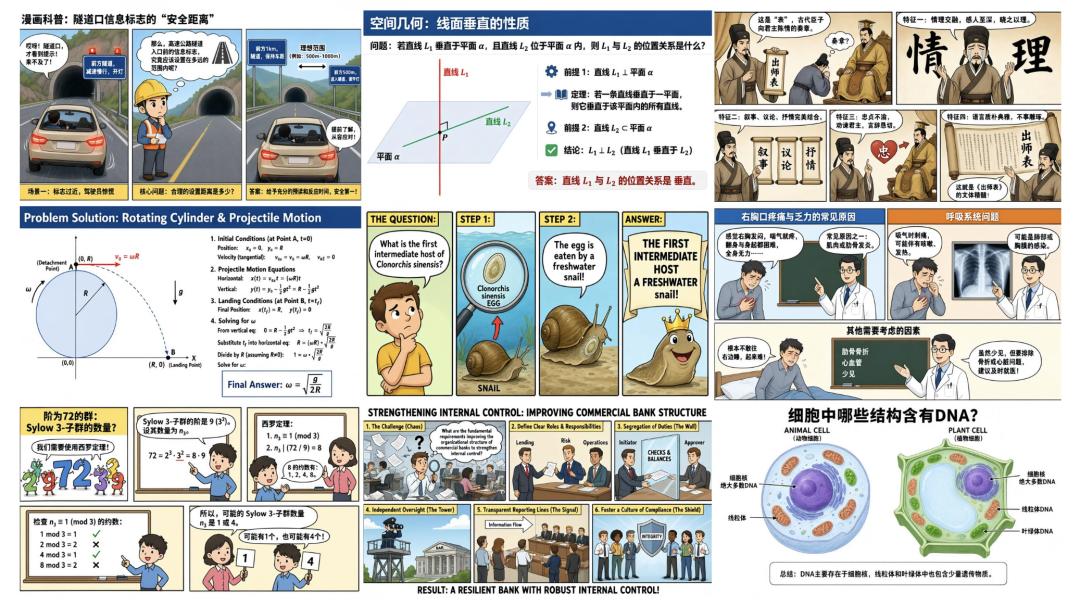
Qwen says it can now help me create 9-grid images, with different themed layouts.
Recently, Alibaba launched a new AI image generation model — Qwen-Image-3.0.
According to official statements, it can not only accurately generate realistic UI interfaces, but also help teachers generate well-formatted final exam papers with one click; designers can also use it to quickly output posters, storyboards and web prototypes, saving the time of building frameworks from a blank canvas little by little.
More impressively, it can simultaneously present 9 knowledge diagrams of different themes in a single image, and automatically arrange them neatly, ensuring both high information density and good aesthetics.
This time, Qwen-Image-3.0 defines its core keyword with just one word: Realism.
It's not just about looking better, nor is it only focused on optimizing art style, composition, and lighting.
Instead, it aims to move AI image generation beyond the "wow, that looks beautiful" phase, and take it a step further: Can this image meet all my requirements, render details clearly, and be directly edited, used, and submitted for work?
The official breaks down this "Realism" into three layers:
The first layer is Realistic Details: It supports precise rendering of 10px tiny text, and can stably reproduce details such as stroke edges, human pores, hair strands, paper textures, and handwritten annotations.
The second layer is Rich Content: Qwen-Image-3.0 supports up to 4.5k token input, and can generate complex layouts such as newspapers, storyboards, exam papers, and PPTs.
The third layer is Comprehensive Knowledge: It natively supports rendering in 12 languages, can generate common UI interfaces for web pages, games, live streams, etc., and can even create popular science posters combined with global knowledge.
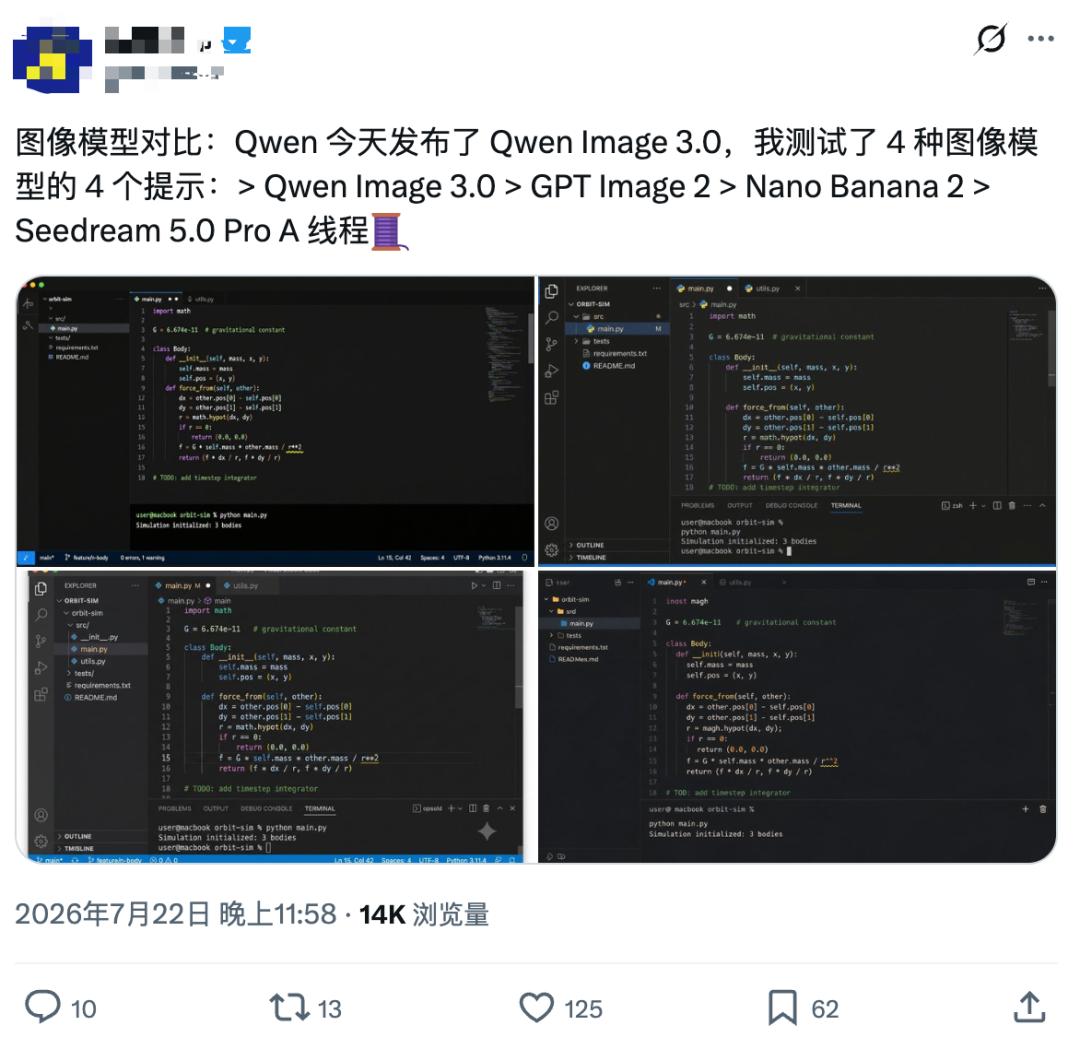
Overseas users have already started testing it, and in this review, Qwen-Image-3.0's performance in image understanding and code generation has surpassed overseas models such as GPT Image 2 and Nano Banana 2.
Sounds very powerful.
However, there has always been an old problem with demo samples released by image models: "Official demos usually only show the most perfect scenarios."
In real scenarios such as editing, education, e-commerce, and design, whether it is truly usable cannot only be judged by promotional descriptions, nor by the first-glance beauty of the generated image — it must be tested in actual use.
Therefore, while receiving widespread praise, there have also been many complaints about Qwen-Image-3.0 on Twitter.
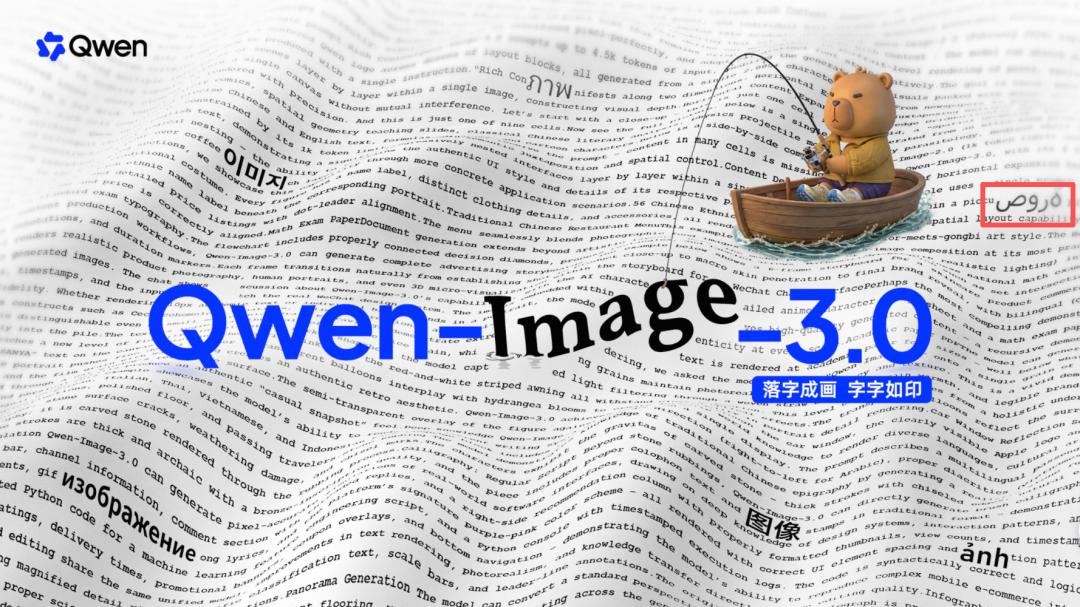
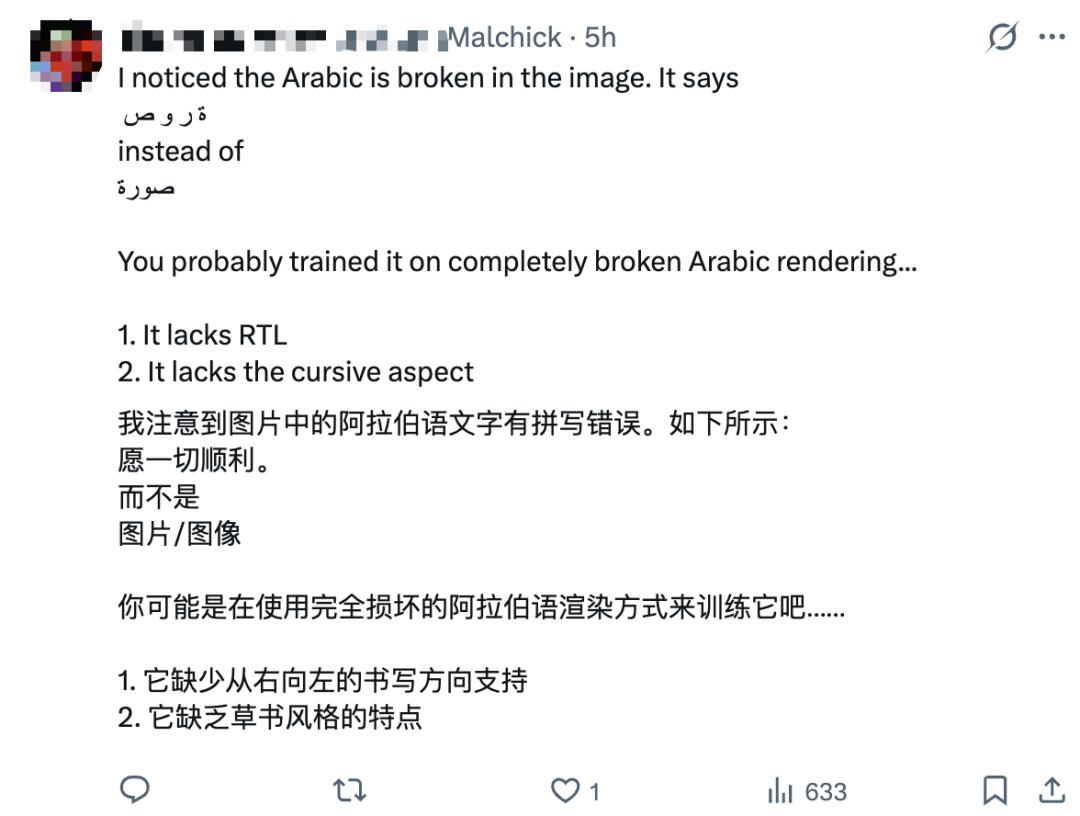
Some users say it is "slow", some complain that it "confuses terms" and "lacks grammatical understanding", and some netizens even directly pointed out that there are Arabic grammatical errors on the official website's cover image:
So this time, focusing on the three directions of "Rich Content", "Realistic Details" and "Comprehensive Knowledge" proposed in official information, we designed 9 specific practical test questions and used up all our generation credits completely.
We want to verify whether it can accommodate requirements, maintain stability, render fine details, and truly understand scenarios.
And most importantly: Can it really help us complete work and meet deadlines?
First, check if its details are realistic and won't look fake when zoomed in
Ding-ding-ding-ding, we start with a killer test: Verify details!
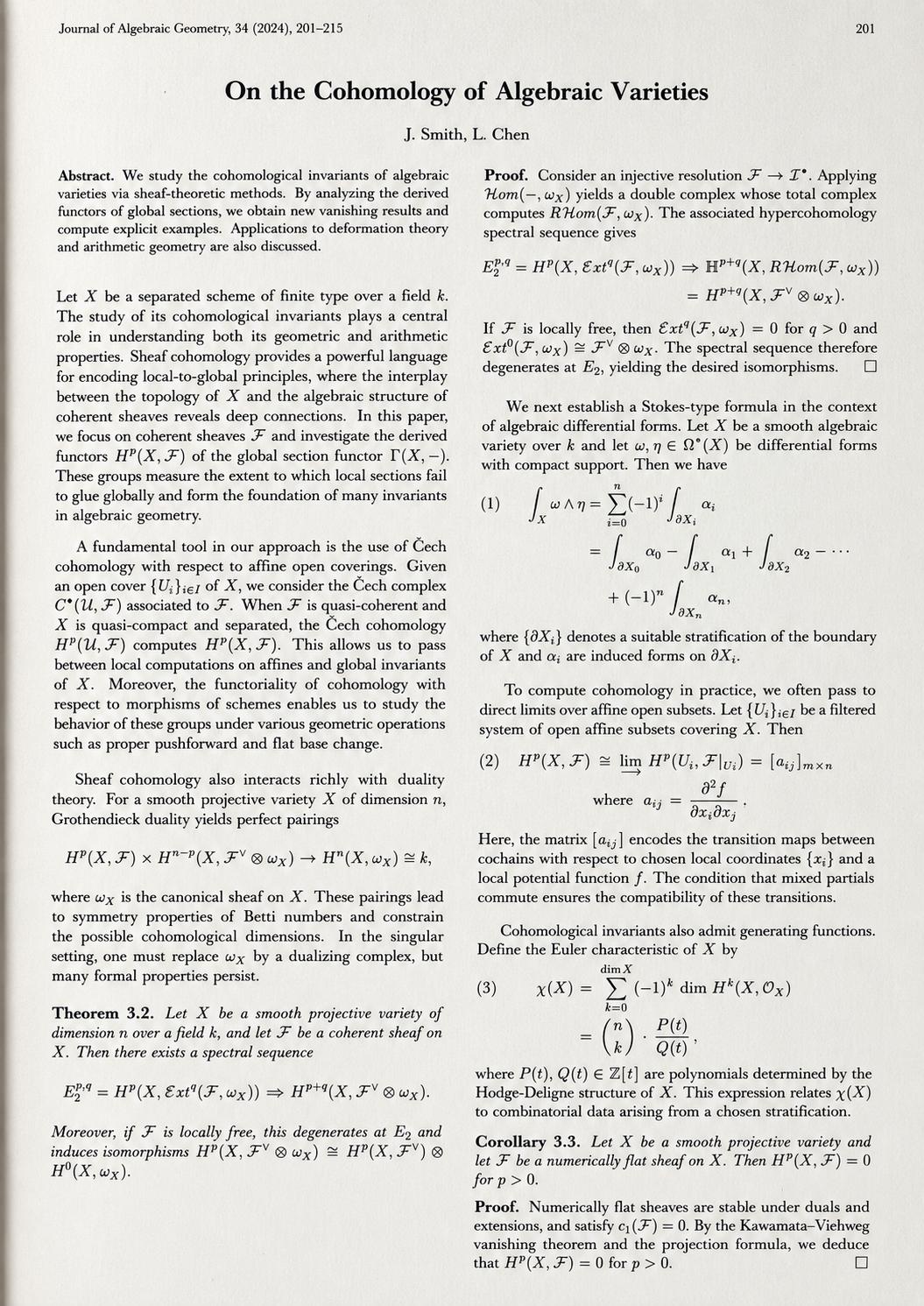
We start with the most uncompromising and error-prone scenario — academic paper pages.
Paper pages look simple, but they are full of pitfalls for AI image generation models: dense tiny text, superscripts and subscripts, Greek letters, fraction lines, multi-line formula derivations...
Looking like a paper from a distance doesn't count — it can only be considered truly capable if it remains clear, sharp and uncluttered when zoomed in.
Can Qwen-Image-3.0 handle this challenge?
Test 1: Academic Paper Formula Page
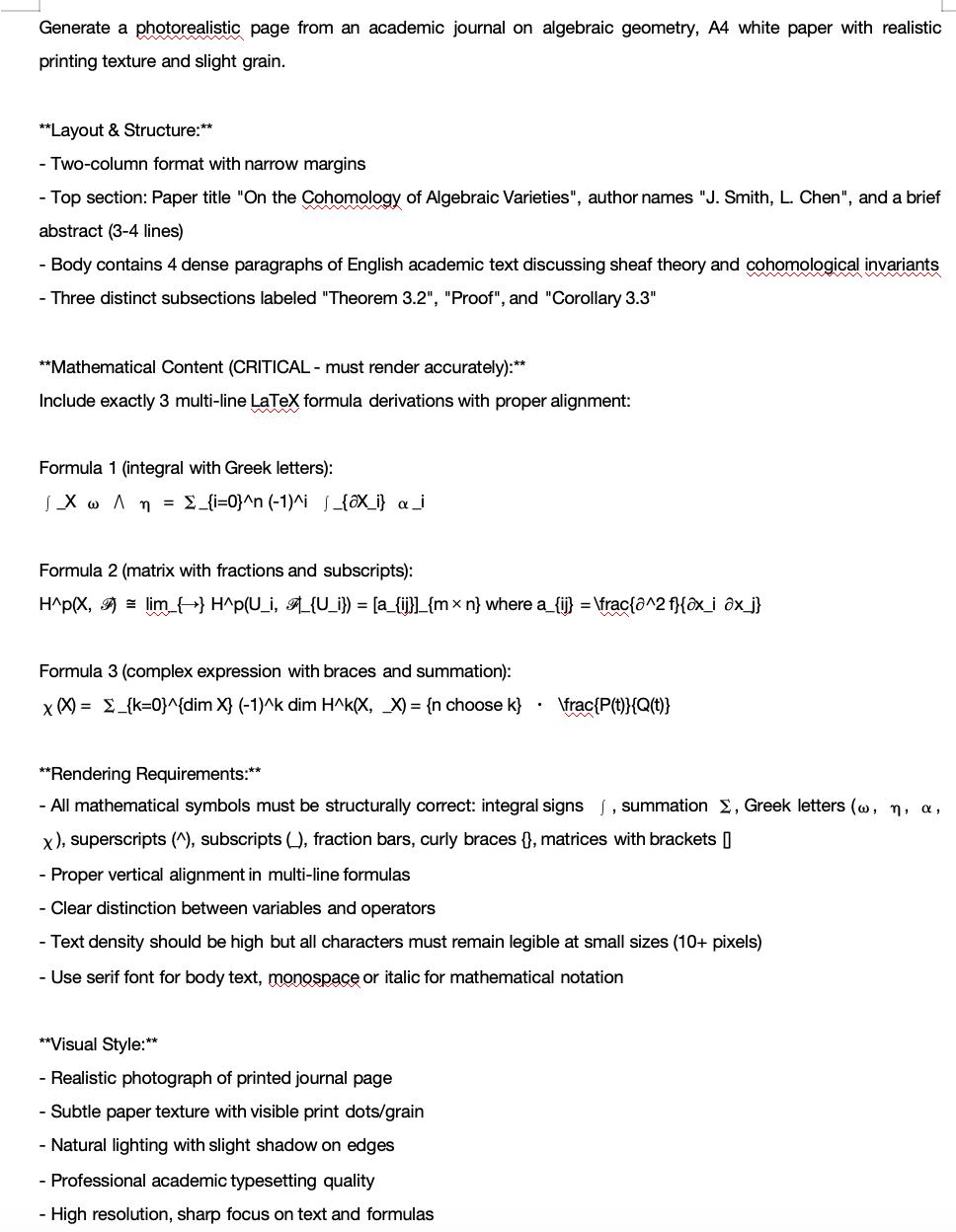
Prompt:
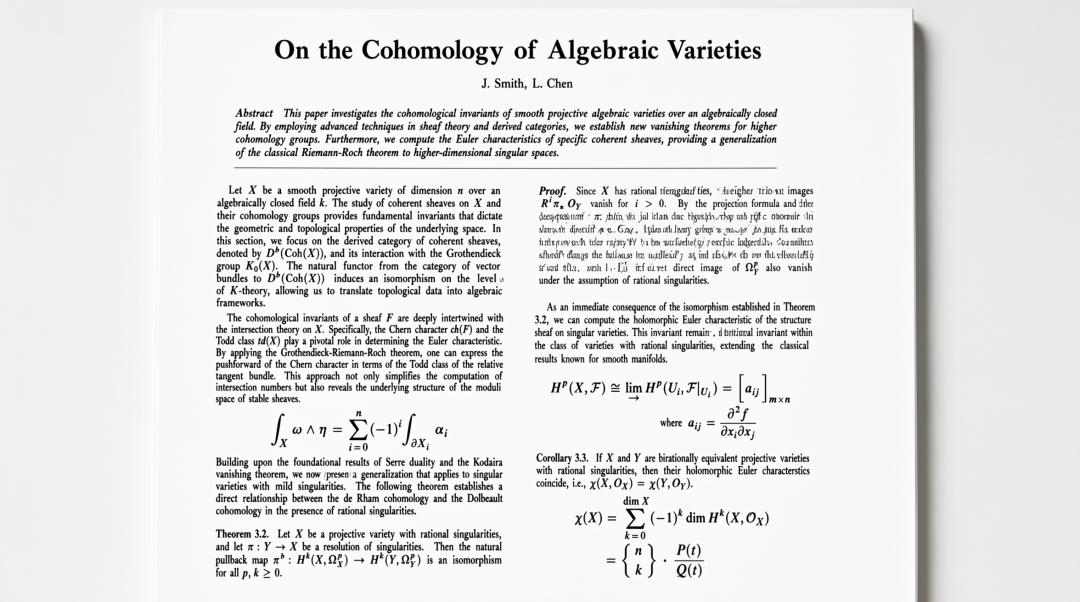
The result is as follows (generation took about 3 minutes and 20 seconds):
The layout is neat and the text is clear — not bad, it passed this test.
Out of curiosity, while waiting for Qwen-Image-3.0 to generate the image, I also used the same prompt template to test the generation performance of ChatGPT Plus. The result is as follows (generation took about 1 minute and 19 seconds):
△
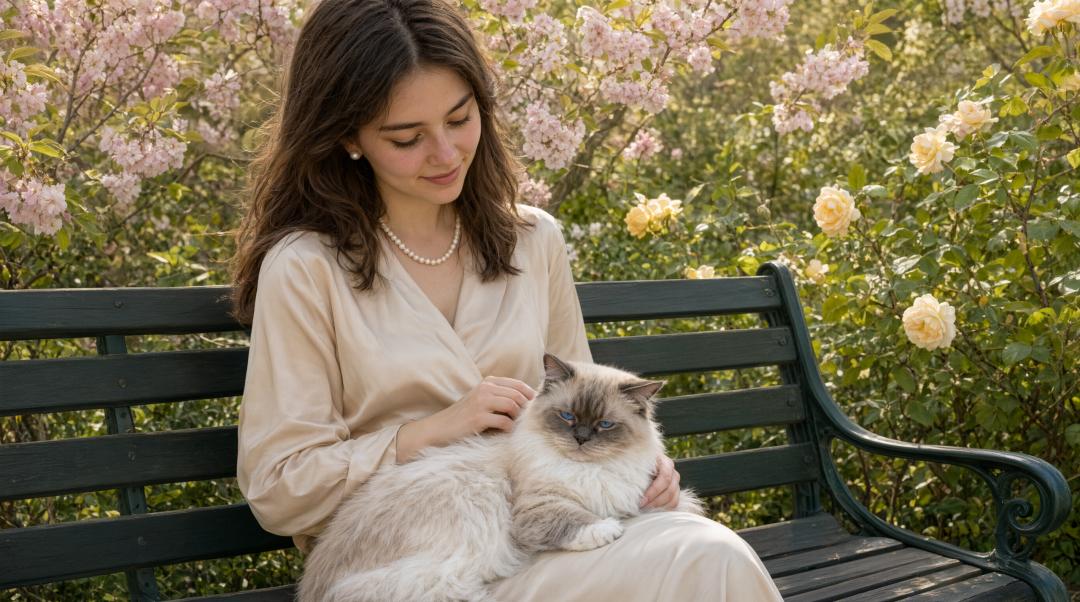
Test 2: Close-up Portrait of Pet and Owner
After testing the paper, let's look at a heartwarming "Owner and Cat" portrait.
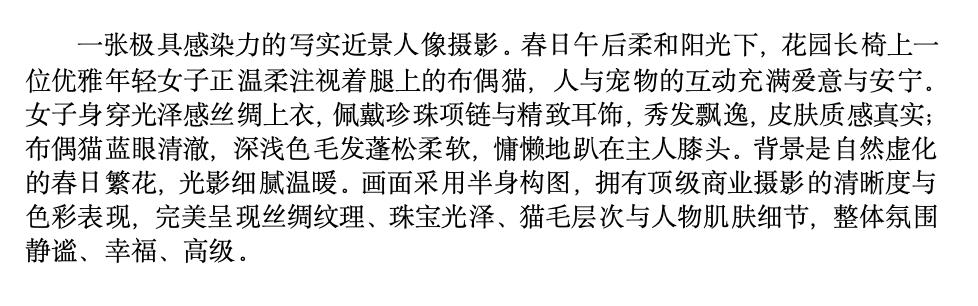
Prompt:
Final output:
Great, I'm very satisfied~
Human skin texture, hair strand texture, clothing material, and the typical proud expression of the cat are all perfectly rendered, with a strong cozy atmosphere.
The only minor issue is that the generation speed is a bit slow (took about 1.5 minutes).
Test 3: Reading Notes
As we all know, generating a new image is one thing, while making fine edits on an existing image is completely another.
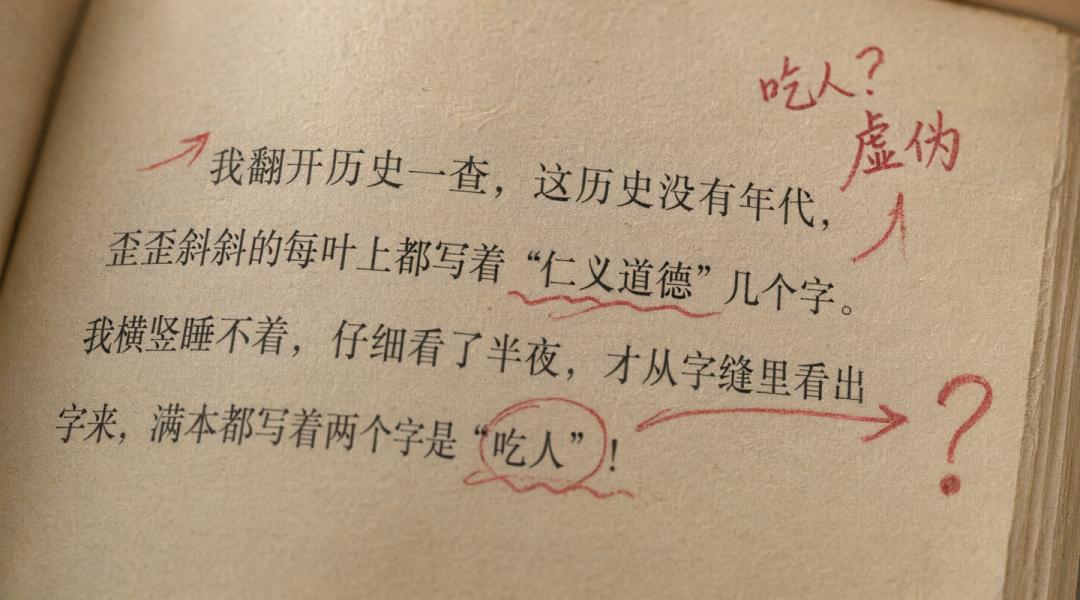
So this time we test whether Qwen-Image-3.0 can, without damaging the original image structure, imitate the habit of high school students taking class notes, and add key notes to Lu Xun's "Diary of a Madman".
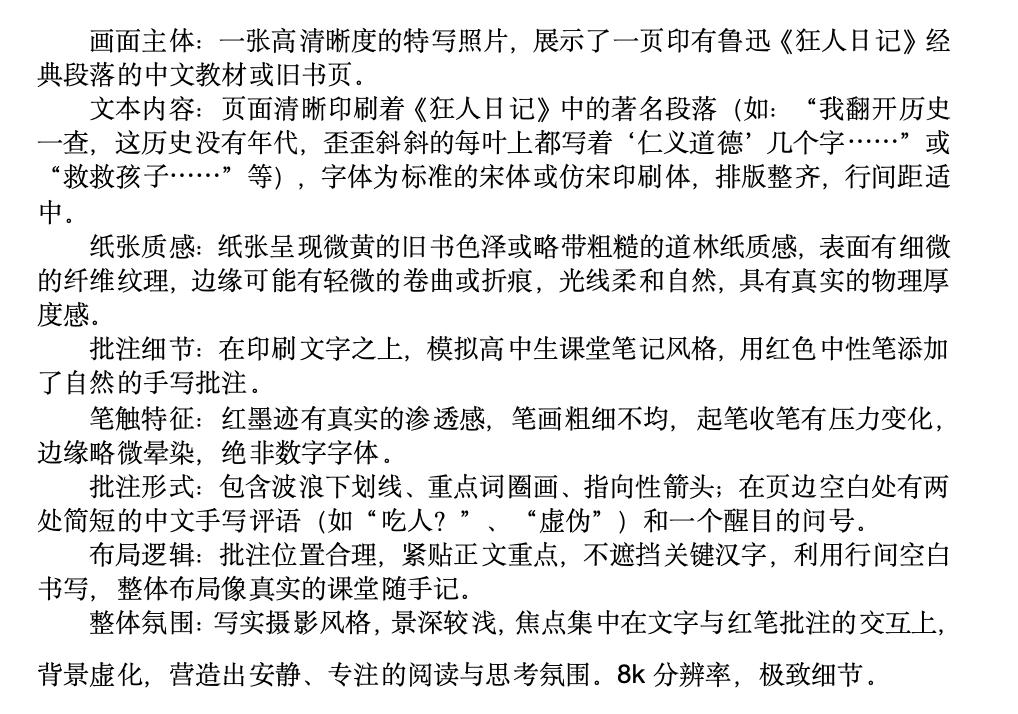
Prompt:
The effect is as follows:
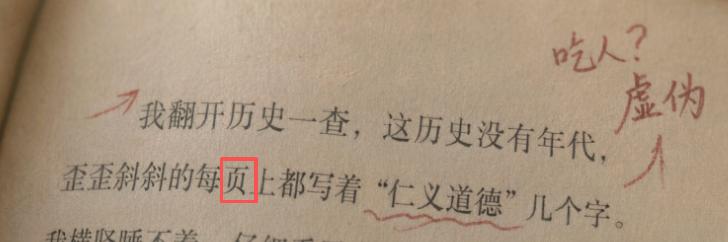
In this process, although there was one homophone typo, overall, it accurately captured the famous paragraphs, did not arbitrarily modify the original text, and the annotations looked like real handwritten notes with traces of human thinking and red pen marks, blending well with the paper texture.
The most amazing part is that it simulated and presented the real thinking process of students from "being confused by the phrase 'eating people'" to "analyzing its 'hypocrisy' essence".
After I pointed out the error in the subsequent conversation, Qwen-Image-3.0 corrected it immediately.
Then check if it can fit all complex requirements into one image
Rendering details well is only the first hurdle.
Many image generation models are capable of drawing, but as soon as there are too many elements in the frame, the layout will get out of control.
To address this pain point, Qwen-Image-3.0 extends the input length to 4.5k tokens.
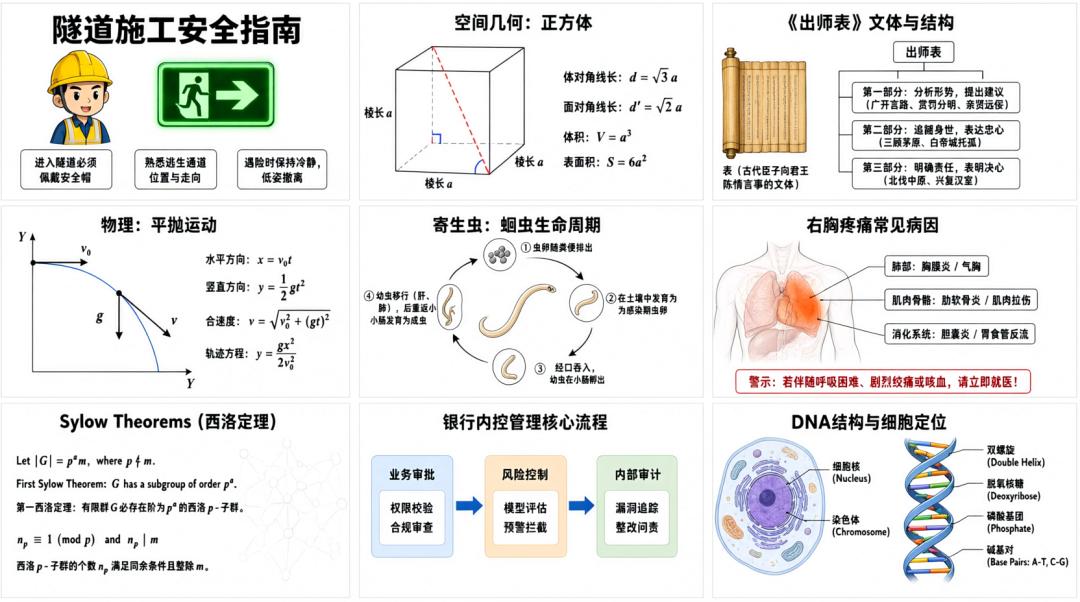
In the second hurdle, let's use the most intuitive 9-grid knowledge diagram test to verify its actual carrying capacity and horizontal layout capability.
Test 4: Complex 9-grid Knowledge Diagram
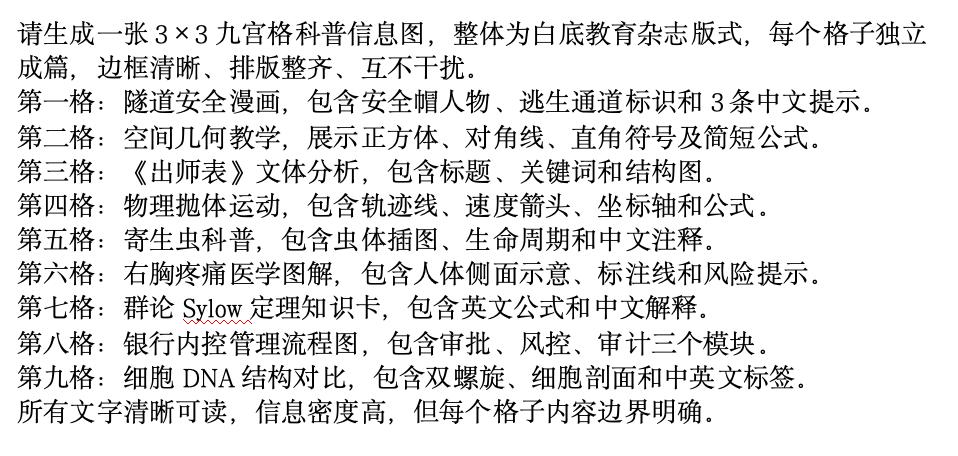
Prompt as follows:
Result:
Good performance, it passed.
Test 5: A High School Math Mock Exam Paper
Next, let's test Qwen-Image-3.0's ability to generate mock exam papers:
Prompt: Generate a realistic printed high school math mock exam paper, A4 portrait layout, with Chinese typesetting. The top should include fields for school name, exam name, name and admission number. The first part has 6 multiple-choice questions, each with 4 options A, B, C, D. The second part has 4 fill-in