Yope, a social app for close friends, has raised tens of millions of US dollars in financing. Not relying on information feeds and algorithms, where is the next growth point for social apps?
According to industry media reports, Yope, a social app focused on private small-circle interactions, recently closed a $12.3 million seed round led by Northzone. This news has once again brought the "no algorithm, no ads, no public content" close-friend social model into the spotlight of developers.
This financing is far from an ordinary investment and financing update. It sends a clear new signal for the track: The overseas social media market no longer only has one growth path based on general public-domain information feeds like TikTok, X, and Meta. Micro-communities for acquaintances, low-pressure UGC, lightweight lockscreen reach, and subscription monetization are forming a complete and independent growth closed loop, while better complying with the increasingly strict global regulatory rules for social media for minors.
For iOS developers targeting overseas markets, the key question worth thinking about right now is not "can we still build new social products", but how to build a lightweight acquaintance relationship chain, design a low-pressure sharing mechanism, and construct an algorithm-independent payment conversion path.
What kind of product is Yope?
Yope has a clear product positioning: it focuses on small-circle photo sharing for friends and family, does not rely on algorithmic feeds, ads, or public content. Instead, it uses groups, messages, photos, AI features, and lockscreen/widget reach to help users share daily moments with their real-life friends.
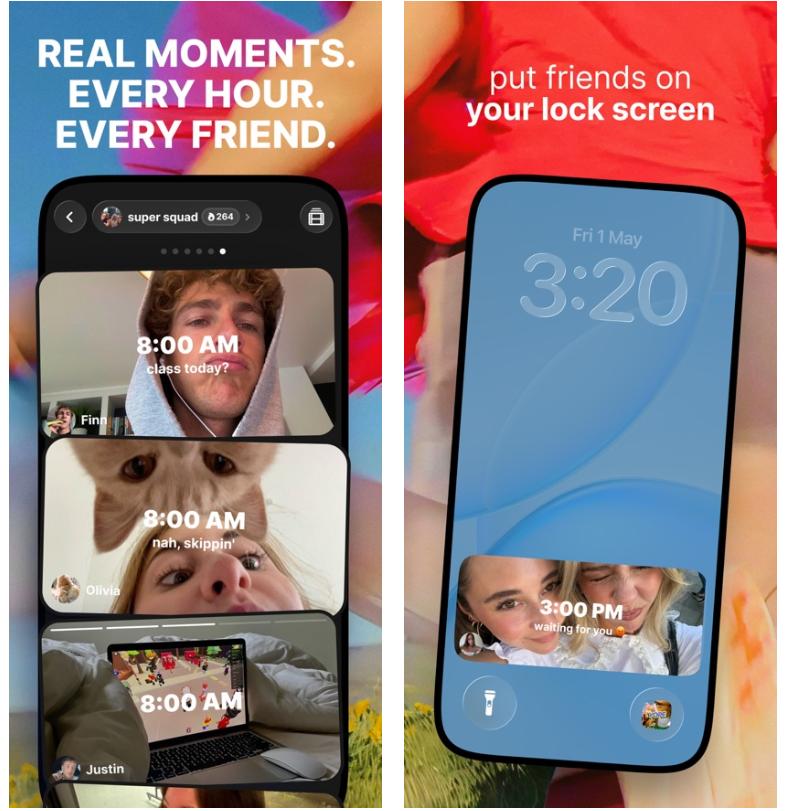
From Yope's product page on the U.S. App Store, its positioning is clearly visible: visible only to friends, photos displayed first, no likes or ranking lists, emphasizing authentic daily sharing. Currently, the app is categorized under the Lifestyle section, is free to download, and offers a monthly premium subscription. It has a 4.7 rating in the U.S. market with over 9,000 total reviews, an age rating of 4+, and includes chat functionality and user-generated content.
Relevant data shows that Yope has accumulated nearly 15 million registered users, with 10 to 20 million content shares per week; more than half of the users are active for more than five days a week, and about 20% of active users have successfully invited their older family members and relatives to join the platform.
Why this product deserves developers' attention
In the past few years, the competition in the social track has often focused on three main areas: building information feeds, optimizing recommendation algorithms, and expanding creator resources. However, the emergence of Yope sends a completely different industry signal: Some young users do not lack content to share with their family or friends, what they lack is a sharing space with low pressure, low performance pressure, and low noise. According to a survey, about 30% of young people run what are commonly referred to as secondary photo accounts or casual daily accounts, sharing more spontaneous and authentic photos with a small group of real-life friends.
According to data monitored by Qimai Data, at 15:00 on July 23, 2026, on the overall U.S. iPhone bestseller list, Snapchat ranked 5th, TikTok ranked 6th, and Life360 ranked 16th; the top positions of the U.S. iPhone Lifestyle bestseller list are mostly occupied by dating and acquaintance social products such as Tinder, Hinge, Bumble, Raya, and Feeld. Similar social products can also be seen occupying top positions on the iPhone Lifestyle bestseller lists in Brazil and Japan.
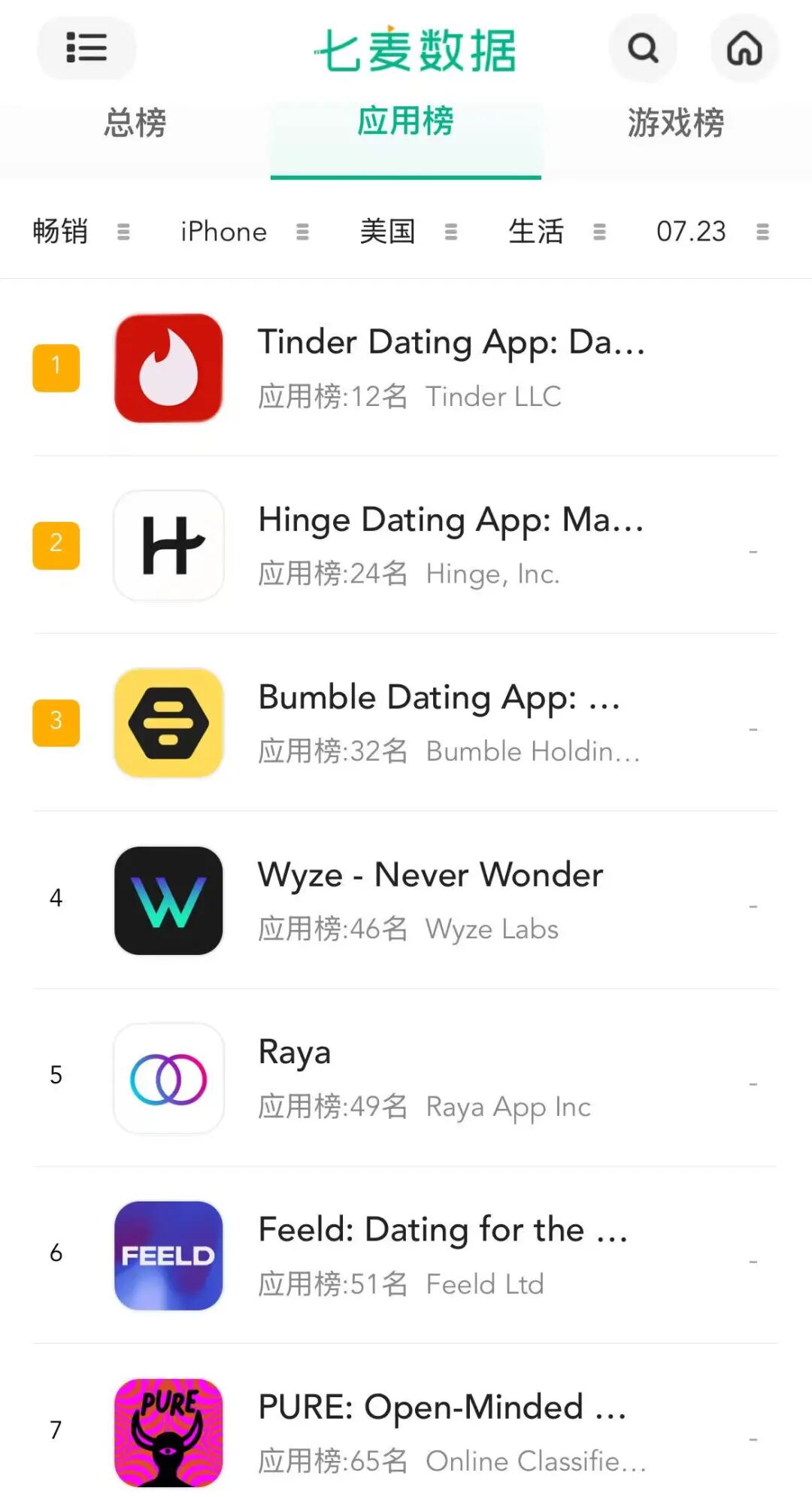
U.S. iPhone Lifestyle bestseller rankings at 15:00 on July 23
Paid growth opportunities for social products have not disappeared, the focus of the track has only shifted from general traffic expansion to more vertical relationship scenarios, trust scenarios, and high-frequency reach scenarios.
Objectively speaking, Yope has not yet broken into the top of the rankings, so it cannot directly prove its commercialization sample through rankings for now. However, its financing news also serves as a reminder: new social products that want to gain incremental users on the App Store cannot simply label themselves as "anti-algorithm", but must fully explain a complete logic: why are users willing to actively invite friends to join, why do they stay for a long time, why are they willing to enable notifications, and why are they willing to pay for subscription benefits?
Practical operation strategies that social app developers can reuse
For developers, the primary difficulty of close-friend social networking is not feature development, but the cold start of the relationship chain. Acquaintance socializing relies on the establishment of bilateral and multilateral friend relationships. Forced invitations, excessive notification pushes, and continuous check-in mechanisms can boost short-term activity, but they can also easily lead to negative user reviews, which in turn reduce the conversion effect of the product page.
For growth teams, it is necessary to re-optimize the presentation on the product page. Yope highlights "visible only to friends", "no social pressure", and "lock screen and widget notifications" on its first screen, which is more attractive than general promotion of AI capabilities. When Chinese overseas teams deploy social, AI companionship, photo sharing, family photo album, or campus circle products, they can try to test customized product pages for different groups of people, instead of using the same set of "social app" selling points for all users.
If you are a product leader, it is recommended to learn about platform regulatory requirements in advance. Apple has added a new age-rating questionnaire for social media features in App Store Connect, and clarified that starting from September 2026, developers will need to complete the questionnaire when submitting new apps, updates, or conducting alternative distribution. Whether a product supports UGC content diffusion and interaction is no longer just a product design choice, it will directly affect the age rating, parental control, and the description of the product page on the store.
Conclusion
Based on the overall dynamics of the track, the value of Yope's financing is not to prove that the close-friend social track has reached maturity, but to provide a more actionable thinking framework for social apps.
First, the social track has more than one path of public content distribution. Small-circle photo sharing, lockscreen reach, voice interaction, stickers, content review, and AI personalized features can all be used as retention tools for light social products.
Second, the commercial design of relationship chain products needs to be more cautious than that of tool-based products. Premium membership benefits should not break the equal experience between friends, and avoid turning payment differences into social pressure.
Third, Apple continues to refine the supervision of social function labeling and age rating. In the future, the product page of social products should not only improve conversion, but also clearly explain to ordinary users, parents, and the platform the content dissemination rules, minor protection plans, and whether the notification and invitation mechanisms are reasonable.
The close-friend social track still has huge room for development, but simply removing algorithms is not enough to support product growth. To break through, it is necessary to balance high-density acquaintance relationships, a low-pressure interaction atmosphere, credible product page display, and complete compliance design.
If your app also operates relying on user relationship chains, you might as well think about these questions: who are the users willing to actively invite to use the product? What is the motivation for users to keep opening the product? And will the current growth strategy cause negative user reviews, which in turn affects the conversion of the product page on the store?
*This article is sourced from Nicole, and the copyright of the article belongs to the original author. The content is for exchange and reference only, and does not constitute professional advice.
This article is from the WeChat official account "Qimai Research Institute", author: Nicole, published with authorization from 36Kr.