Grid Intelligent Computing: How the AI brain that does not blindly stack computing power fills the gap in under-forest scenarios | Underwater Project
From the consumer market to industrial tracks, the drone market, a veritable "Red Sea", has long been crowded with players from all walks of life, yet there remains a niche segment that even leading industry players have rarely ventured into — the understory scenario.
The industrial demand hidden in understory scenarios is staggering: according to data from the National Forestry and Grassland Administration, China's forest stock volume reached 20.988 billion cubic meters in 2025, with national timber output hitting 140 million cubic meters; data from the Food and Agriculture Organization of the United Nations shows that the global annual roundwood harvest is approximately 4 billion cubic meters, behind which lies a massive volume of work including felling area stock accounting and tree diameter at breast height measurement.
The understory environment is complex, and the traditional manual operation model is costly, inefficient, and fraught with dangers. Although the industry has long called for automated alternatives, the understory environment, a classic denied environment, has made it consistently difficult for traditional automation solutions to be implemented effectively.
Shaded by trees, the understory makes navigation devices prone to positioning failures due to lost GNSS signals, while severe attenuation of communication signals prevents real-time, consistent remote image transmission and manual control. Traditional SLAM technology also fails to handle the complex environmental textures that undergo subtle, constant changes such as tree branches swaying gently in the wind.
"Only by building an embodied intelligence solution that supports real-time high-precision spatial perception and follow-up control capable of offline operation on edge devices can we effectively address the operational requirements of the fully denied understory environment," stated Qian Min, Head of Marketing at Grid Intelligence Computing.
Founded in 2025, Grid Intelligence Computing is dedicated to leveraging its self-developed "Grid Domain Learning Technology" to achieve high-precision spatial understanding, with the model automatically generating optimal control functions to deliver effective control capabilities such as complex obstacle avoidance. Based on this technology, the company has launched the "GridAI Brain", an intelligent base compatible with a wide range of hardware devices. This product represents the first time drones have achieved capabilities including GNSS-free autonomous understory flight, millimeter-level diameter measurement, and automatic obstacle avoidance, and it has now entered small-batch commercial delivery.
Dai Hao, Chief Scientist of Grid Intelligence Computing, has over 30 years of technical experience. In 1996, he pioneered the algorithm system combining heterogeneous architecture and high-performance computing, and was specially appointed as a researcher at the National High Performance Computing Engineering Technology Research Center.
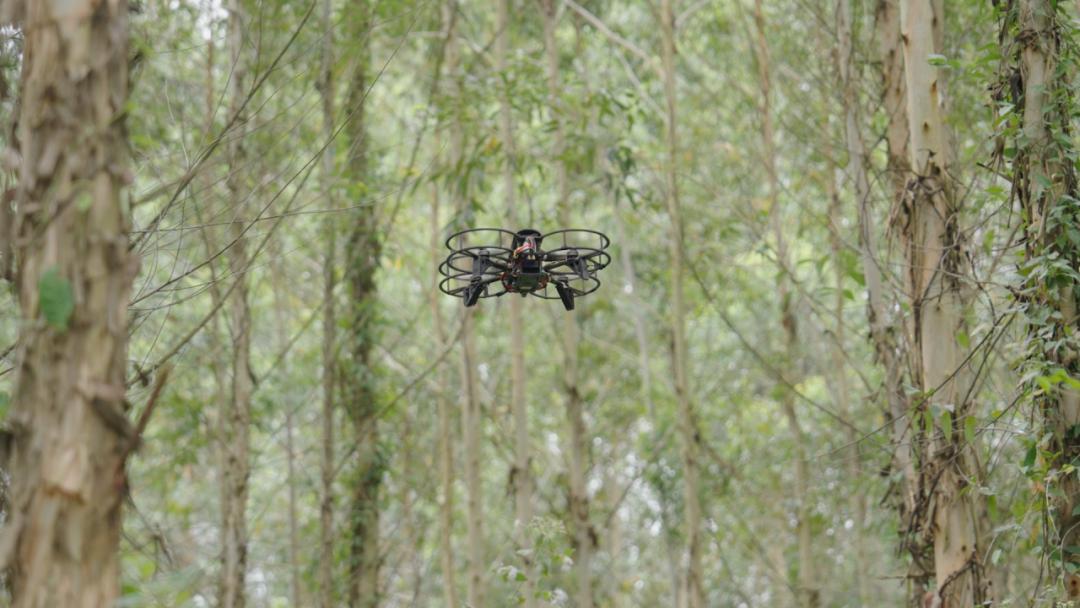
Grid Intelligence Computing Drone
1. Achieving Spatial Understanding with Minimal Data and Low Computing Power Through the Grid Domain Learning Mechanism
Most mainstream drone intelligent solutions today are built on deep learning frameworks. They train models by collecting massive amounts of image data with manual annotations, and identify objects relying on 2D static pixel features. However, the dynamic and variable understory environment — with uneven lighting, crisscrossing and occluding branches — means that the pixel features of the same object can change completely when its angle or lighting shifts, making it difficult for drones trained on deep learning models to effectively perceive the environment and complete tasks in such settings.
The core to solving this problem is to maintain continuous controllability over several intermediate states of the carrier during its movement. That is, when environmental changes occur in physical space, the carrier can quickly follow up and make corrections. This requires the carrier to have two capabilities at the algorithm level: first, rapid perception of spatial changes and accurate capture of key motion-related elements; second, physical perception of the machine carrier itself.
Grid Intelligence Computing's solution is to build a dynamic control function that achieves spatial displacement through power types and physical dimensions, to adapt to changes in different carriers or power modes. Specifically, the self-developed GridAI Brain from Grid Intelligence Computing, based on the grid domain learning mechanism, synchronously retains both temporal and spatial dimension information while parsing continuous video streams, enabling devices to recognize and understand real physical space. For example, smoke and fire have no fixed texture or clear shape, making it difficult for traditional AI models to distinguish them from objects like clouds. GridAI, however, can identify them by judging the distinct spatial motion trajectory of smoke compared to mist and clouds.
More specifically, grid domain learning processes the physical world through three levels of "gridding": first, discrete, traceable entity grids in the scene; second, attribute grids assigned to each entity that change over time, such as position, speed, and movement direction; third, relationship grids that define connections between entities, such as confirming that "a bird's nest is located between two tree branches".
This approach essentially mimics how humans perceive the world: instead of only focusing on pixels, it recognizes objects, captures dynamics, and clarifies spatial relationships. By capturing real-time changes in the state of objects in space across different timestamps, it deduces their motion patterns and predicts trajectories. After defining the understory operation range, a drone equipped with GridAI can build a dynamic spatial field in real time without pre-scanning and modeling, independently plan paths, avoid obstacles, and complete diameter measurement tasks, with no need for a drone operator to intervene throughout the entire process.
Since GridAI parses the underlying spatial structure of the scene and the relationships between objects, information that is not disturbed by lighting or weather, it boasts stronger environmental robustness. In addition, unlike deep learning training that often requires tens of thousands or hundreds of thousands of annotated images, GridAI only needs dozens to hundreds of samples to complete training, drastically reducing overall computing power requirements and hardware power consumption. For example, after learning from just 30 photos of bird nests on tree branches provided by the customer, GridAI achieved 0 false positives, 1 missed detection, and an accuracy rate of 98.3% across 58 test images.
2. Expanding from Understory Scenarios to Broader Use Cases to Build a Universal Intelligent Brain
According to Qian Min, Grid Intelligence Computing's decision to first enter the forestry track was a serendipitous one. In 2025, during discussions with a state-owned forest farm, they learned that understory mapping in global forestry still relies almost entirely on manual operations, creating huge demand for automated alternatives that can deliver precise, efficient, and safe operational results. "This made us re-examine the competitive landscape of the entire industrial drone industry. Leading manufacturers have already achieved great maturity in clear-space and high-altitude flight, but the understory scenario is a blank space that has not yet been filled."
At present, Grid Intelligence Computing's drone equipped with the GridAI Brain has completed technical verification by the Chinese Academy of Forestry, and the company has established deep partnerships with leading forestry enterprises such as China Forestry Chongqing and Zhejiang Feiliu.
However, Grid Intelligence Computing does not position itself solely as a provider of understory operation drones.
Qian Min stated, "Our product is essentially a universal intelligent brain. It can be integrated into smart chip modules, and applied to the robotic arms of embodied robots, unmanned vehicles, or underwater robots, endowing these hardware devices with the ability to autonomously perceive and understand physical space, then make decisions and execute actions. For example, when shore-based radar suffers from inaccurate positioning due to clutter interference, GridAI can convert and accurately fuse target data between the visual coordinate system and the radar coordinate system, providing an anti-noise radar-vision integrated solution."
The versatility of the GridAI Brain is expanding into more industries. For instance, in the warehousing and logistics sector through collaborations with partners including Beijing Guangjia and Googol Technology, the GridAI Brain, leveraging its strengths in small data requirements, low computing power consumption, high precision, and strong generalization capabilities, can work with multi-SKU multi-process robotic arms to cover scenarios including but not limited to single-item picking, packaging, and parcel sorting. In addition, the company has established a strategic partnership with China Unicom Shenzhen.
In the future, Grid Intelligence Computing will take the GridAI Brain as the core link, collaborate with upstream and downstream players in the industrial chain, and provide more complete intelligent solutions for key industries such as agriculture, forestry, and logistics warehousing. From visual perception and automated equipment control to more application scenarios, Grid Intelligence Computing aims to build a cross-scenario universal "intelligent brain", enabling machines and equipment to truly "understand" the complex physical world and gain autonomous action capabilities.