Claude Agent has suddenly rolled out a massive update packed with 500 new skills, leaving netizens exclaiming that it's absolutely insane.
Over the past 45 days, Anthropic has barely paused its development efforts.
Fable 5 and Mythos 5 launched simultaneously, Sonnet 5 cut prices to capture market share, and Claude Code received near-daily updates.
Right after rolling out the Cowork feature yesterday, Anthropic has now dropped six major updates on its Managed Agent Platform (CMA) in one go:
- Skill limit raised from 20 to 500: A single session can host an entire enterprise knowledge base
- 5 adjustable levels of reasoning intensity: Save tokens for simple routing tasks, and crank up full depth for complex inference
- One-click creation of seeded sessions: Preload up to 50 initial events to eliminate cold start delays entirely
- Sub-agent real-time streaming extended to thread level: Track every sub-agent's progress and thought process with full real-time visibility
- 7 new webhooks covering the full lifecycle of environments and memory storage: Polling workflows can now be fully retired
- Agent update version field made optional: Cut out version management overhead for single-process workflows
With support for 500 skills in one session and the ability to run an entire enterprise knowledge base, Anthropic is effectively building an operating system layer for agents!

Skill limit skyrockets to 500, one session accommodates an entire business department
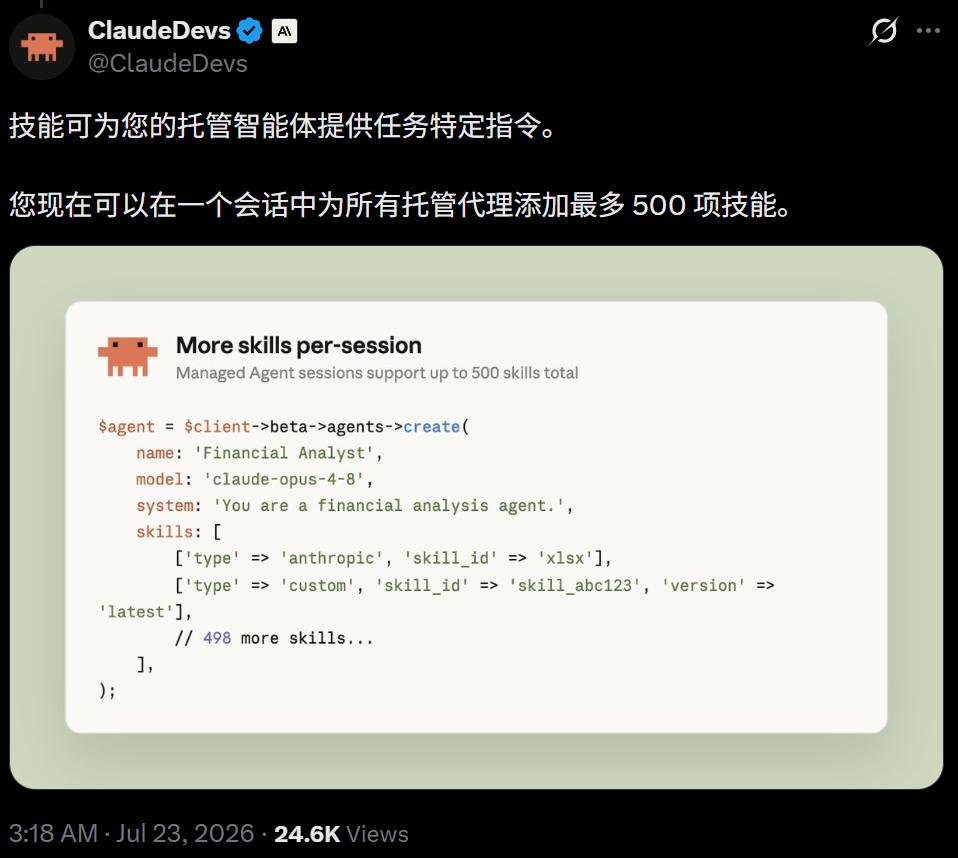
CMA's Skills are knowledge packages that inject specialized instructions into agents, previously capped at just 20.
However, a single financial customer service agent would need at least 7-8 skills just to cover account opening, KYC, anti-money laundering, complaint handling, compliance disclaimers, and multilingual switching. Add in regional regulatory differences and A/B test versions, and users would immediately hit the old ceiling.
That cap has now been lifted all the way to 500.
These 500 skill slots are shared by all agents in a single session, running in a unified managed sandbox. Agents share memory and environment variables, with scheduling coordinated centrally — enough to support a complete, fully functional business unit.
You can even load entire codebase specifications, CI pipeline configurations, and deployment targets directly into one session, enabling agents to handle the full workflow from code writing to production deployment end-to-end.
5 levels of reasoning intensity adjustment, no wasted full-power tokens on simple tasks
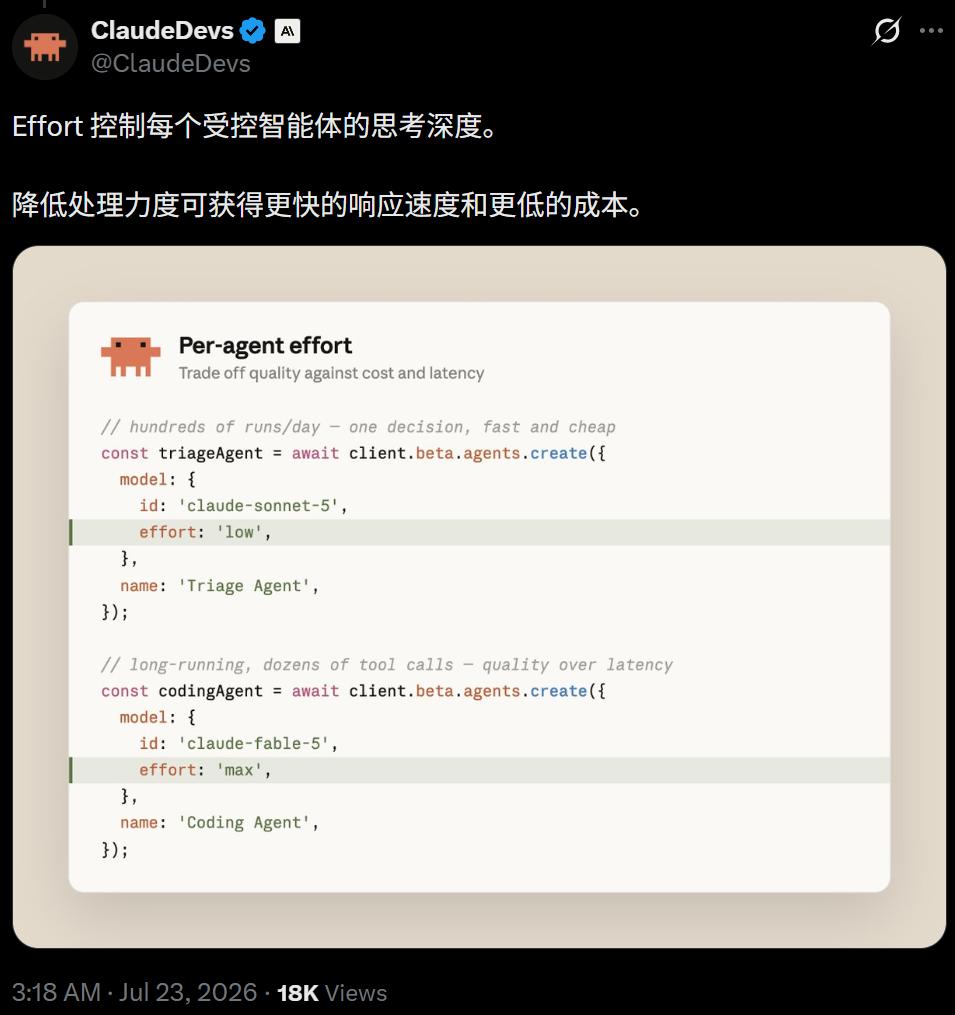
The effort (reasoning intensity) parameter has long existed at the API level, but previously could not be configured independently for individual agents in CMA.
This meant the entire session ran on a single default setting, using the exact same reasoning depth for a question like "What's today's date?" as for "Audit this 500-page financial report". Overthinking trivial tasks was nothing more than unnecessary token burn.
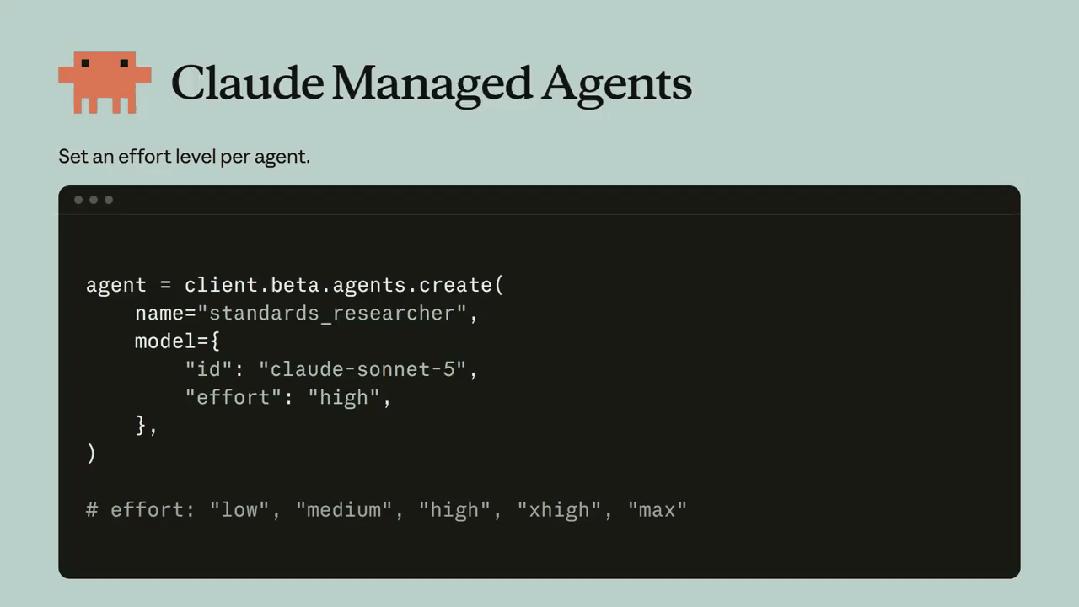
Now reasoning intensity can be defined directly in each agent's model configuration, with five selectable tiers: low / medium / high / xhigh / max.
For a multi-agent customer service system, you can set the routing coordinator to low, product Q&A agents to medium, complaint escalation agents to high, and legal compliance agents to max.
Within the same session, different agents can operate at different intensity levels matched to their task complexity. Finally, there is a continuous, adjustable knob to balance cost and output quality.
Zero cold start delay, full visibility into previously black-box sub-agents
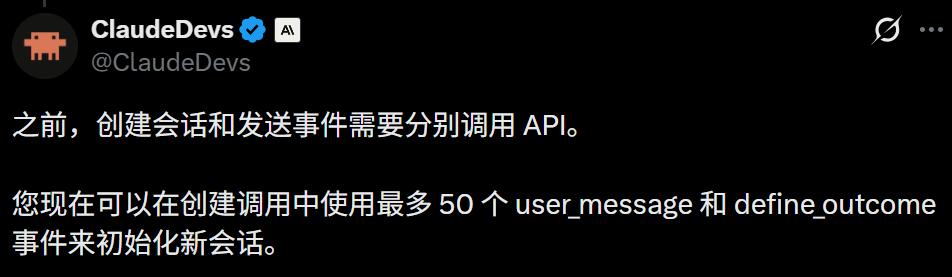
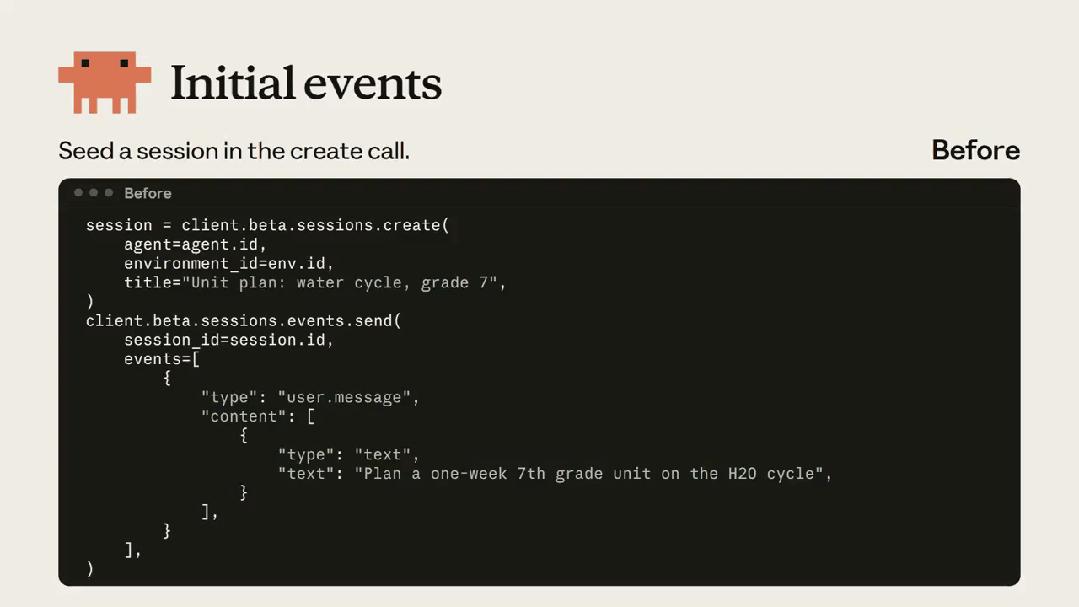
Creating a CMA session previously required two steps: first POST an empty session shell, then populate it with initial events one by one. Under high-concurrency scenarios, accumulated round-trip latency made cold starts painfully slow.
This is now streamlined to a single step. POST /v1/sessions can directly include an `initial_events` parameter supporting up to 50 preloaded events, so the session is fully initialized the moment it is created.
As part of this update, the `version` field in the agent update API has also been made optional.
Previously you had to pass a version number with every update for concurrency control, which would return a 409 error if versions mismatched. This step can now be skipped entirely for single-process use cases.
Sub-agent observability has also taken a major leap forward.
Back in late June, CMA launched session-level `event_deltas` that provided real-time previews of the main agent's text output. But sub-agents remained black boxes — you would never know if a sub-agent had gone off track or frozen until a timeout occurred.
This update drills visibility all the way down to the thread level. You can now subscribe to independent thread streams for individual sub-agents, seeing every step of their thought process and output in real time.
7 new webhooks complete coverage, the polling era is over
CMA already launched webhooks for agent and deployment lifecycle events at the end of June.
This update fills in the remaining two major categories: 4 environment events and 3 memory storage events.
With this full coverage, the entire CMA lifecycle — from environment provisioning and agent deployment to runtime status tracking and memory management — can now be fully event-driven and integrated with external systems.
Automatically trigger alerts when an environment is paused, sync memory updates directly to your internal database, and attach monitoring configurations immediately when a new environment is created.
This is the final missing piece that transforms CMA from an "API product" into a fully operable, production-grade platform.
Anthropic is betting on OS-level depth for agents
As of July 2026, the AI agent infrastructure competition has entered its deep phase, with update cycles now approaching a daily pace.
OpenAI is betting on user-facing entry points, packing chat, coding, and autonomous work capabilities all into the single ChatGPT super app to lock developers in via its massive user base.
Google is betting on underlying infrastructure, building a moat at the base layer with GCP, TPU hardware, and open protocol standards.
Anthropic is betting on OS-level depth, using managed sandboxes, full-stack agent orchestration, and adjustable reasoning intensity to push the capability density of individual agents to new heights.
By expanding the skill limit from 20 to 500, Anthropic is clearly working toward a future where agents become as fundamental and ubiquitous as modern operating systems.
The rapid pace of development already shows the answer: that future is coming very soon.
Reference: https://x.com/ClaudeDevs/status/2080009523952263295?s=20
This article is from the WeChat public account "AI Era", written by ASI Revelation, edited by Moses, and published with authorization from 36Kr.