2026 WAIC is a litmus test for the embodied intelligence industry.
Foreword
Hyping around popular tracks is a constant inertia in the tech industry. In every capital boom, concepts and narratives always make the most noise, while practical implementation and real-world value are always the scarcest.
For embodied intelligence in 2026, WAIC is not only a highlight moment under the spotlight, but also a judgment platform where the truth has nowhere to hide.
With massive capital piling in, hundreds of enterprises gathering on the same stage, and real-machine demonstrations blooming everywhere, everyone is chasing the ultimate story of general intelligence. But we are bound to face the actual current maturity level of the industry.
This article will focus on analyzing
1. Why can't embodied intelligence break out of the performance dilemma that only exists for exhibitions?
2. When swarming into factory work, are enterprises getting a long-term ticket or a homogenized short-term admission pass?
3. What kind of elimination cost will path differentiation and scenario collision bring?
4. What should the real commercial watershed of embodied intelligence be?
"WAIC is not just a pure technology exhibition, but more like an AI carnival catering to public sentiment." Someone left such a comment on social media after attending the 2026 World Artificial Intelligence Conference.
This WAIC pushed the "fever pitch" to the extreme. The flow of people in the embodied intelligence pavilion was always hotter than the air conditioning. More than 200 exhibitors, 208 end products, and over 300 real machines were crowded in the same space.
Robots danced, practiced boxing, folded clothes, prepared drinks, and carried out intelligent handling. All kinds of cool demonstrations took place in turn. The surrounding crowd crowded into a circle holding their phones, with exclamations and shutter sounds intertwined. This is the daily scene of the embodied intelligence exhibition area at WAIC 2026, and it is also the most glamorous section of the entire polished industry.
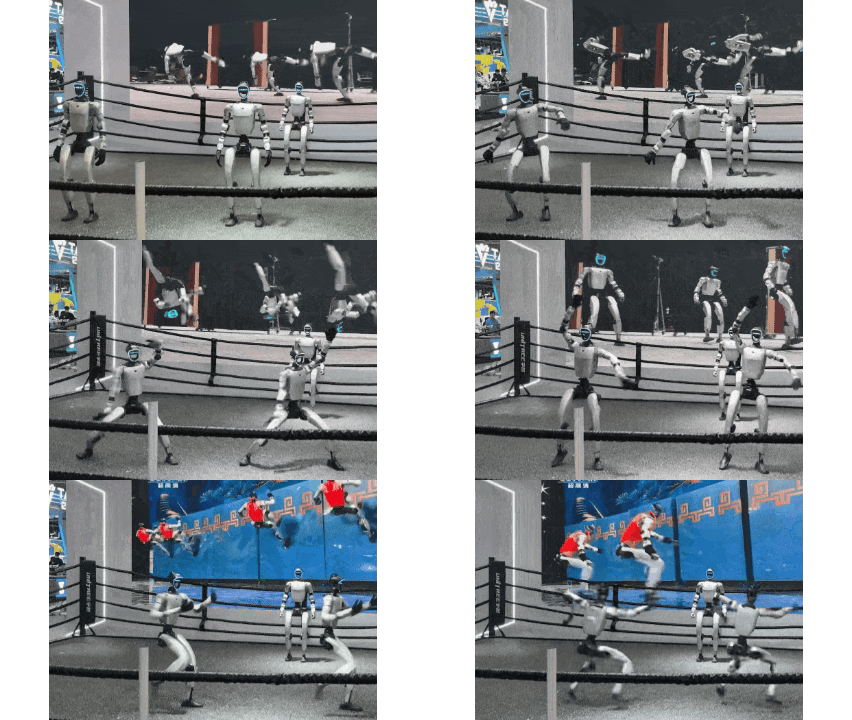
Unitree robot performing boxing

Future Robot demonstrating clothes folding, in 2x speed footage
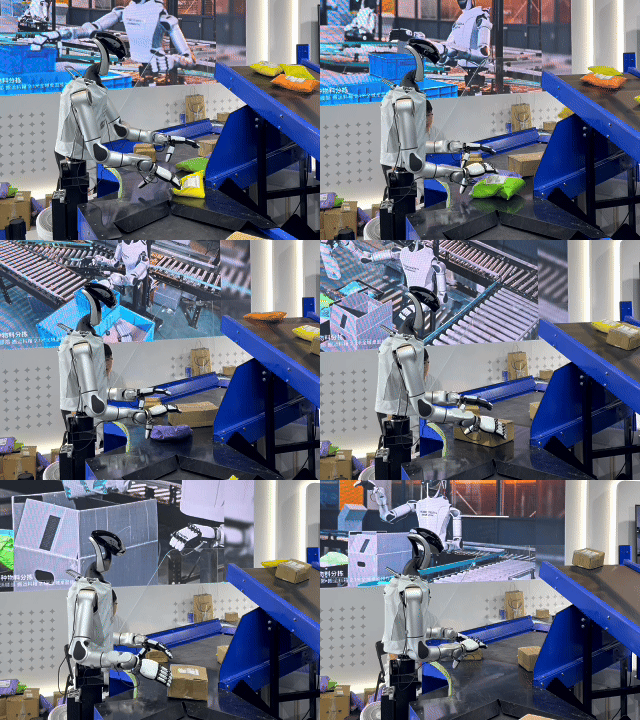
Starbot robot demonstrating express sorting
People flocked to the booths not only to understand the professional technical logic such as end-to-end control, vision-language-action models, and reinforcement learning, but also to see with their own eyes where the future depicted in movies has actually reached.
As a result, technologies were packaged into performances that can be understood in a few minutes, and complex industrial problems were compressed into one successful grab, one smooth turn, and a burst of applause. After the exhibition ended, a practitioner summed up the situation with eight words: "Laypeople are excited, insiders are silent".
Thus, WAIC becomes a special mirror, reflecting the industry's enthusiasm and imagination, as well as the unevenness and truth beneath the hustle and bustle.
For ordinary audiences, it is an accessible AI event; for industry insiders, it is a signal test that needs to be interpreted in reverse.
The more lively a place is, the closer it is to the core of emotions, and the farther away it tends to be from the essence of technology.
Vanity Performances: Technical Compromises and Truth Camouflage Under the Booth Logic
Robots are perhaps the most suitable yet most unsuitable type of AI product for exhibitions.
They are suitable because they are intuitive enough. The human body is naturally a ruler for measuring machines. People can judge whether a robot walks steadily, moves naturally, and responds quickly almost without professional knowledge. They are unsuitable because exhibitions naturally encourage visual wonders rather than long-term value.
On the booth, a successful backflip attracts more attention than eight consecutive hours of stable operation; a human-like appearance is more talkative than deployment costs, maintenance cycles, and safety redundancy.
Embodied intelligence exhibitors naturally follow the exhibition logic: technology must first become content, and then it has the chance to become a product.

"Doujiao" wandering around the venue
An algorithm engineer from a leading enterprise privately admitted that the demonstration version taken to the exhibition is not at the same level as the most cutting-edge research prototype in the laboratory. This is not a choice of a single enterprise, but a compromise of the whole industry based on the exhibition scenario.
For robots, the exhibition environment can be regarded as an extreme working condition.
Complex electromagnetic interference will disturb the readings of LiDAR and force sensors; the complex lighting formed by the mixture of natural light and the venue's top light is enough to cause recognition drift of the vision model; the random walking of the surrounding crowd may break into the path planning at any time. In addition, with the stability requirement of long-term uninterrupted operation every day, any variable can make the amazing effect in the laboratory fail on the spot.
In order to ensure the demonstration effect and avoid public opinion risks, exhibitors generally make downgraded engineering trade-offs: the demonstration tasks are disassembled to the simplest granularity, the decision-making link is greatly compressed, the edge-side large model originally used for generalized scenarios is trimmed to a parameter scale that is just enough, and some high-frequency actions even directly abandon the algorithm and are replaced by fixed rule scripts.
The autonomous decision-making robot in the eyes of the audience may be based on a pre-set path that has been debugged repeatedly; those dexterous operations that arouse amazement are often the optimal performance results after hundreds of on-site calibrations.
This is not entirely deliberate packaging, but more of a realistic compromise. The most cutting-edge research prototypes are inherently fragile. If three out of ten experiments can successfully break through the technical boundary, they are valuable enough. But the exhibition does not accept a 30% success rate, and what it needs is 100% performance completion.
The industry is struggling to move from demos to the delivery stage where robots can work stably without mistakes, and stability is exactly the most luxurious requirement at present. As a result, the upper limit of technology is hidden deep in the laboratory, and only the repeatedly polished lower limit is left on the booth.
In addition, technology confidentiality is a deeper unspoken rule in the industry. The technical solutions that constitute the core barriers, such as sensor layout, force control parameters, model architecture details, and edge-cloud collaborative scheduling logic, are all the hidden cards of each enterprise. No one is willing to put them under the spotlight to be disassembled by peers.
The content that can be photographed and recorded on the booth is often only the desensitized version that can be made public. The real cutting-edge progress only appears in the closed-door conference rooms around the venue, open to a limited number of investors and core customers.
The carnival is not worthless. On the contrary, the public's onlooking creates a kind of scrutiny that the laboratory can never provide. However, applause measures emotions, while the business world always measures stability.
Same Stage, Different Paths: Path Differentiation and Commercial Hollowing
At the peak of the boom, embodied intelligence is often described as a sufficiently broad unified track: large models are responsible for the "brain", robots provide the "body", and data drives the emergence of intelligence, eventually entering factories, shopping malls, and homes. This direction is not necessarily wrong, but it skips the most critical question: who can form a commercial closed loop first?
A large number of robots are crowded in the same space at WAIC, which makes the internal differences of the industry clearer than ever. Behind humanoid robots with similar appearances, there may be completely different business paths and uneven core competitiveness.
Some enterprises are more like hardware companies, with core capabilities in joints, actuators, and motion control; some bet on large embodied models, trying to build general capabilities across different bodies and scenarios; some are essentially system integrators, binding customers through clear scenario understanding and engineering delivery; for other enterprises, their most mature product at this stage is not a robot, but a financing story.
They all seem to be engaged in embodied intelligence, but in fact, they are answering completely different questions. Hardware companies focus on cost, lifespan, and supply chain; model companies focus on data scale, generalization ability, and algorithm architecture; solution companies focus on customer needs, delivery cycles, and return on investment.
It is of course possible for several capabilities to converge in one company, but in the early stage of the industry, trying to overcome the four barriers of ontology, model, data, and application at the same time means that each layer will consume huge amounts of capital, and the whole line will be under pressure if there is any careless mistake.
A deeper problem is that many current embodied intelligence projects are still in the stage of project-based intelligence. Engineers do a lot of adaptation around specific customers, specific production lines, and specific tasks, and finally form a working system.
This is not a bad thing in itself. Almost all complex industries will go through this stage. The real risk is that enterprises tell stories with the valuation of general intelligence, but rely on highly customized engineering services to generate revenue.
If every time you enter a new scenario, you have to re-collect data, debug actions, design processes, and provide on-site maintenance, the more revenue you get, the heavier the organization may be; the more orders you have, the greater the delivery pressure may be. Such a company can become an excellent automation enterprise, but it may not be able to realize the scale effect of a software platform.
Another thing that is easy to overestimate is the humanoid form itself. The human world is indeed designed according to the human body structure. Stairs, door handles, tools, and workbenches are naturally adapted to two hands and two feet, which provides long-term rationality for humanoid robots. But long-term rationality does not equal short-term economic benefits.
A wheeled chassis may be more stable, a fixed robotic arm may be cheaper, and special equipment may be more efficient. What customers buy is never a sense of future, but the optimal solution for a task.
Therefore, in the short term, the competitors of humanoid robots are not just other humanoid robots, but also robotic arms, AGVs, automated production lines, and cheaper human labor.
The excitement at WAIC makes the humanoid form the most prominent entry point for embodied intelligence, but the comparisons at WAIC also repeatedly remind the industry that the humanoid form is only a product form, not a business model, let alone a proof of technological maturity.
The real watershed is not who looks more like a human, but who can find tasks that are better than human labor, superior to traditional automation, and commercially profitable earlier.

Xingxing Origin F1 bionic humanoid robot, on July 21, Xingxing Technology announced the completion of hundreds of millions of yuan in Series A2 financing
However, the shadow of homogenization still hovers between every booth. From industrial production lines to kitchen stoves, robots are demonstrating work, but after careful observation, the scenarios everyone finds are more or less the same, and the solutions are also similar.
A sentence from Zhang Zhengyou, Chief Scientist of Tencent, is almost an accurate portrayal of the entire exhibition area: "Everyone is looking for scenarios where embodied intelligence can play a role, but the scenarios found so far are almost the same."
From doing backflips to entering factories for work, the industry era has iterated, but the narrative stories are still similar. The mirror of WAIC reflects not only the prosperity of the industry, but also the barrenness of commercial imagination to some extent.
Valuation Returns to Rationality: The "Revealing Mirror" is Turned on, and the Knockout Competition Starts Silently
In the past few years, the technology industry has been accustomed to using model parameters, training computing power, and ranking results to judge progress. But embodied intelligence is difficult to follow the same set of criteria.
Model capabilities can leap rapidly through an upgrade, but robots are constrained by materials, structures, batteries, manufacturing, control, safety, and maintenance. This determines that its industrialization speed is likely to be slower than public opinion expects, but once a closed loop is formed, the barriers will be much deeper than pure software.
Zheng Liyin, Co-founder of Qianxin Intelligence, once made such a judgment: 2026 to 2027 is the watershed for embodied intelligence to transition from the storytelling era to the delivery era.
The truly important competition in the future is not about whose robot has more actions, but about who takes the lead in establishing a positive cycle between data, deployment, and cost: robots enter real scenarios and generate high-quality interactive data; data improves models and control strategies; capability improvement reduces deployment difficulty; and the expansion of deployment scale brings more data in turn.
If this cycle can operate, enterprises have the potential to move from project-based operation to productization, and from burning money for scale to self-sustainment.
From this perspective, WAIC is more like a field for centralized expectation calibration, providing a cross-section for observing the industry. Through this mirror, we can see the real maturity level of technology, the real flow of capital, and the true quality of a company.
The public forms their first impression of robots here, enterprises observe the real progress of their peers here, customers compare the pros and cons of different solutions here, and investment institutions re-judge the gap between technological maturity and valuation here. It not only generates bubbles, but also pierces them.
There is almost no dispute that embodied intelligence has great industrial value in the long run. The intelligence of the physical world is a definite direction, and the ultimate potential of the general humanoid form goes without saying. But it is precisely because the long-term space is large enough that too many players, too much capital, and too many narratives will pour in in the short term.
According to data from IT Juzi, in the first half of 2026, the total financing amount of China's domestic embodied intelligence track reached 935 billion yuan, 5 times higher than that in the first half of 2025; the number of financing events reached 322, a year-on-year increase of 137%.
The logic of investors for this track is straightforward and radical: the unit price is benchmarked against automobiles, and the shipment volume is benchmarked against mobile phones. There has never been such a big business in human history.
But the long-term imagination of capital cannot be transformed into current productivity. The annual review significance of WAIC is like an annual industry physical examination, which brings all players to the stage under the brightest spotlight, allowing the market to test, screen, and clear them out.
This process is a bit cruel and disillusioning, but it is the only way for the healthy development of the entire industry.
From large models to the metaverse, from autonomous driving to consumer electronics, every boom follows the same law: swarming in, collective momentum building, bubble bursting, and the survival of the fittest. The only difference is how long this cycle is and who will be left in the end.
At this time next year, the second floor of the Expo Exhibition Hall will still be very lively. But the people standing there may no longer be the same group.