GPT-5.6 overturns a nearly 30-year-old mathematical conjecture, the full conversation is publicly available: the prompt only contains 58 words???
Here we go again??? GPT-5.6 has been on a total tear uncovering mathematical counterexamples lately...
The nearly 30-year-old Dinitz-Garg-Goemans conjecture in graph theory has just been disproven by GPT-5.6 Pro, which found a valid counterexample.
A researcher named Dmitry Rybin completed the entire verification process using only 4 prompts totaling 58 English words.
No thousands-of-words prompt engineering, no complex formulas, the whole workflow basically boiled down to:
Keep researching, keep looking, give me a complete counterexample!!!
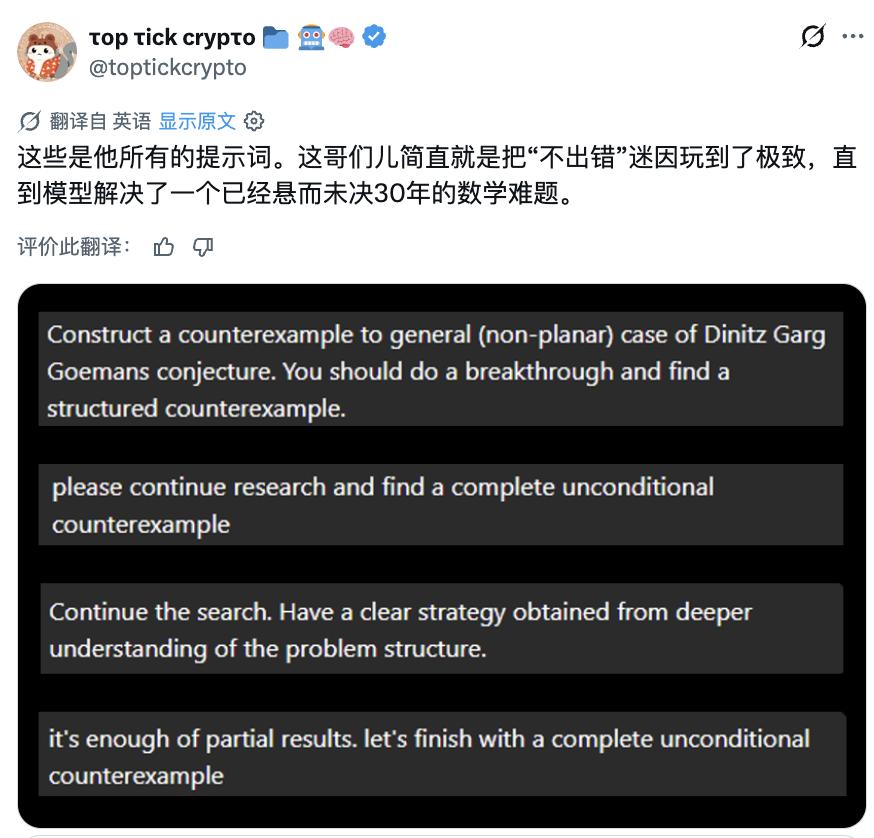
After pushing the model through round after round, GPT-5.6 Pro finally delivered a pretty groundbreaking conclusion —
The Dinitz-Garg-Goemans conjecture is false.
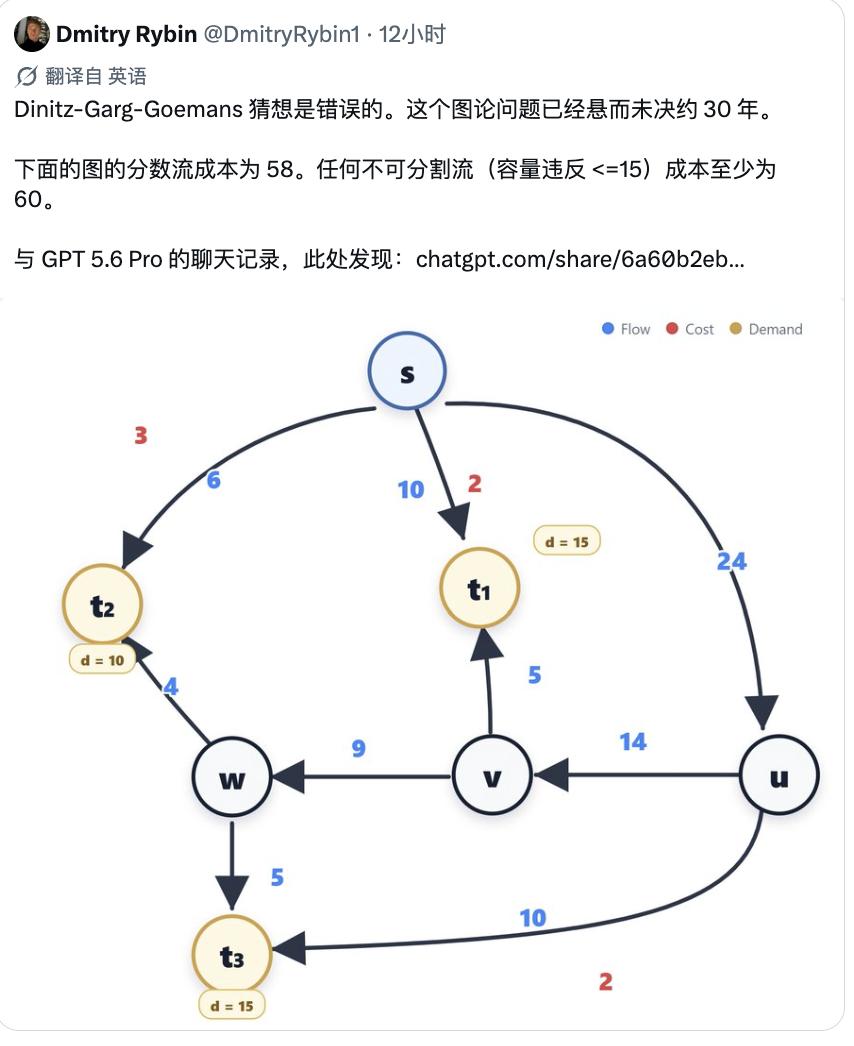
The final deliverables from the AI included not just a schematic diagram, but also four pages of proof certificates, an exact exhaustive enumeration verification program, machine-readable counterexample data, and full LaTeX source code.
And just like that, a 30-year-standing mathematical conjecture was broken, revealing a fatal bug, all thanks to those few relentless prompts???
Nearly 30-Year-Old Conjecture Disproven by GPT-5.6 Pro With a Fatal Counterexample
Let's first break down what this famously long-named Dinitz-Garg-Goemans conjecture is actually all about.
We can simply visualize it as a "delivery routing problem".
Suppose a warehouse needs to ship goods to multiple destinations. When splitting shipments is allowed, the same batch of goods can be divided across multiple routes —
Half goes on the highway, half takes the local roads, as long as everything arrives in the end, it's fine~
But under the unsplittable flow rule, each entire batch of goods must travel one single complete route, no splitting allowed!!!
In reality, this scenario is extremely common: network data transmission, logistics orders, traffic scheduling, and supply chain distribution all face similar problems:
The mathematically optimal solution can split tasks into infinitely small portions, but a single delivery vehicle or a single order in the real world cannot be sliced into 0.37 parts.

△
Once splitting is prohibited, the original optimal solution can no longer be directly applied.
Cargo that was previously spread across multiple roads now has to be routed entirely along a single path, which will very likely cause sudden spikes in load on some roads.
So the core problem this conjecture tries to solve is:
How do you convert a "splittable delivery" solution into a "fully unsplittable delivery" solution, without causing completely unreasonable road congestion?
In 1999, Yefim Dinitz, Naveen Garg, and Michel Goemans published a landmark paper on single-source unsplittable flows, proving that this congestion could be bounded within a certain range.
But after solving the "will congestion get too bad" problem, there's another very practical concern: will the total cost go up?
So Goemans, a renowned scholar in combinatorial optimization, proposed a stronger cost-inclusive version of the conjecture —
While keeping the aforementioned congestion upper bound, the total cost should also not exceed the total cost of the original splittable flow solution.
Put simply: if the original splittable routing scheme can be both cheap and reasonably uncongested, then when every batch of goods is required to travel a single complete route, there should theoretically exist a similarly low-cost scheme that only adds at most one extra unit of congestion.
However, this highly intuitively plausible conjecture has never been proven for general graph structures, and subsequent research only confirmed it for a few special cases.
For decades after that, the conjecture remained neither proven nor disproven.

The counterexample GPT-5.6 Pro came up with this time perfectly breaks the two conditions that the conjecture claims can both hold true:
Neither excessive congestion, nor increased cost.
It constructed a tiny graph with only 7 nodes and 9 directed edges, featuring one common starting point and three destinations, with three batches of goods having demands of 15, 10, and 15 respectively:
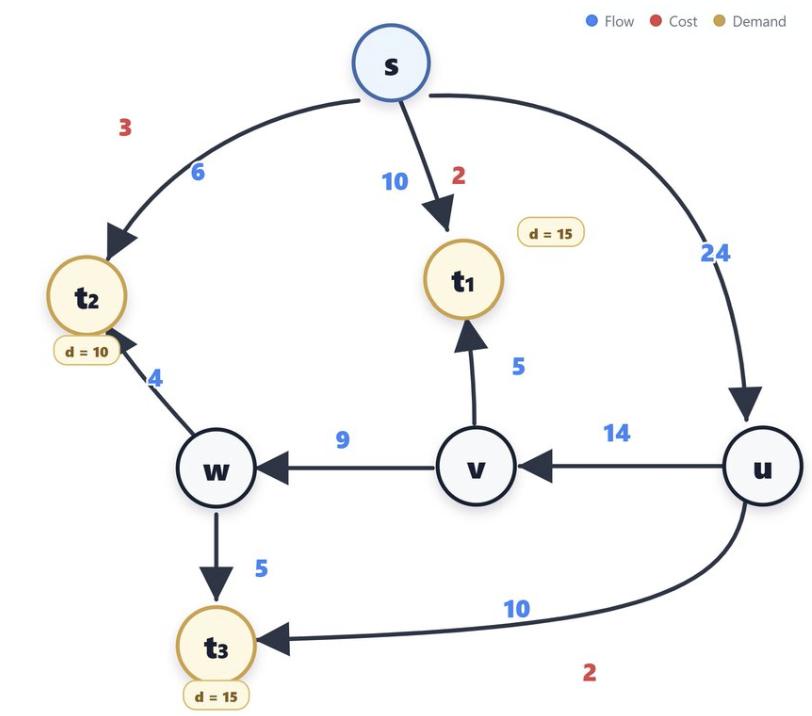
Each batch of goods has two available routes:
One route has a high cost of 30 per order; the other route costs 0, but requires sharing segments of the road with other orders.
If splitting shipments is allowed, the three batches can partially take the paid route and partially take the free route, resulting in a total cost of 58.
But! The moment every batch is required to take a single complete route, the trouble begins...
GPT-5.6 Pro's conclusion is that the three free route options are mutually exclusive with each other!
If any two batches choose the free route at the same time, they will both occupy the same shared road segment, pushing its actual load to 25, 30, or 40 — while the allowed upper limits for those roads are only 24, 29, or 39 respectively.
Every single time, it's exactly 1 unit over the limit.
So to respect the load limits specified by the conjecture, at most one of the three batches can take the free route.
The remaining two batches both have to take the paid route.
Each paid route costs 30, so adding those two batches together, the minimum cost for any scheme that meets the load constraints is 60.
This creates a situation where both conditions cannot be satisfied at the same time: To keep road loads within the specified limits, the minimum cost is 60; to bring the total cost back down to the original 58, at least one road will exceed its capacity limit.
And the original conjecture explicitly claims that both conditions can be satisfied simultaneously.
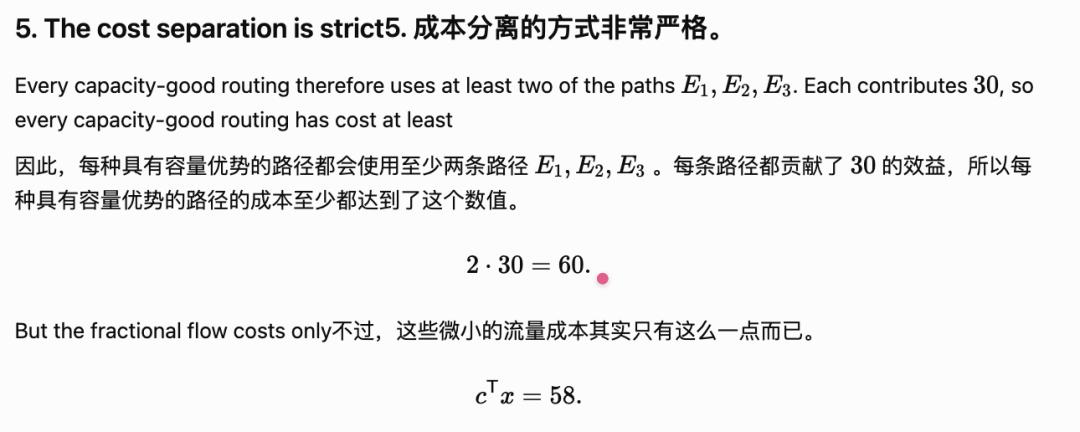
Moreover, verifying this counterexample isn't nearly as complicated as you might imagine.
Each of the three destinations has two path options, making for a total of 2^3 = 8 possible combinations.
Listing all 8 possibilities reveals that 4 of them meet the capacity requirements, with costs of 90, 60, 60, and 60; the other 4 are cheaper, but all of them have roads exceeding their load limits.
Every single case can be exhaustively checked, with no hidden paths left unaccounted for.
In other words, as long as this graph fully aligns with the conditions of the original conjecture, this 2-unit gap between 58 and 60 is more than enough to disprove the entire conjecture.
Four Rounds of Relentless Pushing Forced GPT-5.6 to Spit Out the Counterexample
The most fascinating part of this whole story is hidden in the public chat history between Rybin and GPT-5.6 Pro.
When you see a 30-year-old unsolved mathematical conjecture disproven by AI, you'd instinctively assume it must have required a whole arsenal of hyper-complex prompts deployed one after another!!!
In reality, we all drastically underestimated how simple it was.
Because the very first instruction Rybin sent to GPT-5.6 Pro, apart from the attached file, was nothing more than pure, plain, straightforward language:
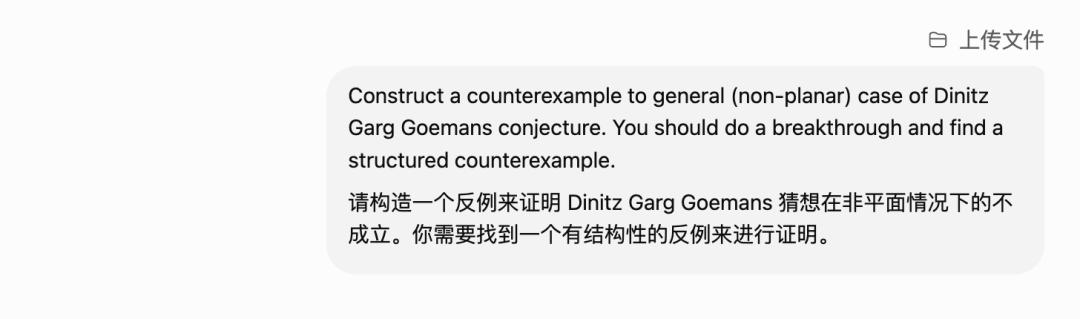
Yep, it's that unadorned and simple.
Right after that, GPT-5.6 Pro got to work following the instructions, grinding away nonstop.
It first built a linear programming validation method, then tested multiple graph structures including hypercubes, layered graphs, and merge-diverge networks, screening thousands of small instances in total.
After all that intensive searching, the model's first round of output was: no valid counterexample found. (doge)
GPT-5.6 Pro even earnestly warned that if the approximate constructions it found at that stage were misrepresented as counterexamples, it would lead to a false mathematical conclusion.
To translate that: I've already tried my best, I really can't solve this problem right now!!!
But our protagonist Rybin wasn't having any of that. He didn't add any new formulas, nor did he manually point the way. He simply replied casually:
Keep researching, find a complete, unconditional counterexample~

So GPT-5.6 Pro dived back into another full round of searching, but the second round still ended in failure.
Rybin kept pushing it, asking the model to first develop a clear strategy based on a deep understanding of the problem structure, then resume searching.
By the third round, the model had narrowed its search scope down to a routing structure with only 24 possible states, seemingly just one step away from the correct answer.
However, the AI still couldn't produce a complete counterexample...
At that point, Rybin sent his fourth prompt: We already have plenty of partial results, let's wrap this up with one complete, unconditional counterexample.

Alright, when you put it that plainly.
This time, GPT-5.6 Pro finally delivered that 7-node, 9-directed-edge counterexample graph — four prompts, totaling 58 English words.
No thousands-of-words character setting, no dozens of tedious rules, the whole process can basically be summed up as:
I push! I push! I keep pushing!

But if you read through the full conversation, you'll realize GPT-5.6 Pro went down quite a few detours over those few hours...
Midway through, the AI found multiple candidate counterexamples that seemed valid at first, but when it exhaustively enumerated every single possible route, it discovered some previously missed "hybrid paths" hidden in the network.
These paths combined segments from different predefined routes to create entirely new paths that quietly bypassed the capacity constraints the model had originally designed.
The result was that counterexamples that looked completely solid collapsed entirely after full validation.
GPT-5.6 Pro summed this up very honestly halfway through:
Checking a few hundred predefined routes is nowhere near enough. A truly valid counterexample must account for every single possible unsplittable flow path that can exist in the entire network.

This makes the entire human-AI collaboration feel very subtle.
On the surface, Rybin only contributed 58 words, but the truly critical action was his ability to judge that the first three rounds of outputs from the model were all intermediate incomplete results, and repeatedly refuse to accept a premature finish.
Wharton School professor Ethan Mollick, after seeing this exchange, even raised a new question:
Who should actually be credited as the author of this work: Rybin who wrote 58 words, or GPT-5.6 Pro that ran continuous deductions for hours on end?
In reality, no matter how the authorship is eventually assigned, this conversation has at least shared a very down-to-earth lesson for using AI —