Dialogue with Ant Digital Technology: Build a Super Factory for Business AI Agents, and Jointly Develop China's Industry-specific Harness Standard through Ecosystem Co-construction
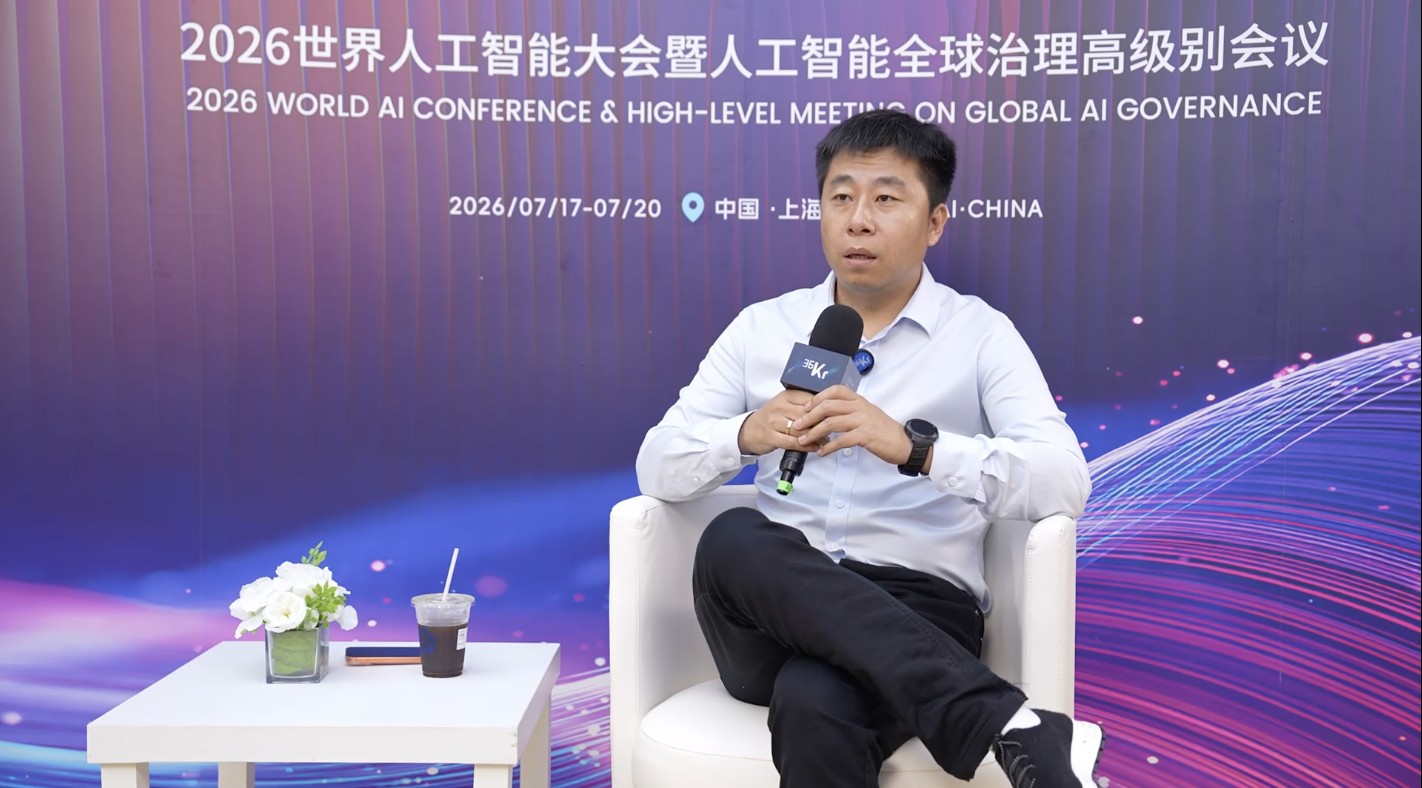
On July 17, the 2026 World Artificial Intelligence Conference (WAIC) kicked off in Shanghai. As a key content window where 36Kr delves deep into the WAIC site for the third consecutive year, the "Kr Talks Future" live studio also launched on-site dialogues simultaneously on the first day of the conference. Sun Lei, Vice President of Ant Digital Technologies and General Manager of the China Business Development Department, was interviewed exclusively by 36Kr's "Kr Talks Future" at the WAIC site. Focusing on topics such as the Super Factory for Business Agents, industry-specific vertical large models, AI engineering capabilities, and enterprise agent implementation, he shared Ant Digital Technologies' latest practices and insights for empowering enterprises with intelligent upgrading.
This year's WAIC is themed "Intelligent Partners, Co-Creating the Future". As the artificial intelligence industry enters a stage of deepened application, the industry focus is gradually shifting from competition over model capabilities to the creation of application value. Compared with the discussions in previous years that centered on parameter scale, model performance, and technological breakthroughs, the 2026 AI industry is paying more attention to a core question: how AI can truly integrate into enterprise business processes, lower application thresholds, and generate value through tangible business outcomes.
Against this trend, business agents are emerging as a critical bridge connecting model capabilities and enterprise applications. For enterprises, relying solely on general large models can no longer meet complex business demands. There is a greater need for agent systems equipped with industry knowledge, business understanding, and engineering capabilities, to help AI truly land in business scenarios and realize the upgrade from individual efficiency improvement to organizational collaborative optimization.
The "Super Factory for Business Agents" launched by Ant Digital Technologies this time is precisely an exploration in this direction. As the application platform supporting the "Super Factory for Business Agents", Agentar 2.0 comes pre-configured with nearly 200 job-level digital expert templates in its first batch, and offers hundreds of subscribable, ready-to-use Skills-level agent tools. Enterprises can quickly activate digital experts with professional knowledge, business process proficiency, and tool invocation capabilities based on specific job roles and operational needs, without building everything from scratch.
For enterprise-grade AI, what truly determines the implementation outcome is not just the model capabilities themselves, but the continuous development of industry understanding, engineering capabilities, and value delivery systems.
The following is the edited transcript of the dialogue, reviewed by 36Kr:
36Kr: Mr. Sun, hello. Could you first introduce the theme of this year's booth? I noticed the key phrase "Super Factory for Business Agents" — how should we understand this positioning?
Sun Lei: The core positioning of the "Super Factory for Business Agents" we launched this year is to solve industry and scenario-specific problems. From last year to this year, the entire AI industry has undergone tremendous changes. The first change is that AI has evolved from the past general question-and-answer mode to the current agent stage, where it can genuinely help users complete tasks and solve problems. From this perspective, AI is moving from general scenarios to vertical industries. The second change is that the industry truly needs to address core issues in business scenarios. Only when agents are fully deployed on the application side can actual business requirements be fulfilled. The third change is that the development goal of AI has shifted from merely improving individual efficiency to advancing organizational evolution. In the future, it is not just about enhancing individual capabilities; more importantly, teams and business divisions will leverage agents to achieve collaboration, enabling intelligent upgrading across the entire organization.
Against these changes, we have integrated Ant Group's own vertical large model capabilities, industry scenario experience, and over 20 years of technical accumulation to refine these capabilities into standardized products for external services. Both large enterprises and small and medium-sized enterprises can access technical and product capabilities similar to those of Ant Group, effectively supporting the intelligent transformation of industries.
36Kr: We know that Ant Digital Technologies initially accumulated extensive experience in the fintech sector. The financial industry has extremely high requirements for security, compliance, and stability. Could you summarize the core concerns of financial institutions as they embrace Agent and AI transformation, and why your solutions can address these pain points?
Sun Lei: In fact, the very reason we launched the "Super Factory for Business Agents" is to solve several key issues. The first is the industry-specific challenge. We believe that AI will inevitably move from general scenarios to vertical scenarios, and vertical scenarios need to leverage industry data to build industry-specific vertical large models. Without the support of industry data and professional capabilities, relying solely on general large models cannot truly solve problems of professional accuracy and business adaptation. Therefore, one of the biggest differences between our Super Factory for Business Agents and other solutions is that we aim to address industry-specific challenges through vertical large models.
The second is the scenario-specific challenge. Today, how to translate business language into technical capabilities to ensure AI truly serves business operations is a critical point.
Based on years of practical experience in sectors such as finance, healthcare, and energy, Ant Digital Technologies has further engineered these capabilities into replicable solutions, enabling AI to truly land in business scenarios.
The third is the ecosystem challenge. The opening of AI capabilities must be integrated with industry ecosystems. We will convert relevant components into APIs and simplify them, so that more partners can quickly integrate and innovate based on their own industry strengths. Therefore, industry-centricity, scenario-centricity, and ecosystem-centricity are the three core directions that distinguish our Super Factory for Business Agents from other solutions.
Back to the financial industry, there are several critical issues in financial scenarios. The first is security and compliance. The financial industry is subject to regulatory requirements, and it is essential to ensure that AI applications comply with relevant regulations. Ant itself operates in financial scenarios such as payments, wealth management, and insurance, and can guarantee the compliance of AI implementations. Without robust security capabilities and a risk control system, it is difficult for AI to truly land in financial scenarios. We would rather delay implementation than make mistakes.
The second is professionalism and hallucination mitigation. Financial services are highly specialized, and AI must be able to accurately understand and respond to professional queries. Our Super Factory for Agents has two important tools: one is the industry-specific vertical large model, and the other is the engineering capabilities focused on business scenarios. The combination of these two capabilities allows for better alignment with real-world scenarios. Therefore, we improve the model's professionalism by integrating industry-specific vertical large models with business engineering capabilities.
The third is outcome validation. Financial institutions have made massive investments in informatization and digitalization in the past, so during AI transformation, they will focus on how to demonstrate value after investment and how to verify ROI.
In response to this, Ant Digital Technologies has proposed the concept of "value delivery, pay-by-result". The so-called value delivery refers to verifying whether the agent truly possesses professional capabilities. We measure this through two main dimensions: first, the accuracy of responses. For example, when a user consults about insurance issues, the agent should be able to accurately answer insurance-related content, rather than giving vague responses about other financial topics. Leveraging the aforementioned vertical large model, our response accuracy in professional scenarios can currently reach over 90%-95%. The second is the consistency rate — that is, comparing the degree of consistency between the answers from professionals and those from the agent for the same question. In relevant scenarios, our consistency rate can currently exceed 85%, which is also the standard Ant Group adheres to in wealth management, insurance, and fund-related scenarios.
In addition, pay-by-result means verifying the value created by AI in actual business operations. For example, whether conversion efficiency is improved in marketing scenarios, or whether risks are reduced in risk control scenarios. Therefore, in the financial sector, security, professionalism, and outcome validation are the three most critical issues: AI applications must comply with regulatory and national requirements; they must be powered by industry-specific vertical large models; and they must deliver tangible, verifiable results. Ant aims to address these issues one by one by leveraging our own best practices.
36Kr: Recently, we have noticed that Ant Digital Technologies is expanding into industries beyond finance. Apart from the financial sector, which industries are you currently focusing on, and what common characteristics do these industries share? Additionally, what challenges have you encountered during the generalization of technology, and how have you resolved them?
Sun Lei: In fact, we are still focusing on the core directions we just mentioned: industry, business scenarios, and security. Apart from the internet industry, many traditional industries are facing common challenges in the process of evolving from digitalization to AI-enabled intelligent upgrading. We hope to reuse the capabilities we accumulated in the financial sector in more industries.
The first key point is underlying data governance. The most critical foundation for industry-specific vertical large models is underlying data, including external data and internal enterprise data. Our approach is to combine our own external data capabilities with the business data of enterprises to build vertical models tailored to specific industries. Therefore, data governance capabilities are extremely important when serving other industries. Without organizing and governing the underlying data, it cannot support vertical scenario models. The financial industry has long had a high level of digitalization, while the data infrastructure in sectors such as manufacturing, healthcare, and industry is relatively more complex. For this reason, our Super Factory for Agents also includes data governance tools and related capabilities to help enterprises complete their foundational infrastructure.
The second key point is the capability to integrate business scenarios, that is, engineering capabilities. The concept of "Harness" has been proposed overseas recently, which essentially refers to how to engineer and implement model capabilities. We aim to build a Chinese industry-adapted version of Harness that aligns with the characteristics of China's industries, which is also a key competitive advantage of the Super Factory for Business Agents. To illustrate how Harness capabilities can be applied across different industries, let's take an example: in financial scenarios, there used to be a "three-workshop" logic. But in our Harness, we have developed a "four-workshop" logic, consisting of intent recognition, planning, execution, and expression. Intent recognition is particularly important here. When a user asks an insurance-related question, their real demand may be asset allocation, wealth management, or product portfolio recommendations. Therefore, it is necessary to first understand the user's true intent before providing follow-up services. Different sectors have different requirements for engineering capabilities. For example, industries such as energy and healthcare may require process designs of different granularities. In the future, we aim to refine an industry Harness that aligns with the characteristics of the Chinese market, which is the goal of our Super Factory for Agents. Currently, we have already accumulated relevant capabilities in sectors including finance, healthcare, energy, mobility, transportation, and aviation.
The third key point is security capabilities. Different industries have different focus areas for security. The financial industry prioritizes regulatory compliance, while the manufacturing sector may focus on production safety, and the energy industry may emphasize prediction accuracy. For example, in the photovoltaic sector, we use time-series large models combined with factors such as weather and on-site conditions to achieve power generation forecasting. Therefore, security capabilities need to be adapted to the unique characteristics of different industries.
The fourth key point is outcome validation. We already have a mature value validation system in the financial and healthcare sectors, but we are still in the exploratory stage for other industries. In the future, we will continue to collaborate with partners to improve outcome evaluation standards, so that industries can truly see the value generated by AI investments.
36Kr: One last question — could you give a preview of Ant Digital Technologies' key development directions in the next 6 to 12 months? What initiatives can people look forward to after WAIC?
Sun Lei: In the next 6 to 12 months, you can focus on several key directions. First, we will continue to expand the portfolio of industry-specific vertical large models and agent matrices. Currently, we have built up capabilities in sectors such as finance, healthcare, energy, and mobility. In the future, we will further standardize product delivery in areas where we have expertise and data accumulation; for other industries, we will collaborate with partners to co-develop industry-specific vertical large models and agents.
Second, we will open up the capabilities of the Chinese industry-adapted Harness. Going forward, we will further organize the engineering capabilities across various industries and develop standardized methodologies. For example, the financial sector has already formed a "four-workshop" model, including intent recognition, planning, execution, and expression. In the future, in sectors like energy and healthcare, we will work with ecosystem partners to explore corresponding industry-specific Harness versions and gradually open up relevant capabilities.
Third, we will continue to improve the evaluation system. We have a very comprehensive evaluation system, and we have already conducted multiple rounds of evaluation and validation in some banking customer projects. For example, for a leading city commercial bank project, we completed 28 rounds of evaluation. In the future, we will continue to update and enrich the evaluation system, using more scientific methods to verify that AI truly delivers value and realizes the "pay-by-result" model. In addition, platform capabilities and tool capabilities will be continuously released. Ultimately, we hope to leverage industry large models, engineering capabilities, and evaluation system development to ensure that agents truly serve industries and deliver tangible value.