Kimi K3 tops the list, Moonshot AI and Astronomy Class Notes
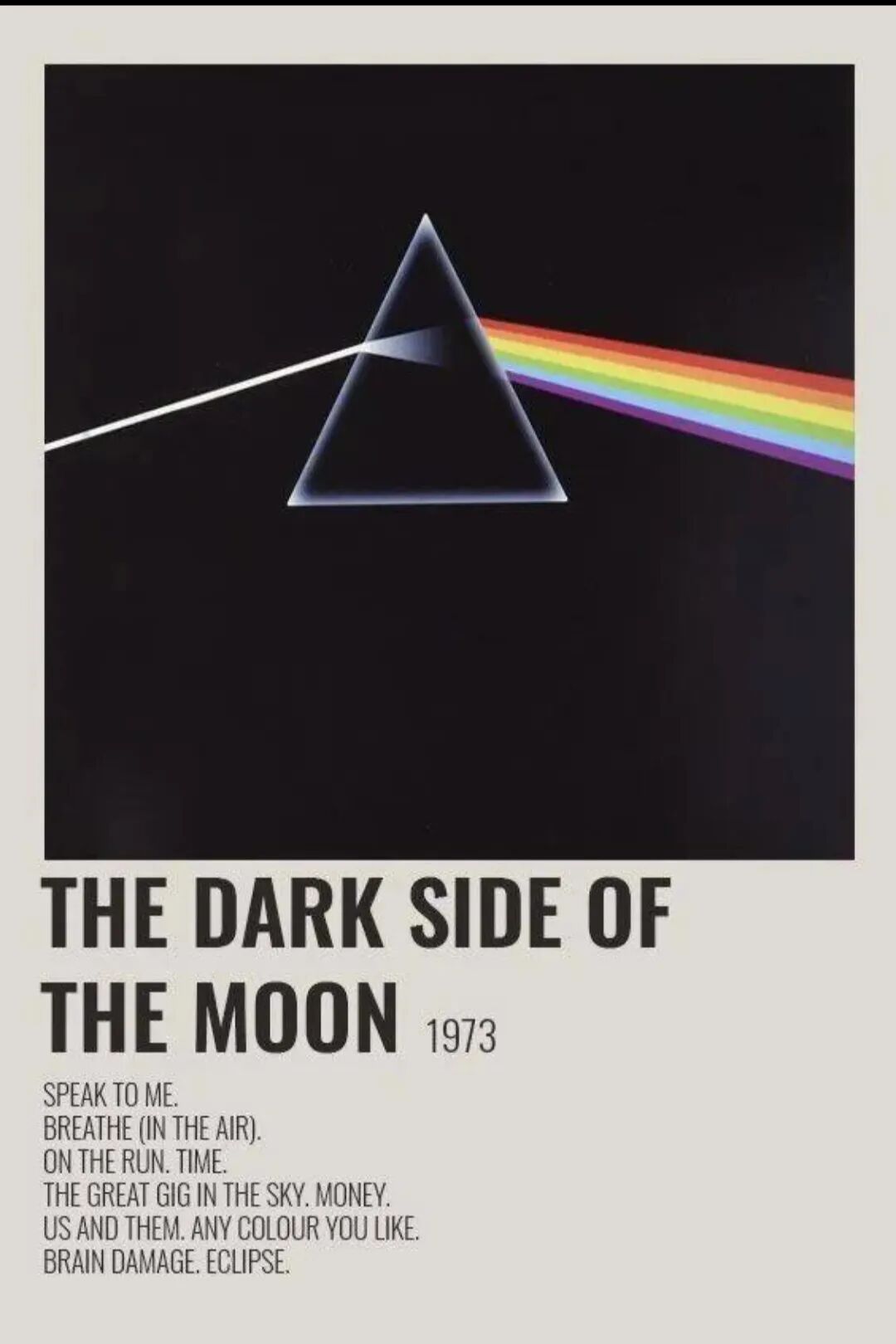
"The Dark Side of the Moon" — the iconic progressive rock album released by Pink Floyd in 1973, half a century later, became the namesake of a Chinese AI company: Moonshot AI.
Just a few days ago, on July 16, 2026, on the eve of the World Artificial Intelligence Conference, Moonshot AI unveiled its new-generation large model Kimi K3 to the world: with 2.8 trillion parameters, it is the world's largest open-source model; it topped the Frontend Code Arena leaderboard with a score of 1679, surpassing Claude Fable 5 and GPT-5.6 Sol. For the first time, a Chinese large model has outperformed those two landmark closed-source giants on this ranking, which overseas observers have called "a new DeepSeek moment." By a curious coincidence, when researchers asked it to reproduce the famously elegant universal relationship in computational astrophysics known as I-Love-Q, a task that typically takes seasoned researchers one to two weeks, K3 completed it in roughly two hours.
The article you are about to read was written by a physics professor, composed during a general education astronomy lecture about the moon, and co-created with Kimi K3. Rock music, astronomy, and AI, separated by half a century and half the globe, converge on a vinyl record, in a tech company, and within a university classroom.
The author starts with the name "The Dark Side of the Moon" — explaining tidal locking, and revealing that the far side of the moon actually gets a full fourteen days of bright midday sunlight every month: the so-called "dark side" is merely the "far side," distant, but never dark. He then extends this metaphor to today's large language models: is the trillion-parameter black box, which even its creators cannot fully explain, humanity's very own "dark side of the moon"?
Unseen does not equal unlit. What follows are his notes from that astronomy class.
On a July afternoon, the window outside felt like an oven that no one had turned off. The air was hot, the walls were hot, even the water flowing from the tap carried a lukewarm, apologetic warmth. Spanish moss hung from the oak trees, stirred by occasional gusts of hot wind, like the tentacles of some aquatic creature.
That afternoon, I was teaching an introductory astronomy course to undergraduate students. Most of the students had enrolled because they had heard the class was "easy to pass." I carried an old record player, pushing the classroom door open with some difficulty. Stacked on the turntable was a well-worn vinyl record, its sleeve edges rubbed white and dotted with decades-old mold stains of various shades.
"Today we're talking about the moon," I said. "But before we start, let's listen to something first."
The stylus touched the grooves, and the classroom fell silent.
The sound of a beating heart began. Thud. Thud. Thud. Drawing nearer, like a giant, unseen beast making its way through the darkness toward the classroom. Immediately after came the clink of a cash register, the chime of a clock shop, airport announcements, a man's laughter and sigh. The music flooded in: *Breathe, breathe in the air*. On the projection screen was the iconic album cover: a beam of white light entering from the left, passing through a prism against a black background, scattering into a rainbow to the right.
The tiered lecture hall was packed with nearly two hundred students, and for a moment, none of them were looking at their phones. This would have been normal in 1973, but in the present day, it was nothing short of a miracle.
"Most of you here probably don't know this album — you weren't even born back then," I said, realizing halfway through the sentence that neither was I, in a way.
"Pink Floyd's The Dark Side of the Moon, released in 1973," I continued. "Today's lecture starts with this album, because its title is wrong."
How the Moon Moves
"What's wrong with it?" asked a boy in the front row wearing a baseball cap. His name was Tyler, one of the rare students who ever spoke up in a large lecture class.
"The word 'dark' is wrong," I said. "First, let's get one thing straight: exactly how does the moon rotate?"
I asked Emily, a student in the front row, to stand in the center of the classroom. "You're going to play the Earth now." Tyler followed the instructions, walking in circles around her while keeping his face pointed toward her the entire time.
Tyler started moving. To keep facing Emily at all times, he had to subtly adjust the direction of his body as he circled her. By the time he finished one full orbit, the whole class could see that his body had also completed one full rotation on its own axis.
"That's exactly what the moon does," I said. "In astronomy, this is called tidal locking. The moon takes 27.32 days to rotate once on its axis; it also takes exactly 27.32 days to complete one orbit around the Earth. Not a fraction off."
"A coincidence?" Emily asked.
"No. It's the result of gravity slowly shaping things over hundreds of millions of years," I told them. Earth's gravitational pull created a slight deformation in the moon, like an invisible hand that gently pressed the brakes on the moon's rotation over and over, until its rotational period perfectly matched its orbital period. From that moment on, the moon has forever kept the same face turned toward us."
Is that amazing? Actually, it's quite common in the solar system. Most major planets have locked their moons in this exact way.
"So we've never seen the other side of the moon?" Tyler pressed on.
"Not exactly."
Next, I introduced "libration," a term that sounds like a line from a Latin love poem. The moon's orbit is elliptical, so its orbital speed speeds up and slows down, while its rotation remains perfectly constant. This allows us to peek a tiny bit more around its eastern and western edges. The moon's equator is tilted by roughly 5.1 degrees relative to the ecliptic plane, so its north and south poles peek out shyly, appearing and disappearing from our view. Add to that the fact that the Earth itself is rotating, so observers on opposite sides of the planet get slightly different perspectives. When you combine all three effects, humanity can see not 50% of the lunar surface, but roughly 59% of it.
"That means, for countless generations, we've gazed up at the same familiar face, but if you are patient enough, that face will let you see nearly 60% of its true form," I said, raising my voice slightly to wrap up that segment.
Some students in the classroom laughed. I couldn't laugh. For some reason, that line sounded a little like something a therapist would say.
The Far Side Is Not Dark
"So then, what's wrong with the phrase 'the dark side of the moon'?"
I pulled up a photograph. In October 1959, the Soviet Union's Luna 3 probe flew past the far side of the moon, transmitting 29 blurry snapshots that looked as if they had been taken through frosted glass. It was the first time humanity ever laid eyes on the moon's far side: there were almost none of the familiar dark lunar maria we know from the near side, just a pockmarked, scarred landscape, like a face that had never been treated gently by youth. On Christmas Eve 1968, the three astronauts of Apollo 8 became the first humans to see the far side of the moon with their own eyes. Incidentally, the famous "Earthrise" photo, showing the blue Earth rising above the gray lunar horizon, was taken on that very mission.
"But pay attention," I tapped the lectern. "Unseen does not equal dark."
The far side of the moon experiences day and night just like the near side. During every synodic month, the far side gets a full 14 days of unobstructed, brilliant sunlight. On the night of a new moon, when you look up and can barely see the moon at all, the far side is bathed in the bright light of midday.
For roughly half of each lunar cycle, the so-called dark side of the moon is one of the brightest wastelands in the entire solar system.
"It should be called the far side. Distant, but never dark."
"Then why did Pink Floyd call it the dark side?" Emily asked.
"Because that's literature, not astronomy."
I told them about the final track on the album, "Eclipse." As the song nears its end and the beating heart fades away, a man's voice speaks one single line in the background. The speaker was Gerry O'Driscoll, the studio doorman, whose voice was recorded casually while the band was chatting. In his thick Irish accent, he said: "There is no dark side of the moon, really. Matter of fact, it's all dark."
There is no dark side of the moon, really. Matter of fact, it’s all dark.
The "dark" in Roger Waters' lyrics was never an astronomical concept — it was a metaphor. In English, the word for "insane person" is lunatic, whose root is the Latin word luna, meaning "moon." Ancient people believed that the full moon could induce madness; werewolves, witches, and insomniacs were all thought to be under the moon's influence. There's a song on the album called "Brain Damage," which sings about "the lunatic is on the grass," and the final line goes: *I’ll see you on the dark side of the moon*. They were singing about Syd Barrett, the band's founding member, a prodigy consumed by drugs and mental illness; they sang about time, money, war, and death; they sang about that tiny, almost invisible crack in every modern person's mind.
"So this is an album that uses an astronomically incorrect term to sing the truth of the human condition," I said. "It spent a staggering 942 weeks on the Billboard charts. To put that number in perspective: that's longer than the total number of semesters you all will spend from kindergarten through college graduation, combined."
The Moon Over Florida
When talking about the moon, you can't skip Florida — it was from here that humanity launched its physical exploration of the moon.
Traveling due east from my location, past endless pine forests, dairy farms, and road signs that read "Caution: Alligators," the salty tang of the ocean grows stronger, until you reach Cape Canaveral. The Kennedy Space Center. Launch Complex 39A. The giant Vehicle Assembly Building stands alone beside the lagoon, with an American flag painted on its side so large it covers the area of dozens of basketball courts, looking from a distance like a postage stamp stuck on a wall.
At 9:32 a.m. on July 16, 1969, the Saturn V rocket carrying Apollo 11 lifted off from here, leaving Earth behind. Armstrong, Aldrin, and Collins — three human beings — set course for that tidally locked rock 380,000 kilometers away.
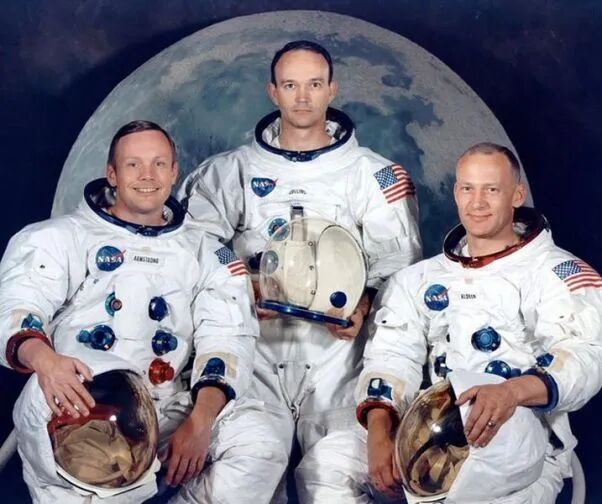
From left: Neil Armstrong, Michael Collins, Buzz Aldrin (Image credit: Baidu Baike)
I once went to watch a launch. It wasn't an Apollo mission, but a later Falcon 9, the flagship rocket of SpaceX, the company that recently had a phenomenal public listing. It was 6 p.m., right in the middle of rush hour. The moment the countdown hit zero, a cloud of mist lifted a pillar of flame, which across the water looked like a newly lit match, slowly tracing a clean, smooth arc across the sky. The sound took a long time to catch up. First came a low rumble, then crackling explosions, like a thunderstorm played back in slow motion. The rocket climbed higher and higher, shrinking smaller and smaller, until it turned into a meteor flying backward, vanishing into the zenith.
In that moment, I suddenly thought of President Kennedy's 1962 speech: "We choose to go to the moon." The speech was delivered at Rice University in Texas, but it was the salty Florida breeze that turned those words from rhetoric into physical reality.
On that launch day, only a handful of cars were parked beside me by the water to watch. The endless stream of traffic behind us drove past, completely uninterested. They say there are launches now several times a month, and even without disturbing residents, they barely draw any attention from the local population anymore.
A Company Named Moonshot AI
I once came across a news story: an artificial intelligence company based in Beijing was thriving, and its latest product had reached the top of industry benchmark rankings. Its Chinese name translates to "The Dark Side of the Moon," and its English name is Moonshot AI. I stared at that name for 10 seconds, and suddenly I smiled.
The company was founded in 2023, which by my calculation, is exactly the 50th anniversary of the release of *The Dark Side of the Moon*. The name was taken directly from the album, which is Yang Zhilin's favorite record. Yang Zhilin comes from a natural language processing background, and his academic papers have a staggering number of citations. But what attracted me wasn't that — it was another detail: when he was studying at Tsinghua University, he and his future co-founders formed a rock band together. In their office, every meeting room is named after a rock band, and two electric guitars and a piano stand permanently in the corner.

One of their meeting rooms is named "Queen." Brian May, the guitarist of Queen, is one of the most academically credentialed rock musicians in history. In the early 1970s, he was pursuing a PhD in astrophysics at Imperial College London, studying the scattering of sunlight by interplanetary dust — the faint, almost imperceptible glow on the horizon just before dawn. In 1974, as the band became globally famous, he dropped his unfinished thesis to become a rock guitar hero. Thirty-three years later, in his sixties, he returned to Imperial College, finished his thesis, and received his long-overdue doctorate. And Freddie Mercury, the band's lead singer, whose stage name "Mercury" is the very planet that orbits closest to the Sun.
A company that builds "the mind of machines" dedicated a meeting room to a rock band whose lead guitarist holds a PhD in astrophysics. Rock music, astronomy, and AI, separated by half a century and half the globe, had somehow converged inside that very meeting room.
Night Thoughts on the Porch
That night, I sat on my porch and listened to the entire album from beginning to end again. The moon hung as usual over the oak treetops, completing its rotation every 27.32 days, neither fast nor slow. It still only shows us one side, patiently watching humanity go about its business for tens of thousands of years: making calendars, calculating tides, naming madness, writing poetic lines like "How rare is a bright full moon," and singing *I’ll see you on the dark side of the moon*. The phrase "the dark side of the moon"