36Kr Exclusive | Former Wall Street Investor Steps Into the Field to Develop "Robotic Hands", Solving the Industry's Data Pain Points with "Self-developed Visual-Tactile Technology + Hardware-Software Closed Loop"
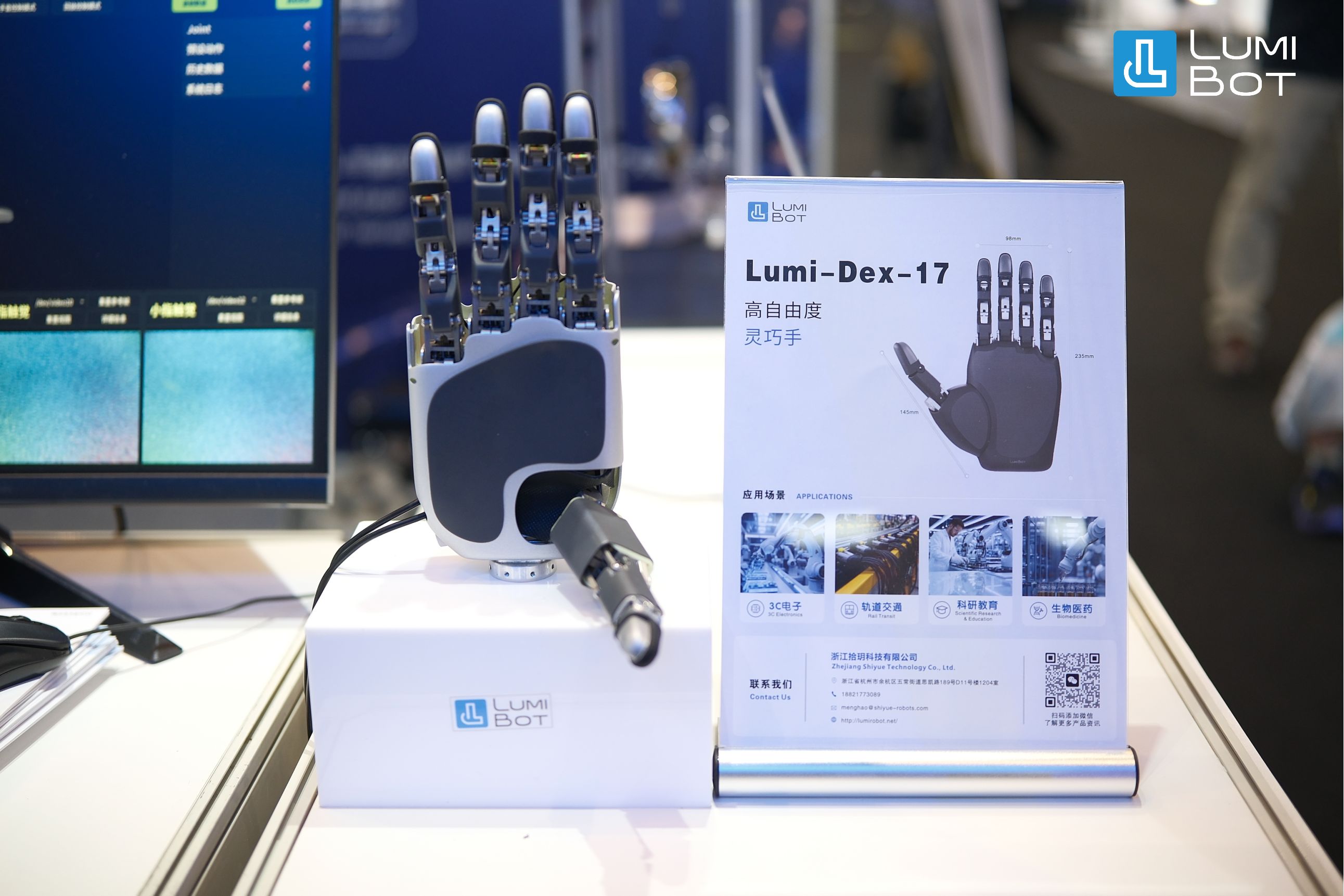
Image source / Enterprise
This article contains approximately 2100 words, with an estimated reading time of 5 minutes
Author丨Ou Xue
Editor丨Yuan Silai
36Kr Hard-Kr has learned that LumiBot, a provider of robotic dexterous manipulation solutions, has recently completed a multi-million-yuan angel round of financing. This round is led by a fund under a listed company. The funds will be mainly used for team expansion, product iteration and small-batch production line construction, as well as dexterous manipulation data collection and model R&D.
LumiBot was established in early 2025, focusing on providing dexterous manipulation solutions for high-precision scenarios such as industrial manufacturing and precision assembly. At present, the company has launched four major product lines: the Lumi-Dex series high-degree-of-freedom dexterous hands, the Lumi-Tac finger-shaped visuo-tactile sensor, the Lumi-Mind dexterous manipulation model, and the Lumi-Mod motor module.
In terms of the team, founder Wu Yuwen once led investments in multiple projects including AI intelligent vision and coffee robots as an investor. Technical director Song Kaiyou studied under Academicians Xiong Youlun and Yin Zhouping, previously served as a senior algorithm expert at Ant Group, and led the multi-version model training of the Bailing multimodal large model; algorithm director Chen Yifan comes from Baidu's autonomous driving team and led the implementation of China's first pure-vision high-level intelligent driving solution; product director Zhong Qiaoheng once founded a dexterous hand company and achieved mass production.
In the wave of embodied intelligence, dexterous hands are regarded as the "last centimeter" for robots to complete refined operations. Founder Wu Yuwen judges that dexterous hands are an unavoidable bottleneck for robots and also a track with extremely high value chains.
One of LumiBot's core differentiators lies in its self-developed Lumi-Tac finger-shaped visuo-tactile sensor. Different from traditional array tactile sensors, this solution uses a micro camera to capture the deformation of the gel surface, models and decouples multimodal information such as force, texture, and slip, and has a spatial resolution of 10μm level and a force control accuracy of 0.02N.
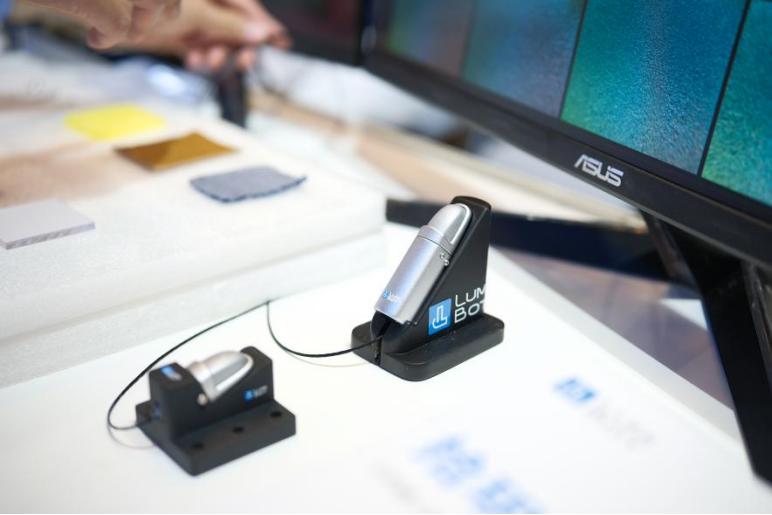
Lumi-Tac visuo-tactile sensor (Image source / Enterprise)
Wu Yuwen told Hard-Kr: "Visuo-tactile perception is recognized by academia as the future direction of dexterous hand perception. Its improvement on operation success rate is significantly better than other types of tactile sensors. It has an extremely high upper limit in the field of physical intelligence and will be the standard configuration of high-end dexterous hands in the future. We are a team that took the lead in independently developing dexterous hands and owning our own visuo-tactile solution."
On the hardware side, the company's self-developed Lumi-Mod micro motor module achieves high torque output in a compact volume. Aiming at the common industry problem of severe heat generation during long-time operation of dexterous hands, LumiBot has launched the world's first micro joint module with active heat dissipation, which can reduce the temperature by more than 50°C, increase the continuous no-load service life to more than 5000 hours, and take the lead in breaking through the engineering barrier that enables dexterous hands to support 24-hour continuous and stable industrial operation.
Wu Yuwen revealed that the difficulty of active heat dissipation lies in the extremely limited internal space of dexterous hands. The company achieved this breakthrough by changing the motor configuration to free up the space originally used for wiring harnesses and motors to create air ducts.
In terms of degree of freedom layout, the company adopts a differentiated strategy. The 11-degree-of-freedom dexterous hand is targeted at the mass market, has been produced in small batches, started sales last month, and is expected to generate annual revenue of 20 million to 30 million yuan, with shipments of 100 to 200 units.
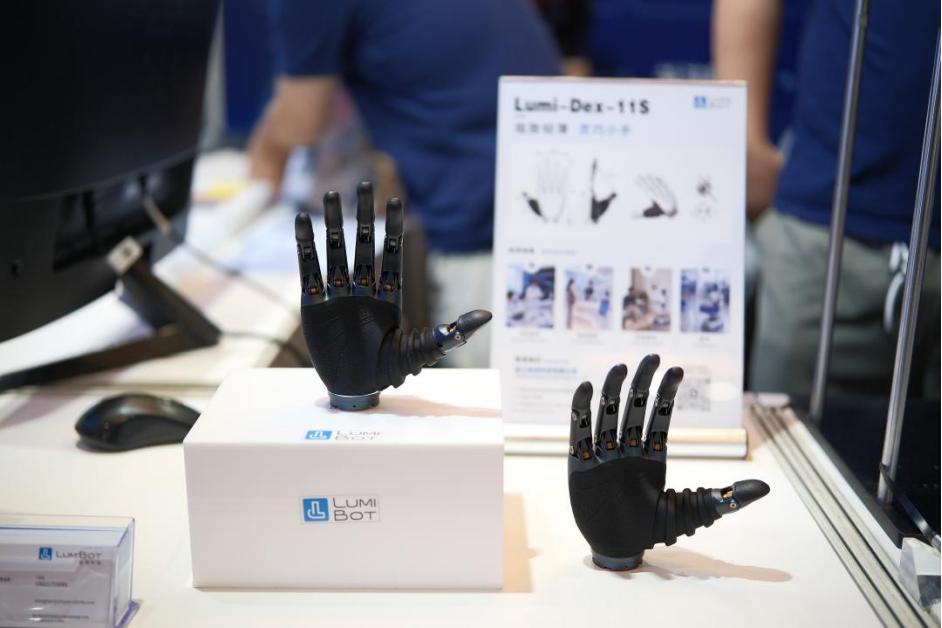
Lumi-Dex-11S dexterous hand (Image source / Enterprise)
The flagship product with 23 active degrees of freedom is oriented to high-end scenarios, and is divided into two technical routes: one is equipped with a hollow cup motor module and will be launched soon; the other is equipped with the world's first active heat dissipation solution and is expected to be released in October this year.
At present, LumiBot has chosen a dual-track parallel strategy of industrial scenarios and humanoid robot OEMs. The company has launched million-level orders with leading industrial customers to explore the collaborative application of dexterous hands and industrial robotic arms in scenarios such as spraying. In addition, cooperation with customers including China Unicom and Siyuan Electric is also advancing.
The following is an edited excerpt of the conversation between Hard-Kr and Wu Yuwen, founder of LumiBot:
Hard-Kr: What changes have taken place in your cognition after transitioning from an investor to an entrepreneur? How do you view the dexterous hand track?
Wu Yuwen: The biggest change is the understanding of "time" and "details". Investment focuses on trends, while entrepreneurship requires precision down to cash flow and yield.
Making a prototype of a dexterous hand does not mean it can be sold. After we completed the 11-degree-of-freedom prototype, we spent nearly half a year iterating to push the low-degree-of-freedom product to mass production. In terms of track judgment, I used to think that the degree of freedom was the most critical, but now I see that "durability" takes priority over "dexterity" in industrial scenarios. Factories are most concerned about "how many hours it can run continuously without breaking".
In addition, I used to think that humanoid robots would drive the development of dexterous hands, but in actual operation, the demand for industrial robotic arms equipped with dexterous hands is more certain and the willingness to pay is stronger. Industrial scenarios are the most solid fundamental market at present.
Hard-Kr: The company is promoting 23 active degrees of freedom while shipping 11-degree-of-freedom products in small batches. What is the consideration behind this?
Wu Yuwen: The core is the layered matching of technical barriers and market demands. The 11-degree-of-freedom product has controllable cost, is suitable for scenarios such as handling and sorting, and can quickly achieve volume shipments and verify the supply chain. 23 active degrees of freedom are close to the physical upper limit of the human hand. With each additional degree of freedom, the difficulty of integrated control and heat dissipation increases exponentially.
We have reduced the finger gap to less than 1.5mm through self-developed motor modules, and realized active heat dissipation without changing the external dimensions, which is a global first. The two lines are complementary: the 11-degree-of-freedom product achieves mass shipment, while the 23 active-degree-of-freedom product builds technical barriers.
Hard-Kr: Data is regarded as a key bottleneck for the implementation of dexterous hands. How do you solve this problem specifically?
Wu Yuwen: There is almost no public data for high-degree-of-freedom dexterous hands equipped with tactile perception. We are advancing on three paths: purchasing open-source simulation data for pre-training; self-developing visuo-tactile data gloves for teleoperation collection; using Ego video direct collection to allow workers to operate directly in the factory, and mapping the movements to the dexterous hand through motion retargeting, which can be deployed on a large scale at low cost. On the model side, we have self-developed the VTLA architecture with a "cerebrum-cerebellum" layered design, and the atomic skill library covers basic skills such as grasping, rotating, and alignment, which can be directly called.
The closed loop of "collection → training → deployment → feedback" is the biggest difference between us and pure hardware companies. Selling hardware is just an entry point, and continuously providing operational intelligence is the long-term value.
Investor's View:
Fund under a listed company: When investing in embodied intelligence, we value the team's ability to solve the underlying pain points of the industry. Now the industry is not short of hardware or algorithms, but lacks high-quality data assets. The lack of easy-to-use teleoperation equipment is the crux that leads to difficult data collection and low data quality. What attracts us most about LumiBot is its "hardware-software integrated" global perspective. Starting from the teleoperation equipment at the source, it not only makes up for the shortcomings of industry data collection, but also realizes a full-stack self-developed closed loop of "extreme hardware + high-quality data + cutting-edge models". This closed-loop capability gives LumiBot extremely high scarcity, and also allows us to see a feasible path for embodied intelligence to truly move towards scenario implementation.