Why is Kimi in a hurry to go public after K3?
From a 2.8-trillion-parameter model to $300 million ARR, this 300-person team has crafted a precise capital narrative in just five days: K3 serves as its technical bargaining chip, API revenue forms its commercial foundation, and the Hong Kong stock IPO acts as the final rivet to lock this narrative into the capital market.
In the early hours of July 16th, Moonshot AI dropped a technical bombshell.
Kimi K3 — the world's largest open-source model with 2.8 trillion parameters — was released without any prior announcement. On the Code Arena programming leaderboard, it claimed the top spot with a score of 1679, leaving Anthropic's Claude Fable 5 (1631 points) and OpenAI's GPT-5.6 Sol (1618 points) far behind. Across seven categories including front-end development, algorithms, and data structures, K3 took first place in six of them.
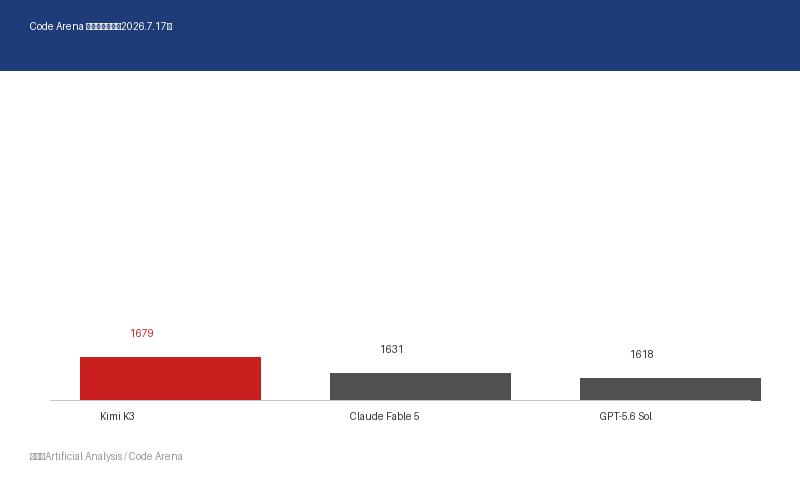
Source: Artificial Analysis / Code Arena
The market was caught completely off guard. Within 72 hours of K3's release, the U.S. stock AI sector lost approximately $4700 billion in market value, and the Philadelphia Semiconductor Index plummeted 12.5% in a single week, directly falling into a technical bear market. The Hong Kong stock market also suffered heavy losses — Zhipu (02513.HK) plunged 28.49% in a single day, while MiniMax dropped 15.62%. Elon Musk posted just one word on X: "Impressive." The official Kimi account responded succinctly: "Welcome to the 2 trillion+ club."
The show has only just begun.
Three days later, late at night on July 19th, Moonshot AI announced the suspension of new user registrations — its computing power infrastructure was overwhelmed by the massive surge in demand brought by K3. On the same day, according to reports from the Science and Technology Innovation Board Daily and National Business Daily, the company sent a listing proposal to investors, expecting to complete its Hong Kong stock IPO as soon as within 6 months. On July 21st, co-founder Huang Zhenxin held a media briefing to comprehensively address questions about K3 and the company's commercialization plans for the first time.
Three major events, all packed into five days. This is no coincidence.
K3 is the bargaining chip in Yang Zhilin's hand, $300 million ARR is the company's solid foundation, and the rush to go public stems from the fact that — on the path to proving that "Chinese large models can make money through APIs", Kimi has already succeeded, and an IPO is the only way to cement this success story in the capital market.
With cumulative financing exceeding 37 billion yuan (approximately $5 billion), the company is backed by top-tier institutions including HSG, Xiaohongshu, Alibaba, and Tencent. These funds gave Moonshot AI the resources to develop K3, but it also means that investor exit channels must be opened. No matter how much capital exists in the primary market, it must eventually flow back. Going public is not an optional choice — it is a necessary one.
01
What Makes K3 Stand Out? Pricing Power Matters More Than Parameter Scale
Let's start with the parameters. At 2.8 trillion, as the world's largest open-source model, this figure alone is striking enough.
But what Moonshot AI really wants to convey is not just "we are huge". The true ace up its sleeve is K3's architectural combination: the KDA hybrid linear attention mechanism paired with attention residuals, and an MoE architecture with 896 experts that only activates 16 during each inference run. This combined approach has a clear goal — to drive down costs through extreme sparsification while preserving model performance. The 1 million-token context window is no gimmick either; it meets the hard core business demand of enterprise clients for processing long documents, code repositories, and financial report analysis.
Programming capability is K3's sharpest competitive edge. Topping the Code Arena leaderboard with 1679 points not only outperforms Fable 5 and GPT-5.6 Sol, but also secures six first places across seven categories including front-end development. Dean W. Ball, Head of Strategy at OpenAI, made a thought-provoking comment: "K3 has excellent performance that cannot be achieved through distillation." The subtext of this statement is clear: this achievement is not copied from others, but developed independently.
However, K3's most impressive feature is not its benchmark scores, but its pricing strategy.
Input pricing at $3 per million tokens, output at $15 per million tokens — exactly the same as Anthropic's Sonnet 5. Kimi is no longer competing for market share solely on "cost-effectiveness"; it is beginning to claim "pricing power". What does this mean? It means K3's cost structure can already support this price point, and the market recognizes its value.
Moonshot AI calculated the numbers in its own technical documentation: K3's API cost is less than one-third of that of comparable top-tier U.S. models. Its decision to price at the same level as Sonnet 5 speaks volumes about its gross profit margin. This is not a price war — it is a profit war.
Of course, K3 is not without its weaknesses. On Artificial Analysis's general intelligence index, K3 scored 57, ranking third globally, behind Fable 5 (60 points) and GPT-5.6 Sol (59 points). There are still gaps in areas such as general reasoning and multimodal understanding. Huang Zhenxin did not avoid this point during the July 21st briefing — "We are very strong in programming, and our general capabilities are still catching up." This kind of honesty is itself a show of confidence.
On July 27th, K3's full model weights will be fully open-sourced. This will further amplify its ecosystem influence and put greater pricing pressure on closed-source competitors.
02
Suspending New Users: The Bittersweet Pain Behind Computing Power "Circuit Breaker"
Just 48 hours after K3's launch, the company's computing power infrastructure was overwhelmed. Late at night on July 19th, Moonshot AI made a counterintuitive decision: to suspend new user registrations.
"We would rather give up incremental revenue than compromise the experience of our paying customers." That is the core message of Huang Zhenxin's original statement. Hitting the brakes voluntarily at the peak of commercial momentum is an unusual move in the large model industry. Most companies would choose to expand capacity, add servers, and even sacrifice partial service quality to maintain growth. Moonshot AI took the opposite approach.
This decision sends two layers of underlying signals.
The first layer reflects the firmness of the company's product philosophy. Huang Zhenxin repeatedly emphasized "values" during the briefing — the experience of paying customers takes priority over growth from free users. This statement may sound abstract, but in the large model industry, free C-end users are the easiest growth metric to inflate through marketing, while API-paying customers represent real, tangible revenue. Moonshot AI chose the latter, demonstrating a clear understanding of its core user base.
The second layer reveals the real challenges of its computing power predicament. A 300-person team managing a 2.8-trillion-parameter model, while simultaneously supporting API calls from over 200 countries worldwide — this operational ratio is near the global limit. Overseas paying user numbers have surged 400%, and API revenue has grown by approximately 400% — the demand curve has steepened far faster than the pace of supply capacity expansion.
Suspending new registrations acts as a "circuit breaker" mechanism, protecting existing paying customers from service quality fluctuations. However, this bittersweet pain also exposes a deeper issue: if computing power remains a persistent bottleneck, what is the ceiling for the company's growth?
For large model companies, computing power is not just a cost issue — it is a strategic issue. Training requires GPUs, and inference requires even more. K3's sparse architecture has indeed reduced some inference costs, but as user scale grows exponentially, these cost savings will quickly be offset by increased operational volume. Moonshot AI needs to resolve this issue before going public, otherwise the figures on its quarterly financial reports will not look favorable.
03
$300 Million ARR: The Inflection Point for Chinese Large Model Commercialization Has Arrived
If K3 represents the technical story, ARR represents the commercial story. And the latter is exactly what the capital market truly wants to hear.
Moonshot AI's ARR growth curve is impressive even by global AI industry standards: it exceeded $100 million in March 2026, surpassed $200 million in May, and hit $300 million in mid-June. Tripling in three months is not linear growth — it is an inflection-point explosion.
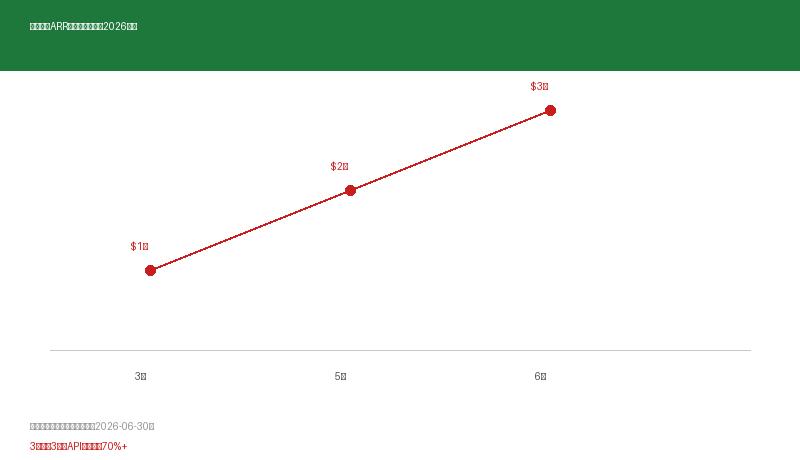
Source: Shanghai Securities News, Wall Street CN (2026-06-30)
What matters even more is the revenue structure. API revenue accounts for over 70% of total revenue. What does this mean? It means Kimi is not burning money to inflate C-end user metrics — enterprise customers are voting with real money. Developers, startups, and large corporations have integrated Kimi's APIs into their own products and services, generating genuine call volumes and willingness to pay.
Overseas data is even more noteworthy. Overseas paying users have grown 400%, API revenue has increased by approximately 400%, and its services cover more than 200 countries. In the 20 days following the release of K2.5, revenue exceeded the total for the entire year of 2025. Moonshot AI is evolving from a Chinese company into a global company, and its internationalization is not marketing-driven — it is product-driven: developers can tell immediately if an API works well once they try it.
This path is highly similar to Anthropic's. From the very beginning, Claude bet heavily on APIs and enterprise customers, taking a relatively restrained approach to C-end products. As a result, Anthropic achieved approximately $1 billion ARR by the end of 2024, with a valuation of around $180 billion. Moonshot AI's current ARR is roughly one-third of Anthropic's at the same stage, but its valuation has already reached $31.5 billion — 1.75 times Anthropic's valuation at that time.
The capital market is assigning a premium to Moonshot AI. The underlying logic of this premium is: if Kimi can prove that the "API-first" model can succeed in China too, then it is not just a follower of Anthropic, but a leader in a parallel track.
K3's pricing strategy further validates this judgment. Matching Sonnet 5's price point indicates that Kimi's target customers are global developers, not just the Chinese market. It is targeting the market share of Anthropic and OpenAI, rather than engaging in price wars with domestic competitors.
The transformation from "financing-driven" to "product-driven" is of profound significance for a Chinese large model company. Previously, all Chinese AI startups essentially told the same story — "I can build a Chinese version of ChatGPT". Now Kimi is telling a different story — "I can build an API that global developers are willing to pay for". These two stories have completely different valuation models.
A detail worth considering: K3's API pricing is exactly the same as Sonnet 5's, but its cost is less than one-third of the latter's. This means Moonshot AI holds enormous room for price cuts — if market competition intensifies, it can reduce prices to seize market share while still maintaining healthy gross margins. If it maintains current prices, every additional API call will directly increase profits. This flexible pricing power, which allows both offense and defense, is the moat that the capital market values most.
04
Rushing to Go Public: Timing, Valuation, and Hidden Concerns
So why now?
Three windows of opportunity have opened simultaneously, and they will not come again. First, the ARR inflection point — $300 million ARR is a psychological threshold that the capital market views as a signal that "the business model has been fully validated". Second, the K3 release — 2.8 trillion parameters plus topping the Code Arena leaderboard has given Moonshot AI its strongest technical narrative in nearly a year. Third, reference precedents from competitors — Zhipu listed on the Hong Kong Stock Exchange in January 2026, MiniMax has also gone public, and Hong Kong Stock Exchange Chapter 18C provides a fast track for technology companies, with established precedents already set.
According to reports from the Science and Technology Innovation Board Daily and National Business Daily, Moonshot AI sent a listing proposal to investors on July 19th, expecting to complete its Hong Kong stock IPO as soon as within 6 months. The company is in the process of dismantling its VIE and red-chip structures, and has maintained close communication with investment banks including China International Capital Corporation and Goldman Sachs. Moonshot AI has not issued any public response so far — a standard practice during the quiet period before an IPO.
The valuation curve provides another perspective. At $4.3 billion at the end of 2025, $10 billion in February 2026, $20 billion in May, and $31.5 billion in July — its valuation has increased 6 times in half a year. Capital is pouring in to grab shares, but the capacity of the primary market is limited. After reaching $31.5 billion, who will be the next buyer in the next round of financing? Instead of continuing to tell stories in the primary market, it is better to bring that story to the open market in Hong Kong.
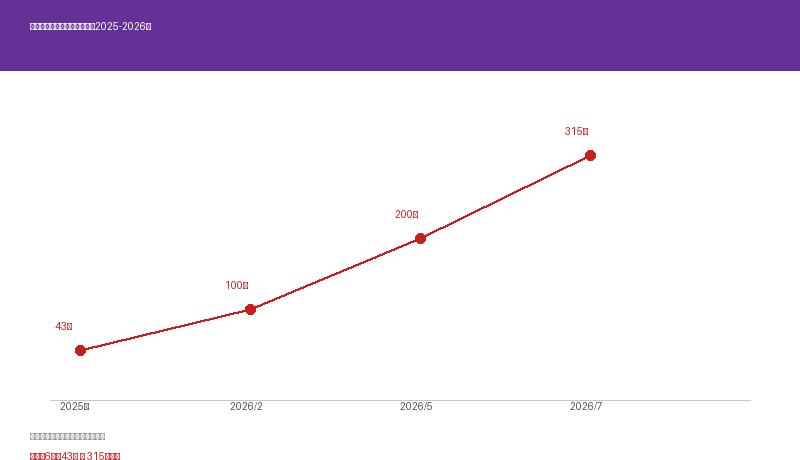
Source: Science and Technology Innovation Board Daily, National Business Daily
Hong Kong Stock Exchange Chapter 18C is a tailor-made listing channel. Introduced in 2023, these listing rules allow unprofitable technology companies to go public at a lower threshold, specifically opening a green light for "hard technology" enterprises. Zhipu has already successfully navigated this path, and MiniMax has followed suit. Moonshot AI does not need to pave the way from scratch — it only needs to follow the established route.
But what happens after going public? Several hidden concerns cannot be ignored.
A 300-person team. This size is lean for an AI startup, but will 300 people be enough to handle the quarterly financial reporting pressure, compliance requirements, and investor relations management that come after an IPO? Anthropic had more than 1000 people at the same stage, and OpenAI has more than 5000. Moonshot AI has achieved nearly half of its competitors' ARR with one-third of their workforce, which is an efficiency advantage — but it also carries management risks.
The computing power bottleneck is already objectively restricting growth. Suspending new user registrations is only a symptom; the root cause is that supply cannot keep up with demand. After going public, every quarter's revenue growth will be scrutinized under a magnifying glass. If the speed of computing power expansion lags behind, the stock price will react immediately.
The double-edged sword effect of the open-source model. Fully open-sourcing K3's model weights is beneficial for ecosystem expansion, but it also poses challenges to commercialization. Enterprise customers can directly download and deploy the model themselves — why would they still pay for your API? Moonshot AI needs to find a sustainable balance between "open ecosystem" and "commercial monetization".
There is also a less encouraging reference case: after Zhipu's Hong Kong stock listing, its share price fell sharply from its peak of HK$2980. The market's enthusiasm for AI concept stocks is limited, and once performance falls short of expectations, valuations will be cut without mercy.
The deeper competitive landscape is also changing. Anthropic's latest valuation is $965 billion, and OpenAI