AI smartphones are starting to revolutionize themselves.
The inaugural year of agentic smartphones has truly arrived.
From July 17 to 20, 2026 World Artificial Intelligence Conference (WAIC 2026) was held in Shanghai. Large language models stepped down from the spotlight, making way for a full-scale carnival of AI hardware.
Apart from a range of new products such as AI glasses, humanoid robots, and AI earphones, smartphones have also "sprouted new shoots from old branches". Three players — Honor, Nubia, and Stepverse — unveiled their respective "agentic smartphones" almost simultaneously.
If last year's WAIC saw attendees debating which model was more powerful, this year exhibitors are more eager to answer one question: What can AI do? The answer is becoming increasingly clear — AI will permeate every device closest to people.
As the most frequently used smart terminal, smartphones are destined to be transformed by AI.
Yet after three years of hype around AI phones, the results remain underwhelming: The first-generation Doubao AI phone was blocked by multiple apps; Apple Intelligence for Chinese mainland users arrived belatedly; Honor, OPPO, and vivo currently only offer limited smart features...
Can AI phones truly move beyond the simplistic intelligence of voice assistants? This year's WAIC may have the answer.
The Agentic Smartphone Wave Arrives
At the WAIC 2026 venue, three different exhibition booths showcased their respective "world's first" agentic smartphones.
Honor brought the world's first robotic phone, the Robot Phone; ZTE's mobile brand Nubia, in collaboration with ByteDance, launched the Nubia NaviX Ultra — the world's first AI agentic smartphone equipped with the Doubao Mobile Assistant;
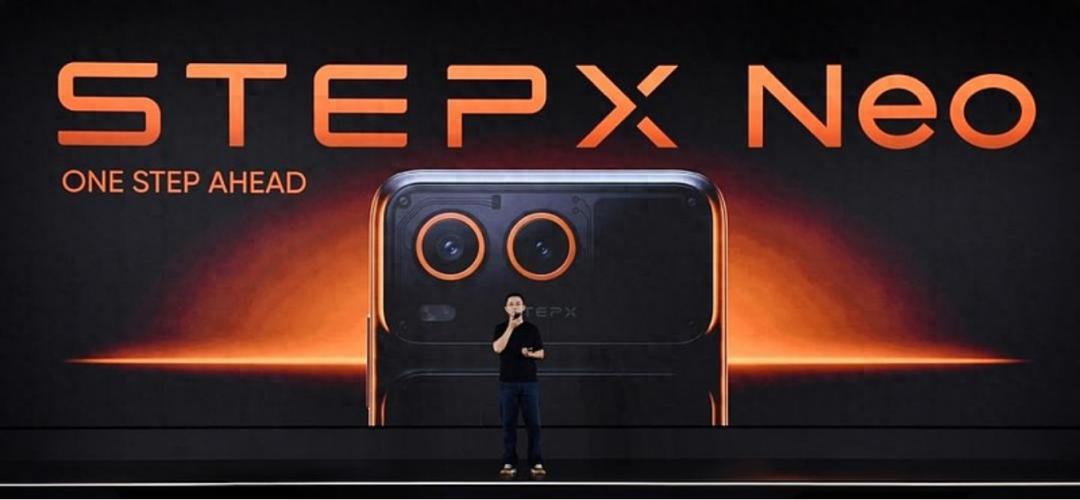
While Stepverse launched STEPX, a large model-native AI terminal brand, the agentic-native operating system Step AOS, the personal agent Amoo, and the world's first large model-native agentic smartphone STEPX Neo.
Three manufacturers from different fields, three products claiming to be the "world's first" agentic smartphone — this in itself demonstrates that there is no universally recognized standard in this track. Everyone can redefine what "first" means, precisely because no one has truly cracked the market yet.
Honor, Doubao, and Stepverse indeed have different strategies.
Doubao collaborated with ZTE's Nubia at the end of last year to release the Nubia M153, also known as the first-generation Doubao AI phone.
Its biggest selling point was bypassing apps entirely by embedding the Doubao large model directly into the Android underlying layer, allowing the agent to autonomously operate the graphical user interface (GUI). In simple terms, this meant the AI simulated human visual recognition and simulated touch to operate apps.
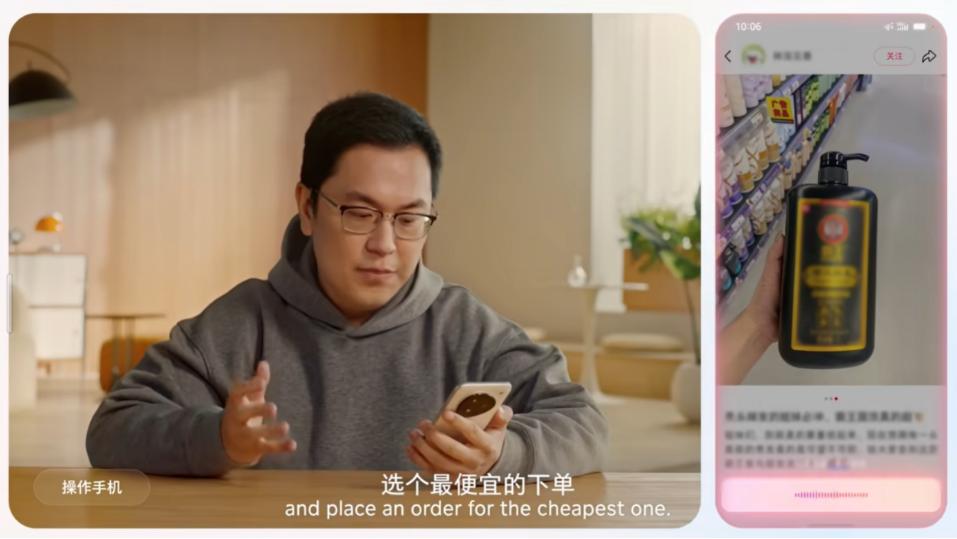
Yet only a week after launch, the first-generation Doubao AI phone faced collective "blocking" from mainstream apps like WeChat, Alipay, and Meituan. Data security, user understanding, and traffic entry points are all capabilities that these apps are unwilling to cede.
As a result, the second-generation Doubao AI phone adopted a new approach: the GUI Agent is only responsible for ordinary apps that have not been adapted, while mainstream apps such as payment and social apps open partial data through A2A or MCP standard interfaces, allowing different agents to directly control them.
Stepverse took a different path. Instead of embedding a smart assistant into the operating system, it added a dedicated execution layer on top of the Android foundation, reconstructing the underlying framework from scratch to build Step AOS — natively adapted for agent operation.
YIN Qi, Chairman of Stepverse, explained, "If you open a door for an agent on an old system, it will always be a guest. Only by building a dedicated execution environment for the agent can it become a true native resident."
In his view, simply adding AI features to an old system cannot solve the fundamental problem. Agents should be elevated to a system-level status close to the user, reorganizing these scattered capabilities.
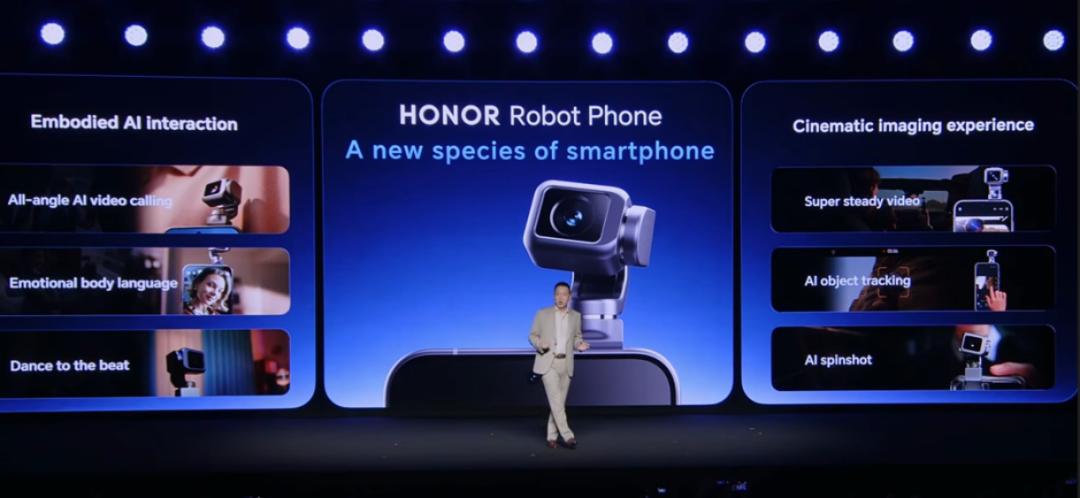
Honor not only equipped its phone with a "brain" but also added "hands". It launched the Robot Phone, alongside the industry's first partner-type multimodal agentic operating system, Agentic OS.
Dr. HUANG Fei, Chief AI Scientist of Honor, stated that the essence of Agentic OS is not "adding an AI assistant to the system", but reconstructing a new operating system centered on "intent" and "tasks".
Unlike the approaches of the other two companies, Honor's Robot Phone features a 4-DOF gimbal with multimodal perception capabilities, extending the agent's interaction scope into the physical world.
The three manufacturers have distinct moves: Doubao excels in models and user ecosystems, Stepverse in model capabilities and system reconstruction, while Honor focuses on hardware engineering and system-level integration.
Yet they all converge on the same path — reconstructing the underlying operating system. This is the inevitable route for traditional smartphones to evolve into AI smartphones, as their operational logics are fundamentally different.
The logic of traditional operating systems is "people operate apps", so even though incumbents stuff AI features into their systems, apps still operate in silos. Users must jump between operations to complete complex tasks, and the phone has not truly "learned to think".
The logic of agentic operating systems, however, is to reconstruct the entire OS, using one central brain to mobilize the device's data and capabilities. Users do not need to specify detailed operations — they only need to state their goals, and the agent will decide which resources to access and automatically complete the task.
Three manufacturers, three routes — essentially reshaping the intelligent experience of AI phones at different levels.
Can They Avoid the Previous "Pitfalls"?
It is evident that the next generation of AI phones will no longer compete on who has the smarter model, but on who can truly define the next-generation operating system, using one "brain" to command the entire device.
In June this year, at the OpenAI Voice Hack Night event, a team demonstrated an "Agentic Operating System" designed for mobile phones. It breaks the traditional app ecosystem, eliminating the need to call any conventional apps, with all interfaces generated instantly.
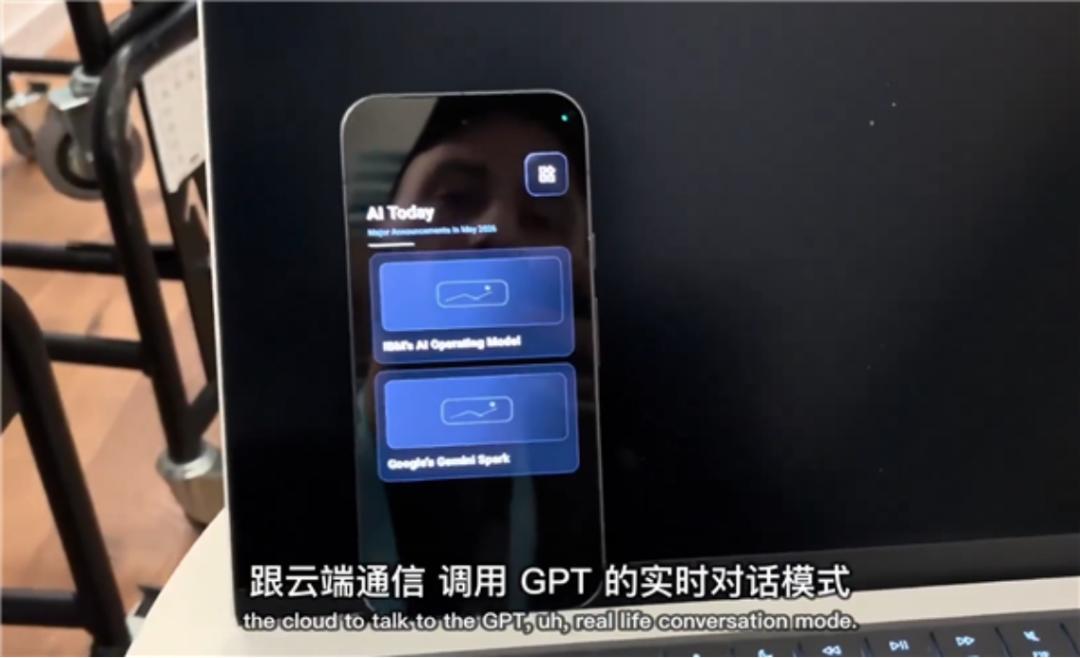
Daring to imagine, this could well be another form of future AI phones — yet this vision is destined not to be achieved overnight.
The first and most intractable problem is the ecosystem game.
After the first-generation Doubao AI phone hit a wall, this round of agentic phones has learned its lesson. They generally adopt an alliance model to cooperate with app vendors, no longer attempting to bypass apps to obtain operational permissions.
For example, Stepverse's first batch of ecosystem partners includes Alipay, Meituan, Didi, and Amap. However, the most market-relevant platforms — WeChat, Taobao, and Douyin — are not on the list.
This reflects a side reality: although app vendors have opened up permissions, the challenge of benefit distribution remains unresolved. Questions like how to distribute transaction commissions generated through agents, or who owns users guided by agents, are still up in the air.
More importantly, leading app vendors are unwilling to step back into the background. The more dominant the vendor, the more they want to hold user intent firmly in their hands. Take WeChat as an example: it has already cooperated with system agents like Huawei's Xiaoyi and Xiaomi's Xiaoai through the A2A mechanism, but with limited open permissions — temporarily not enabling access to WeChat Pay, mini-programs, or Moments.
The vision of an agentic operating system that can "command all apps with one sentence" remains a blueprint. There is still a long way to go before achieving true ecosystem win-win cooperation.
The second problem lies in the phone's model capabilities and on-device computing power.
What Doubao and Stepverse are trying to do is something that phone manufacturers have long aspired to achieve. However, constrained by the insufficient stability of on-device computing power and model capabilities in previous years, the AI capabilities of phone manufacturers have long been limited to simple functions like photo editing, audio recording, and translation.
Now, however, the timing may be more favorable.
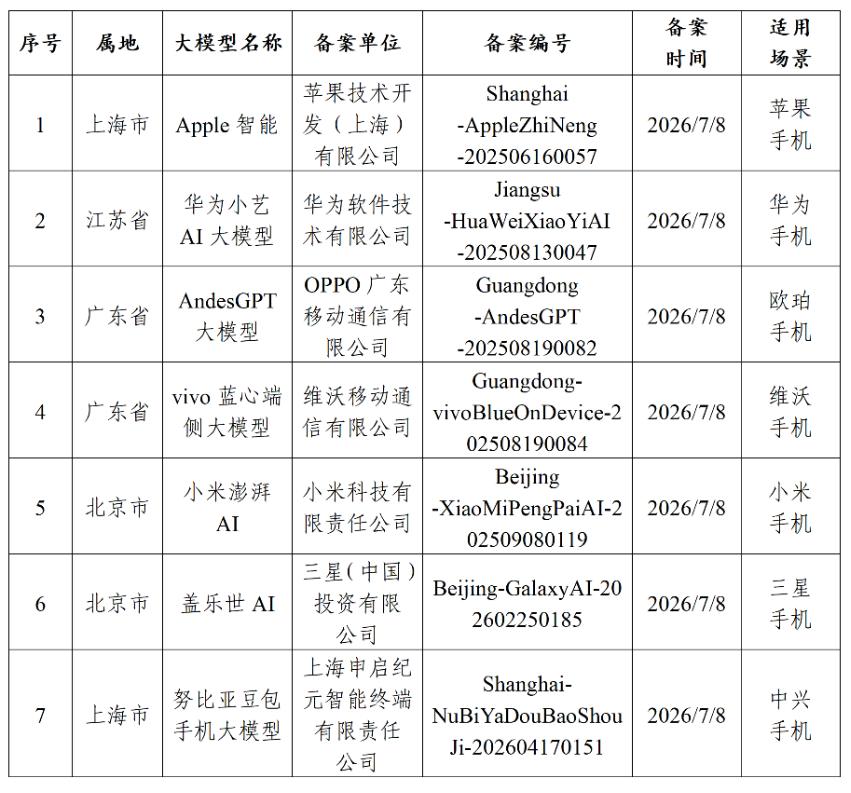
Recently, seven on-device generative AI services for mobile phones — including Apple Intelligence, Huawei Xiaoyi, and Nubia Doubao Mobile Large Model — completed filing. This signifies that on-device mobile models have moved from conference concepts to compliant implementation stages.
Thus, Apple has partnered with Qwen and Baidu, while negotiating with Silicon Valley startup PrismML — which can compress an approximately 54GB raw model to under 4GB, directly elevating the task magnitude that on-device models can handle by several levels.
Vivo's self-developed 30B parameter on-device large model requires only 2GB of RAM, enabling full local deployment; MiniCPM5 from MindOS, after quantization, occupies only 0.5GB of storage space and is confirmed to be equipped on Samsung devices.
In the past, the tasks that various phone manufacturers' on-device models could handle were quite limited. But as smarter, lighter, and more efficient on-device models become a reality, the "brain" inside the phone finally has the chance to truly operate at full capacity.
Accordingly, the third problem circles back to hardware.
When major AI phone manufacturers no longer compete on model parameters, but on model efficiency — on who can maximize the model's capabilities within limited physical space — the hardware requirements for AI phones will comprehensively upgrade.
On-device AI needs to adapt to NPU, CPU, and GPU, while also managing thermal control, battery life, memory, and system permissions. With chip power consumption constraints, balancing the demands for slimness and heat dissipation is inherently a complex hardware engineering challenge.
It is clear that this agentic smartphone competition will be a marathon of system capabilities. Only by crossing the hurdles of ecosystem, model, and hardware can manufacturers truly stride across the "watershed" separating traditional smartphones from AI phones.
Who Will Control the Next-Generation "Entry Point"?
So, who stands the best chance of finishing the full race first and seizing the entry point of next-generation smart terminals?
The agentic smartphones at the WAIC exhibition have indeed delivered many eye-catching performances:
For instance, according to the Doubao Mobile Assistant community, the second-generation Doubao AI phone has improved intent recognition accuracy, can memorize favorited content across various apps, and the longer you use it, the better Doubao Mobile understands you; it also supports simultaneous multi-task submission.
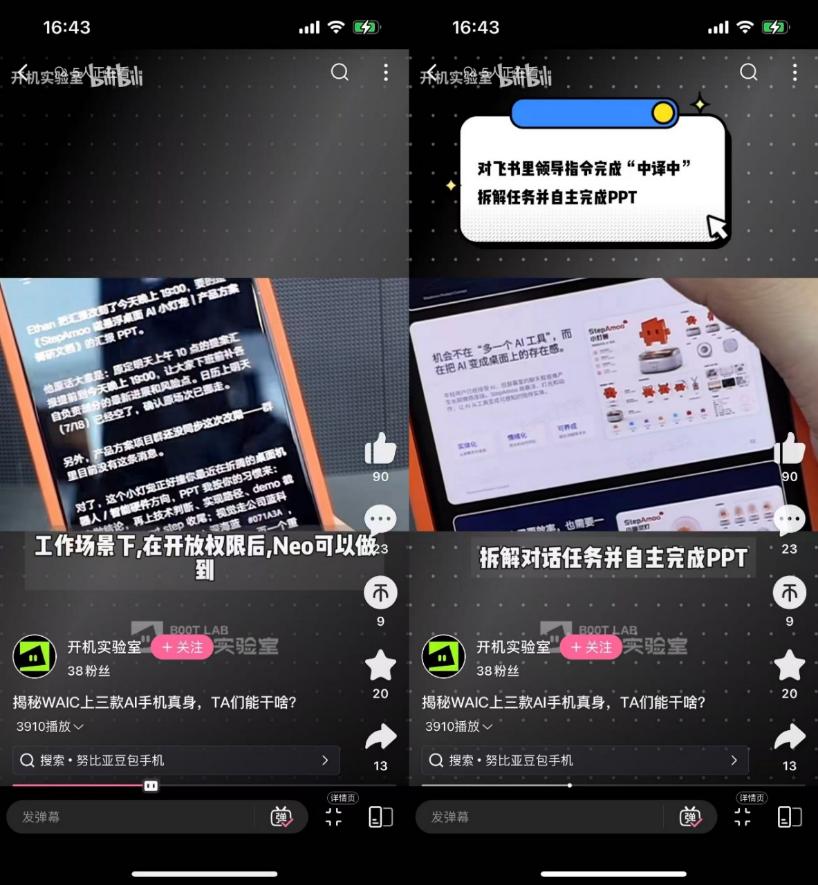
According to Bilibili blogger "Startup Lab" who tested devices on-site at the exhibition, the Stepverse STEPX Neo can generate PPTs directly on the phone; Honor's Robot Phone's mechanical gimbal can move smoothly, automatically tracking shooting subjects and adjusting posture based on user gestures.
Yet it seems premature to claim that anyone has successfully defined the "next-generation terminal".
Possessing software, hardware, and ecosystem capabilities only means that manufacturers can build an agentic smartphone that can not only "work" but "work well". Whether consumers are willing to embrace it, and whether its business model is sustainable, still requires long-term verification.
First and foremost are security and privacy. When an agent can operate across apps, establishing a trusted boundary in sensitive scenarios like payments — so users dare to entrust their wallets to an "agent" — will be a trust issue more difficult to solve than technical challenges.
Additionally, while AI technology allows more diverse players to step forward and define the next-generation terminals themselves, large model enterprises that have never actually manufactured phones still face doubts over whether their product experience can meet standards.
Finally, in the past, consumers only needed to pay for the smartphone hardware. But when every task execution may consume tokens that users need to pay for, whether their willingness to pay can support a new business ecosystem remains uncertain.
There is also a deeper question: Is the agentic smartphone necessarily the final form of the future?
YIN Qi, Chairman of Stepverse, once stated that future agentic smartphones may no longer be phones at all. LI Jian, CEO of Honor, also believes that AI will evolve from operating systems to embodied interactions, reconstructing the relationship between humans and the physical world.
From this perspective, as long as the next-generation smart terminal can enable agents to act as human proxies, its form — whether earphones, glasses, watches, or some yet-unnamed format — is entirely open to possibility.
Forms will change, carriers will be replaced. What ultimately defines next-generation smart terminals will still be how the "brain" operates. It must master top-tier large model capabilities and on-device deployment capabilities, have profound software and hardware engineering experience, and hold greater sway over the application ecosystem.
The final winner has not yet emerged, but the path toward the future is becoming increasingly clear.
This article is from WeChat Official Account "Bohu Finance", written by Kai Kai, and published by 36Kr with authorization.