Messi invested in Fei-Fei Li
"Stories and legends all belong to him."
In the just-concluded final of the FIFA World Cup 2026, Spain defeated Argentina to lift the FIFA World Cup Trophy. 39-year-old Lionel Messi broke down in tears on the pitch, which might be the final match of his World Cup career.
Few people noticed that Messi had long been paving the way for the second half of his life. It turns out that he has become a VC — in 2022, he joined forces with a group of top VC figures to found a venture capital firm Play Time in Silicon Valley, USA. Opening the official website of Play Time, it is clear to see that the firm has recently invested in World Labs, a company founded by "AI godmother" Li Feifei.
The twilight of the football gods has come, and the era of the football king is fading. After countless twists and turns, now we meet Messi — the "tech investor".
It turns out that Messi has invested in Li Feifei's company
Unexpectedly, Messi has also become a peer in the VC industry.
The story dates back to 2022. In October of that year, on the eve of the Qatar World Cup, Messi founded an investment firm called Play Time in San Francisco. Its slogan points out the core direction — "At the intersection of sports&technology". The firm's first fund is about 200 million US dollars, targeting global sectors including sports and technology.
Messi Group released a statement at that time: Play Time's investment targets cover start-ups at all stages. It will also help founders build football technology companies or invest in sports teams, and consider taking equity stakes in sports teams to invest in "football technology".
Messi is serious about making investments. His partner is Razmig Hovaghimian, a figure with both entrepreneurial experience and in-depth VC expertise. He previously sold his self-built video streaming website Viki to Rakuten for approximately 200 million US dollars, and later became a partner of Graph Ventures, an early-stage venture capital fund in Silicon Valley. Another special advisor, Michael Marquez, is also a well-known figure in Silicon Valley's VC circle.
According to Pitchbook data, Play Time has made 10 investments since the end of 2022. Its early investments include the football game platform Matchday and the football collectibles platform AC Momento, while almost all of its remaining investments are related to AI.
The most notable move is Messi's investment in World Labs founded by Li Feifei. In February this year, World Labs completed a new round of 1 billion US dollars financing, pushing its valuation to 5 billion US dollars. The investor list includes giants such as NVIDIA and AMD, and Messi's Play Time is prominently listed among them.
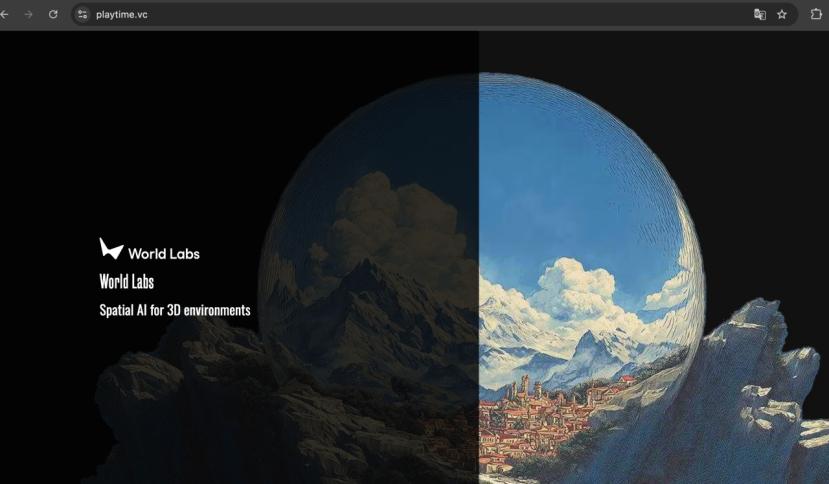
Securing a spot in this round of financing means, to some extent, that Messi's investment platform has further penetrated into the core circle of Silicon Valley's technology industry.
The official website of Play Time also lists a series of technology companies: AI data platform SuperAnnotate, 3D visualization tool Intangible, physical world foundation model Perceptron, robot developer Field AI, voice AI generation service Fish Audio... Among them, Field AI is backed by NVIDIA, Bill Gates and Jeff Bezos.
It can be seen that Play Time's investment path has covered two cutting-edge tracks: AI underlying tools and physical robots, breaking the stereotype that cross-border investments by sports stars only focus on real estate, catering and streetwear brands.
The victories and defeats on the green pitch will eventually come to an end, but the competition in the technology industry has only just begun. In the past, people knew Messi as a legendary football king recorded in history; perhaps in the future, people will gradually get familiar with his another identity: the "Boss Messi" as an AI investor.
Farewell to the World Cup, the past of the football king
The reason why Messi can become today's "Boss Messi" traces back to the young boy in Rosario.
In 1987, Messi was born into an ordinary family in Argentina, and he showed his talent in playing football at a very young age. At the age of 13, his father took him to Barcelona for a trial training. At that time, he was only 1.4 meters tall, much shorter than his peers — he was diagnosed with growth hormone deficiency at the age of 11, and the family could no longer afford the nearly 1,000 US dollars monthly treatment cost.
But the thin and small Messi amazed everyone during the trial training. The senior director of the first team of Barcelona signed him immediately on a piece of tissue paper, and promised to cover all his treatment expenses. In 2004, Messi officially signed his first professional contract with Barcelona, and made his debut for the first team in the same year.
At that time, someone asked Messi about his future goals, and he said: "First, get into the Argentina national team, then win a World Cup."
Also in that year, Messi was called up to the Argentina national team to participate in the South American Youth Championship. The 17-year-old Messi was full of anticipation: "I just want to play for Argentina, because I love Argentina, and I just want to feel that blue and white." In 2005, he was officially promoted to the senior national team.
Everyone knows the rest of the story. At the 2022 Qatar World Cup, Messi led Argentina to lift the FIFA World Cup Trophy, leaving a legendary story recorded in history.
The outside world generally speculated that it would be Messi's last World Cup. But at the 2026 FIFA World Cup, 39-year-old Messi still showed up — he led Argentina all the way to the final, delivering an outstanding record of 8 goals and 4 assists, setting many unrepeatable records. However, Argentina eventually lost 0-1 to Spain and failed to defend its title.
Even so, with 8 Ballon d'Or awards, 4 UEFA Champions League titles, 10 La Liga titles, 1 World Cup trophy and 2 Copa América titles, Messi has won almost all the honors a football player can get, and has become the "greatest football player" in the hearts of countless people.
"It's very painful, this wound is very difficult to heal. But I will also remember all the good things, and those matches where we fought with all our strength to achieve a comeback will stay in my memory forever." The day after the final, Messi updated his social media account. Perhaps in the future, there will be no more Messi in the World Cup.
Stepping off the pitch, they step into the venture capital circle
Leaving the stadium, the next battle has already begun.
According to Forbes' data in June, Messi's personal net worth has exceeded 1.1 billion US dollars (more than 7 billion RMB), with an annual total income of up to 140 million US dollars. Looking back many years later, this transformation from the football pitch to Silicon Valley may become another story in Messi's life that is worth talking about repeatedly.
Messi's transformation is not an isolated case. NBA star Andre Iguodala once said: "When I first entered the NBA, everyone was talking about luxury cars and brand-name clothes, but now everyone is discussing which technology company has invested in by whom."
Nowadays, this sentence is more and more like a footnote of the era in the sports industry — a group of top athletes actively knock on the door of the VC circle in the middle and late stages of their professional careers.
Cristiano Ronaldo, known as the "King of the Champions League", is a very typical example. At the end of last year, he took an equity stake in AI search company Perplexity AI. This young company, founded in August 2022, is committed to surpassing Google with AI search, and its valuation has exceeded 20 billion US dollars. Over the years, Ronaldo has also invested in health platform HBL, sports micropayment platform ZujuPay, media company Cofina, CR7 Hotels, and holds shares in start-ups such as personalized supplement company Bioniq and wearable technology company WHOOP, maintaining a very active investment status.
Shaquille O'Neal, the legendary NBA center, bet on Google in his early years, and later joined alternative investment firm Jacmel Partners as a founding partner, whose platform focuses on investing in sectors such as transportation, energy and digital industries.
This list is still growing: Giannis Antetokounmpo founded the venture capital firm BYL Ventures; former F1 world champion Nico Rosberg raised 100 million US dollars to set up his own VC fund; tennis star Novak Djokovic joined General Atlantic as a global strategic advisor; the retired Gareth Bale also joined a sports investment platform.
Turning our sight back to China, there are also many sports champions in the Chinese VC circle. Li Ning partnered with PE institutions to set up a fund, investing in overseas sports and consumer brands; Yao Ming joined forces with professional investors to establish Yao Capital, which focuses on the sports industry; Yi Jianlian once directly invested in companies such as 52TOYS.
In the past, after retiring, athletes would either become coaches, work as commentators, or open restaurants. Now, they try to expand their business territories beyond the pitch through equity investment.
But investing is never an easy thing. The returns of venture capital are often accompanied by risks, and failures are common especially in fields that they are not familiar with. Although star athletes hold a large amount of wealth, cross-border investment without professional background is not easy in the era of hard technology investment.
Yi Jianlian's investment approach provides a reference. In addition to direct investment, he also entrusts part of his capital to professional investment institutions for management, becoming an LP. This may be closer to the essence of investment than judging by himself whether a technology project is worth betting on.
After all, it is difficult for people to make money beyond the scope of their own cognition.
This article is from the WeChat official account "PE Daily" (ID: pedaily2012), written by Zhou Jiali, and authorized for release by 36Kr.