Report on China's Education Industry Financing Trends in the First Half of 2026: Where Has All the Capital in the Venture Capital Circle Gone?
Introduction
In the first half of 2026, the investment and financing landscape in China's education industry presents distinct characteristics of "overall contraction, early-stage dominance, and small-scattered distribution". According to statistics, a total of 16 financing events occurred in the first half of the year, of which 12 disclosed the financing amount, with a total countable financing sum reaching 121 million yuan. Compared with the first half of 2025, the number of financing events decreased by 33.3%, and the countable financing amount dropped by 89.6%, with both figures hitting the lowest level in the past six years. There were 13 angel round deals, accounting for 81.3% of all events; vocational education ranked first with 7 events; 7 projects explicitly mentioned "AI" in their names or business descriptions, distributed across multiple sectors including vocational education, edtech, educational enterprise services, and early childhood education. Heiban Insight has sorted out the disclosed investment and financing data of the education industry in H1 2026, and combined with the data from the same period between 2021 and 2025, attempts to observe the new trends of education financing in this period from the perspectives of long-term trends, monthly distribution, financing rounds, geographical distribution, and segmented tracks.
Note: As per convention, events with undisclosed financing amounts are not counted in the total sum. For statistical convenience, we calculate the amounts by taking midpoint values: several million yuan in financing is calculated as 3 million yuan; tens of millions yuan in financing is calculated as 30 million yuan; additionally, for conservatism, financing close to 10 million yuan is calculated as 6 million yuan, while financing close to 10 million US dollars is calculated as 6 million US dollars (equivalent to 36 million yuan); the 10-million-yuan level refers to exactly 10 million yuan; near 100 million yuan refers to 60 million yuan; over 100 million yuan refers to 100 million yuan. Attachment: The financing time is calculated based on the media disclosure date.
01. Statistics of Education Industry Financing Events and Amounts in the Past 6 Years: Significant Contraction in 2026 Financing
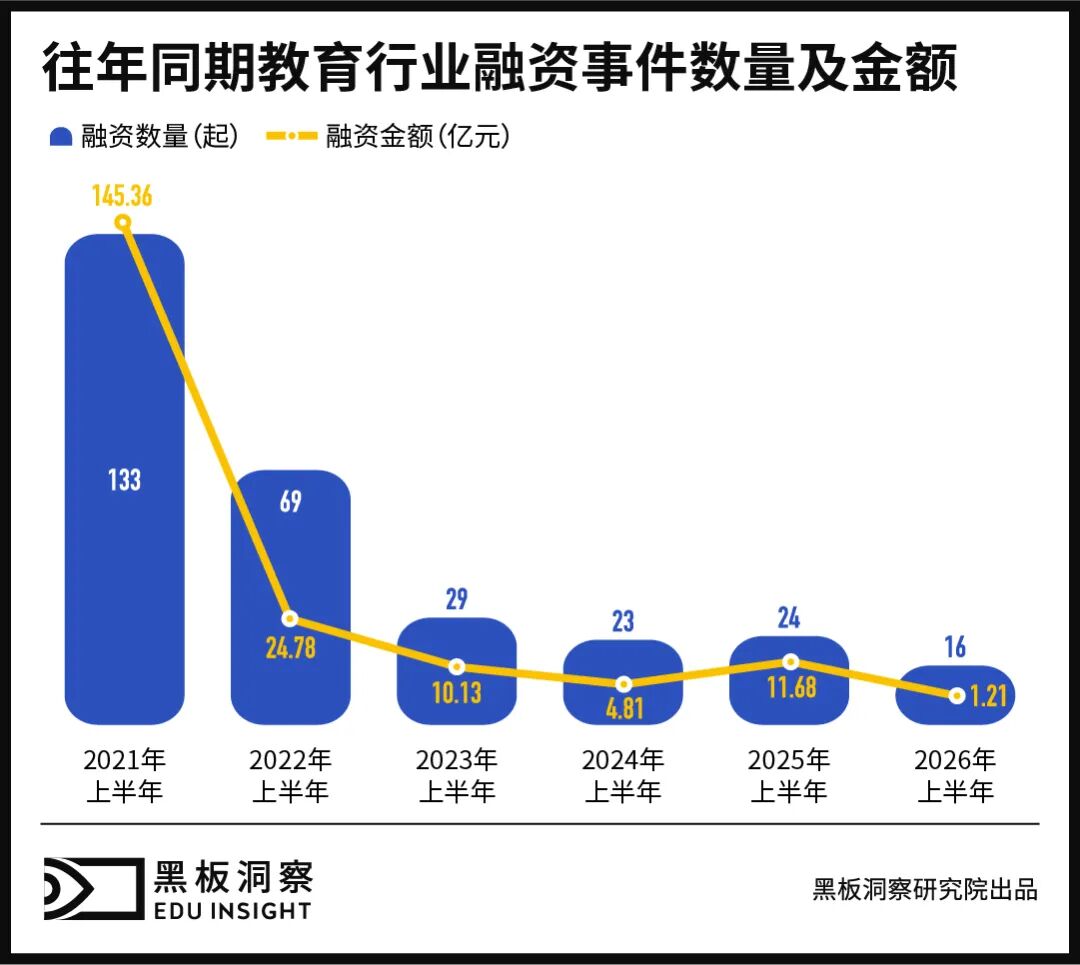
Over the past six years, the overall H1 financing in the education industry has shown a clear downward trend. The number of financing events dropped from 133 in H1 2021 to 23 in H1 2024, and the financing amount decreased from 14.536 billion yuan to 481 million yuan; in 2025, the number of events rebounded slightly to 24, and the financing amount rose to 1.168 billion yuan, showing a partial recovery of "stable volume and rising amount" for a period.
Entering 2026, the aforementioned recovery did not continue: the number of H1 financing events dropped to 16, a year-on-year decrease of 33.3%; the countable financing amount fell to 121 million yuan, a year-on-year decline of 89.6%, with both indicators hitting the lowest level in the past six years. Compared with H1 2021, the total number of events decreased by 88.0%, and the total financing amount dropped by 99.2%. This means that education industry financing is not only lacking large-scale projects, but project activity has further shrunk, and capital strategies have shifted from limited recovery back to "low frequency, early-stage, cautious trial investment".
In terms of financing scale in this period, there are 6 events at the million-yuan level and 6 at the ten-million-yuan level respectively, zero events exceeding 100 million yuan, and 4 additional events with undisclosed amounts. The average financing amount of the 12 disclosed projects is about 10.08 million yuan, with a median of 9.5 million yuan, and the financing scale of most disclosed projects is concentrated around the 10-million-yuan mark.
02. Overview of Monthly Education Industry Financing in H1 2026
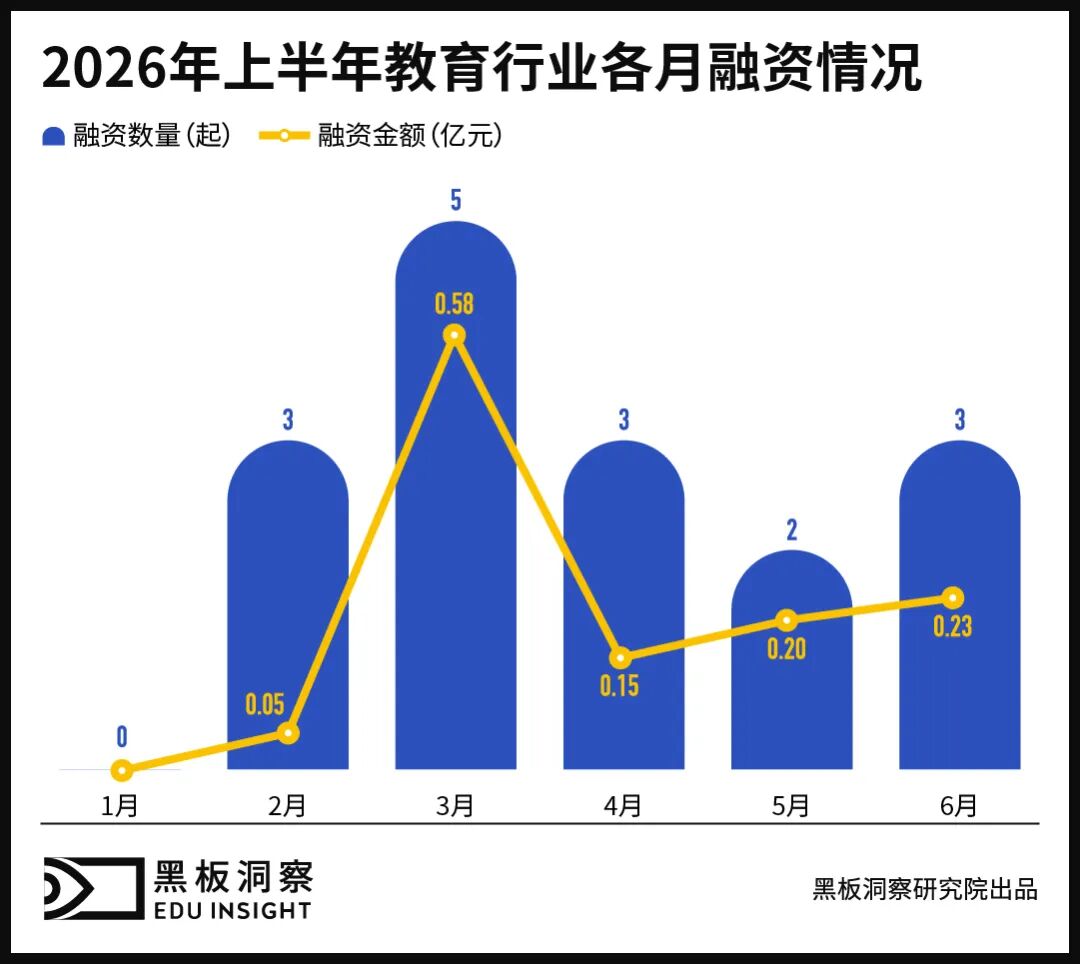
In H1 2026, education industry financing features "concentrated surge in March and scattered progress in other months". No financing events were recorded in January; the market started to pick up in February, and the number of events rose to 5 in March, with the countable amount reaching 58 million yuan, both hitting the highest single-month values in the first half of the year. Among them, the financing amount in March accounted for 47.9% of the total countable amount in H1, nearly half of the total.
The number of financing events from April to June was 3, 2, and 3 respectively, with countable amounts of 15 million yuan, 20 million yuan, and 23 million yuan respectively. Neither the event frequency nor the amount exceeded the March level. Overall, capital deployment in the first half of the year did not form a continuously rising monthly curve, and the overall scale was driven up by the single-month peak in March, with financing rhythm showing obvious phased and project-driven characteristics.
03. Distribution of Education Industry Financing Rounds in H1 2026
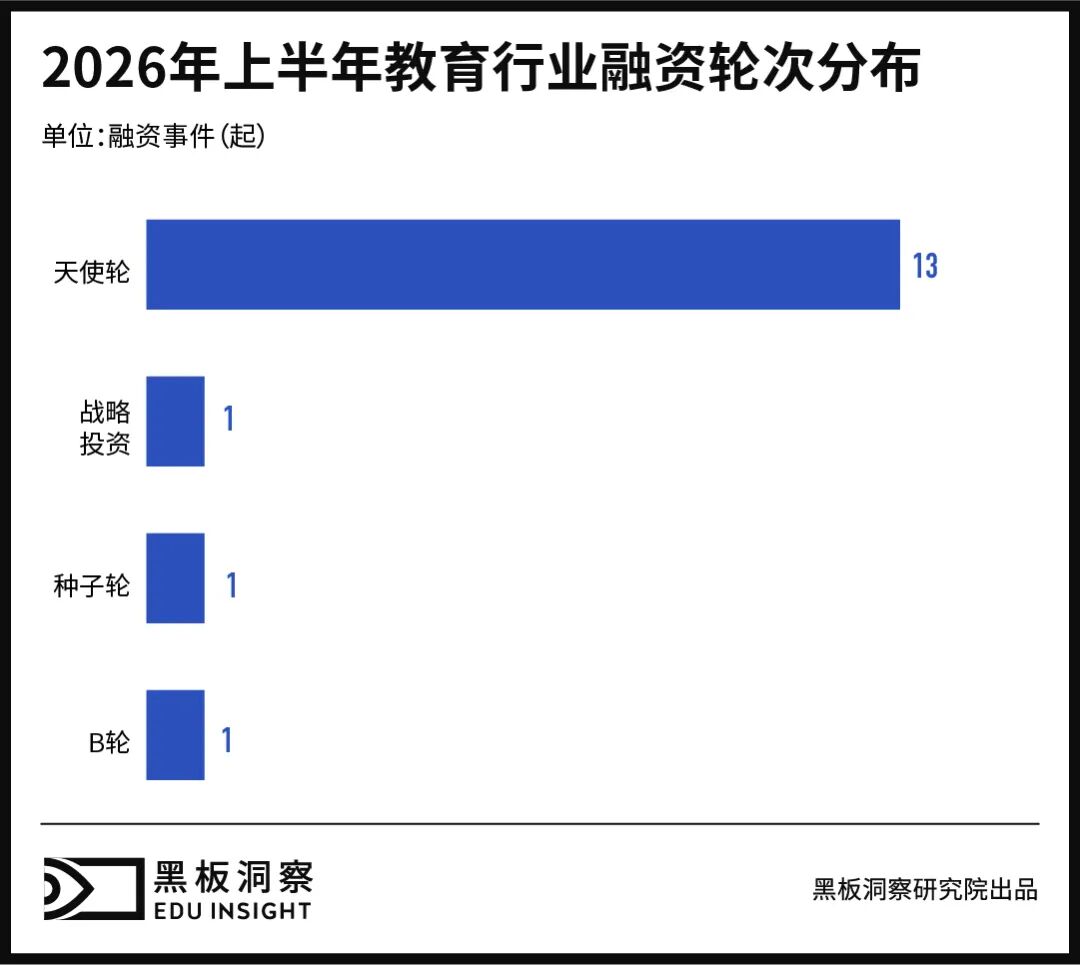
In H1 2026, education industry financing rounds are highly concentrated in the early stage. There were 13 angel round deals, accounting for 81.3% of the total; if seed rounds are included in early-stage financing, early-stage projects total 14, accounting for 87.5% of all events. In contrast, there was only 1 strategic investment and 1 Series B deal respectively, with no Series A, Pre-Series A, or later-stage rounds appearing in the sample.
It is worth noting that the entire 121 million yuan of countable financing amount in H1 came from angel round projects, but this does not mean there is no capital investment in other rounds. Instead, the 3 events of strategic investment, seed round, and Series B all did not disclose specific amounts. What can be confirmed is that capital activities in this period are mainly focused on startup projects; for the actual scale of mid-to-late stage financing, judgment still needs to wait for more amount disclosures.
04. Geographical Distribution of Education Industry Financing in H1 2026
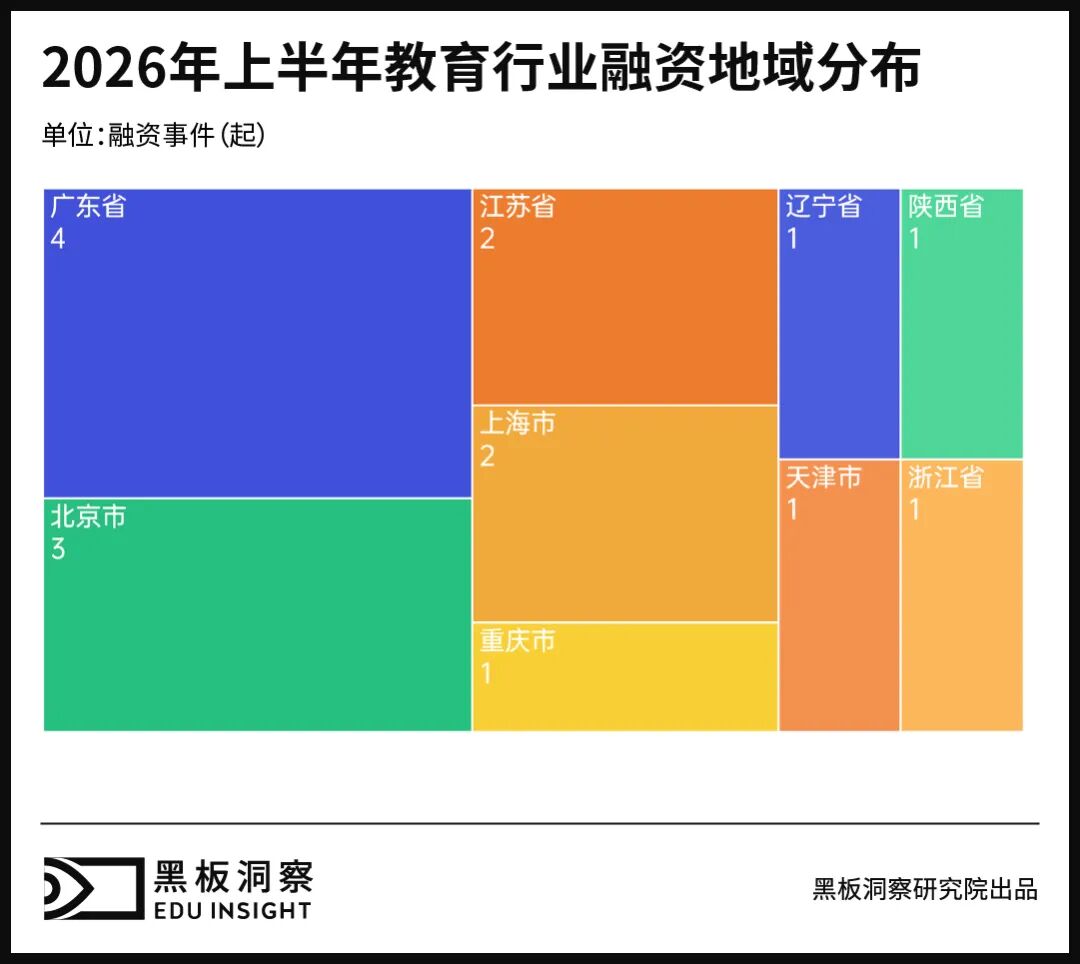
In H1 2026, the geographical distribution of education industry financing presents a pattern of "agglomeration in leading provinces and cities, and sporadic distribution in other regions". Guangdong ranks first with 4 events, followed by Beijing with 3, and the two regions together account for 43.8% of all events; Jiangsu and Shanghai each have 2 events, and the remaining 5 provinces and cities each have 1 event.
The geographical ranking of event numbers is not completely consistent with that of financing amounts. Although Jiangsu only has 2 events, its countable financing amount reached 40 million yuan, ranking first across all regions, mainly driven by the 30 million yuan financing of Qicai Psychological Education; Guangdong's 4 events have a countable amount of 24 million yuan, with the largest number of events but more dispersed single-deal scale. It can be seen that Guangdong reflects the density of project supply, while Jiangsu reflects the driving force of single-deal amount, and regional popularity requires observing both the number of events and the financing scale.
05. Segmented Track Financing Distribution of the Education Industry in H1 2026
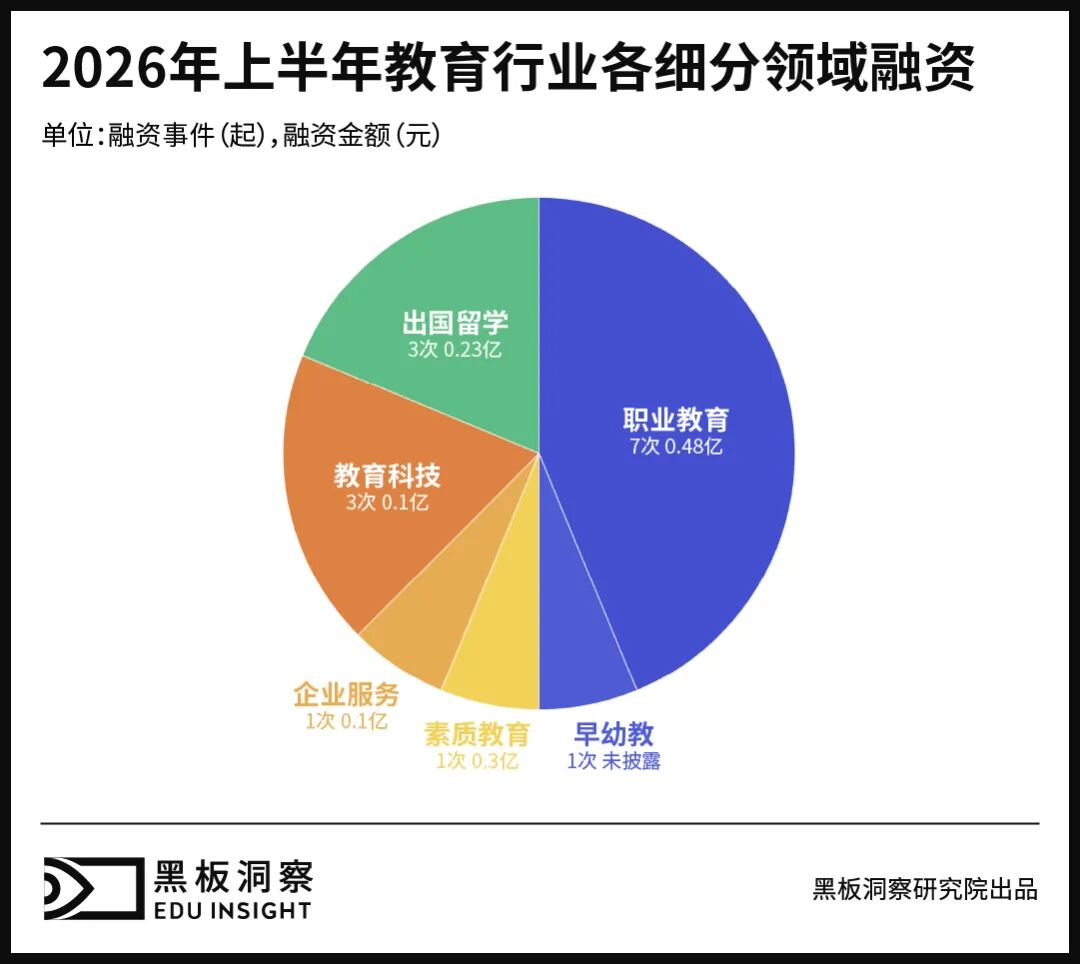
In H1 2026, education industry financing presents a structure of "vocational education leading, AI capabilities penetrating horizontally, and segmented demands emerging at multiple points". Vocational education ranks first with 7 events and 48 million yuan in countable amount, accounting for 43.8% of the event number and 39.7% of the countable amount. In terms of specific businesses, projects cover exam preparation, vocational skill training, continuing medical education, educational consulting and other directions, with capital focuses concentrated on learning outcomes, vocational capabilities, and clear service scenarios.
Overseas study and edtech each have 3 events, with the countable amount of overseas study reaching 23 million yuan and that of edtech being 10 million yuan; although quality education only has 1 event, the 30 million yuan financing of Qicai Psychological Education makes it the second-ranked track in terms of amount. There are a total of 7 projects explicitly mentioning "AI" in their names or business descriptions, accounting for 43.8% of all events, spanning 4 segmented sectors. Overall, AI is not an isolated track in this sample, but more like a fundamental capability embedded in exam preparation, training, software, content, and hardware products.
06. Top 5 Education Industry Financing Events in H1 2026
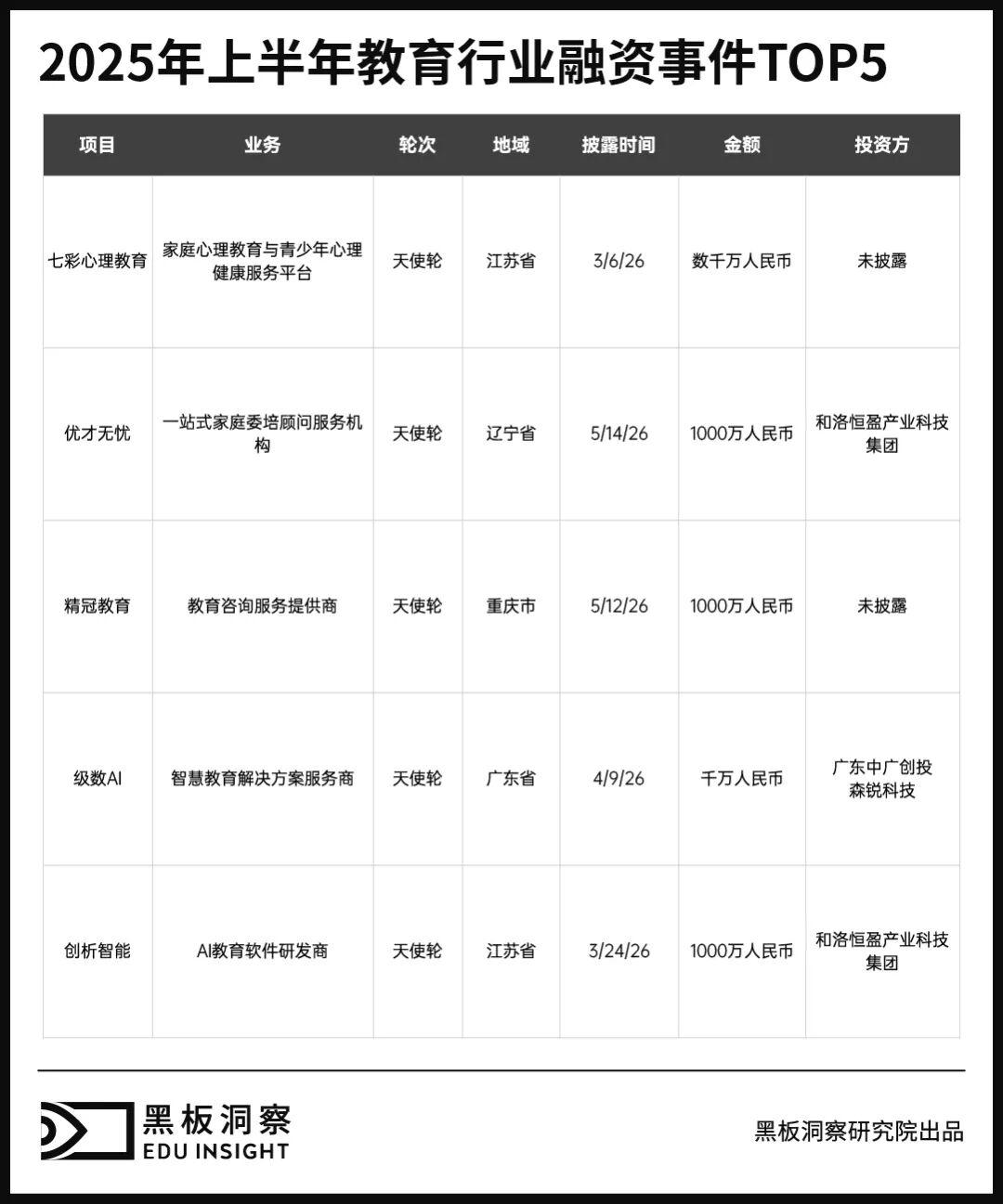
Qicai Psychological Education ranks first with a financing amount of 30 million yuan calculated according to the caliber in the table, accounting for 24.8% of the total countable financing amount in H1. Multiple subsequent projects are concentrated at the 10-million-yuan level, and no obvious gap is formed between leading projects. Since 5 projects have the same calculated amount of 10 million yuan in the table, this table determines the TOP5 in reverse chronological order of disclosure time for projects with equal amounts, and another project Daniu Chuguo also has 10 million yuan financing but is not included in the table.
In terms of the composition of TOP5, all 5 projects are angel rounds, with businesses spanning psychological education, family-customized talent training, educational consulting, educational enterprise services, and AI educational software. Leading projects are not concentrated in a single traditional track, but developed around clear demands, vertical scenarios, and technology applications, which confirms the overall early-stage and application-oriented characteristics of the first half of the year.
Conclusion
In H1 2026, investment and financing in the education industry further contracted against the trend of the past six years: 16 events and 121 million yuan in countable financing both hit new lows for the same period. At the same time, the structure in this period remains clear: angel rounds account for the absolute majority, million-yuan and ten-million-yuan projects each make up half of the disclosed events, vocational education takes the lead in both event number and financing amount, while AI is distributed across multiple segmented scenarios. The key focus of capital is not to achieve rapid expansion through a single large-scale financing, but to find projects that can respond to specific demands such as vocational capabilities, learning efficiency, mental health, and cross-border services through smaller-scale early-stage investments.
Meanwhile, there are still 4 events with undisclosed amounts in the first half of the year, and the amounts of strategic investment, seed round, and Series B projects are all not public, which limits the judgment on the financing scale of non-angel rounds. Three points are worth continuing to observe in the second half of the year: whether AI-related projects can move from early-stage verification to subsequent rounds, whether vocational education can maintain its advantage in event numbers, and whether the current structure will change after non-angel round projects disclose their financing amounts. Based on current data, the keyword for education financing is not "comprehensive warming up", but early-stage trial investment, scenario implementation, and cautious screening.
This article is from the WeChat official account "Heiban Insight" (ID: heibandongcha), author: Er Dong, published by 36Kr with authorization.