New Tesla FSD Capabilities Uncovered: Autonomous Driving Now Boasts a "User Model", Enabling Highly Personalized AI Drivers That Offer Unique Experiences for Every User.
ChatGPT can remember your chat history, understand your expression habits, and even adjust its response style based on past interactions.
Now, this kind of "memory capability" is stepping into the physical world.
A single tweet from Elon Musk has revealed new ongoing changes in Tesla FSD:
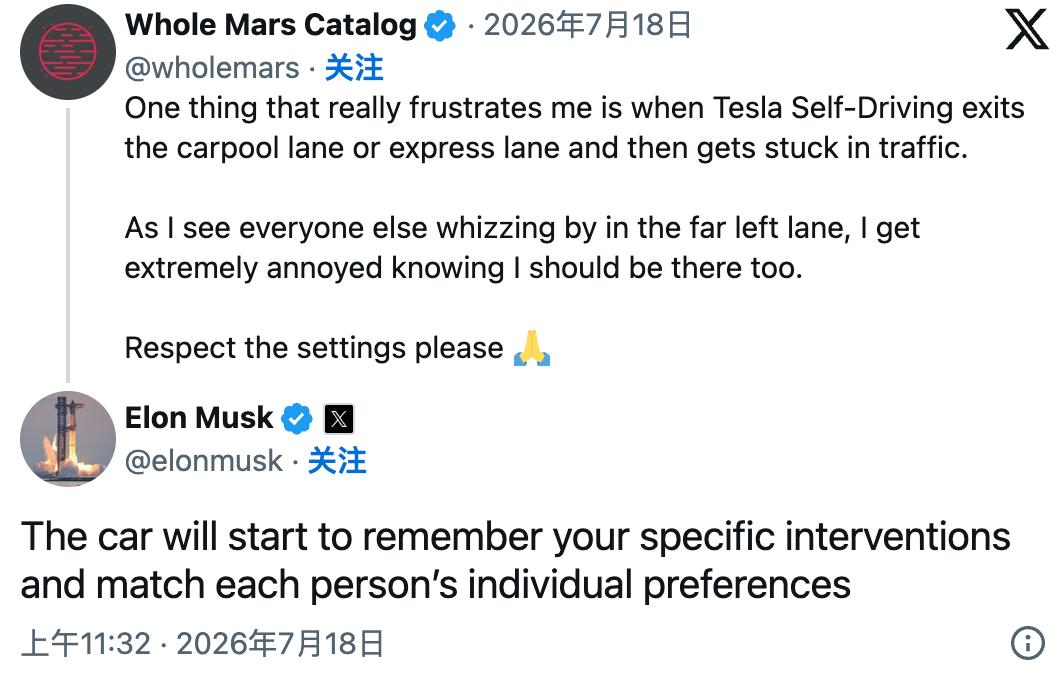
FSD is beginning to gain the capability of "personalized experiences for every user".
From parking preferences, driving interventions, to long-term driving habits, FSD is attempting to memorize the distinct traits of each individual.
It is evolving from "one AI serving all users" to "everyone having their own dedicated AI".
Elon Musk Confirms: FSD Starts to Gain "Long-Term Memory"
The story originates from two recent public replies made by Musk.
The first one in June was related to parking habits.
A user suggested that they hoped FSD could remember their parking patterns at fixed locations, such as where to park when arriving home or at the office.
Musk responded:
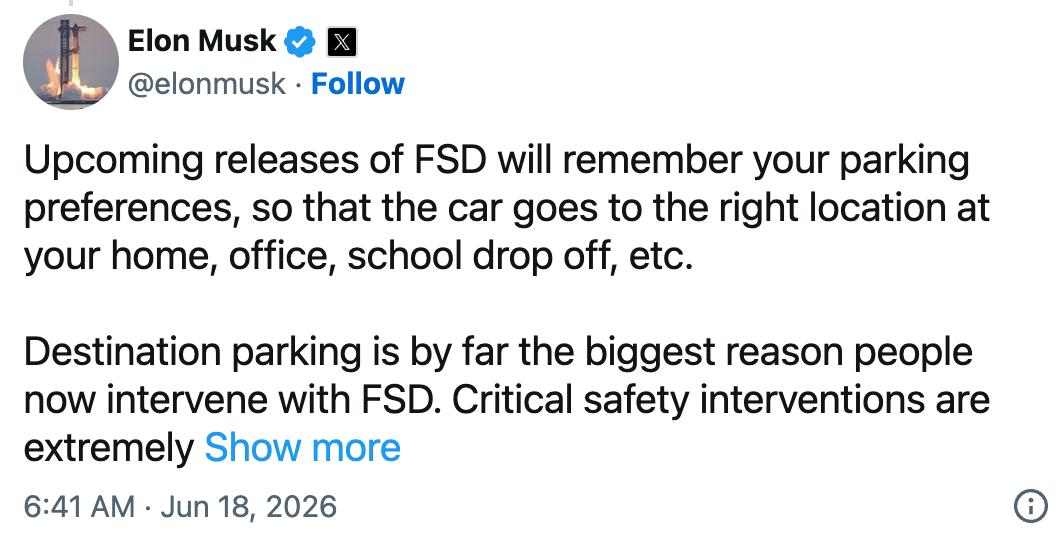
FSD will soon be able to remember users' parking preferences.
The more recent reply is even more critical.
Some users reported that FSD's driving decisions did not align with their personal habits in scenarios like lane selection and lane-change timing.
Musk stated that future vehicles will record users' specific takeover behaviors and gradually match each individual's driving preferences.
Essentially, these two replies point to the same core fact:
FSD is evolving from handling one-off driving tasks to achieving long-term understanding of the driver.
In the past, autonomous driving systems were designed for an abstract, generic user.
No matter who sat in the driver's seat, the underlying model remained identical.
It knew what kind of road was ahead, what other vehicles were nearby, and how to plan the route properly.
But it had no way of knowing: whether you prefer changing lanes in advance or would rather wait a few extra seconds; whether you like following the preceding vehicle closely or prioritize a more comfortable driving experience; or exactly where you are used to parking when you get home.
These human-specific driving habits had never been incorporated into autonomous driving systems before.
Now, Tesla is making this information a core part of the AI's decision-making process.
Different from our previous discussions about FSD, this "long-term memory" feature does not require FSD to re-learn "how to drive" — that fundamental task has already been completed by the base model.
What it is learning is: within the bounds of safety, how you want it to drive.
This also marks Tesla's first public move toward Personalized FSD:
Evolving from "one model serving all drivers" to "base model plus individual driving preferences".
Why Now?
The concepts of "personalized experiences for every user" and "the more you drive, the more it understands you" have been talked about in the smart vehicle industry for many years.
But real-world implementation has long been difficult, as user experience fully relies on the automaker's initiative and technical capabilities for OTA updates, and it is not rare to see degraded experience after system updates.
This is because up to now, the vast majority of autonomous driving players are still competing at the model and data level, essentially focusing on solving: how to make AI a better generic driver.
After Tesla completed the end-to-end reconstruction for its V14 system, it has taken the lead in exploring a brand new question:
How to make AI your exclusive personal driver.
Behind this shift are several emerging research directions in the autonomous driving field in recent years:
Driver Modeling, Preference Learning, and Human-in-the-loop Learning.
The earliest of these directions is Driver Modeling.
Simply put, it creates a digital profile for each driver: for example, some people drive more aggressively, prefer a shorter following distance, and want to complete lane changes faster; others are more conservative, tend to decelerate in advance, and take the initiative to overtake less often.
Traditional autonomous driving systems ignore all these differences, defaulting to a hypothetical "average driver".
The problem that Driver Modeling aims to solve is: the AI should be able to identify exactly what type of driver is sitting in the driver's seat.
Technically, such solutions usually extract features from historical driving data, such as steering wheel operations, changes in accelerator and brake inputs, speed fluctuations, lane change frequency, and following distance. Then an additional model generates a Driver Embedding vector.
This vector does not alter the basic driving capabilities of the system, but acts as an input to the planning system to influence subsequent decision-making.
However, Driver Modeling still has a flaw: it mostly judges "what type of person you are", rather than understanding "what specific choices you prefer".
Thus, in recent years, Preference Learning has emerged. It no longer focuses on whether a driver is aggressive or conservative, but instead pays attention to which specific choice the driver prefers in a given scenario. For example, when encountering a slow-moving vehicle, Option A is to change lanes in advance for higher efficiency, while Option B is to stay in the current lane for a more comfortable experience.
Through long-term observation of the user's choices, the AI gradually learns which option this specific user tends to select.
This is highly similar to the Preference Learning logic used in large language models: the base model capability is the foundation, and user feedback determines the personalized traits.
The Intervention mechanism Tesla mentioned this time actually aligns closely with this direction.
Of course, there is a third direction: Human-in-the-loop, which solves the problem of how to keep humans continuously involved in the autonomous driving learning process.
Traditional machine learning usually relies on massive amounts of labeled data. But in the autonomous driving field, the truly valuable data is rarely generated during normal driving — it appears when the AI does not know how to handle a situation.
In the past, Tesla collected massive amounts of fleet data, essentially using its global vehicle fleet as a data collection network. In the future, if this feedback is further bound to individual user accounts, the value of this data will be transformed:
It will not only help Tesla optimize a unified base model, but also help individual vehicles understand specific users.
Tesla has not publicly disclosed the specific architecture of the FSD personalized feature yet, but combining it with the end-to-end route adopted after FSD V12, we can make a reasonable inference: the possibility of training a separate model for each individual user is the lowest.
The reason is straightforward: if every user had an independent model, it would lead to extremely high training costs, difficult updates, and would undermine the advantages of Tesla's unified model.
A solution that better fits FSD's existing system is likely to be: base end-to-end model plus a user preference memory layer. The underlying base model is responsible for visual perception, road condition judgment, safe driving, and general route planning.
A lightweight User Preference Layer will be added on top, to record parking habits, driving rhythm, route preferences, and historical takeover behaviors.
The base model determines "whether it is safe to drive this way", while the preference model determines "whether you prefer driving this way".
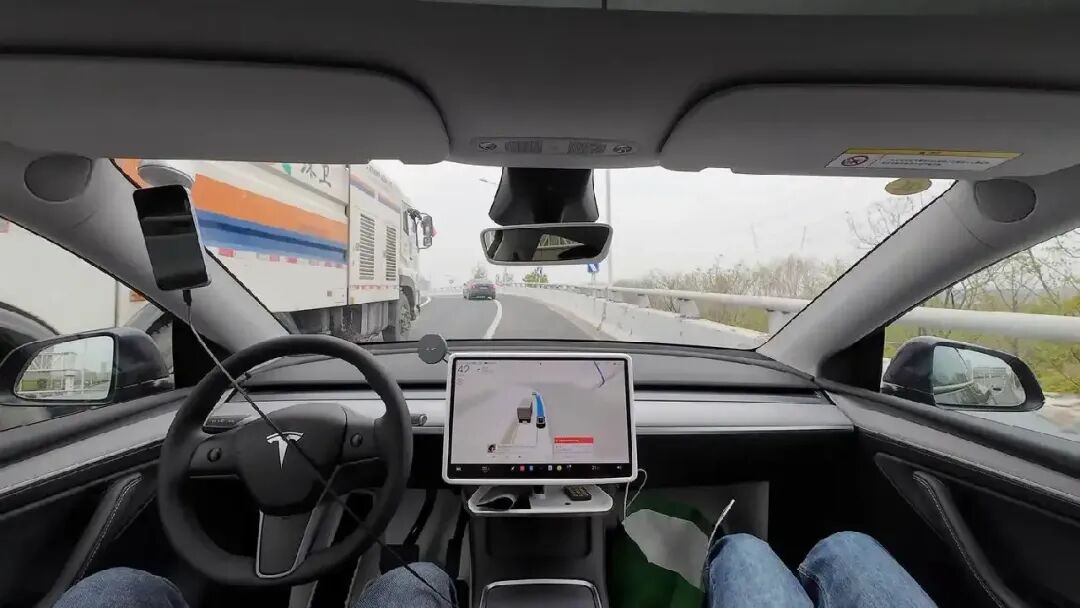
This development path is actually highly similar to that of modern large language models: GPT is not retrained from scratch for each individual user. Instead, it achieves personalization through mechanisms such as Memory and User Profile.
However, the real core challenge lies here: personalization must never cross the safety boundary. The AI must be programmed to refuse to learn dangerous behaviors you may have, such as speeding or reckless lane changes.
This is exactly the most noteworthy part of Tesla's current exploration: it is not making the AI become a perfect copy of you, but making it "increasingly aligned with your preferences within safety constraints".
AI Vehicles Enter the Era of "Personalized Experiences for Every User"
Over the past few years, the core of autonomous driving competition has been: who has more data, who has a more powerful model, and whose capabilities are closer to a human driver.
But with the launch of Tesla's Personalized FSD, the next phase of competition is set to shift.
Today, most smart vehicles still serve all users using a unified strategy. But in the future, AI drivers will increasingly resemble real human drivers — not because they have emotions, but because they fully understand your personal habits.
This means that User Model may become a new core capability layer for autonomous driving.
Musk has killed two birds with one stone by solving two major problems: first, he has pointed out a new selling point direction for smart vehicles, which is a path that avoids extreme homogeneity and inefficient cutthroat competition in the industry.
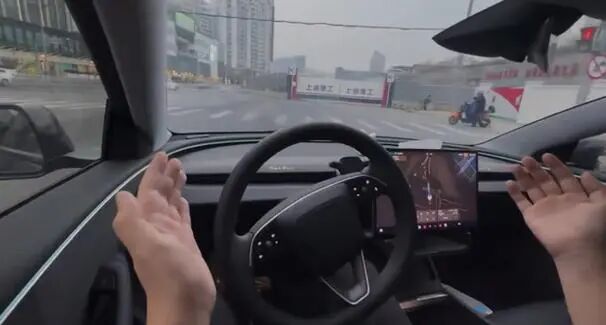
After valet-to-valet autonomous driving becomes widely adopted, how to create differentiated value for the AI driver on mass-produced vehicles will become a new key problem.
When all vehicles are capable of basic navigation and intelligent driving, the next round of competition will focus on: who understands you better, who aligns more closely with your driving habits, and who acts more like a long-term driving companion that you trust.
Of course, this also puts forward much higher requirements for technical capabilities.
Especially for "one for all" autonomous driving solution providers, it is very difficult to allocate enough resources to develop such personalized features. Even if they are willing to open permissions for automakers to conduct custom development on top of the base model, there are very few OEMs that have the code-level AI development capabilities required.
Therefore, this trend is a major benefit for players with full-stack in-house R&D capabilities!
Second, there was a long-standing question that once put Musk in an awkward position: is there an inherent contradiction between Tesla's business model of manufacturing and selling private cars, and the ultimate goal of autonomous driving development?
After fully autonomous driving becomes ubiquitous, it seems that there will no longer be a necessity for people to own private vehicles.
Therefore, Personalized FSD solves this urgent problem for Musk — even as Robotaxi deployment is advancing rapidly, private vehicles equipped with personal AI drivers still retain significant value and necessity.
After all, for Robotaxi services, using one AI to serve all users is the optimal solution, which can never provide the highly customized, personalized driving experience tailored to each individual.
The Personalized FSD development path is actually very similar to the evolution of generative AI.
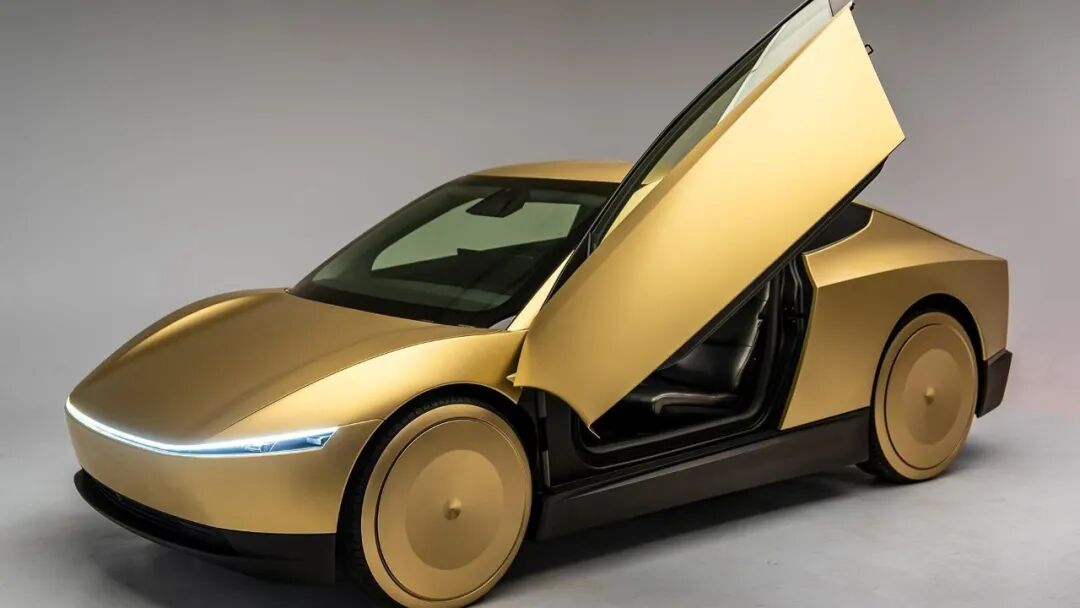
ChatGPT becomes more personalized through its Memory feature, and AI Agents accomplish complex tasks by leveraging long-term memory capabilities.
In the future, vehicles, as a critical entry point connecting to the physical world, will also likely be equipped with their own long-term memory systems. Of course, this does not mean that autonomous driving technology has already reached full maturity.
Tesla's specific implementation approach, safety constraint mechanisms, and the boundaries of this personalized capability all still require further real-world validation.
But at the very least, a clear new industry trend has emerged.
This article is from the WeChat Official Account "Smart Vehicle Reference" (ID: AI4Auto), written by Jia Haonan, and published by 36Kr with authorization.