Even the da Vinci surgical robot has begun to reduce costs.
In the second quarter of 2026, Intuitive Surgical, the parent company of the da Vinci surgical system, delivered a standout performance: Revenue reached $2.89 billion, rising 19% year-over-year; GAAP net income hit $818 million, up approximately 24%.
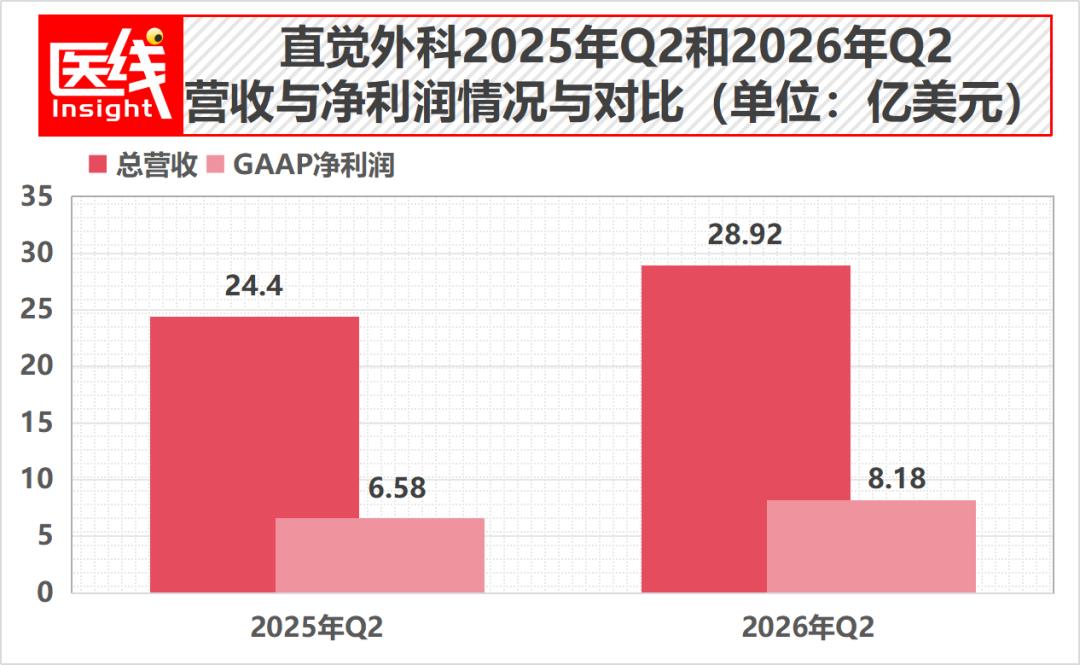
Data source: Intuitive Surgical Q2 2026 Earnings Report
During the same period, the global installed base of da Vinci systems climbed to 11,710 units, with the latest da Vinci 5 accounting for half of the 468 systems deployed in the quarter.
In terms of the core surgical volume metric, da Vinci procedures grew 15%, while the Ion bronchial robotic system saw a sharp 36% surge, with its installed base reaching 1,096 units, a 21% year-over-year increase. Additionally, the company spent $380 million on stock repurchases during the quarter.
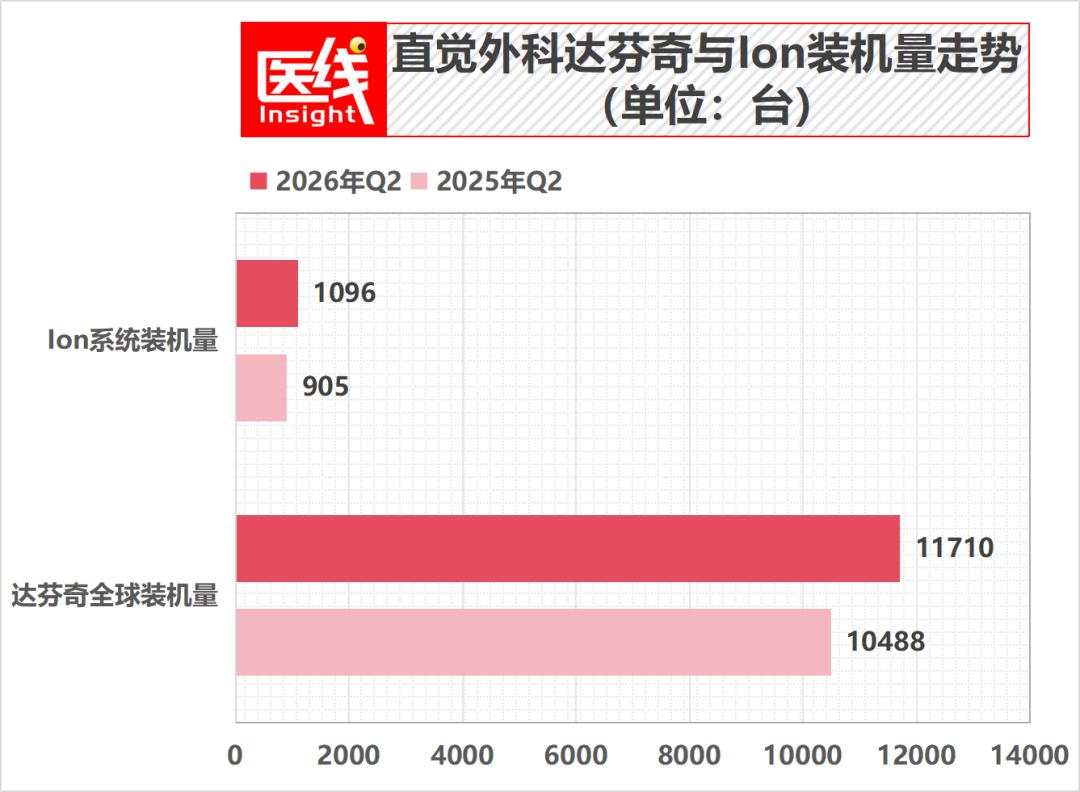
Data source: Intuitive Surgical Q2 2026 Earnings Report
The financial figures are impressive, but the stock performance was underwhelming. The day after the earnings release, Intuitive Surgical's share price dropped by as much as 13%.
Behind this lies a shifting growth trajectory: despite a 12% year-over-year increase in the global installed base of da Vinci systems and approximately 15% growth in global surgical volumes for the quarter, the company did not raise its full-year surgical volume guidance, still projecting 13.5%–15.5% growth in global da Vinci procedures for 2026, and noted that the final result would likely land near the midpoint of this range.
"Some customers have reported that changes in patient insurance coverage and premium levels may affect when patients choose to seek medical care and treatment. The company believes the expiration of ACA subsidies had a 'modest negative impact' on da Vinci procedure growth in the U.S. during the second quarter," Intuitive Surgical CEO Dave Rosa stated during the earnings call.
For a medical device giant that has long commanded a high valuation, "still growing" is simply not enough.
What investors are truly concerned about is that, as its core U.S. market matures, patient affordability faces headwinds, and more competitors enter the space, how much longer can da Vinci sustain the growth model it built on premium hardware and high-margin disposable instruments?
Intuitive Surgical has clearly recognized the market's concerns, and its answer can be summed up in two words: cost reduction.
This cost reduction initiative spans tiered product offerings, operating leases, extended use cycles for instruments, and recurring revenue models. Intuitive Surgical is redesigning the cost structure of the da Vinci system and reshaping its revenue streams.
01
The Premium Narrative Is Fading
The Product Line Is Moving Downmarket
In the past, da Vinci's most defining feature was being "state-of-the-art."
Today, Intuitive Surgical has added an equally critical criterion to its product lineup: making the systems affordable and accessible to more hospitals.
While the da Vinci 5 continues to target large hospitals and complex surgical procedures, Intuitive Surgical is accelerating the rollout of the XiR system.
The da Vinci 5 emphasizes force feedback, computing power, and digital capabilities; the XiR is tailored for more cost-conscious customers, with a focus on serving U.S. ambulatory surgery centers, small hospitals, and overseas markets with weaker payment capacity.
For cost-sensitive customers, Intuitive Surgical is leveraging flexible product configurations to expand coverage across hospitals with varying payment capacities. Mature existing products and refurbished systems are also being prioritized, and they are expected to play a more prominent role in device deployments over the coming quarters.
For hospitals adopting surgical robots for the first time, these systems may lack the prestige of the latest generation models, but they can still integrate with Intuitive Surgical's established fourth-generation instrument and service ecosystem.
A full product matrix has now taken shape.
The da Vinci 5 secures the premium market and complex procedures, the Xi addresses mainstream demand, while the XiR, X, and refurbished systems extend coverage further downmarket to cost-sensitive customers. Intuitive Surgical is now using products at different price points and with different configurations to cater to hospitals across all affordability levels.
Device procurement models are also rapidly becoming more flexible.
Earnings reports show that of the 468 da Vinci systems deployed in the second quarter, 254 were placed via operating leases, pushing the lease penetration rate up to 54% (compared to 49% of the 395 deployments in the same period last year).
Among these, 131 units were placed using usage-based flexible leasing arrangements.
Furthermore, the earnings report specifically notes that thanks to the large installed base under leases, the increased average selling price of da Vinci systems, and the expanded volume of system deployments, total system revenue for the quarter still grew robustly to $685 million.
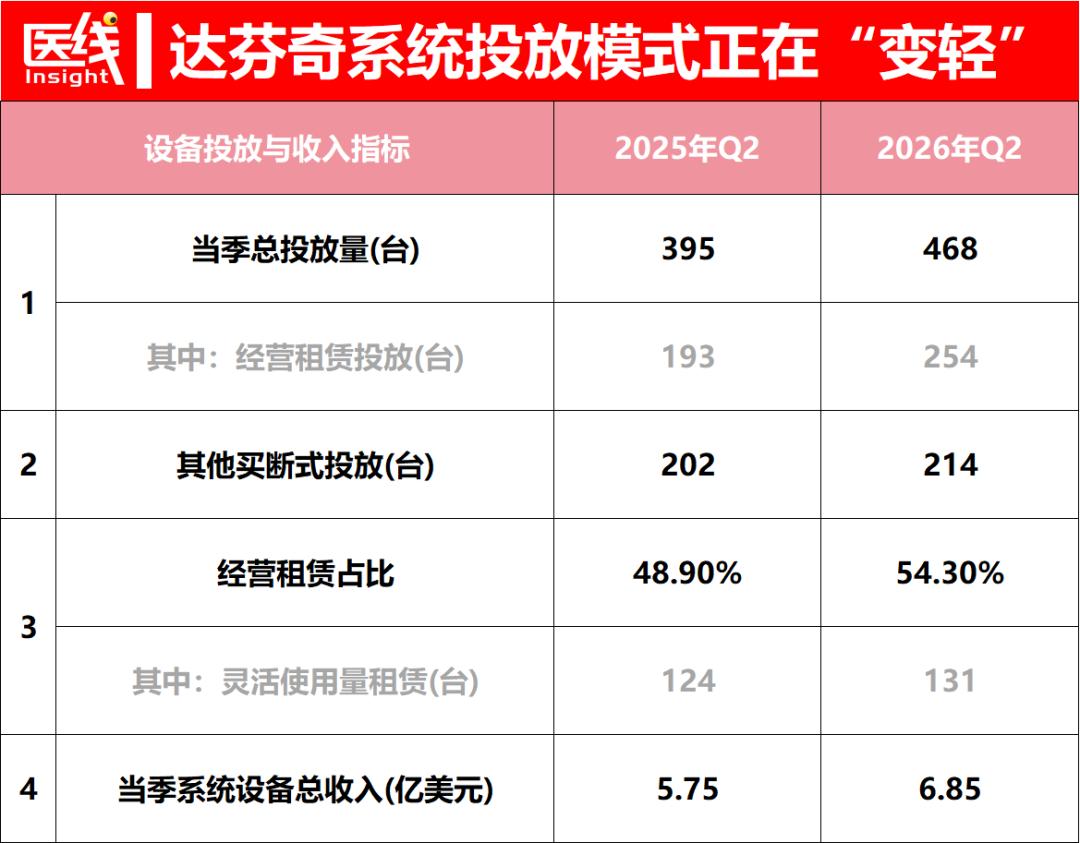
Data source: Intuitive Surgical Q2 2026 Earnings Report
This means the giant is lowering barriers through "downmarket accessibility" without sacrificing current-period profits.
For hospitals, leasing breaks down large one-time capital expenditures into more manageable long-term operating costs; for Intuitive Surgical, lower installation thresholds expand its customer base and encourage hospitals to deepen their engagement with its instrument, maintenance, and software ecosystems.
Upfront cost pressures are mitigated, while long-term customer relationships are extended.
02
The Giant Is Taking Action
Starting with Adjusting Its Own Instrument Revenue
The move that truly tests management's resolve is taking place on the disposable instruments side.
Intuitive Surgical plans to start in the first half of 2027 increasing the allowed usage cycles for some EndoWrist instruments, to reduce the per-procedure cost for hospitals.
This initiative will first target high-volume benign disease procedures, as well as markets with lower reimbursement levels and tighter cost constraints; force feedback instruments, staplers, and energy products will not be included initially.
This change directly impacts the company's most lucrative revenue stream.
In the second quarter of 2026, Intuitive Surgical's instruments and accessories revenue reached $1.735 billion, up 18% year-over-year, remaining the company's largest source of revenue.
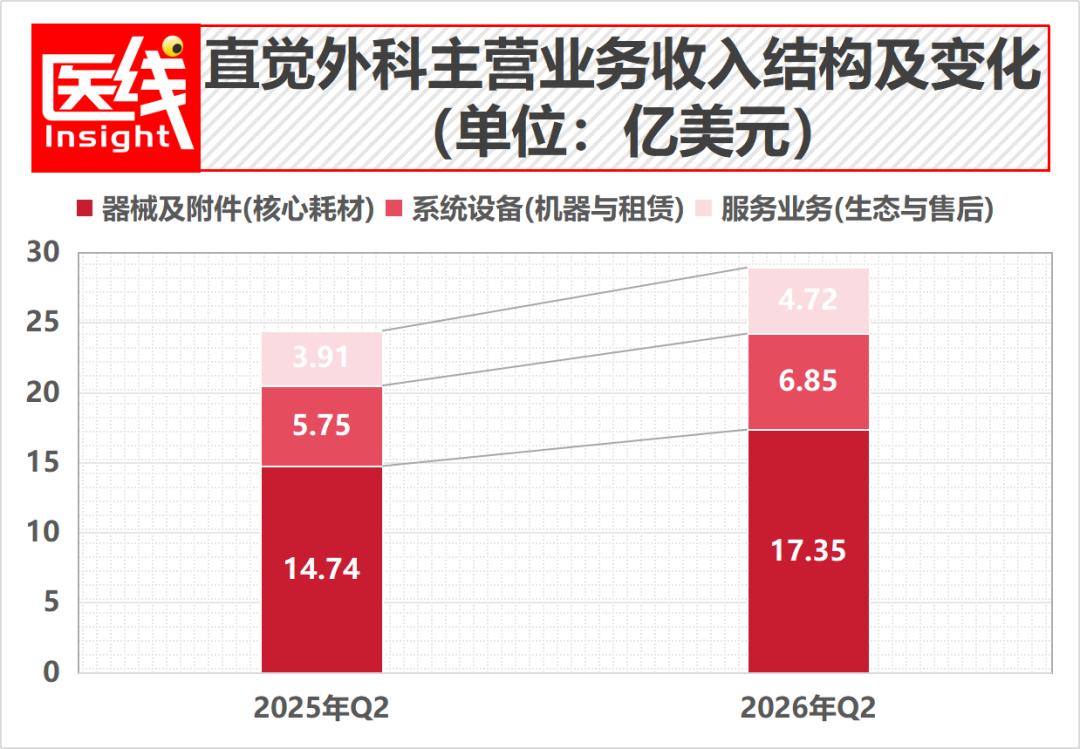
Data source: Intuitive Surgical Q2 2026 Earnings Report
During the same period, the instruments and accessories revenue generated per da Vinci procedure was approximately $1,830.
As instrument usage cycles are extended, a single instrument can support more procedures, and per-procedure disposable instrument revenue will likely decline in the short term.
During the earnings call, multiple analysts asked how much this initiative would impact instrument revenue in 2027 and 2028.
Intuitive Surgical did not provide specific figures, but management's priority is clear: between growth and short-term profits, the company is willing to sacrifice some per-procedure revenue in exchange for a much larger total market size.
As long as lower costs can unlock more low-complexity procedures and markets with limited payment capacity, this tradeoff is worthwhile.
A leading industry player voluntarily accepting "self-cannibalization" indicates that the competitive metrics for surgical robots have fundamentally shifted.
Hospitals initially focused on whether a robot "could perform a procedure," then moved on to evaluating "how well it performs," and now they are calculating "whether it can be deployed at scale with sufficiently low costs."
As robotic surgery expands from high-value procedures such as prostate cancer treatment to high-volume procedures including hernia repair and cholecystectomy, equipment utilization, surgical turnaround time, instrument costs, and insurance reimbursement standards will all become core factors in procurement decisions.
Intuitive Surgical has explicitly positioned the XiR and the extended instrument usage program toward high-volume, repeatable, price-sensitive surgical scenarios. Complex procedures can justify a premium for innovative capabilities; for high-volume procedures, reliability, efficiency, and cost-effectiveness together determine whether the equipment can operate sustainably.
03
The Next Step:
Lower Hardware Margins, Monetize the Ecosystem
The flip side of this cost reduction initiative is the restructuring of profit sources.
In the second quarter, Intuitive Surgical's "recurring revenue" base, composed of instruments, services, and system leases, remained solid.
Beyond core disposable instruments, service revenue rose approximately 21% year-over-year to $472 million; driven by the growth in leased installed systems, da Vinci system lease revenue also increased. The My Intuitive Plus platform bundled with the da Vinci 5 integrates remote collaboration, simulation training, and AI-powered case insights into a recurring revenue system.
Earnings reports show that Intuitive Surgical's R&D expenditure in the quarter reached $371 million, a sharp 18% year-over-year increase. The giant is investing heavily to convert lower hardware entry barriers into a deeper moat built on software and data.
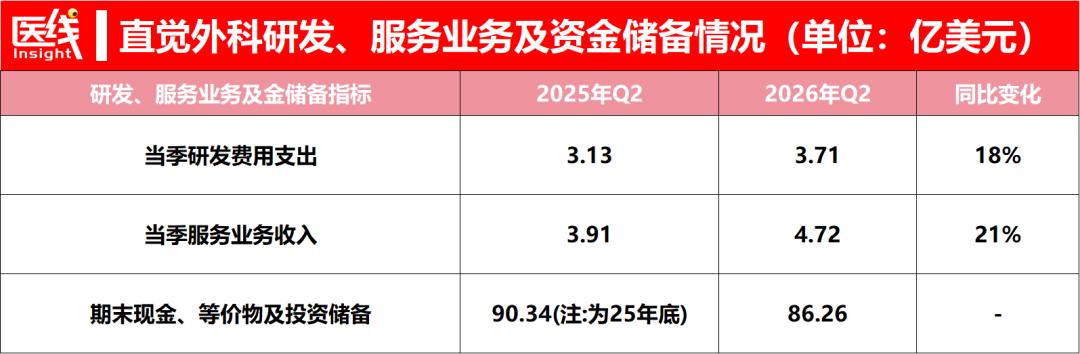
Data source: Intuitive Surgical Q2 2026 Earnings Report
Intuitive Surgical's role is evolving. It still sells robotic systems, but at the same time it is operating a unified "surgical operating system" that integrates devices, instruments, services, software, training, and data.
Within this framework, the XiR, refurbished systems, and operating leases are designed to lower entry barriers; extended instrument usage cycles reduce per-procedure costs.
As the installed base and surgical volumes expand, instruments, services, leases, and digital products will then generate more long-term recurring revenue.
The entry point can become more affordable, but the ecosystem must become more robust.
This path is increasingly similar to the consumer tech industry's model of expanding user bases with entry-level hardware, then driving sustained monetization through the ecosystem. The customers for surgical robots are hospitals, surgeons, and clinical departments, and the ecosystem barriers are even higher: clinical evidence, surgeon training, surgical instruments, after-sales service, and hospital workflow integration all require long-term accumulation.
As a result, lowering margins on the hardware side will not necessarily weaken da Vinci's business model.
As long as more systems are deployed in hospitals, more surgeons begin using them, and more procedures are routinely performed, Intuitive Surgical can turn a one-time hardware sale into a multi-year ongoing relationship.
04
The China Market Is Accelerating This Transformation
The most immediate pressure comes from the China market.
As explicitly stated in the earnings report, the company is facing competitive pressures including from local Chinese rivals.
Management has repeatedly noted that the China market is facing fewer tender activities, intensified competition from domestic surgical robot manufacturers, and policy-driven price pressure. While da Vinci procedure volumes in China continue to grow, new device deployments have clearly encountered headwinds.
Intuitive Surgical must not only contend with the rising number of domestic Chinese surgical robot brands, but also adapt to changes such as centralized procurement, medical service fee adjustments, and higher hospital requirements for return on investment.
For domestic Chinese surgical robot companies, these developments send two clear signals.
The first signal is largely positive.
da Vinci's new focus on the XiR, refurbished systems, operating leases, and instrument cost reduction effectively validates the longstanding practical challenge that Chinese companies have highlighted: The adoption bottleneck for surgical robots lies not only in technology, but also in whether hospitals can achieve a favorable economic return.
The second signal is more of a wake-up call.
"Lower prices" are no longer the exclusive competitive advantage that domestic firms can rely on.
Intuitive Surgical has already proactively moved downmarket with tiered product offerings and flexible payment models, while retaining its massive surgeon training ecosystem, mature instrument portfolio, long-accumulated clinical evidence, and global after-sales support network.
If domestic companies limit their competition to device selling prices, they may find that the giant can easily cede margin on the hardware side while maintaining its ecosystem advantage through instruments, services, and software.
More critically, the earnings balance sheet shows that as of the end of the second quarter, Intuitive Surgical holds $8.63 billion in cash, cash equivalents, and investments.
Going up against a giant with such abundant resources, competing solely on "low prices" is like throwing an egg against a stone.
The next phase of competition will be decided by total cost of ownership.
The winner will be the company that enables hospitals to perform more procedures at lower costs, reduces the surgeon learning curve, builds a comprehensive instrument portfolio covering different procedures, and provides a full suite of solutions including leasing, usage-based pricing, maintenance, and training — the one that can turn device installations into sustained, routine clinical use.
da Vinci's move to reduce costs indicates that the competitive landscape of the surgical robot industry has shifted.
This industry is moving beyond the early stage driven by scarce technology and premium hospital adoption, entering a new phase where scale, efficiency, and payment capacity together determine market success.
When the most dominant industry giant starts meticulously calculating the cost of every device, every instrument, and every procedure, the large-scale commercialization of surgical robots may only just be beginning.
This article is from the WeChat public account <