Gemini 3.5 Pro is stuck in a difficult development phase, and Google has first handed in two draft versions.
On July 21, Google unexpectedly launched two new models:
Gemini 3.6 Flash and Gemini 3.5 Flash-Lite.
With zero prior warning and no advance notice, the two models have appeared directly in the model selector of Google AI Studio and Gemini.

One of these two models is focused on stronger coding and Agent capabilities, while the other is designed for lower-cost large-scale inference calls.
As for the flagship model Gemini 3.5 Pro, after months of widespread public anticipation, it still has not made its official debut.
According to previous plans, 3.5 Pro was originally scheduled to launch in June. Now that more than half of July has passed, this highly anticipated model still has not been officially unveiled.
With the flagship-level performance report being delayed for so long, what exactly does Google intend to do by first releasing these two "draft" models?
01
3.6 Flash: Cheaper than the previous generation, but not smarter
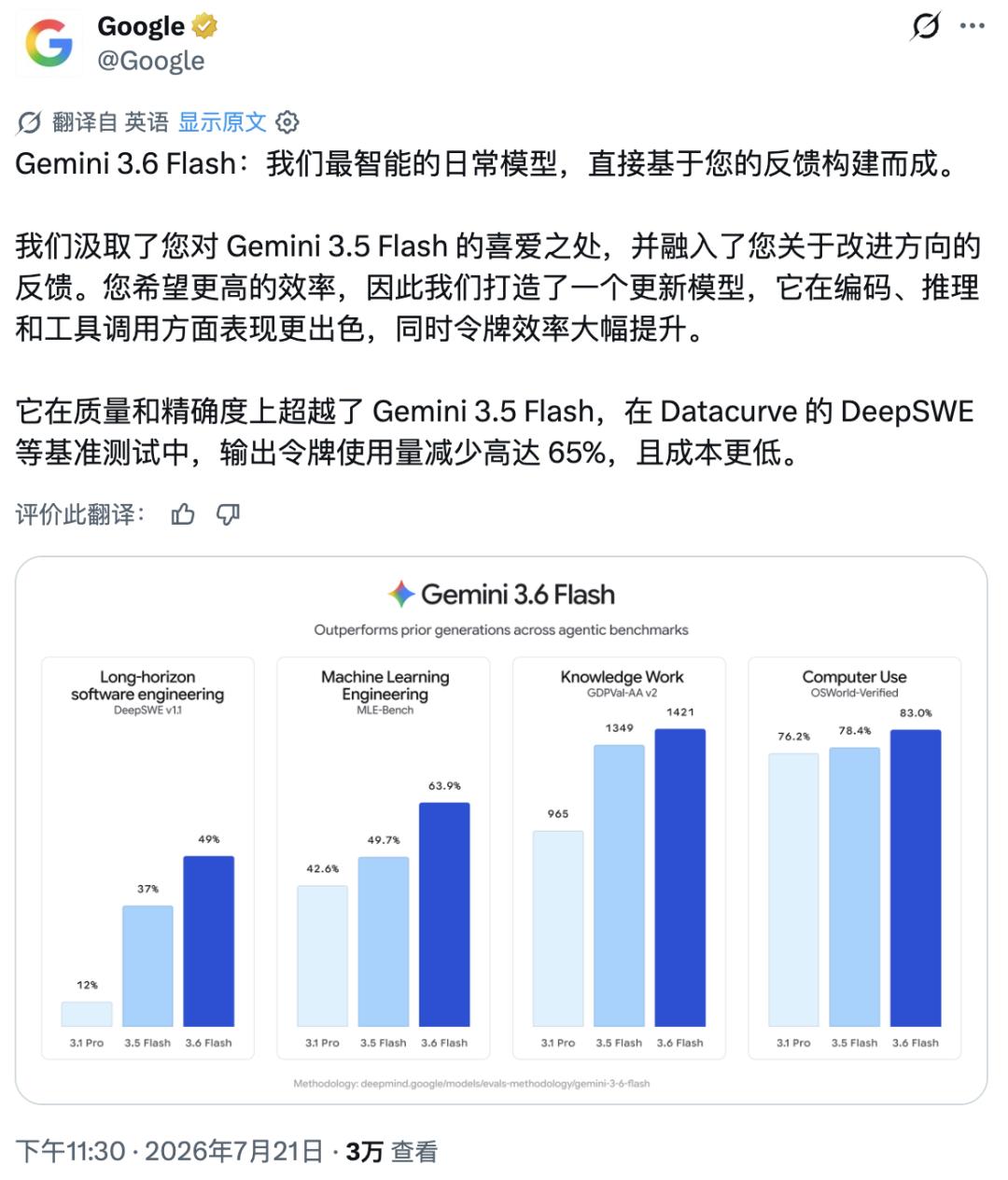
Google states that compared to the previous generation Flash model, Gemini 3.6 Flash further improves its performance in coding, reasoning, and tool calling, while reducing operating costs by cutting down output tokens.
Gemini 3.6 Flash is positioned as a high-efficiency model for real-world production environments, or to put it more bluntly, it is built to serve Agent applications.
In the Agent era, a single task may require dozens of rounds of model calls, which means the model not only needs to be capable, but also fast enough and affordable enough.
Google has already strengthened this product roadmap on Gemini 3.5 Flash. According to the official API documentation, Gemini 3.5 Flash supports a 1 million-token long context window, which can process massive amounts of information in one go. It also supports code execution, external tool invocation, file search and other capabilities, enabling it to handle more complex and long-running tasks.
Gemini 3.6 Flash continues this roadmap. It does not prioritize the quality of a single response, but targets a positioning that is "affordable enough for real daily workloads".
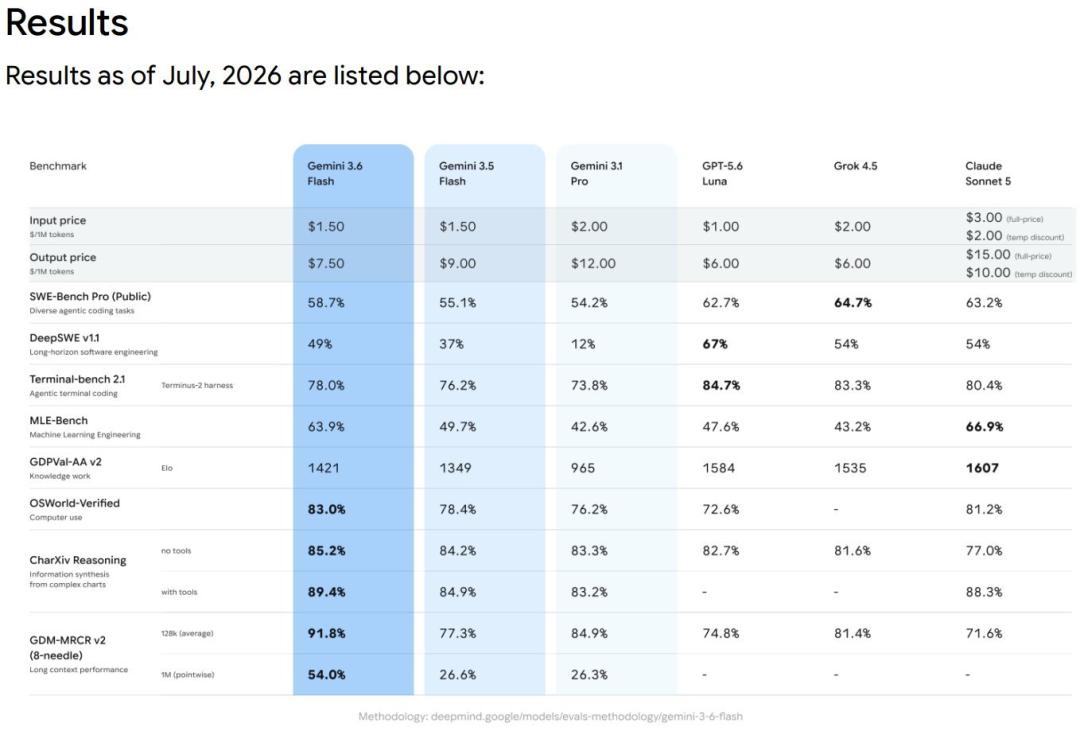
The pricing of Gemini 3.6 Flash is as follows:
- Input: $1.50 per million tokens
- Output: $7.50 per million tokens
Compared with the previous Gemini 3.5 Flash, which was priced at $1.5 per million tokens for input and $9 per million tokens for output, the input cost remains unchanged, but the output cost has been further reduced.
For enterprises that need to make massive AI calls, this cost reduction is likely far more important than a few percentage points of improvement on benchmark tests.
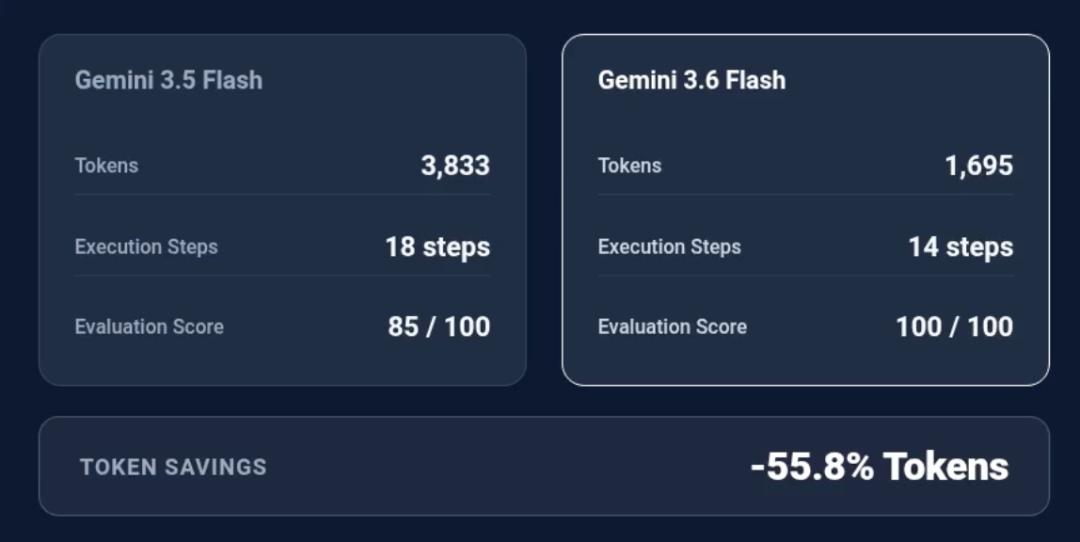
In addition, an internal test demonstrated by Google shows that when completing the same task, Gemini 3.6 Flash reduces token consumption by 55.8% compared to 3.5 Flash, while raising the task performance score from 85 to 100.
Of course, this is only Google's own test result, which only illustrates the direction Google wants to showcase:
The new model is not only more cost-effective, but also can complete the same task, or even deliver better results, with less computational resources.
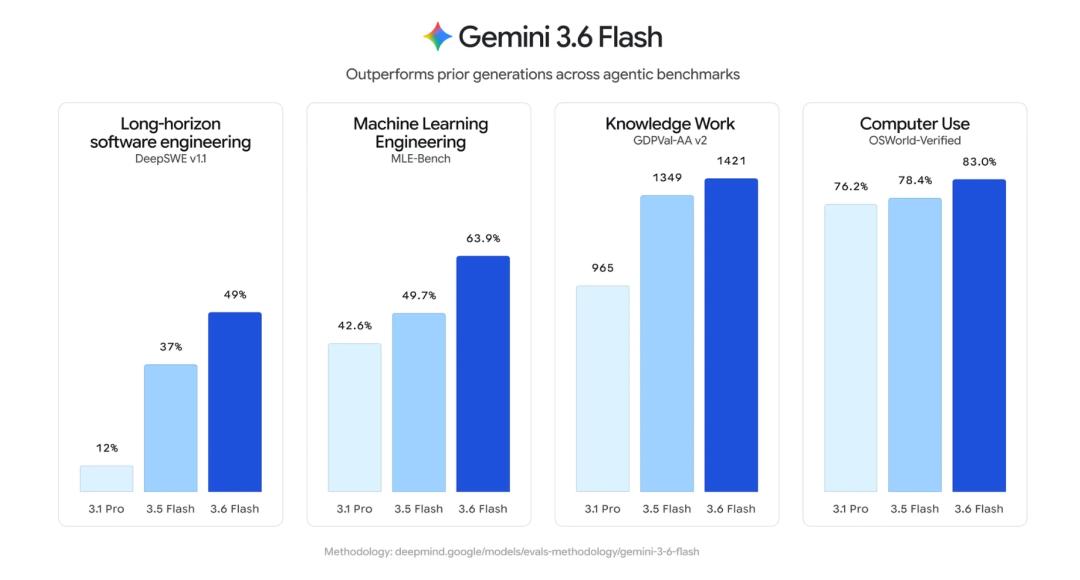
In the publicly released benchmarks, Google mainly highlights the model's coding capabilities and Agent performance.
In the DeepSWE code evaluation, Gemini 3.6 Flash scored 49%, higher than the previous generation's 37%. Google states that the new model can reduce invalid code modifications and redundant execution processes.
In the OSWorld-Verified benchmark that tests AI's ability to operate computers, Gemini 3.6 Flash scored 83%, surpassing 3.5 Flash's 78.4%.
In the MLE Bench for machine learning tasks, Gemini 3.6 Flash scored 63.9%, a significant improvement over the previous generation's 49.7%.
However, the above data mostly demonstrates that Gemini 3.6 Flash has made progress compared to the previous generation.
When placed in the current competitive landscape of large language models for horizontal comparison, Google positions its model against GPT-5.6 Luna, Grok 4.5, and Claude Sonnet 5 (which also clearly reveals the product's market positioning).
The results show that Gemini 3.6 Flash does not take a comprehensive lead, and GPT and Claude models still maintain advantages in complex software engineering and knowledge work tasks.
But this is exactly the value of the Flash series:
It does not necessarily need to be the most powerful model; it only needs to deliver sufficient capabilities at a cost significantly lower than that of flagship models.
Apart from official evaluations, according to pre-launch testing by Artificial Analysis, Gemini 3.6 Flash scored 50 on the Intelligence Index, on par with Gemini 3.5 Flash.
This means that if we only look at the model's overall "intelligence", Gemini 3.6 Flash does not bring substantial upgrades.
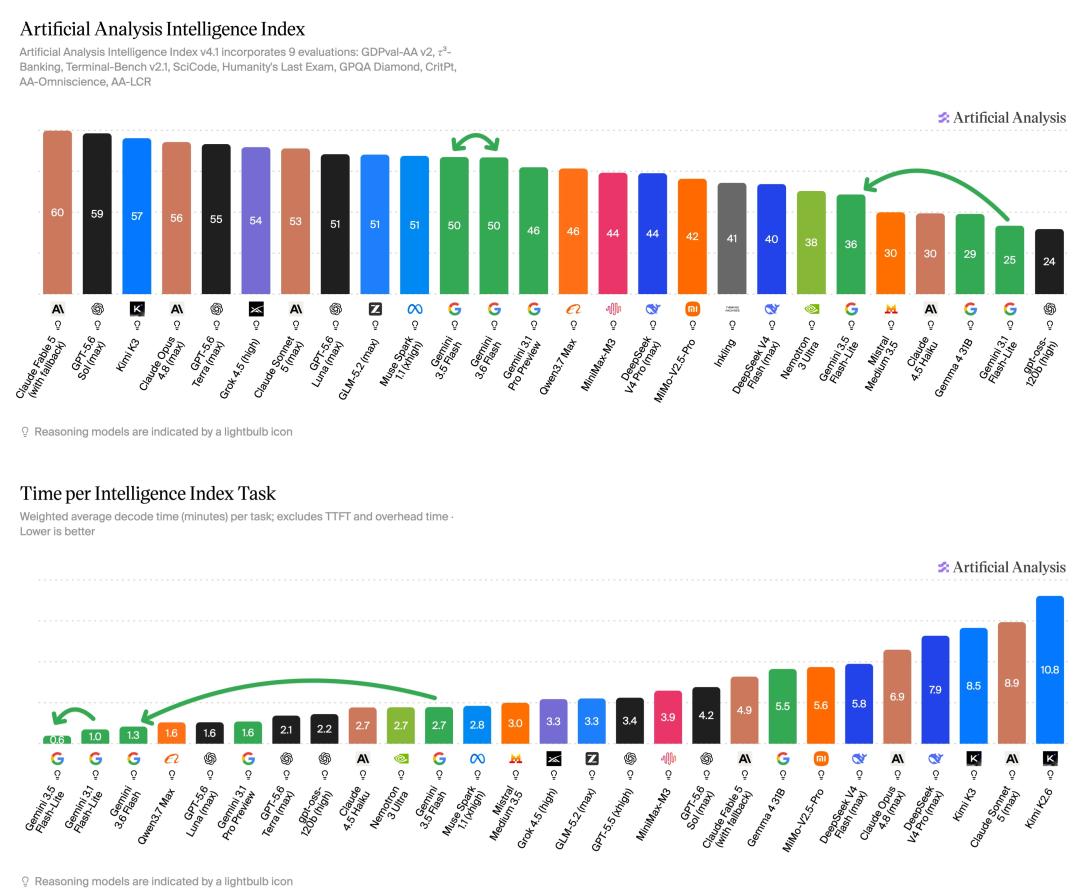
However, its excellent speed performance makes up for this shortcoming perfectly.
Artificial Analysis also calculated the average time the model takes to complete Intelligence Index tasks. The results show that Gemini 3.6 Flash takes an average of about 1.3 minutes per task, which cuts the total time by half compared to the previous generation 3.5 Flash's roughly 2.7 minutes.
At the same time, the task completion time of Gemini 3.5 Flash-Lite has also dropped from the previous generation 3.1 Flash-Lite's roughly 1.6 minutes to about 0.6 minutes.
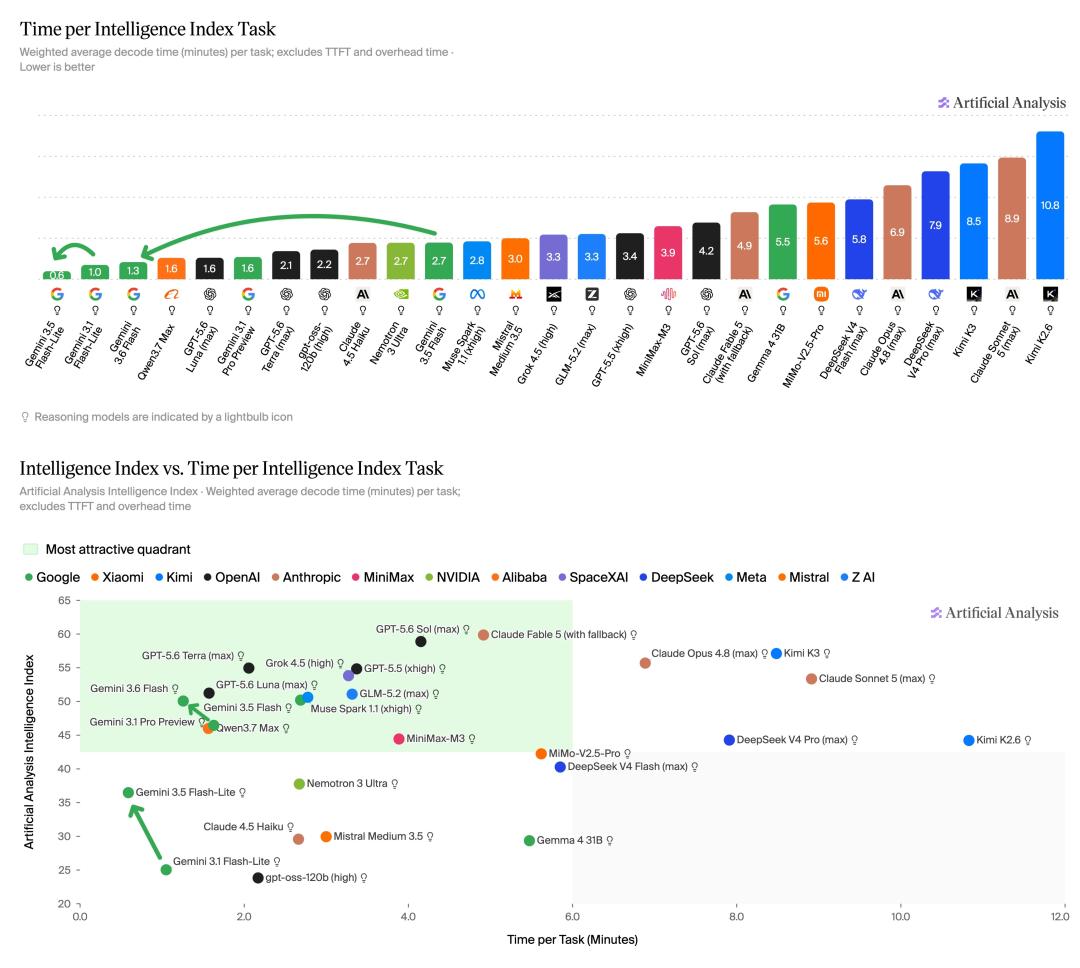
Overall, the upgrade direction of Gemini 3.6 Flash is essentially efficiency — less token consumption, lower operating costs, and Agent capabilities that are better suited for long-running operations.
For users who are accustomed to using Gemini 3.5 Flash, this is indeed a very impressive upgrade.
02
3.5 Flash-Lite: Faster, but not cheaper than the previous generation
Now let's take a look at the other model, Gemini 3.5 Flash-Lite.
As the name suggests, Flash-Lite is a more lightweight version in the Flash product line. Compared to the standard Flash model, it sacrifices a portion of the upper limit of capabilities in exchange for lower costs and faster inference speeds.
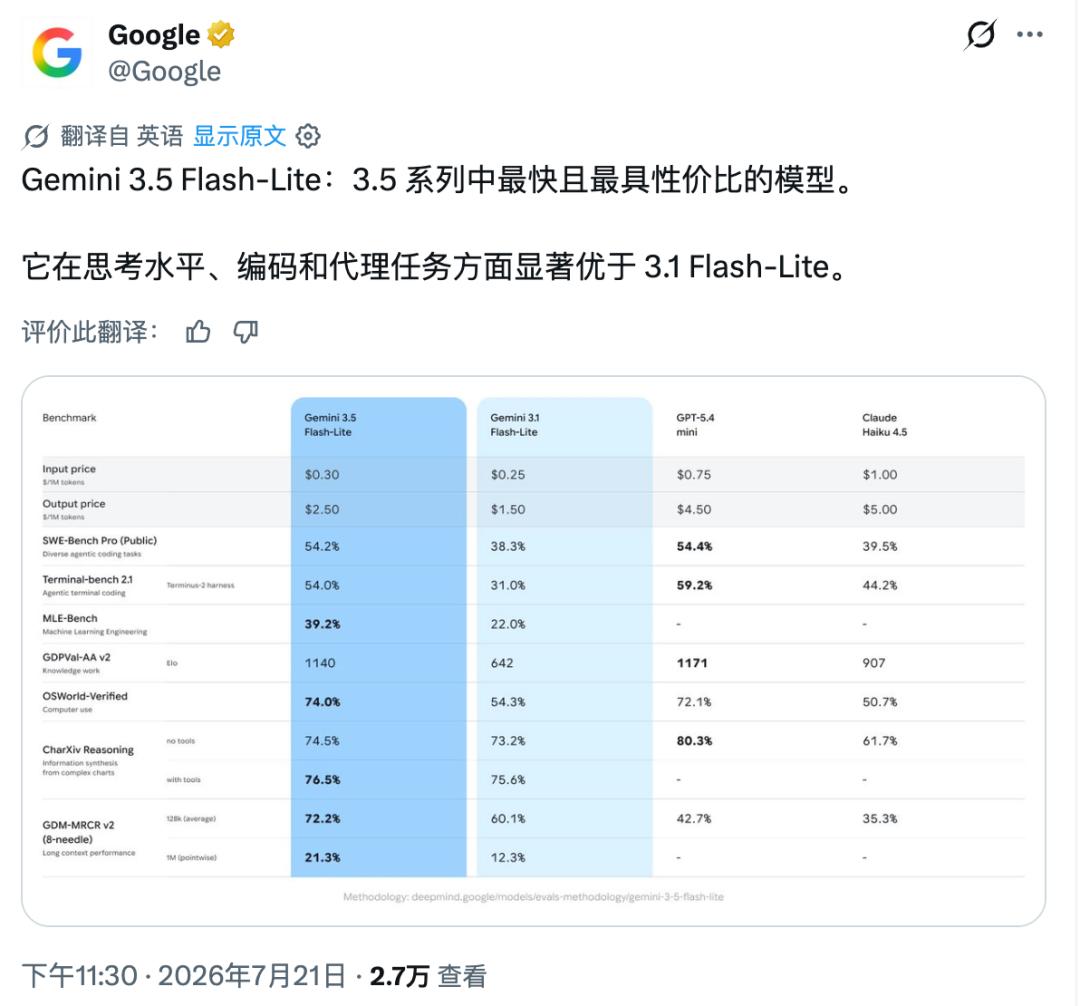
As mentioned earlier, the task completion time of Gemini 3.5 Flash-Lite has dropped from the previous generation 3.1 Flash-Lite's roughly 1.6 minutes to about 0.6 minutes.
3.5 Flash-Lite is also the fastest model in the 3.5 series. According to test data from Artificial Analysis, its generation speed reaches approximately 350 tokens per second, which already places it at the high-speed tier among current mainstream large language models.
The pricing of Gemini 3.5 Flash-Lite is as follows:
Input: $0.30 per million tokens
Output: $2.50 per million tokens
Compared with Gemini 3.6 Flash, its input price is about 1/5, and its output price is about 1/3. However, compared with the previous generation Gemini 3.1 Flash-Lite, the new model does not see a further price cut.
Although Gemini 3.5 Flash-Lite can reduce partial costs by cutting output volume thanks to improved capabilities, it is still difficult to offset the increase in unit cost when all factors are considered.
According to official documentation, compared with the previous generation Gemini 3.1 Flash-Lite, the new model shows significant improvements across different thinking levels. Developers can adjust the model's depth of reasoning based on specific task requirements.
In addition, Gemini 3.5 Flash-Lite has a built-in Computer Use capability, which helps Agents operate computer environments more reliably and complete cross-application tasks.
In specific tests, Gemini 3.5 Flash-Lite also shows significant improvements over the previous generation model: in the Terminal-Bench 2.1 programming Agent test, its score rose from 31% to 54%; in GDM-MRCR v2 which tests long-context understanding capabilities, its score increased from 60.1% to 72.2%; in the GDPval-AA v2 task execution test which is closer to real work scenarios, its performance metric jumped from 642 to 1140.
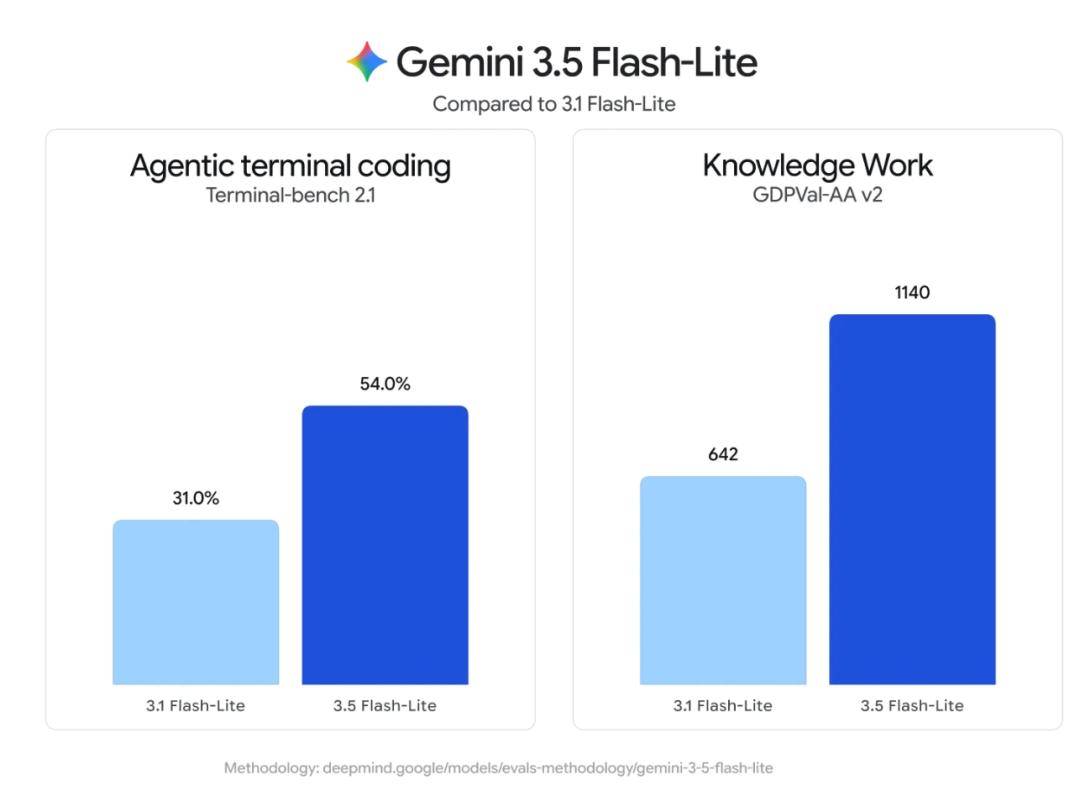
It is worth noting that in some Agent and code-related tests, Gemini 3.5 Flash-Lite even outperforms the previous generation Gemini 3 Flash model which was positioned at a higher tier.
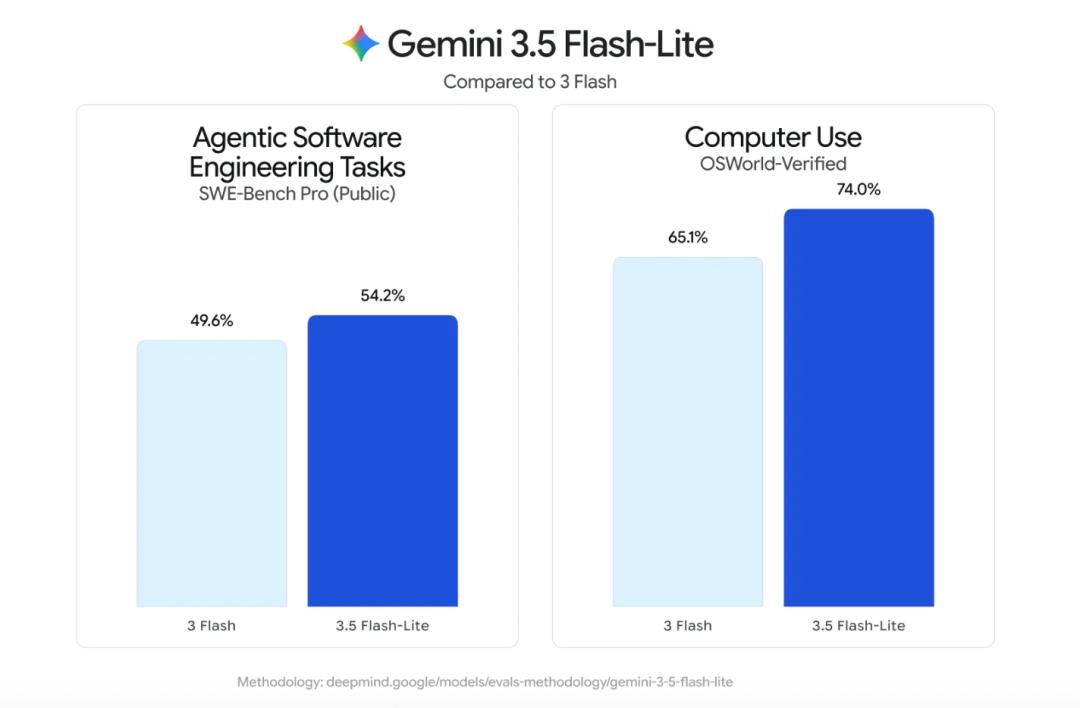
For example, in the SWE-Bench Pro software engineering test, Gemini 3.5 Flash-Lite scored 54.2%, higher than Gemini 3 Flash's 49.6%; in OSWorld-Verified which tests AI's computer operation capabilities, Gemini 3.5 Flash-Lite also surpassed Gemini 3 Flash's 65.1% with a score of 74.0%.
This means that as model capabilities continue to improve, some Agent tasks that previously required much larger models to complete are gradually being migrated to cheaper and faster models.
By the way, apart from the first two general-purpose models targeted at regular users, Google has also launched Gemini 3.5 Flash Cyber.
This model is specifically designed for cybersecurity scenarios. According to official documentation, within the CodeMender system, multiple Gemini 3.5 Flash Cyber Agents can work collaboratively to handle different analysis tasks separately, and finally compile the results into a complete report. In the CyberGym cybersecurity benchmark, Flash Cyber also delivers performance close to that of cutting-edge models.
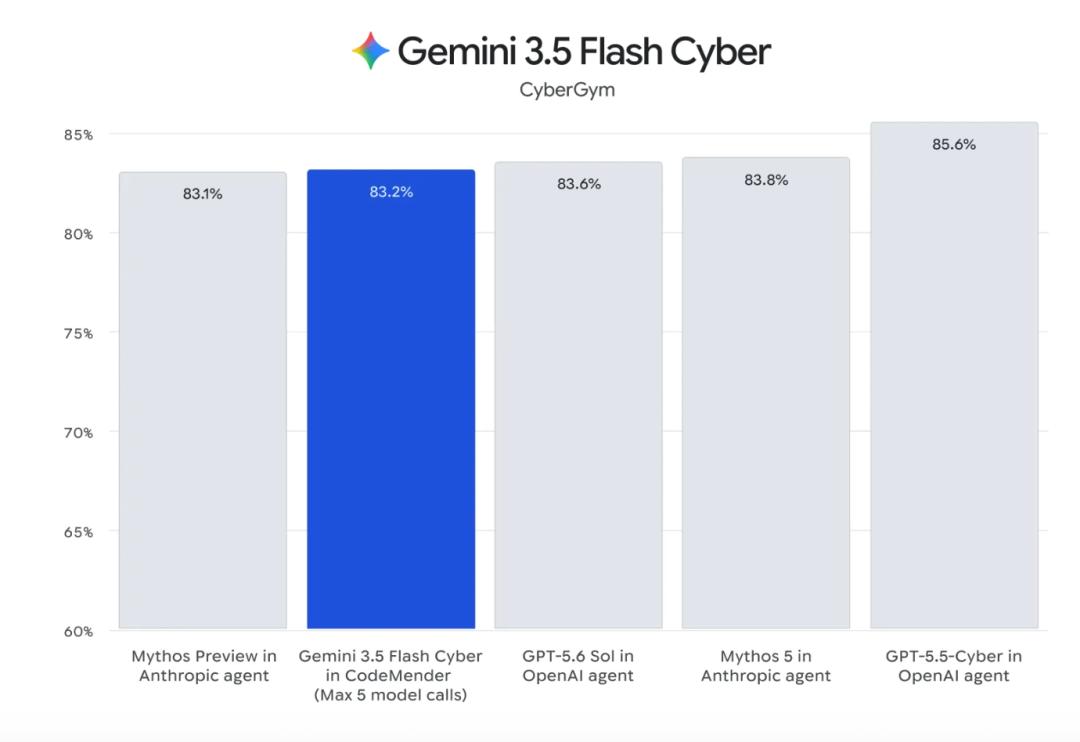
This model will not be made publicly available for now, and will only be accessible to governments and trusted partners through the CodeMender platform.
03
3.5 Pro: Google's long-overdue flagship performance report
If Gemini 3.6 Flash and Gemini 3.5 Flash-Lite can be regarded as Google's judgment on the large-scale application of AI, then Gemini 3.5 Pro represents the upper limit of Google's model capabilities.
But the problem is: this performance report still has not been submitted to this day.
At the I/O event in May, Google stated that Gemini 3.5 Pro would be launched "within the next month or so", which was originally scheduled to be released in June this year. Now more than half of July has already passed.
According to a Bloomberg report on July 16, the release timeline of Gemini 3.5 Pro has fallen months behind the original plan. Google is continuing to optimize the model's capabilities, especially its coding performance, in order to meet its internally set performance targets.
The latest Reuters report shows that up to now, Google still has not announced a specific launch date, only stating that the model is being tested with partners and will be released "very soon". Another press release reveals that the training work for Gemini 4 has already begun.
And as we all know, "very soon" is just a polite way of saying the timeline is uncertain.