Shanghai WAIC In-depth Observation: Models Go Stealth, Agents Run Wild
The 2026 WAIC showcases a distinct shift: large language models are receding from the center of exhibition booths, while AI agents are collectively stepping into the spotlight.
DeepSeek and Zhipu are absent, and Kimi, which just released its K3 model, still stays tucked in a corner. Even for high-profile exhibitors MiniMax and StepStar, their display focus is no longer limited to core models.
Even model vendors with relatively low public visibility like StepStar have completely abandoned pure model demonstrations, shifting their full focus to agents and hardware terminals.
On the other side of the exhibition hall, tech giants including Alibaba, Tencent, Baidu, and Ant Group are aligning their flagship products with office scenarios. Alibaba's Qwen integrates multiple office agents, Tencent is heavily promoting WorkBuddy, and Baidu's "Dazi" product is positioned as a dedicated workplace companion. Writing code, generating reports, creating PPTs, invoking tools, and integrating into business workflows have become universal keywords across the venue.
This does not mean the competition in the model sector has ended — on the contrary, fierce rivalry among model vendors continues beyond the exhibition walls. At the same time, however, an increasing number of industry observers recognize that large models are gradually being embedded into underlying infrastructure.
01
Zhichun Road does not believe in permanent model leadership
This year at WAIC, five of the renowned "Six Rising AI Stars" from the previous generation are present: Kimi, StepStar, MiniMax, Baichuan Intelligence, and 01.AI. Even Baichuan and 01.AI, which have shifted focus away from foundational model development, attended. The sole notable absence is Zhipu, which has enjoyed exceptional market momentum in recent months. (DeepSeek has consistently opted out of WAIC participation.)
WAIC serves as a critical window for enterprises to showcase their products to users, partners, and investors. Larger booth layouts typically signal a stronger desire to attract public attention. Zhipu participated in WAIC last year but remained entirely out of the public eye this year, a sign that the company — whose market value once exceeded one trillion yuan — no longer requires excessive public exposure.
On June 13, 2026, Zhipu released its GLM-5.2 model, which far exceeded market expectations. Breakthroughs in AI Coding, long-horizon tasks, and agent capabilities earned GLM-5.2 recognition from the developer community and industry institutions, reigniting capital market confidence in Zhipu.
However, the intense iterative race among the three leading firms based on Zhichun Road — DeepSeek, Kimi, and Zhipu — shows no signs of slowing. A lead on industry leaderboards one day can easily be overtaken by a competitor the next. Zhichun Road simply does not believe in permanent model dominance.
Sure enough, Kimi soon delivered a significant market blow to Zhipu. On the very day WAIC opened, Zhipu's market value plummeted sharply. On July 17, Zhipu's closing share price stood at HK$1107, marking a single-day drop of 28.49%. By the final day of WAIC on July 20, its market value fell a further 19.56% to close at HK$890.5. Over two trading days, Zhipu accumulated a total decline of 42.47%, with its market capitalization shrinking to HK$414.6 billion.
Market consensus widely links this stock price correction to Kimi's launch of its K3 large model on the evening of July 16.
K3 features a total parameter count of 2.8 trillion (MoE) with approximately 32 billion activated parameters. It delivers standout performance in programming, agent capabilities, and long-context processing across multiple public benchmarks, with some test results surpassing those of GLM-5.2. This has sparked market concerns over the sustainability of Zhipu's technological leadership, loosening the underlying logic supporting high AI sector valuations.
That said, competition is not the sole contributing factor. A confluence of negative market factors amplified negative sentiment: a large-scale unlocking of restricted shares in early July increased potential selling pressure, while Zhipu's prior share placement at HK$1588 saw its stock price quickly fall below the placement price, leaving participating institutions with substantial floating losses.
These factors, combined with the large cumulative stock price increase in the preceding period, already-high valuation levels, and the overall weakness in the Hong Kong stock technology sector, collectively drove this market correction.
Even though Kimi released its new model the day before WAIC opened, the company maintained a low profile throughout the event.
Kimi's booth was small and located in a corner last year, and this year's layout was no different. Compared to the spacious, crowded booths of MiniMax and StepStar, Kimi's exhibition area appeared relatively quiet.
The most eye-catching element was its blue background, with some visitors queuing to collect promotional gifts, overseen by several staff members — a portion of whom were temporary part-time workers.
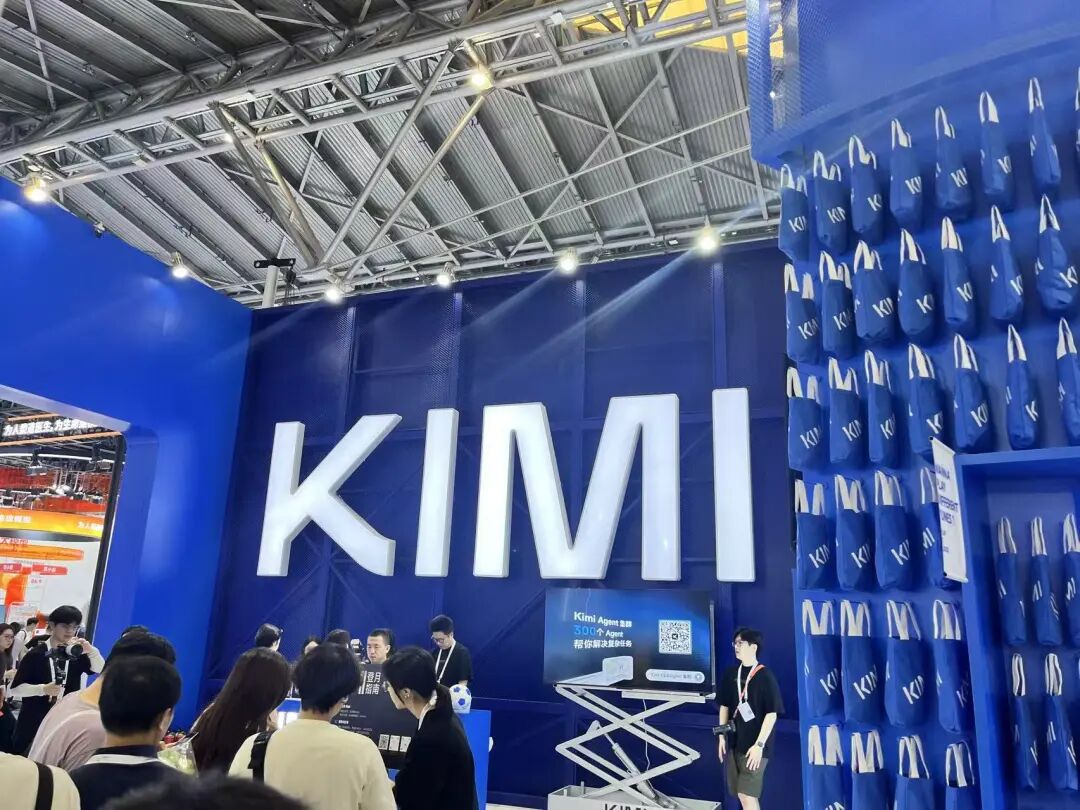
Kimi paid relatively little attention to WAIC last year, in part because the team focused intensely on developing new models to catch up after facing competitive pressure from DeepSeek.
This year, Zhipu became Kimi's larger rival, prompting the team to redouble its efforts to keep pace. Core team members remained fully occupied behind the scenes to ensure the successful launch of K3, leaving them no available time to participate in WAIC.
However, multiple independent tests confirm that K3 has truly surpassed domestic open-source models, even creating a sensation in Silicon Valley — earning far broader recognition than participation in WAIC could have delivered.
MiniMax and StepStar, both Shanghai-based model vendors, naturally treat WAIC as their home event, investing in large booth spaces and showcasing a wide range of products. Despite widespread criticism following the release of MiniMax's M3 model, the product's introduction still occupies a prominent position at the booth, highlighting its capabilities in coding, agent functionality, multimodal understanding, and long-context processing.
Notably, last year MiniMax's founder and CEO Yan Junjie was at the peak of his public profile, delivering a keynote speech titled "Everyone's AI" at the WAIC opening ceremony main forum, where he shared a table with AI pioneer Geoffrey Hinton.
This year, the market landscape has shifted dramatically. MiniMax's market value has remained persistently depressed, and Yan Junjie appears to have little energy to spare for WAIC. A MiniMax employee told our team, "Our boss has been in a low mood every day recently."
Even so, MiniMax's booth retains a highly visible position near the entrance, with a festive red color scheme that draws a constant stream of visitors taking photos.
In contrast, Yin Qi, Chairman of StepStar and Horizon Robotics, attended this year's opening ceremony as a special guest and delivered a keynote speech titled "When Agents Enter the Physical World" at the main forum.
Once a pure model company, StepStar has almost entirely removed model demonstrations from this year's event. On July 13, StepStar officially launched STEPX, a large-model-native AI terminal brand, marking the company's strategic transition from a model developer to a terminal manufacturer. While competition among large model companies once centered primarily on model performance, StepStar aims to embed model capabilities directly into devices that users interact with daily, using hardware terminals to carry agent functionality.
Concurrent with the brand launch, StepStar released Step AOS, an agent-native operating system built for the agent era, a personal agent product named Amoo, and made its debut with the STEPX Neo, a large-model-native agent smartphone.
StepStar's models once had minimal visibility among the "Six Rising AI Stars," but the company — once seen as a latecomer in foundational model development — has pivoted directly to the red-hot agent track. As an industry-focused AI entrepreneur rather than a purely technical founder, Yin Qi has long sought practical integration points between AI and real-world industries.
Yin Qi has finally seized the current agent-driven opportunity to redefine his company's competitive position. Undoubtedly, shifting from the model competition arena to the agent and hardware terminal sector places him on far more familiar battleground.
Compared to foundational model development, building agents and related applications represents a strategic "down-dimensional" shift. StepStar is currently in the final preparation stages for its Hong Kong stock IPO, a move that implies significant constraints on its valuation upside potential.
The remaining two of the "Six Rising AI Stars" that have moved away from foundational model development, Baichuan Intelligence and 01.AI, have fully transitioned to a more mature industry stance. 01.AI's founder Li Kaifu even hosted a new book signing event directly at his company's booth, aiming to attract top enterprise decision-makers in the AI era.
02
Agents run wild
It is undeniable that beyond large models, AI agents have emerged as a defining highlight at this year's WAIC, with nearly every vendor showcasing agent products as core offerings.
Alibaba, with its diverse business lines, allocated a substantial portion of its booth space exclusively to agent demonstrations. Notably, Alibaba's consumer-facing Qwen product is now heavily emphasizing office scenarios. The booth features a long, dedicated office table with ten computers arranged in two rows, almost always fully occupied by visitors during the event.
Office scenarios represent a shared priority for both model startups and large tech giants this year, with Kimi, Doubao, and ChatGPT all targeting this high-potential market.
In the past, Qwen primarily functioned as a "business assistant" within Alibaba's internal ecosystem, supporting e-commerce, food delivery, and customer service use cases. However, by presenting office scenarios as a standalone, highlighted offering at its WAIC booth, Alibaba signals a clear strategic shift in Qwen's primary application focus.
According to a report from *Caijing*, Qwen has integrated three existing agent products — QoderWork, Wukong, and MuleRun — evolving from a general-purpose chat assistant into Alibaba's dedicated agent for office scenarios. A Qwen team member confirmed to us, "Office scenarios are definitely the core focus for Qwen."
In addition to Alibaba's coding-focused agent Qoder, its no-code platform Miaowu, and products supporting agent development security, Alibaba DAMO Academy also publicly debuted "DAMO Lingshu," its first agent platform dedicated to scientific research.
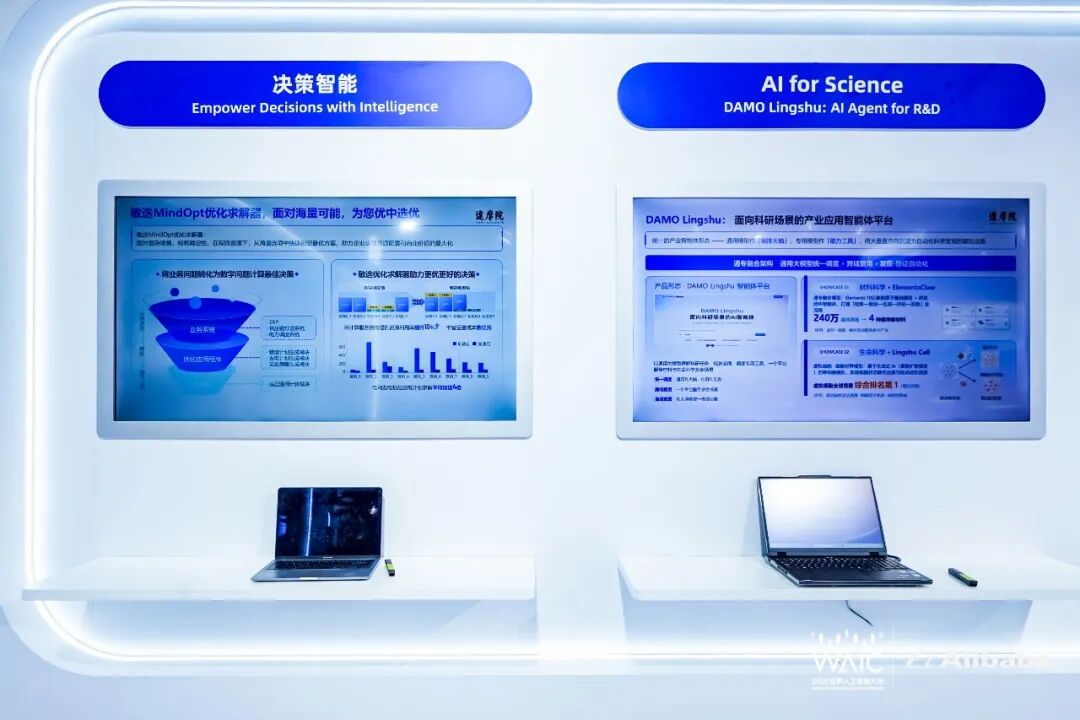
"DAMO Lingshu," designed as an agent for cutting-edge scientific exploration, drew significant curiosity from researchers at the event, indicating that the AI for Science track is gradually entering mainstream public view. We learned that the platform has been in internal testing since its development began in the second half of last year, with initial access limited to two core scientific research domains: life sciences and materials science.
In fact, in early July this year, DAMO Academy collaborated with universities to launch ElementsClaw, the industry's first dedicated agent for superconductor materials research, which has already discovered and validated four new superconducting materials.
Positioned right next to Alibaba's Qwen booth is Tencent. Similarly, Tencent's Yuanbao assistant is largely sidelined, with the most prominent booth space reserved for agent products.
At the booth entrance, a dedicated display board for agent applications showcases Tencent's star consumer product WorkBuddy, its AI-native coding agent CoderBuddy, and Qclaw. WorkBuddy, positioned as an AI-native workplace agent workspace covering all office scenarios, launched in March this year and has since become one of China's most active AI-native office agent products.
According to data released by Analysys on July 20, Tencent WorkBuddy recorded over 20 million monthly visits in China's PC-side AI-native office agent market in June, ranking first in market share. Driven by explosive market momentum, WorkBuddy has widely been regarded as Tencent's new "ticket to success" in the AI era.
Tencent treated WAIC as a dedicated promotional event, inviting service partners to provide on-site support. Team members approached nearly every visitor to ask whether they had experienced WorkBuddy. One partner representative told us that during a dedicated WorkBuddy promotion event held in Wuxi the previous day, the team received over 170 customer inquiries and closed deals with more than 40 enterprise clients.
Beyond general-purpose office agents, the theme at Tencent's Hunyuan model display area focuses on enabling seamless model integration with agents. The booth showcases a wide range of models hosted on Tencent's large model service platform, including Kimi, GLM, DeepSeek, and the latest Hunyuan models HY3 and HY World 2.0.
As the old saying goes, "After searching thousands of times, Baidu appears right beside you." Located not far from Tencent's booth, Baidu is also expanding its full AI agent portfolio, covering both general-purpose agents and vertical scenario-specific agents. Baidu's general-purpose agent "Baidu Dazi" was selected as one of WAIC's top 10 "Treasures of the Pavilion," positioned on-site as a dedicated AI companion for workplace professionals.
A prominent slogan at the booth — "No extra innings at work, let Baidu Dazi handle it for you" — clearly reflects the industry trend of AI agents evolving from auxiliary tools into full-fledged workplace collaborators.
A Baidu Dazi team member told us, "Baidu Dazi focuses on broad, general coverage, while our vertical scenario agent 'Famou' targets commercial use cases with deeper, more specialized capabilities. In the future, these vertical agents will all be integrated into Baidu Dazi as callable skills for users."
Agents continue to spread across the exhibition hall, growing in diversity and ambition.
Major vendors including Ant Group, iFLYTEK, SenseTime, and FaceMind have all reserved their core booth spaces for agent demonstrations. A product manager from Ant Group explained the widespread enthusiasm for agents: on one hand, significant improvements in model capabilities, paired with market education from widely adopted agents like Doubao and Qwen, have demonstrated that users can complete traditional office tasks such as generating reports and creating PPTs through natural language conversations.
On the other hand, the B-end coding sector has already proven to be the most profitable segment for AI applications. Other enterprise scenario use cases remain largely uncharted territory, with no widely validated successful business models, prompting companies to rush to stake their claims on new opportunities.
Notably, ByteDance maintained its usual low profile and did not participate in WAIC. However, a Doubao smartphone experience zone was set up at ZTE's booth, displaying the Doubao Phone 2.0 prototype that was not yet available for hands-on testing. Even absent from the event, ByteDance's presence still felt ubiquitous.
A Google Cloud executive described the current mobile software ecosystem, predicting that Qwen and Doubao will emerge as two of the largest AI entry points, while Tencent retains its advantage as a super app. In the long term, the market will feature a coexisting landscape of AI assistants (agents), super apps, and AI search engines.
03
A non-stop race
The shifts observed at the 2026 WAIC venue are a microcosm of the broader AI industry's evolution in the first half of this year. As model capabilities become sufficiently robust, their application focus is naturally shifting from personal entertainment scenarios to office environments that demand far higher standards for accuracy and compliance.
The receding visibility of models does not imply their diminishing importance. Competition surrounding foundational models is far from over: the current 3-trillion-parameter scale is just a starting point, and we have learned that several leading model vendors are already in training phases for 5-trillion and 10-trillion-parameter models.
Model competition is no longer inherently equivalent to end-product competition. Exhibitors are racing to launch agent products capable of writing code, generating reports, creating PPTs, and integrating directly into business workflows — and large models themselves are not lacking for more polished user interfaces.
While large models generate reasonable next-step recommendations based on input, agents must execute that step, observe real-world outcomes, and dynamically determine subsequent actions. Technically, research frameworks including ReAct, Generative Agents, and Voyager supplement models with critical mechanisms for action execution, memory retention, feedback processing, and self-correction, enabling sustained operation in real-world environments.
While strong model performance is essential for real-world deployment, equally critical are mature business workflows and the engineering capabilities required to process data distributed across disparate platforms.
Agents are increasingly functioning as an intelligent orchestration layer within systems, while large models — as the core "production layer" for intelligence — are being embedded into underlying infrastructure. For large model vendors, agents have become the "magic touch" that translates raw model capabilities into tangible user value.