The "Six Little Dragons" of world models got into a heated debate at WAIC, and industry dividends lie in areas outside the mainstream consensus.
World model is currently one of the most hyped yet least consensus-driven fields in the AI industry.
There is no convergence in its conceptual definition, technical routes, training methods, data standards, or evaluation metrics...
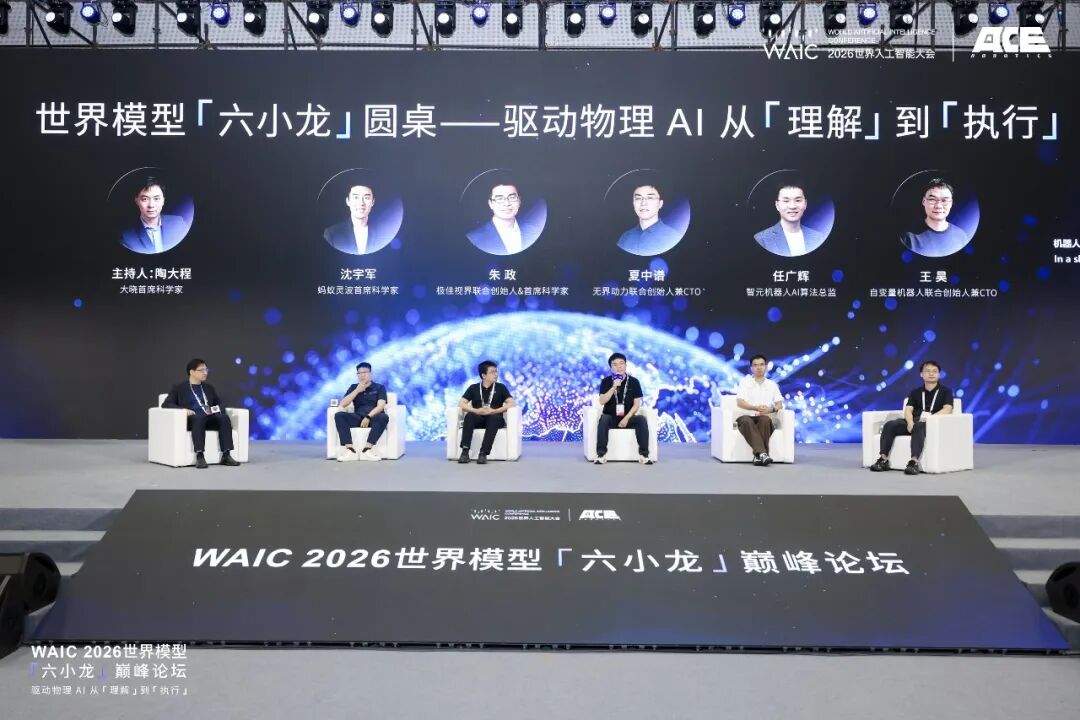
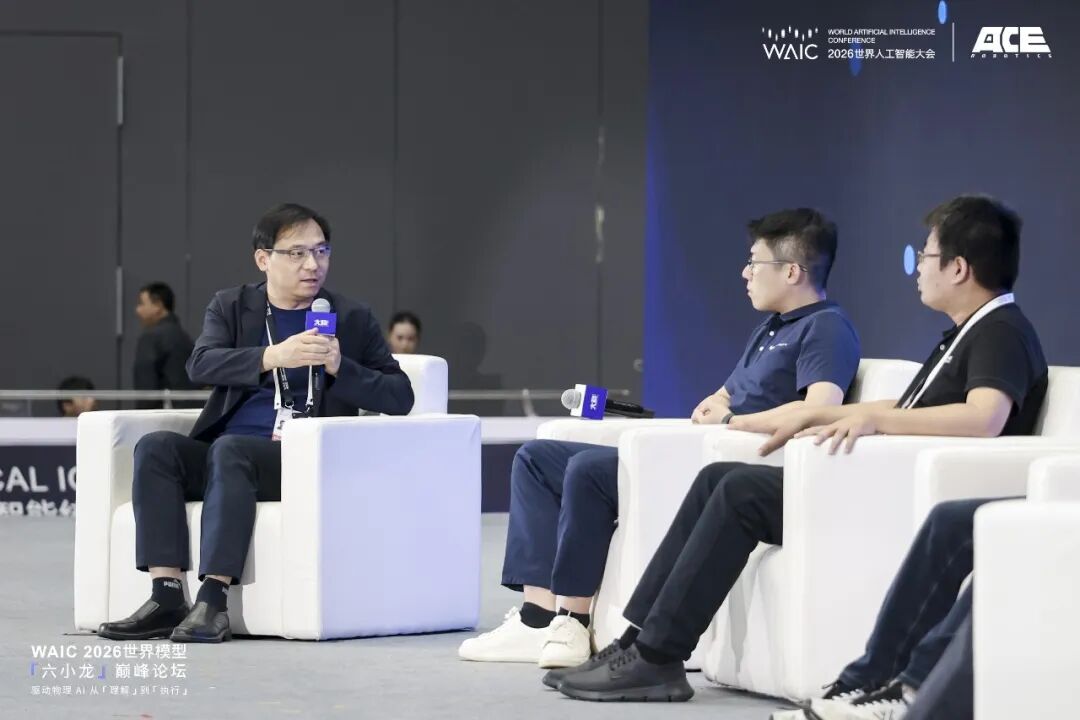
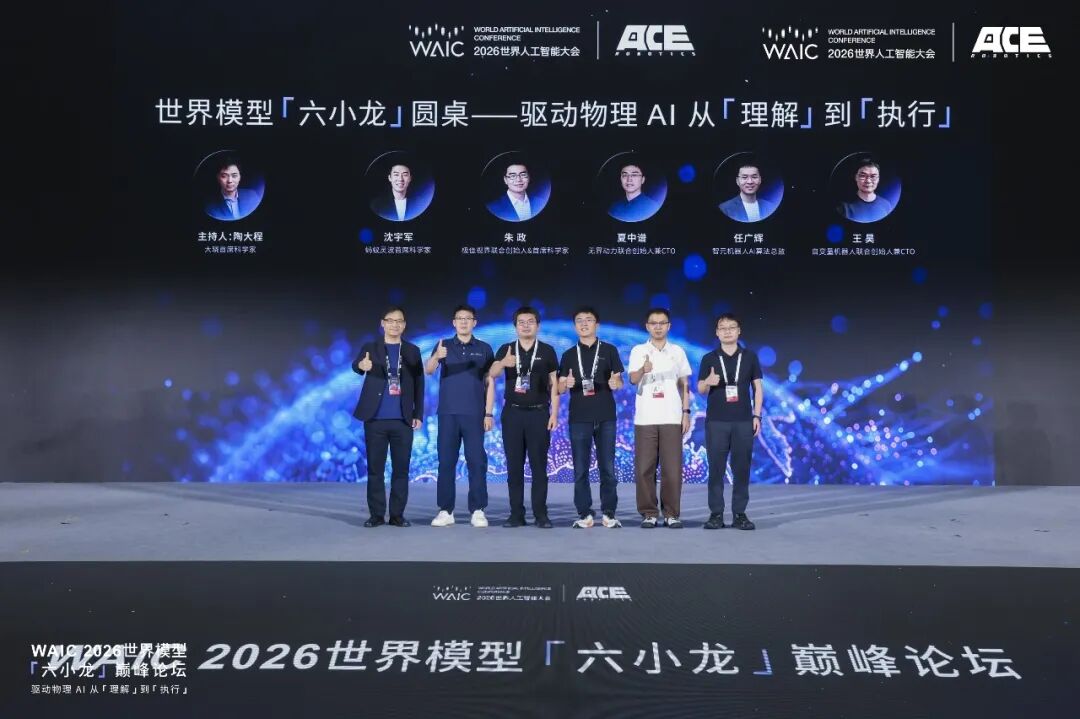
On July 19th, during the "Six Rising Stars of World Models" forum at WAIC, an information-dense roundtable discussion gathered the world model technical leads from six companies. They are:
Tao Dacheng, Chief Scientist of Daxiao Robotics (Host)
Shen Yujun, Chief Scientist of Ant Lingbo
Zhu Zheng, Co-founder & Chief Scientist of Excellent Vision
Xia Zhongpu, Co-founder and CTO of Unbounded Dynamics
Ren Guanghui, Director of AI Algorithms at Agibot Robotics
Wang Hao, Co-founder and CTO of Independent Variable Robotics
The perspectives shared by these guests represent the industry's most cutting-edge thinking on world models, which is well worth exploring.
What Capabilities Matter the Most?
We won't dwell on the few existing consensuses, as the disagreements among the guests are the most intriguing part.
Let's start with the ongoing debate over technical routes for world models.
The technical routes these six companies are currently betting on can be roughly categorized into three schools based on the metric of "in what space does the model simulate the world":
Pixel Generation School: Represented by Excellent Vision
Latent Space (JEPA) School: Represented by Unbounded Dynamics
Integration School: Represented by Daxiao Robotics (integrated understanding, generation, and prediction), Ant Lingbo (launched a full suite of world models across multiple routes), Independent Variable Robotics, and Agibot Robotics
Due to their different technical routes, these companies naturally hold differing views on many key issues.
For example: To what extent should a world model understand the physical world?
One side hopes it can be as close to a physical simulator as possible.
Xia Zhongpu from Unbounded Dynamics proposed that evaluating a world model should focus on its prediction accuracy for states like geometry, motion, and force.
The other side argues that robots don't need to become physicists first.
Shen Yujun from Ant Lingbo believes that "physical rationality" is more important than "physical precision". Robots only need to understand that iron of the same weight falls faster than cotton, but they don't need to know exactly how much faster—they can just observe it.
He stated that robots don't have to calculate every trajectory or reproduce every physical parameter. It's sufficient for them to know which differences will affect their immediate actions.
The guests also hold divergent views on the criteria for evaluating model capabilities.
Ren Guanghui from Agibot believes that long-term physical consistency of reasoning is one of the essential indicators for evaluating the capabilities of a world model.
However, Wang Hao from Independent Variable Robotics directly states that long-horizon simulation is a "pseudo-demand". He prioritizes the timeliness of reasoning over this capability. If reasoning is too slow to meet the decision window, even the most comprehensive understanding becomes useless.
Beneath these clashing perspectives, each guest is defending the strengths of their own company's model.
For the model's understanding of the physical world, latent spaces can directly regress physical quantities, hence the demand for physical precision. Pixel generation inherently learns "visually plausible" results, so it only guarantees physical rationality.
As for long-term consistency, Agibot's world model is largely designed to act as a simulator, where long-horizon simulation is the lifeblood of the simulator. Independent Variable Robotics integrates the world model and VLA into a single end-to-end framework, where prediction is a pre-step for action generation. The longer the prediction horizon, the slower the reasoning and the more decision time it consumes.
What Will Converge First?
Apart from the debate over technical routes, what is most likely to be the first point of convergence for world models in the next phase?
The guests have varying judgments on this.
Ren Guanghui and Xia Zhongpu believe it will be unified representation. Language models have found their tokens, but embodied intelligence has not yet found its own "token". Modalities such as vision, language, and action need to be aligned into a single representation.
Wang Hao bets on integration: video generation contributes future prediction, latent space contributes reasoning, and 3D explicit modeling acts as spatial memory. Leveraging each of their strengths to build a new architecture is a pattern that already occurred during the development of large language models.
Shen Yujun's bet is on tactile perception. He is confident that the industry will reach a consensus in the next phase that tactile perception will become an indispensable modality for robots. Once tactile data achieves a breakthrough, world models for the physical world and those for the digital world will go their separate ways.
Many current robot world models are migrated from video generation models built for the digital world. Ant Lingbo, however, is developing an embodied-native world model, starting from the requirements of control and execution, pre-trained from scratch based on an autoregressive architecture. This model is designed for "predicting while acting", rather than generating visually appealing images.
Tao Dacheng believes that the next convergence of world models will not occur on a single technical route, but on a horizontal, unified evaluation benchmark.
He gave an example: the boom of deep learning did not happen because neural networks defeated the feature engineering camp in debates, but because ImageNet put all methods under a single unified benchmark. Once the benchmark is unified, convergence will naturally follow.
During the forum, Daxiao Robotics launched PHYSICAL IQ, positioning it as the first embodied-native physical intelligence evaluation benchmark platform for multi-scenario, multi-robot, and multi-task use cases, to fairly quantify the physical intelligence level of different robot bodies and world models.
From Demo to Deployment
Despite the differing technical routes, once robots enter the physical world, the final evaluation criterion becomes very simple: can they complete tasks stably?
According to Xia Zhongpu's definition, this is "decision effectiveness"; Ren Guanghui describes it from a more technical perspective as "how much it ultimately improves the policy metrics"; Zhu Zheng defines it as "the success rate of multi-task operation on real robots". These metrics have different names, but their goals are aligned.
Stably completing a task in a demo is not difficult, since unlimited resources can be invested for a single demonstration. The real challenge lies in large-scale deployment in the real world.
Wang Hao shared a pattern: when model capabilities improve from 90% to 99%, and then from 99% to 99.9%, the cost invested does not grow linearly.
A seemingly minor error rate in the experimental environment can translate to repeated manual interventions and reworks at the deployment site, eventually leading to unsustainable operational costs.
The ability to handle random and unexpected situations is also a necessary capability for robots to develop after leaving the laboratory.
Shen Yujun gave an example in a supermarket scenario: when a robot is looking for a bag of vegetables, a customer might have accidentally placed it in the milk cabinet. A single incident like this might be a rare occurrence, but for a robot that interacts with different customers every day, this is a regular situation.
Tao Dacheng from Daxiao Robotics emphasized the importance of edge-side capabilities for deployment.
Many world models run on the cloud, but the time left for a robot to make a judgment might only be tens to hundreds of milliseconds. The network cannot always be online, and the cloud cannot always be waiting.
He said: The hardest part is not making the model smart, but making that intelligence affordable, reliable, and responsive.
In one sentence: A demo showcases the upper limit of capabilities, while deployment tests the lower limit of capabilities.
Finally, there is a thought-provoking question: World models only truly became popular in the first half of this year. Looking back two years from now, what are we doing right, and what are we doing wrong at this moment?
Shen Yujun said that the industry sometimes confuses "the inherent capabilities of a model" with "the demonstrated capabilities of a model". The inherent capabilities of a model are internal attributes such as generalization efficiency and interactivity; the demonstrated capabilities are external presentations such as generation quality.
He believes that in two years, all work done to improve the inherent architectural capabilities of the model will be proven right, but over-pursuing the externally demonstrated capabilities may not be a correct direction. All preparations made for the data pipeline will be proven right, but it is uncertain whether the data accumulated now will eventually be used or iterated later.
Zhu Zheng said that too many non-model related tasks are currently diverting attention. When the base model has not yet converged, exploring too many commercialization scenarios at this stage will most likely not succeed.
Ren Guanghui stated that in two years, world models will become more "embodied-native", requiring larger-scale embodied-native data and architectures designed specifically for embodied use cases.
This roughly one-hour roundtable discussed several of the most noteworthy topics about world models, presenting representative consensuses and disagreements in the current stage of the industry.
Tao Dacheng's summary was spot on: Disagreements are the material for academic papers, while overlapping insights form the foundation of the industry. For the entire industry, disagreements are not a problem—they are actually the current dividend.
This article is from the WeChat official account "QbitAI" (ID: QbitAI), authored by Lin Fangzhou, and published with authorization from 36Kr.