RTDT Laboratories, a Swiss engineering and technology enterprise, develops wireless smart sensor patches to monitor the operating status of wind turbine blades in real time | Top 100 Swiss Innovations

Image source: startupticker
Swiss engineering and technology firm RTDT Laboratories was founded in 2022, focusing on the R&D of wireless intelligent sensing patches. These patches integrate microelectronic sensors and proprietary algorithms, enabling real-time collection of aerodynamic and structural data of blades during actual operation. Combined with supporting analysis software, the data is transformed into decision-making foundations for wind turbine control, design, operation and maintenance, supporting structural health monitoring and power performance optimization of wind turbines.
RTDT Laboratories is a spin-off company of ETH Zurich, co-founded by Imad Abdallah, Aris Mukherjee, and Konstantinos Tatsis. Imad Abdallah, the company's CEO, holds a PhD from the Technical University of Denmark, with research focused on design load and safety optimization of modern wind turbines. He previously served as a postdoctoral researcher and senior scientist at ETH Zurich, overseeing intelligent monitoring, inspection, and full lifecycle assessment for wind turbines. Aris Mukherjee, the company's COO, holds a Master's degree in Electrical Engineering and Information Technology from ETH Zurich, and was previously responsible for investment analysis and business expansion at Serpentine Ventures. Konstantinos Tatsis, the company's CSO, holds a PhD from ETH Zurich, with research focused on dynamic system virtualization that fuses data-driven models and physical models. He previously worked as a senior data scientist at the Swiss Data Science Center.
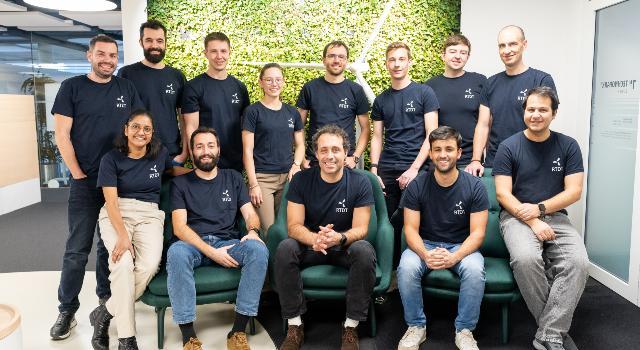
Image source: VentureLab
Traditional wind turbine operation and maintenance has long relied on nacelle sensors, simulation models, and manual inspections, making it difficult to obtain real, continuous data such as aerodynamic pressure, vibration, strain, and structural loads on blade surfaces in real time. As blades increase in length, traditional sensors cannot be directly deployed on blade surfaces, leaving operators unable to grasp pressure distribution, inflow conditions, and aerodynamic efficiency under real wind conditions. Meanwhile, uniform factory parameters cannot adapt to the differences in terrain, turbulence, wind shear, and dominant wind direction across various wind farms, resulting in power generation losses. At the same time, most wind turbine designs are based on wind tunnel tests and simulation models, lacking support from measured data, making it difficult for manufacturers to verify designs, optimize structures, and control costs, with inaccurate remaining service life and risk prediction. In addition, regular inspections, drone checks, or shutdown examinations can only detect already formed surface defects, making it hard to identify load anomalies, vibration changes, and performance degradation in advance, which easily leads to unexpected shutdowns and high maintenance costs.
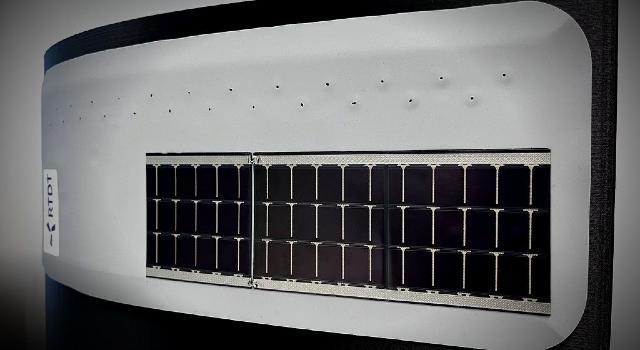
Image source: VentureKick
RTDT Laboratories has developed an integrated hardware-software wireless intelligent sensing patch, which can obtain aerodynamic and structural data of wind turbine blades in real operating environments in real time, and output optimization suggestions through algorithm analysis software, helping manufacturers and operators improve wind turbine operational efficiency.
In terms of hardware, the patch is embedded with a variety of micro electronic components and sensors, which can continuously measure actual operational data of blades such as aerodynamic pressure, acceleration, vibration, mechanical load, and temperature, while synchronizing timestamps. The data is wirelessly transmitted to the wind turbine gateway, then uploaded to the cloud to generate a digital twin model of the blade, used for comparing with the original design, accurately evaluating pressure distribution, and guiding the optimization of blade design and control. The patch can be fixed on the blade surface with removable adhesive tape, no drilling or modification to the main blade structure is required, and deployment can be completed within minutes. Its ultra-thin and lightweight design adapts to any position of the blade. The patch adopts an ultra-low power consumption design, integrates photovoltaic cells and an intelligent battery management system, no external power supply is needed. Currently, the patch is available in two specifications: 400×160×4mm and 160×160×4mm, suitable for retrofitting in in-service wind turbines, installation in blade factories, blade transportation monitoring, wind tunnel tests, and other scenarios.
In terms of software, the supporting software from RTDT Laboratories features calibration, analysis, and decision recommendation functions. The software calibrates real-time data collected by the patch to ensure reliability; its proprietary algorithms perform local and global analysis on the data from specific blade positions and the whole turbine level, including blade kinematics, aerodynamic pressure coefficient, inflow conditions, and structural integrity identification, while supporting visual analysis such as phase averaging and conditional averaging to complete advanced performance assessment; its decision recommendation function further transforms analysis results into specific actionable suggestions, such as controller tuning for specific sites, annual power generation improvement, blade design optimization, and equipment service life extension, thereby enhancing the profitability of wind turbines.
In July 2025, RTDT Laboratories completed a $4 million pre-seed financing round, led by Swisscom Ventures, with participation from Rockstart, BackBone Ventures, Kickfund and other investors. The funds will be mainly used to expand the production capacity of wireless intelligent sensing patches, increase pilot deployments with wind power industry partners, and strengthen commercial expansion in markets such as Europe. The company plans to achieve large-scale deployment in early 2027.

RTDT Laboratories is a 2025 TOP100 Swiss Startups honoree. The TOP100 Swiss Startups list brings together the best "Swiss Made" tech innovation startups and growth-stage companies, serving as the most internationally influential benchmark ranking in Switzerland's tech innovation sector. Since 2011, this list has selected 100 of the most pioneering and market-promising Swiss innovative enterprises and 25 Swiss growth-stage companies with the highest unicorn potential across Switzerland every year, covering fields including life sciences, engineering machinery, robotics, information and communications technology, low-carbon technology, and food technology. The TOP100 Swiss Startups and its series of brand events are landmark activities in Switzerland's innovation ecosystem, representing the highest ground of Swiss innovation and the forefront of international investment and financing.
The 2025 Chinese version of TOP100 Swiss Startups is honorably released by Insight Tech. Insight Tech is the authorized Chinese partner of TOP100 Swiss Startups, responsible for the operation and promotion of TOP100 Swiss Startups in China and assisting the listed projects in developing commercial cooperation with China. Insight Tech is a service provider for Sino-European (Swiss) industrial innovation cooperation, dedicated to promoting the localization of Swiss innovations in China and the internationalization of Chinese industries through ecosystem construction and cross-border empowerment.
To obtain the full TOP100 Swiss Startups list and industry-specific rankings, please visit the official WeChat account or website of Insight Tech.