China Three Gorges Renewables' H1 net profit drops over 70%, while power generation of China Longyuan Power and SDIC Power continues to decline, the new energy power generation industry is hit by a "double whammy of volume and price"
In the first half of 2026, profitability across the entire new energy power generation industry contracted, with three layers of pressure restructuring the industry's fundamental logic.
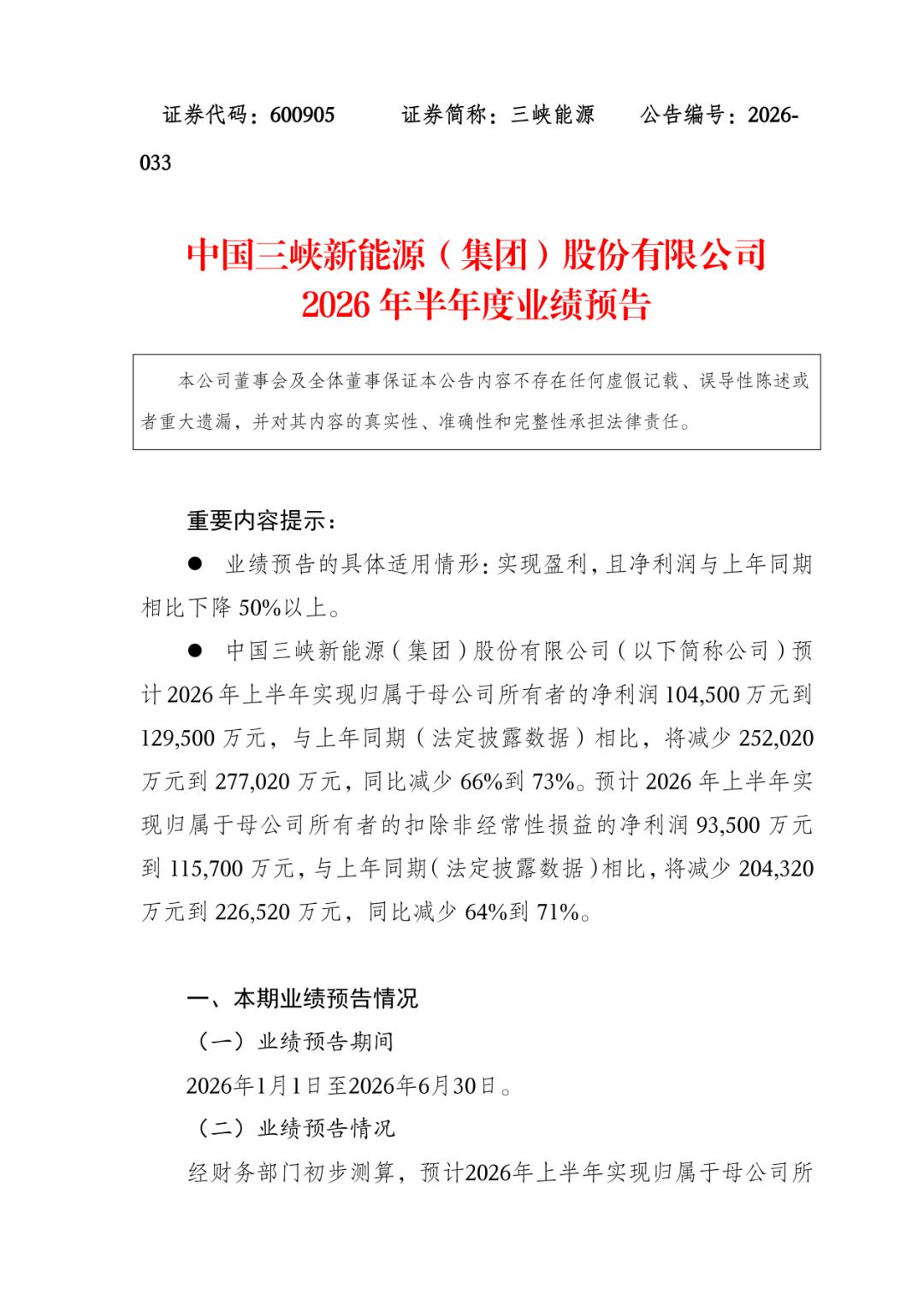
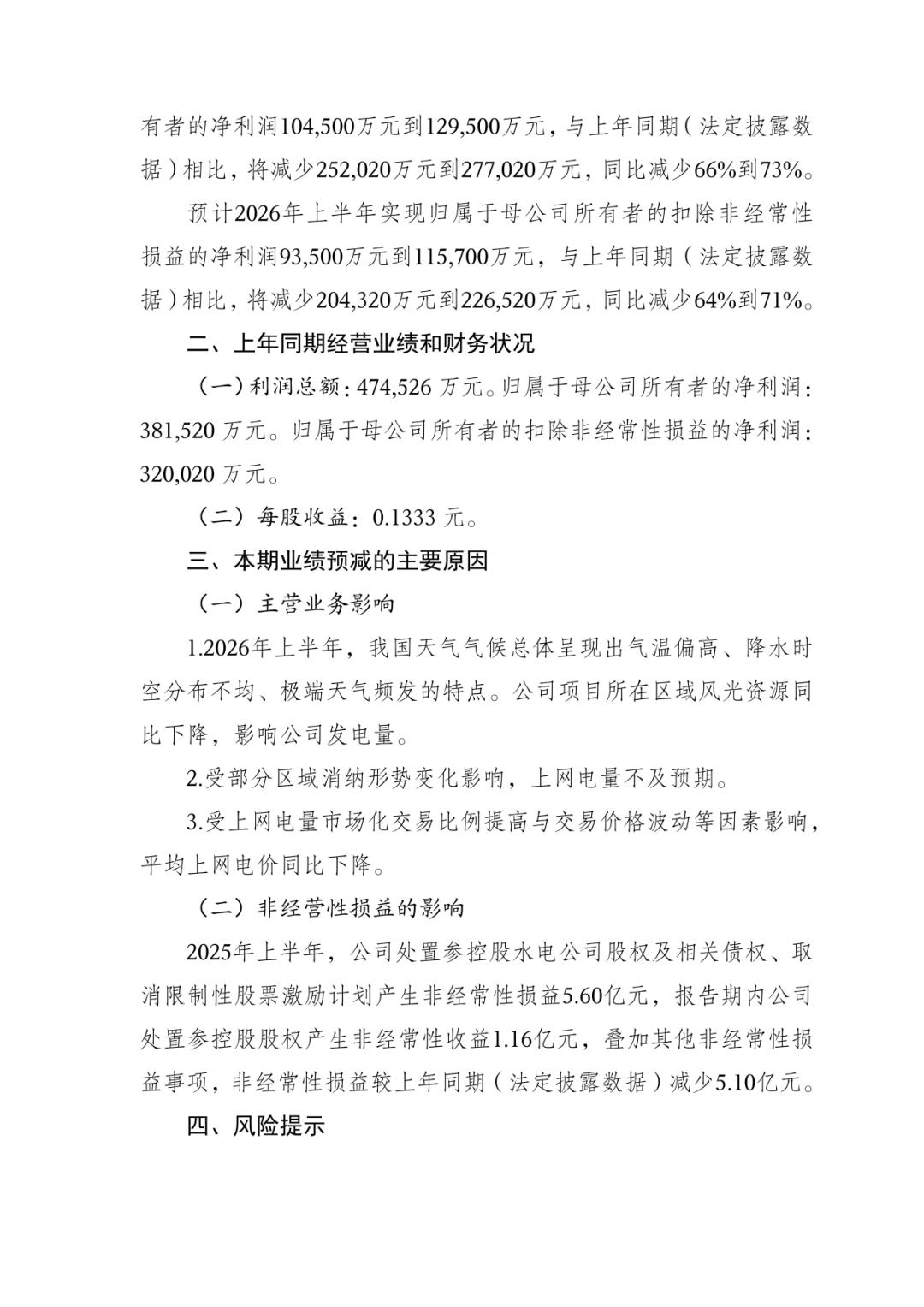
Foresee Energy notes that on July 14, Three Gorges Energy released its 2026 semi-annual performance forecast, estimating net profit attributable to shareholders of listed companies to be between 10.45 billion yuan and 12.95 billion yuan, a year-on-year decrease of 66% to 73%.
The corresponding figure for the same period last year was 3.815 billion yuan. The company cited three reasons for the change: a year-on-year decline in wind and solar resources, changes in local consumption conditions leading to grid-connected power generation falling short of expectations, and a higher proportion of market-based transactions alongside price fluctuations that dragged down the average grid tariff.
Reviewing operational data from other listed power companies over the same period reveals that the new energy power generation industry is undergoing widespread profit contraction. The three pressures on the resource side, consumption side, and tariff side are continuously intensifying, systematically restructuring the "volume-price logic" that the industry has long relied on for survival.
01
Divergence in Resource Conditions
Weak Wind/Solar Output and Uneven Water Inflows Make Natural Conditions the Largest Uncertain Variable
Three Gorges Energy lists the decline in wind and solar resources as the top reason for its performance change.
In the first half of 2026, the company's total cumulative power generation reached 39.521 billion kWh, growing by only 0.53% year-on-year compared to the same period last year. Of this total, wind power generation hit 24.262 billion kWh, down 3.19% year-on-year, while solar power generation reached 14.894 billion kWh, up 7.07% year-on-year.
The slight increase in total generation was almost entirely driven by solar power, while wind power, which accounts for a larger share of the company's total generation, saw a clear decline.
This is not a problem unique to Three Gorges Energy.
Leading wind power enterprise Longyuan Power recorded cumulative total generation of 38.78 million MWh in the first half of 2026, down 2.19% year-on-year, with wind power generation specifically dropping 6.67% year-on-year. In the single month of June, Longyuan Power's total generation reached 5.35 million MWh, down 7.48% year-on-year, with wind power generation falling by as much as 9.73% year-on-year.
Bank of America Securities projects Longyuan Power's mid-term net profit to be around 3.2 billion yuan, with a 12% year-on-year decline in the second quarter, noting that "the downward trend in profitability driven by tariffs and utilization hours has not yet ended."
On the other side of the resource spectrum is hydropower.
It is reported that China Yangtze Power's six domestic cascade power stations generated a total of 132.744 billion kWh in the first half of 2026, representing a 4.81% year-on-year increase.
However, this growth was almost entirely driven by 28.74% higher water inflows at the Three Gorges Reservoir, while generation at the four power stations of Wudongde, Baihetan, Xiluodu, and Xiangjiaba all declined year-on-year. Water inflows at the Wudongde Reservoir were 16.94% below the multi-year average.
In other words, different power stations under the same company showed completely opposite generation trends due to varying water inflow conditions. SDIC Power saw its on-grid hydropower generation fall 7.84% year-on-year in the first quarter, with Yalong River Hydropower recording an even steeper 9.95% year-on-year decline, directly caused by below-average water inflows in their respective river basins.
National-level data also confirms this trend. From January to May, the cumulative average utilization hours of national power generation equipment reached 1155 hours, 95 hours less than the same period last year. Wind power utilization hours saw a notable year-on-year decline, and while solar utilization hours turned positive year-on-year in May, overall levels remain at a low point.
A joint report released by the Global Energy Interconnection Development and Cooperation Organization and the China Meteorological Administration projects that the average available generation hours for Chinese wind power in 2026 will drop by nearly 10% compared to 2025.
For the industry as a whole, the "on-off year" fluctuation pattern for wind and solar resources is normally a natural occurrence. But as frequent extreme weather becomes the new normal, the "multi-year average" assumption that new energy project revenue calculations rely on is being broken.
An El Niño event of moderate or higher intensity is highly likely to develop during the summer and autumn of 2026, extending resource uncertainty well into the second half of the year.
For power generation enterprises that are highly dependent on natural resources, resource volatility is evolving from occasional shocks to a systematic risk.
02
Consumption Under Pressure
Power Is Generated, But Cannot Be Transmitted Out
More challenging than being unable to generate power is the scenario where generated power cannot be delivered to the grid. Three Gorges Energy explicitly stated in its announcement that "changes in local consumption conditions led to on-grid generation falling short of expectations" — a direct reference to the resurgent problem of wind and solar curtailment.
In the first half of 2025, the national wind power curtailment rate reached 5.7% and the solar power curtailment rate hit 6.6%, nearly doubling compared to the same period in 2024. Conditions have not improved in 2026. From January to February, national wind power utilization rates fell by 2.3 percentage points year-on-year, and solar power utilization rates dropped by 3.1 percentage points year-on-year. The curtailment rate in some regions has already approached 10%.
Shin Energy recently released an announcement forecasting that its first-half net profit will fall 25% to 35% year-on-year, directly citing "curtailment losses caused by consumption capacity constraints in multiple provinces across mainland China" as the cause.
The root of the problem lies in the severe mismatch between the rapid growth of installed capacity and the grid's consumption capacity. By the end of May 2026, the total cumulative national installed power generation capacity exceeded 4 billion kW, with solar power installed capacity reaching 1.26 billion kW (up 16.3% year-on-year) and wind power installed capacity at 660 million kW (up 17.0% year-on-year). A growing gap has emerged between the rapid expansion of installed capacity and the pace of progress in grid construction and peak-shaving capabilities.
Foresee Energy believes that new energy power generation enterprises are trapped in a structural contradiction: without installed capacity growth, economies of scale cannot be realized; with continued installed capacity growth, consumption pressure will keep rising. Improving consumption capacity involves multiple interconnected factors including grid investment, energy storage configuration, and cross-provincial dispatching, which cannot be resolved overnight. The fact that Three Gorges Energy's total generation in the first half of the year grew by only 0.53% — far below its installed capacity growth rate — has already revealed the tangible consequences of this contradiction.
03
Downward Tariff Trend
Market-Oriented Reform Pushes New Energy Into a Price Red Ocean
More subtle and far more persistent than the contraction in generation volume is the collapse in power prices. The third reason cited by Three Gorges Energy — "the rising proportion of market-based transactions for grid-connected generation and associated price volatility" — points directly to the tariff pressure new energy is facing after full integration into the power market.
In 2025, the National Development and Reform Commission and the National Energy Administration jointly issued the "Notice on Deepening the Market-Oriented Reform of New Energy On-Grid Tariffs to Promote High-Quality New Energy Development" (Document No. 136), explicitly stipulating that in principle all grid-connected generation from new energy projects must enter the power market. Previously, around 85% of new energy generation was purchased at a guaranteed price based on the benchmark coal-fired tariff, with only the remaining portion participating in market transactions. After full market integration, the logic of price formation has been completely transformed.
Market prices have not been encouraging. From January to February 2026, the national average grid-purchased tariffs stood at 0.362 yuan/kWh and 0.360 yuan/kWh respectively, down 0.043 yuan and 0.035 yuan year-on-year, with the decline significantly widening compared to the same period in 2025. During midday hours when solar generation peaks, some provinces have even seen near-zero or even negative tariffs. Bidding for mechanism-based tariffs at solar projects in Ningxia hit a low of 0.18 yuan/kWh, while tariffs in Xinjiang fell as low as 0.15 yuan/kWh — both below the full lifecycle cost of the projects.
Data from the prospectus of China Resources New Energy provides a more intuitive reference: between 2023 and 2025, its average on-grid wind power tariff dropped from 0.45 yuan/kWh to 0.35 yuan/kWh, while the average solar on-grid tariff fell from 0.37 yuan/kWh to 0.28 yuan/kWh. While installed capacity grew by 64%, profit dropped by 26% — all the lost value was eroded by falling power tariffs.
For new energy power generation enterprises, the impact of falling tariffs is structural rather than cyclical. With the "guaranteed volume and guaranteed price" protective framework removed, enterprises must face a harsh reality: while the marginal cost of new energy power generation is close to zero, the upfront fixed investment is enormous. Once tariffs fall below a certain threshold, profits will be compressed exponentially. Currently, the industry's cost structure, investment decision-making logic, and even financing models are largely built on the previously stable tariff expectations of the past — expectations that are now being dismantled by the market.
04
Industry Divergence
Relative Advantages of Hydropower and Systemic Dilemmas for New Energy
A horizontal comparison provides a clearer full picture of the situation. Facing the same resource volatility, China Yangtze Power achieved 4.81% generation growth in the first half of the year; Three Gorges Energy's generation grew by only 0.53%; and Longyuan Power saw its generation fall by 2.19%.
Even among power generation enterprises, performance trajectories have diverged significantly.
The advantages of hydropower lie in higher resource predictability, higher priority for grid consumption, and relatively lower exposure to market-driven tariff shocks.
China Yangtze Power reported 6.761 billion yuan in net profit attributable to shareholders in its first-quarter report, up 30.5% year-on-year. SDIC Power recorded 2.118 billion yuan in net profit attributable to shareholders in the first quarter, up 1.91% year-on-year. Even with generally weak water inflows across the hydropower sector, both China Yangtze Power and SDIC Power maintained positive profit growth.
In contrast, Three Gorges Energy's profit decline far outpaced its generation decline, which suggests that the destructive impact of falling tariffs is far greater than the impact of reduced generation volume itself.
This divergence demonstrates that the new energy power generation industry's old growth model driven by installed capacity expansion has clearly failed. With the resource, consumption, and tariff sides all under simultaneous pressure, simply pursuing larger installed capacity can no longer translate into profit growth. The industry needs to re-examine the fundamental logic of its business model.
This performance forecast from Three Gorges Energy is not just an isolated operational fluctuation at a single company. It is a footnote marking the entire new energy power generation industry's transition from the "policy dividend era" to the "market-oriented growing pains era."
Frequent extreme weather caused by climate warming is a long-term trend, not an occasional event. New energy installed capacity continues to grow at a rapid pace, which will only increase consumption pressure going forward. Market-based transactions expose tariffs to supply and demand fluctuations, yet the industry has not yet established effective price risk management tools.
The combination of these three factors means that the profit pressure on new energy power generation enterprises is not short-term, but structural. The key question facing the industry is no longer "how much power can we generate," but "how much is that power worth, and can we sell it?" The answers to these two questions are becoming increasingly uncertain.
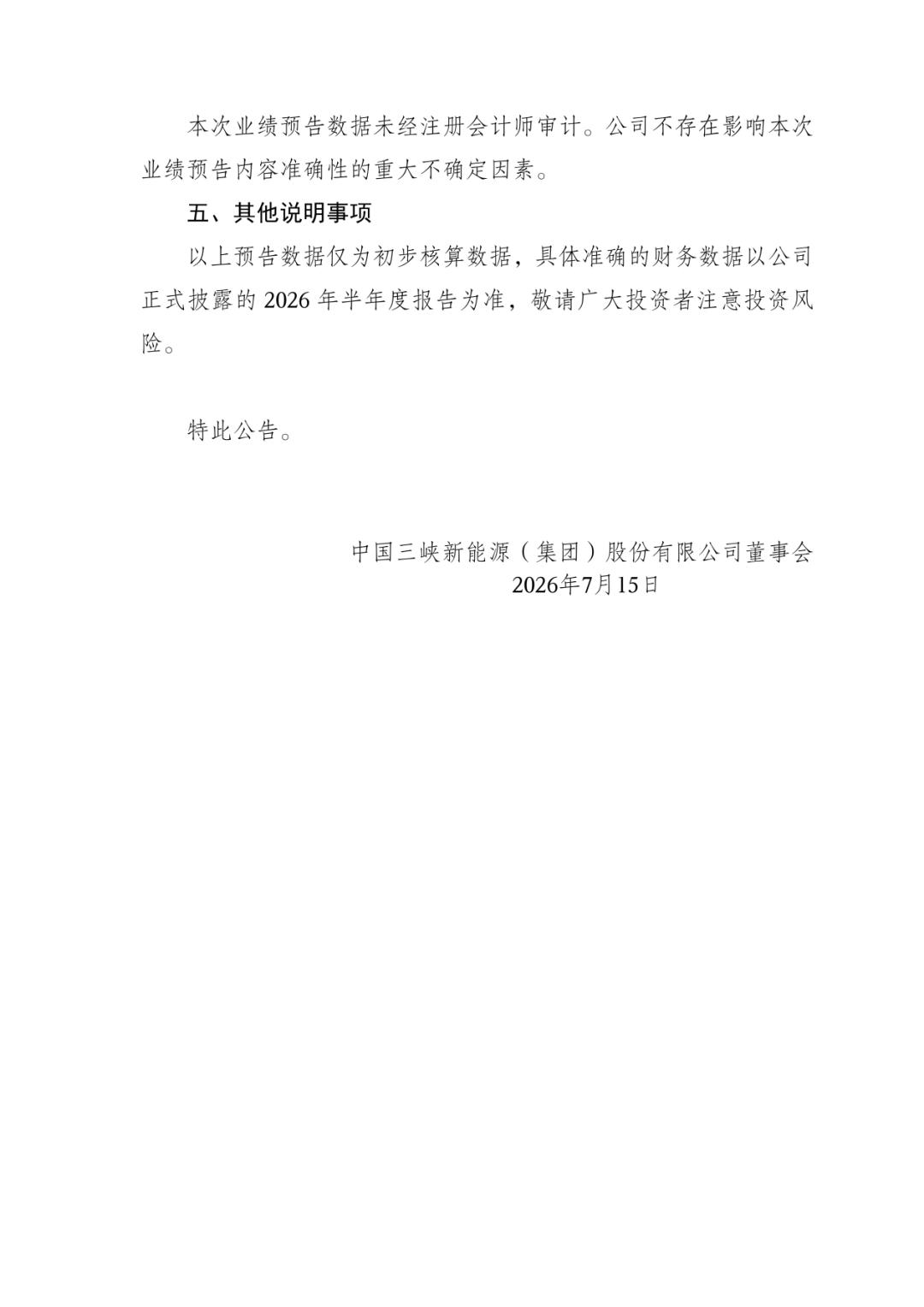
The full original announcement from Three Gorges Energy is attached below:
This article originates from the WeChat Public Account "Foresee Energy", written by Wang Mengjiao, and is republished by 36Kr with authorization.