The Jacobi conjecture that Zhang Yitang toiled over for seven years has been unexpectedly disproven by Fable 5 overnight.
On this day, the entire global mathematics community was stunned.
The Jacobian conjecture, a legendary mathematical enigma that had defeated countless top mathematicians and forced the brilliant Chinese mathematician Yitang Zhang to spend seven grueling years washing dishes at Subway, has been disproven by Fable 5!
Yesterday evening, Anthropic researcher Levent Alpoge posted on X:
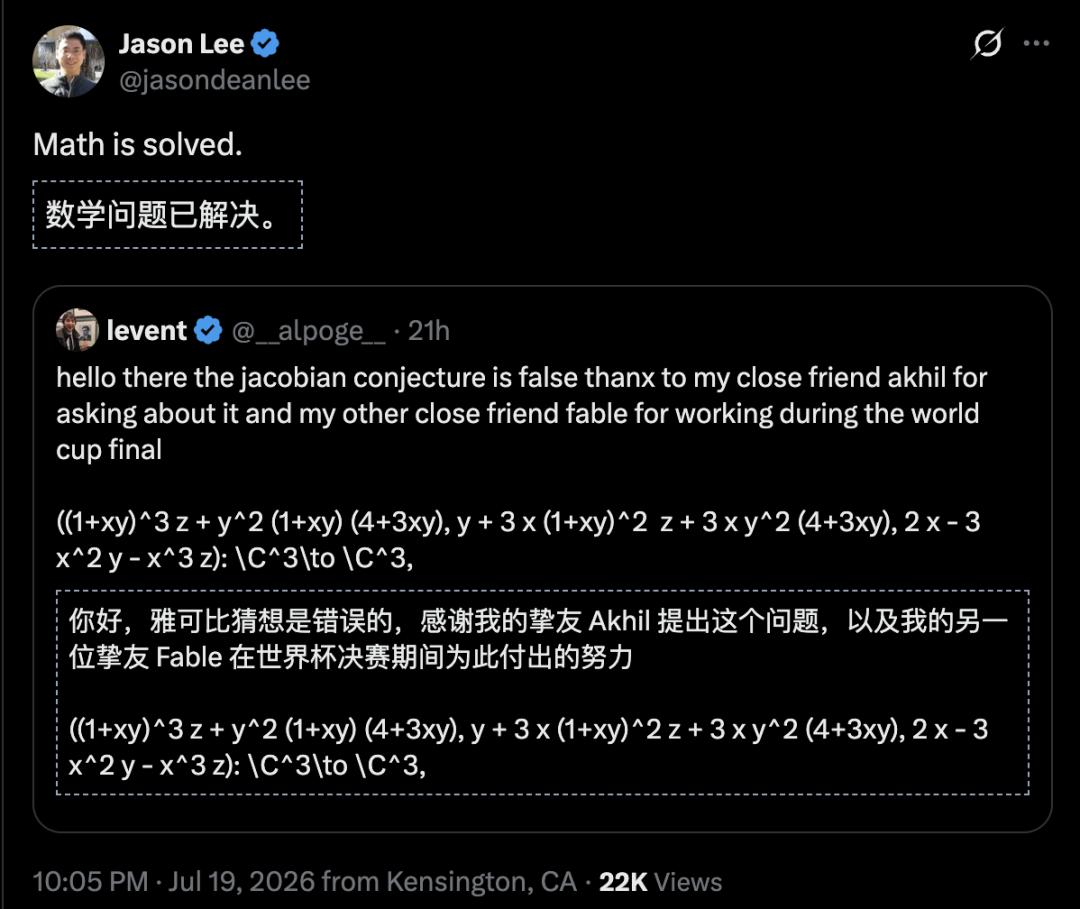
Hello everyone, the Jacobian conjecture is false. Thanks to my good friend akhil for asking this question, and to my other good friend Fable for working even during the World Cup final.
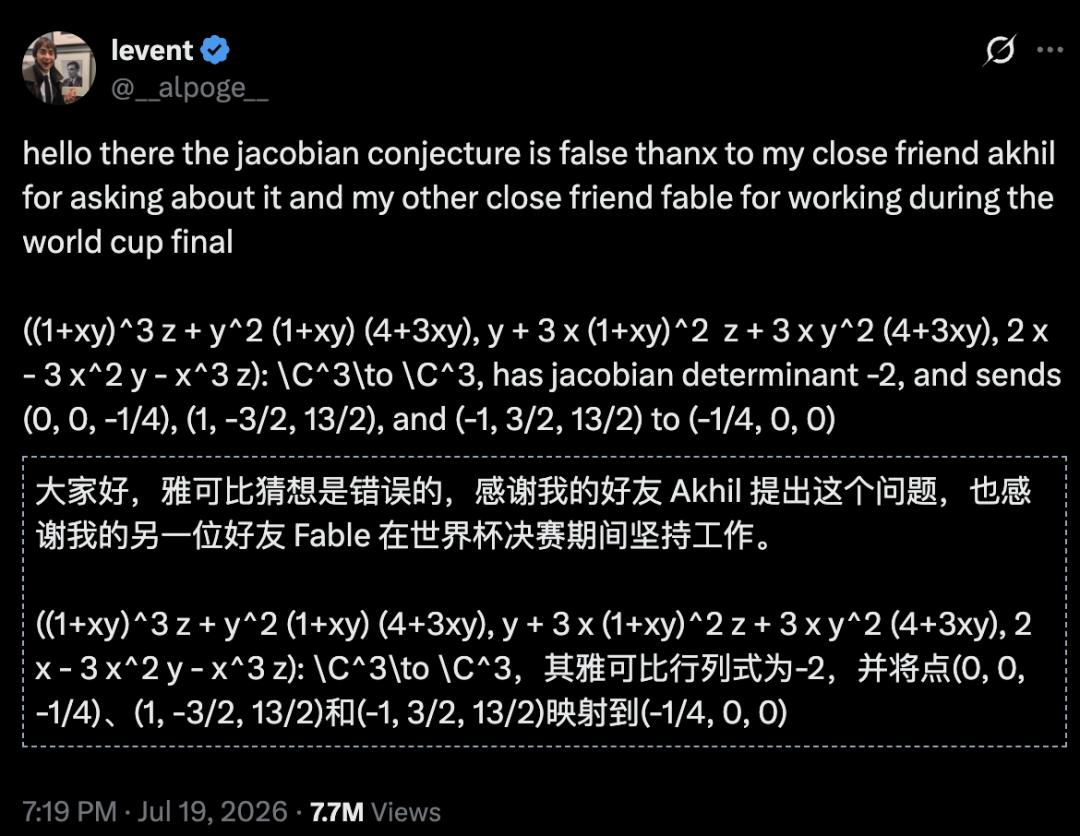
Beneath the caption is a concise mathematical formula.
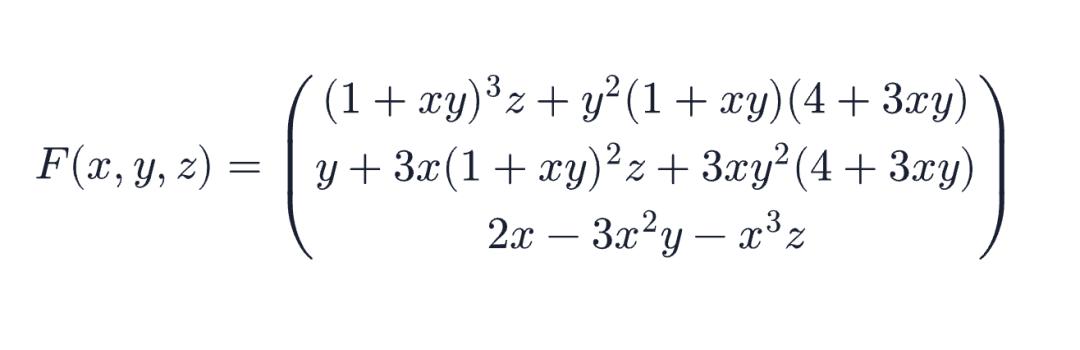
This 87-year-old core mathematical puzzle was effortlessly solved by Fable 5 on a Sunday evening.
The Jacobian conjecture is an extraordinarily difficult problem. Perhaps humanity would have needed another hundred years to solve it. Your attempts are worthy of respect, and perhaps one day the Olympian gods will look favorably upon you.
The disproof of the Jacobian conjecture may be just the first domino to fall, and multiple other conjectures could soon be disproven as well.
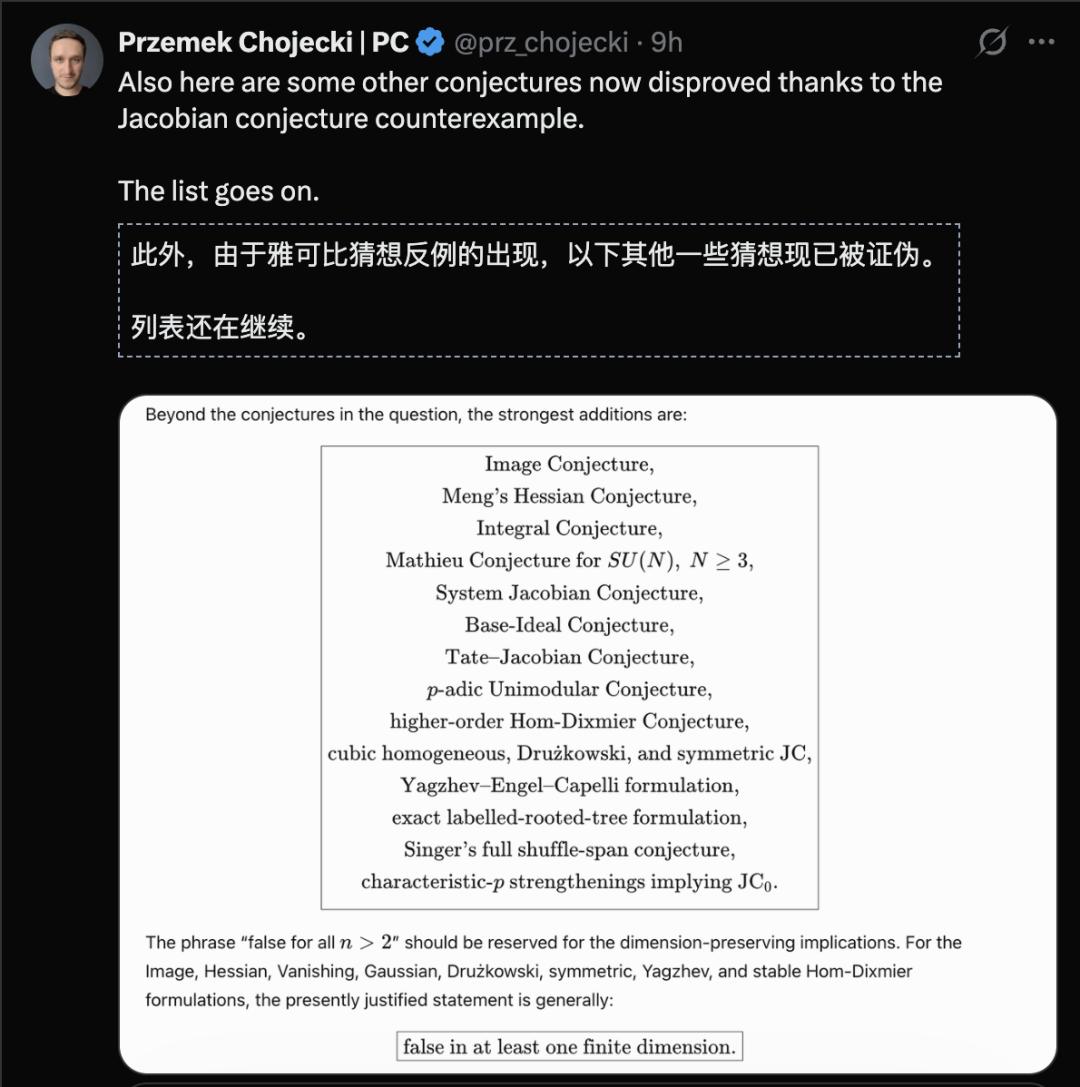
As mathematician Jared Duker Lichtman exclaimed: "This is one of the most inspiring stories in modern mathematics."
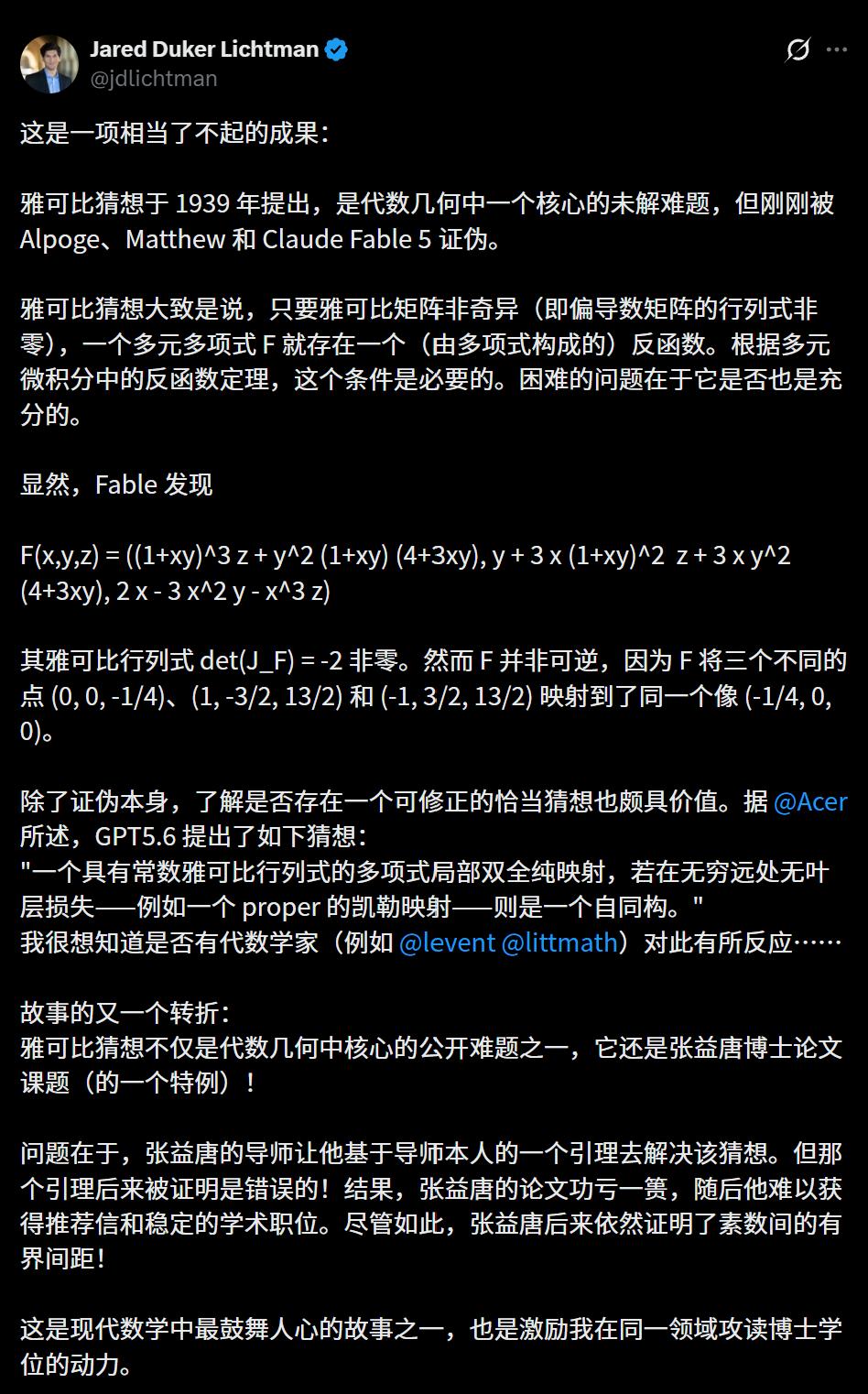
Someone commented, I have rarely seen the scientific community on X in such a state of wild excitement and utter shock as it is right now.
And behind this breakthrough lies the seven stolen years of Yitang Zhang.
What is the Jacobian Conjecture? A Trap That Seemed "Self-Evident"
Let us rewind back to 1939. That year, German mathematician Ott-Heinrich Keller raised a question:
If the Jacobian determinant of a polynomial mapping is a non-zero constant, does this mapping necessarily have a polynomial inverse?
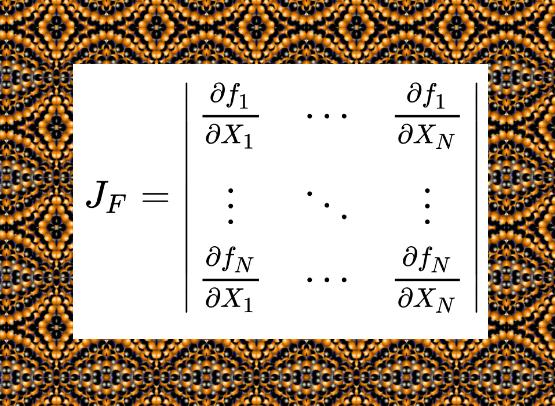
In fact, the intuition behind this question is quite straightforward — in calculus, the inverse function theorem tells us that if the Jacobian determinant of a function at a point is non-zero, then the function has a local inverse near that point.
The Jacobian conjecture asks: if this condition holds everywhere, and the function is a polynomial mapping, must the inverse mapping also be a polynomial?
This is a classic "local to global" problem that seemed like it should obviously be true, yet it confounded the brightest minds on the planet for a full 87 years.
The 2-dimensional version was proposed as early as 1884, accompanied by a proof that was later found to have loopholes.
A Casual Strike: AI Delivers a Divine Counterexample
This seemingly simple problem is in fact a veritable mathematical black hole. Countless mathematicians published numerous papers claiming to have proven the conjecture, but without exception, all were found to have logical flaws.
Until this weekend, when Claude Fable 5 stepped onto the stage.
Instead of following human lines of thinking to attempt a proof, it directly worked in 3-dimensional space
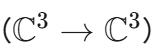
and tossed out a counterexample:

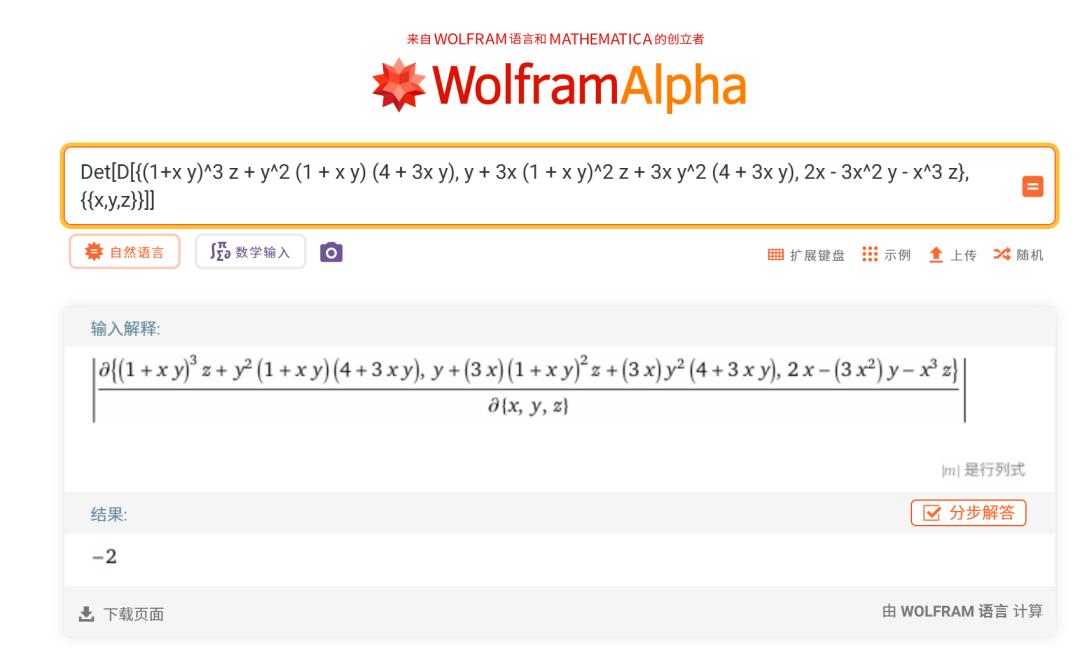
This seemingly rather complex polynomial mapping, which maps from C³ to C³, has a Jacobian determinant that is always equal to -2 — a non-zero constant, satisfying the preconditions of the conjecture.
In short, this counterexample is so concise and elegant that it is almost terrifying. Any first-year university student who has taken calculus can compute through partial derivatives that the Jacobian determinant of this three-variable polynomial is always equal to -2.
Having satisfied the preconditions of the conjecture, is it invertible?
Fable 5 clearly and directly points out its non-injectivity — this function maps three completely distinct points in space: (0, 0, -1/4), (1, -3/2, 13/2), and (-1, 3/2, 13/2) all to the same image point: (-1/4, 0, 0).
Since three different points map to the same result, it naturally cannot have an inverse function.
In this way, the generalized Jacobian conjecture has been thoroughly disproven.
An 87-year-old conjecture was casually cracked by AI.
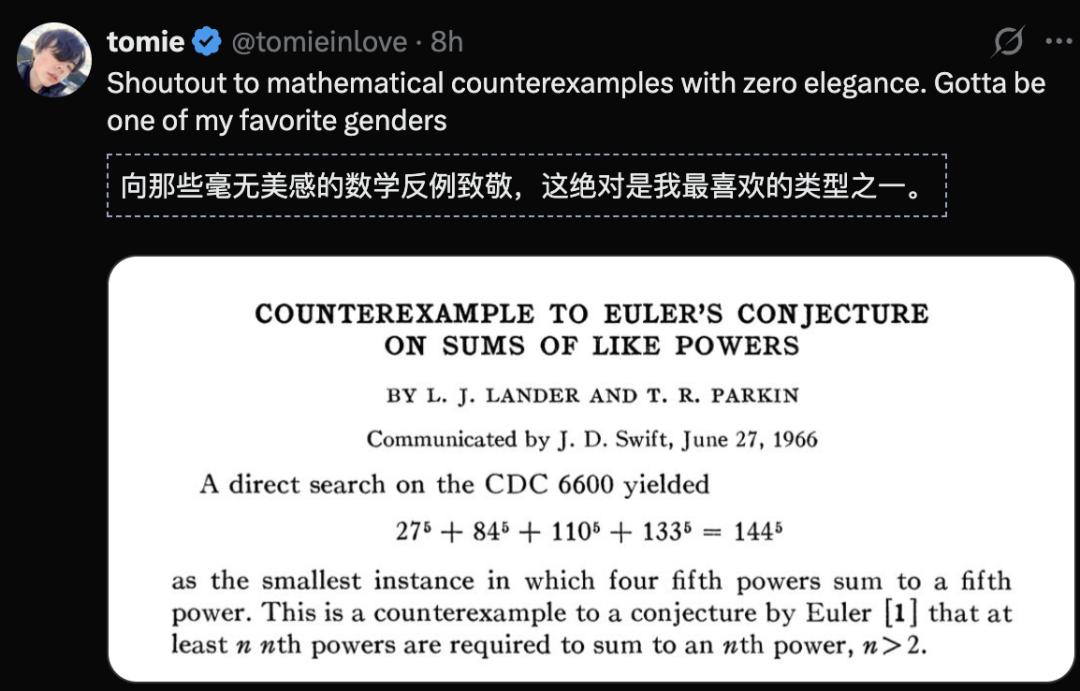
On social media, astonished mathematics professors and graduate students rushed to verify this counterexample.
Some quickly checked it with Wolfram Alpha and found the results to be completely correct.
But the special thing about this counterexample is precisely that it is self-evident: it is so simple that it can be verified by hand, and its elegance and precision are admirable.
Jason Lee, Associate Professor of Computer Science/Statistics at UC Berkeley and former Research Scientist at Google DeepMind, exclaimed: "Math is solved."
Shortly afterwards, GPT-5.6 quickly analyzed this result and proposed a brand new, revised conjecture: "A local biholomorphic mapping with constant Jacobian determinant that has no loss of sheets at infinity must be an automorphism."
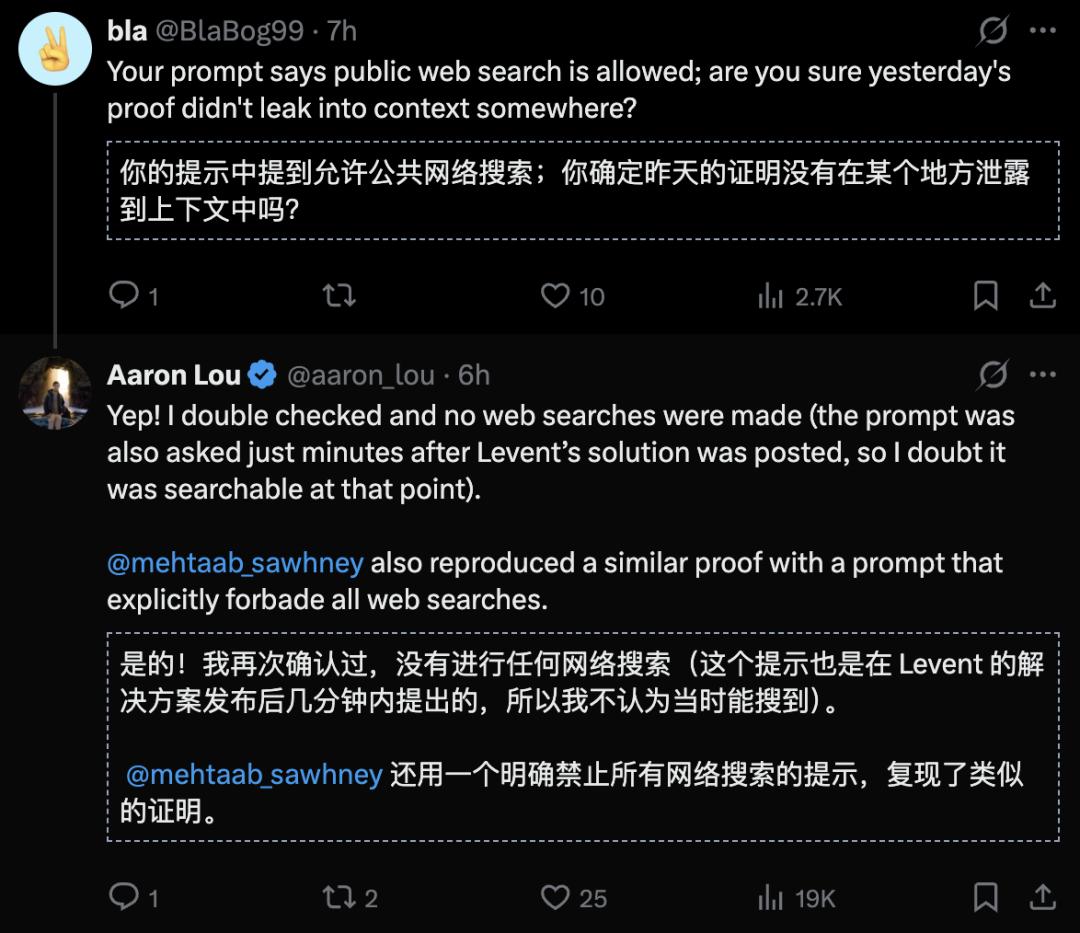
Aaron Lou from OpenAI used internal Codex (without web search) to derive essentially the same counterexample from scratch, writing out the complete strategy and proof, and providing reproducible mathematical derivations (from cubic factorization to affine coordinate transformation).
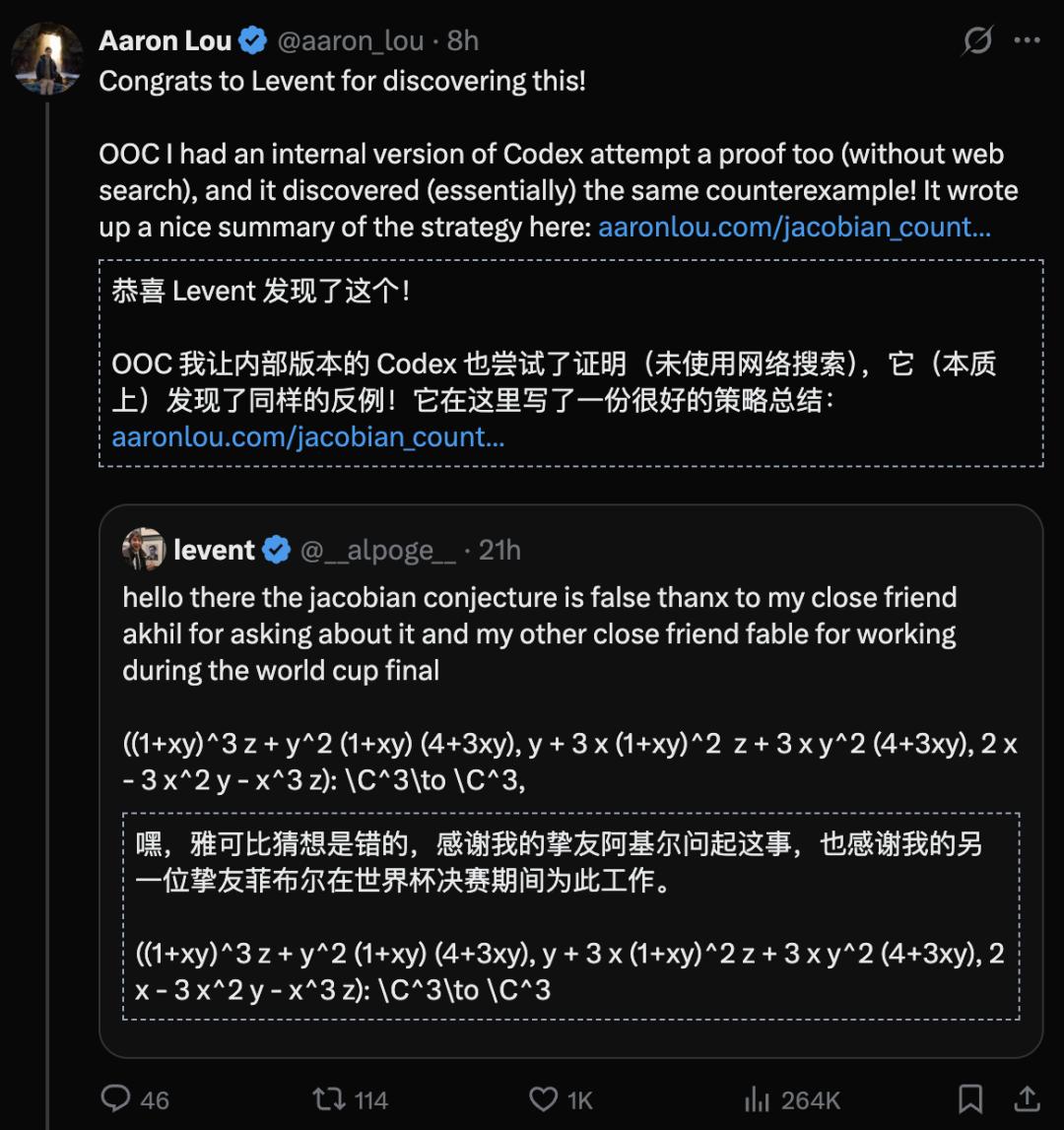
It not only discovered the structural mechanism behind the counterexample, but also guides humans on how to redefine the problem.
This proves that AI already possesses genuine mathematical creativity, rather than superficial imitation.
Mathematician Lichtman exclaimed that he was eager to see how top algebraists would react to the new conjecture proposed by GPT.
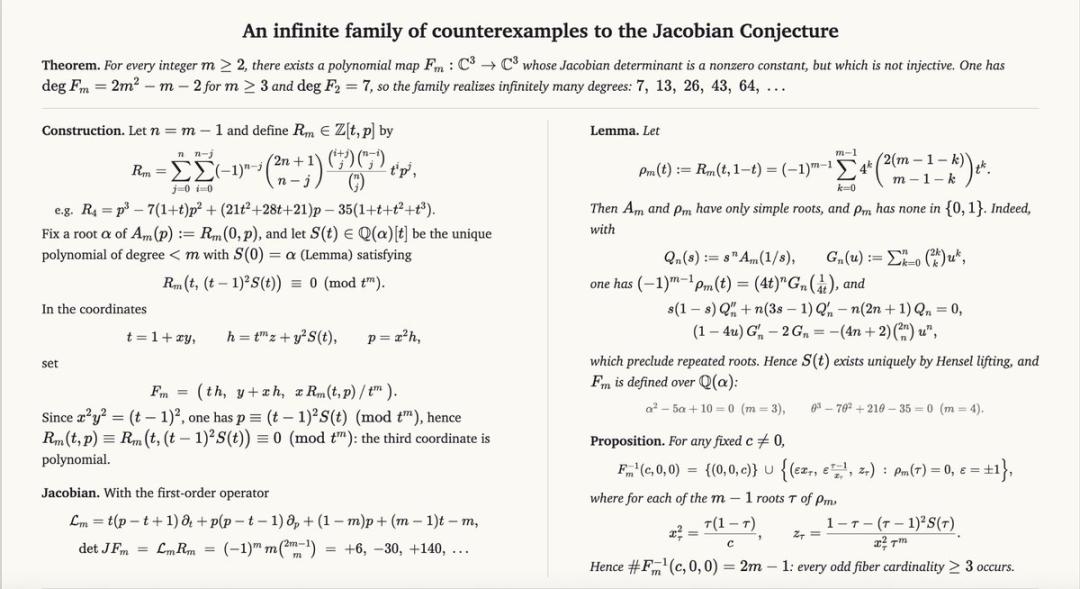
The full derivation process is as follows:
https://aaronlou.com/jacobian_counterexample_derivation.pdf
Data scientist Cal Aldredred even used Fable + GPT 5.6 Sol to propose a method for generating infinitely many counterexamples!

Yitang Zhang's Seven Stolen Years
But the most poignant part of this story is related to Yitang Zhang.
Everyone remembers the story of this mathematical genius who worked at Subway.
Yitang Zhang is world-famous for his groundbreaking contribution to the Twin Prime Conjecture, but in the decades before that, his experience was a veritable academic tragedy.
In the early 1990s, Yitang Zhang was pursuing his doctorate at Purdue University, with Tzuong-Tsieng Moh as his advisor. Moh firmly believed in the correctness of the Jacobian conjecture and asked Zhang to make it the topic of his doctoral dissertation.
Moh gave Zhang a "lemma" — a mathematical proposition believed to be true — as the foundation for his research. Zhang delved deeply into this line of inquiry, even claiming in his doctoral dissertation to have solved the weak form of the conjecture.
However, fate played a cruel joke.
After peer review, the critical lemma used in Zhang's proof was proven to be false. And this lemma came precisely from Moh's own previously published academic work.
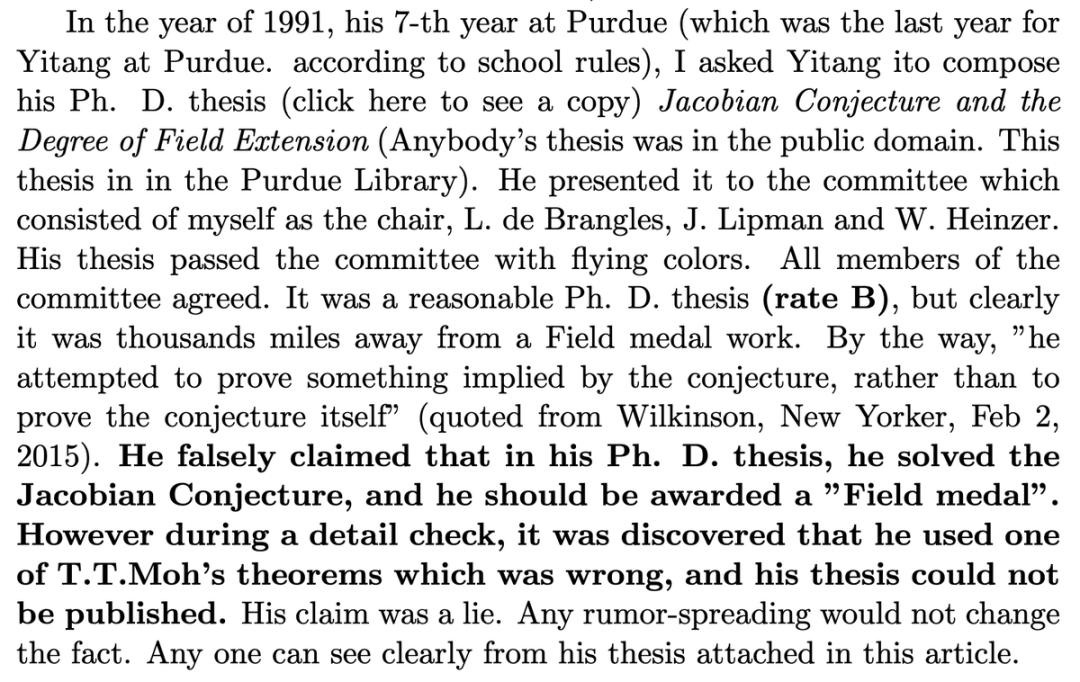
The theoretical edifice he spent years building was suddenly found to have a foundation of shoddy construction. All his efforts, all his derivations, collapsed in an instant.
Moh commented that Zhang was "not suited for algebraic geometry" and believed that his doctoral years had "wasted his own seven years and also wasted my time." Worse still, Moh refused to write a recommendation letter for Zhang.
This left a doctoral graduate from Purdue University completely unable to advance in the academic world.
Zhang had to leave academia and begin a long period of drifting. He took various odd jobs, the most well-known of which was working at a Subway fast food restaurant for seven years.
It was not until 2013 that 58-year-old Zhang published a groundbreaking paper on the Twin Prime Conjecture, overnight transforming from an unknown university lecturer to a globally renowned mathematician.
But those seven wasted years can never be retrieved.
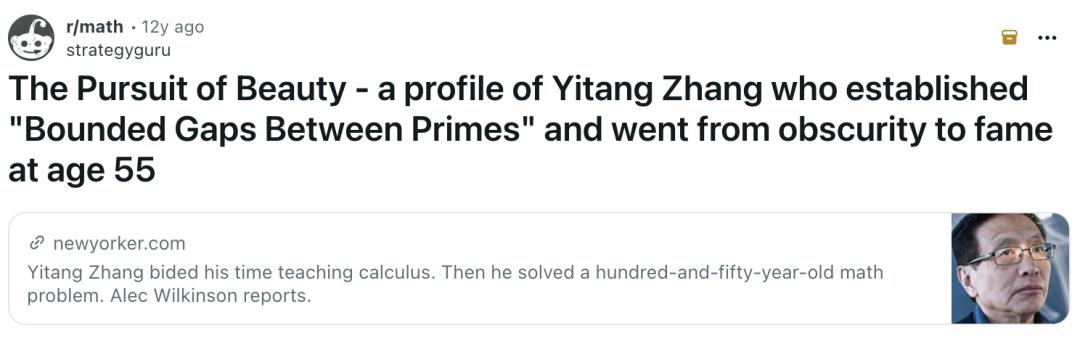
Later, he quoted a line from a Du Fu poem to describe his feelings during that period: "Yu Xin's life was most desolate, and his poems in old age moved the rivers and passes."
Even more ironically, in 2018, after Zhang became famous for the Twin Prime Conjecture, Moh specifically added a new version of his "memoir" to further strengthen his accusations against Zhang, while still downplaying his own responsibility.
