An emotional companionship app with 60 million users developed a home robot after generating hundreds of millions in revenue | Product Watch
Author | Huang Nan
Editor | Yuan Silai
When the apps under its umbrella generate hundreds of millions of yuan in annual revenue and attract millions of daily active users, Ren Yongliang, founder and CEO of Xinyan Group, made a decision that everyone considered "irrational": to embed AI emotional companionship capabilities into a hardware mold — to build a robot.
Xinyan Group's most well-known product is called Cece, which came from the previous internet era, launched in 2013. It mainly provides users with general psychological science popularization and assessment, as well as online emotional companionship, and received Series B financing from Tencent. By 2025, Cece had more than 60 million users.
However, relying solely on a 12-year-old online emotional companionship product obviously cannot make further progress in this AI era. Ren Yongliang perceived that the online interaction mode has irreparable capability boundaries.
Screen-based conversation is a one-way and fragmented form of communication, which is difficult to capture physical 3D information and cannot meet complex needs such as parent-child companionship, emotional comfort for the elderly, and daily home interactions. Looking at the mainstream smart terminals on the market, some have too high interaction thresholds, while others only have simple playful functions. There has always been a lack of embodied carriers that can independently understand the family atmosphere.
This gap made Ren Yongliang see a window of opportunity for emotional interaction hardware. While the industry is still competing in bionic joints and performance movements, he believes that what family scenarios truly need is an embodied carrier that can understand the atmosphere and know how to advance and retreat to provide emotional "presence".
Recently, Xinyan Group's family proactive intelligent companion robot Buboo (Buboo 1) made its debut offline interactive experience at WAIC 2026.
At the exhibition booth, there was no noisy voice-triggered demonstration. When visiting users just stopped to watch, Buboo would take the initiative to approach slowly and speak softly. When the other party raised their hand to signal the end of the interaction, it would quietly retreat to the corner and return to standby mode. Without a wake-up word throughout the whole process, it completed several rounds of natural communication that involved observing words and expressions.
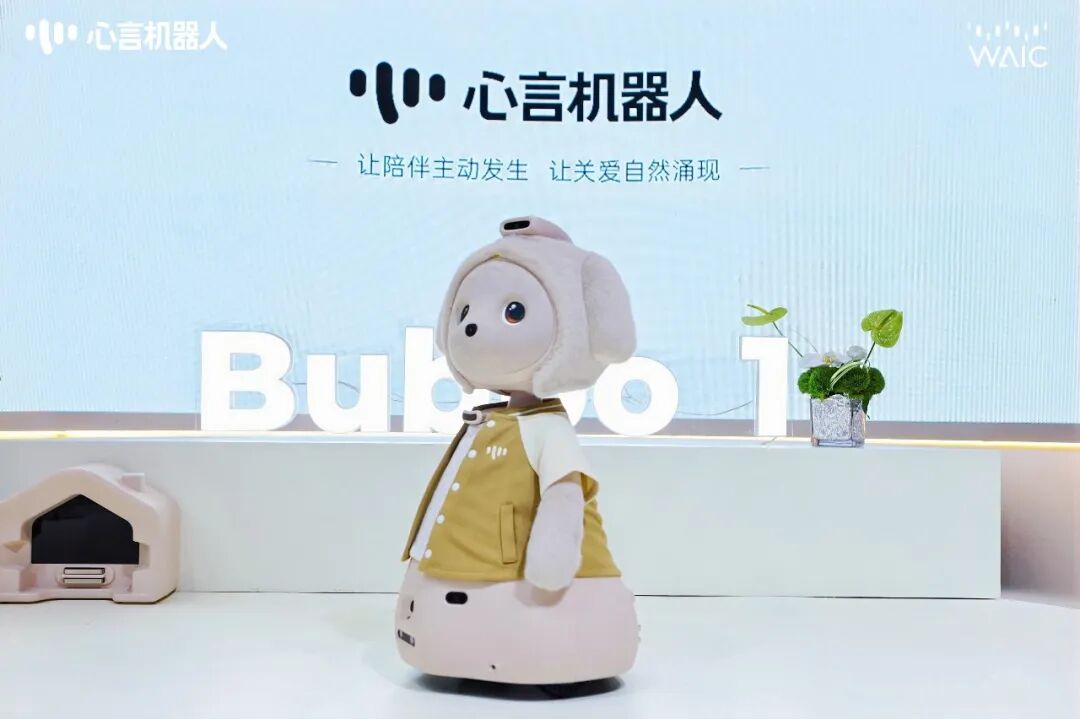
Family proactive intelligent companion robot Buboo 1 (Source/Enterprise)
Ren Yongliang judges that the industry is in the process of transitioning from "demonstration-type electronic toys" to "family agents with a sense of presence". The competition in the next stage will focus on multi-modal proactive perception capabilities, native data accumulation in vertical home scenarios, and the construction of long-term emotional memory models.
At present, no successful family robot has truly achieved widespread adoption in the market. In this track where there is no standard answer yet, Buboo is trying to answer: when AI finally has a physical form, how should it respond to human emotional needs?
Proactive Interactive Robot
To understand Buboo, we must first clarify its attribute distinction from most consumer-grade robots.
Smart speakers, desktop AI pets, various plush companion toys, etc., most products follow the same interaction logic: triggered by the user's wake-up word, the machine responds when hearing the corresponding command. This model is suitable for fragmented usage scenarios such as smartphones and in-vehicle environments. However, once applied to family spaces that require 24/7 presence, problems quickly emerge. If users forget to charge, are unwilling to speak, or want to be alone, the device will be left unused for a long time and eventually become a dust-collecting ornament.
Buboo tries to break out of this trigger framework.
"Our first goal is to remove the wake-up word first, so that the robot can initiate interactions on its own," Ren Yongliang, founder and CEO of Xinyan Group, told 36Kr. "When it perceives the user's facial expressions, body movements, and even changes in spatial distance, these are all valid input signals that Buboo can read. The system will independently judge the current situation and give feedback."
However, this "proactive interaction" has a key limitation: it does not talk to everyone frequently without distinction, but matches the interaction preferences of different users and dynamically adjusts the interaction frequency relying on the edge-side memory model.
If the user tells Buboo that they "want to rest", the interaction scenario will be recorded by the system. When a similar state is subsequently recognized, Buboo will proactively reduce the probability of initiating a conversation. In the view of Ren Yongliang and his team, this sense of propriety is an essential capability for household robots: if a 24/7 home device frequently makes sounds, lights up, or pops up prompts regardless of the scenario, it will only continuously create psychological burdens on users. "It must know when to be silent to better grasp the boundaries of interaction," Ren Yongliang said.
This refined design of interaction boundaries also defines Buboo's role positioning: to become a new family partner that can understand emotions and know when to be present and when to step back appropriately.
Reflected in the product appearance, the entire Buboo body is designed with full rounded corners and no sharp edges. The outer layer is covered with skin-friendly plush fabric, paired with a large-sized anthropomorphic eye shape. Its height is 65 cm, which is not an arbitrarily set parameter, but the optimal body size for home use calculated by the team.

Proactive Interaction (Source/Enterprise)
Ren Yongliang explained that the height of 65 cm exactly matches the eye-level field of view of a 3-year-old child. If the body is too low, ground debris and low furniture will continuously block the visual picture, and the completeness of the environmental information collected by the robot will be greatly reduced. With the full-field observation view brought by the upright body, the robot's spatial judgment of the environment and characters can also be effectively improved.
At the same time, Ren Yongliang believes that it is far from enough to let the robot "see" the physical world. It also needs a smart enough "brain" to understand what is happening in front of it — who is the master in the house, when guests come, whether the child's smile is out of happiness or mischief, and whether the elderly person's silence is due to tiredness or low mood. The complexity of these problems cannot be solved by a general large model plus a set of voice interfaces.
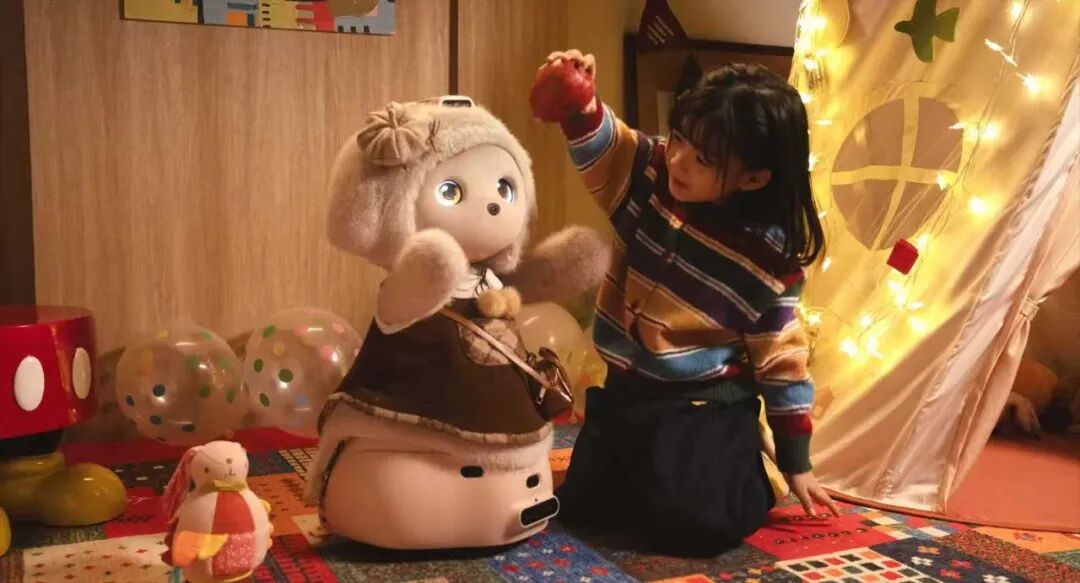
With a height of 65 cm, it matches the eye-level view of a 3-year-old child (Source/Enterprise)
Based on the trillions of levels of emotional corpora accumulated by Cece over more than ten years, Xinyan Group's self-developed Xinyuan large model has built a three-layer progressive technical base for Buboo.
The bottom layer is the Xinyuan large language model, which integrates Multi-Agents, RAG retrieval, and long-cycle memory modules. Its core task is not knowledge Q&A, but to understand the context, such as whether the user's tone is rapid, and the reason for repeatedly mentioning the same word. These materials are scenario Context that traditional models cannot learn from public corpora.
The middle layer is the Xinyuan multi-modal large model, which covers visual reasoning, far and near field speech recognition, and anthropomorphic speech synthesis. It is responsible for translating the pictures, sounds, and distance information captured by the robot into semantic signals that the model can understand.
The top layer is the Xinyuan xyVLA embodied model, which connects the complete chain of "seeing — understanding — acting". A representative scenario is that when a child rushes in front of Buboo with a painting without saying a word, the xyVLA layer first activates the visual module to recognize the content of the painting, then calls the language model to generate encouraging conversations, and finally uses the motion control module to make Buboo tilt its head, get closer, and output feedback with an anthropomorphic voice. The whole set of actions is completed coherently in a few seconds.
"Many people think it's easy to make a robot speak," Ren Yongliang said. "But when to speak, to whom to speak, and whether the output content fits the current scenario are the technical difficulties that the industry generally finds hard to overcome."
The essential difference between the Xinyuan model system and the mainstream general large models is: general models are only trained on online text corpora and lack 3D context such as real home scenes, facial micro-expressions, and body movements; while the Buboo model is natively adapted to the real home environment, which can simultaneously read pictures, emotions, and spatial information before completing dialogue output, filling the gap of LLM in landing in home scenarios.
Home Physical AI Terminal
Official data from Xinyan Group shows that the Cece app has more than 60 million registered users, 80% of whom are women, and more than one million people open it every day to check their emotional status. This product has brought hundreds of millions of yuan in annual revenue and continuous profitability to the parent company.
Since the establishment of Xinyan's robot business, many people have wondered why an internet company that focuses on online emotional services and has achieved steady revenue would choose to cross the border and invest high costs in self-developed hardware.
However, Ren Yongliang observed a clear user life cycle curve: once users get married and start a family, the frequency of opening and using the app and their online duration will drop significantly.
Nevertheless, the emotional talking needs in the love stage are met online, but the emotional pain points in offline scenarios such as the companionship gap after marriage, parenting anxiety, intergenerational communication barriers, and empty-nest elderly, cannot be fully covered by the text interaction mode on mobile phones.
"Online agents solve the one-on-one talking needs, but what family scenarios need is not a listener, but an embodied carrier that can participate in daily life, perceive emotions, and undertake delicate emotional needs," Ren Yongliang said. "This is also the core reason for us to develop Buboo — it is a natural physical extension of the user life cycle of the Cece product."
Xinyan migrates the emotional understanding capabilities accumulated over the years, such as emotion perception, psychological counseling, and relationship insight, from the virtual space to a physical AI terminal that can stay in the home 24/7, allowing it to truly enter the user's offline life space. Paired with the Cece App product, it covers the full-stage emotional needs of users from falling in love to starting a family.

Deep Emotional Understanding Capability (Source/Enterprise)
Based on the positioning of the home physical AI terminal, Buboo is currently building functions around three types of real home scenarios. The first is relaxed language companionship, which is different from task-oriented K12 education hardware, providing a stress-free home foreign language communication environment for young children's language enlightenment and regular parent-child conversations.
The second function is long-term emotional comfort. It is equipped with the emotional companionship capabilities and emotion recognition technologies accumulated by Cece, mainly targeting working parents and empty-nest elderly, alleviating pain points such as parent-child relationship alienation caused by the lack of parenting companionship for working people, cognitive degeneration, and social isolation of elderly users.
The third is to provide a lightweight AI image recording function. Users only need to wave to trigger shooting, and the photos will be automatically converted into comic style and pushed to the corresponding App; all image data is processed locally, fully protecting the privacy of family portraits.
In addition, when the user is away from home, the robot will independently capture interesting pictures of the elderly, children, and pets in the home scene and push them synchronously, alleviating the user's anxiety after leaving home.
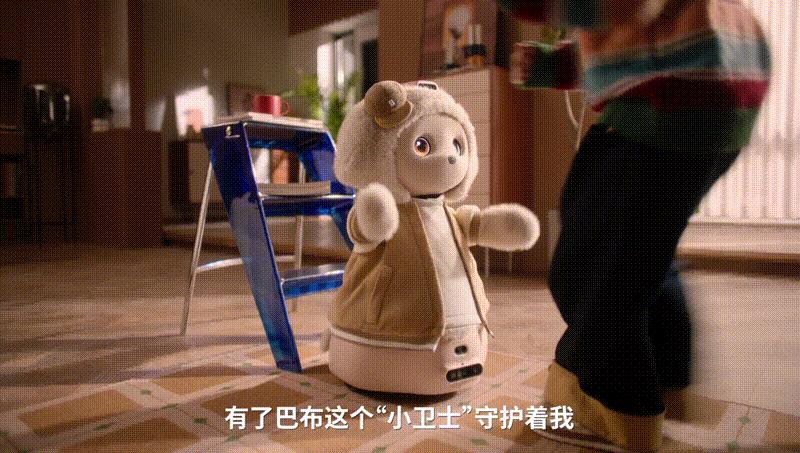
Remote Picture Synchronous Push (Source/Enterprise)
2026 is regarded by the industry as the "year of differentiation" for embodied intelligence. At the WAIC 2026 booth, the industry has clearly divided into two paths: one is oriented to productivity scenarios such as factory production lines and logistics warehousing; the other focuses on family scenarios, emphasizing emotional companionship and multi-generational communication. The latter is at the inflection point of transitioning from toys to embodied terminals full of "sense of life".
If the Cece App solves the need to "be understood", what Buboo tries to respond to is the user's desire to "be accompanied". This path seems offbeat, but in essence, it is addressing a more fundamental problem: in today's increasingly atomized society, within the emotional gaps of the family, to achieve tangible, high-quality, and sustainable presence through physical form.