$1 Billion in Education Funding Flows to These Tracks
In the first half of 2026, the global edtech industry secured $1 billion in venture capital funding.
This figure represents a 25.7% (approximately 26%) decline from the $1.35 billion recorded in the same period of 2025. If we only look at funding amounts, the edtech market continues to cool down. However, HolonIQ simultaneously released another data point: the number of deals in the first half of the year remained largely unchanged.
While total funding stays at a low level, project activity has not declined in tandem. Global edtech investment is shifting from widespread contraction to a redistribution across sectors, regions, and individual projects.
01
Funding Remains at a Low Level,
Regional Performance Has Diverged
From an overall trend perspective, global edtech funding has not yet emerged from its adjustment cycle. HolonIQ data shows that in H1 2026, global edtech venture capital reached only $1 billion, a year-on-year decrease of 25.7%.
Looking back at the past few years, edtech funding has experienced dramatic fluctuations: funding hit $16.1 billion in 2020, and further climbed to $20.8 billion in 2021, setting an all-time high. But as the pandemic dividend gradually faded, funding scales began to decline continuously, dropping to $10.6 billion in 2022, only $3 billion in 2023, and further falling to $2.3 billion in 2024. Full-year 2025 funding rebounded to $2.6 billion, yet this recovery trend did not carry over to 2026.
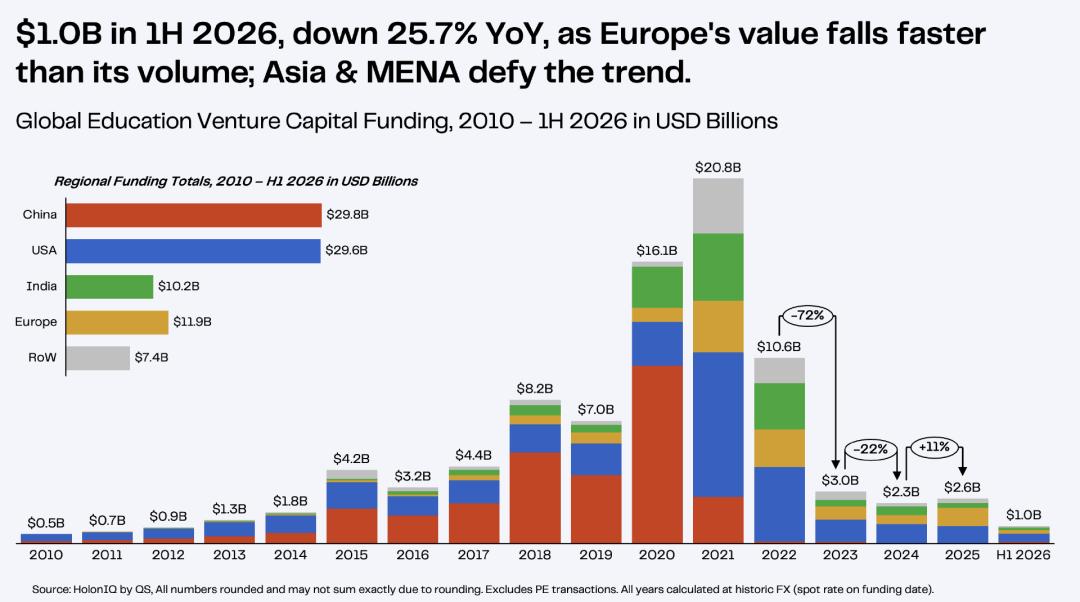
Figure 1. Global Edtech Venture Capital, 2010 to H1 2026
Compared to the $20.8 billion peak in 2021, current global edtech funding scales have shrunk by more than 87%, and the industry has transitioned from a high-growth phase to a more rational adjustment cycle.
However, judging the industry's temperature solely by funding amounts is not comprehensive. In the first half of this year, the number of global edtech funding deals remained largely stable, which means investment institutions are still active, have not stopped seeking edtech projects, but are making more cautious investment decisions, with large-scale financings significantly reduced.
From a regional perspective, the global edtech funding landscape remains highly concentrated. From 2010 to H1 2026, China accumulated $29.8 billion in total funding, and the United States accumulated $29.6 billion. The two countries together account for roughly two-thirds of the global total, remaining the world's most important edtech funding markets. However, in recent years, edtech funding in China has slowed noticeably after regulatory adjustments, while the U.S.'s share of global funding has increased.
At the same time, several new regions are starting to send positive signals. In H1 2026, Asia, as well as the Middle East and North Africa, became the few markets that bucked the trend with growth. Among them, the number of funding deals in East Asia rose 37% year-on-year, and the Chinese market has also begun to show initial signs of recovery following its regulatory adjustments. In contrast, the decline in European funding amounts is outpacing the drop in deal count, indicating that investment activity still exists, but the size of individual financings is shrinking.
This marks the first change in edtech funding in the first half of the year: the market has not re-entered an expansion phase, but capital has not stopped flowing entirely. Investors are still making moves, though they are no longer placing widespread bets.
02
K-12 Sees the Most Active Deals,
Vocational Training Attracts the Most Capital
If regional divergence reflects the flow of capital, then changes across sectors can better demonstrate investors' judgments.
By deal count, in the first half of this year, vocational training and development, as well as K-12 education, became the two most active tracks, together accounting for approximately 75% of the total global edtech funding deals, forming the core direction of capital deployment.
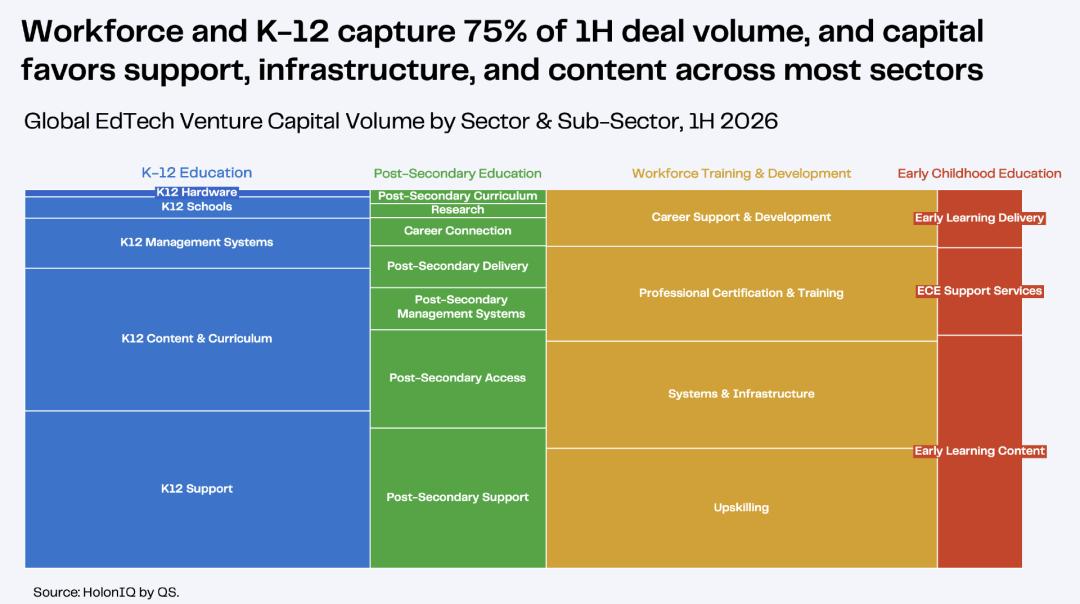
Figure 2. Total Global Edtech Venture Capital by Industry and Sub-sector, H1 2026
Among all segments, vocational training remains the most capital-attracting field. In the first half of this year, language learning platform Preply completed a $150 million financing, and skills training platform Multiverse secured $70 million in funding. Both financings focus on corporate skill enhancement and talent development. As the global labor market continues to face skill gaps, more and more enterprises are starting to address talent supply issues through digital training, skill upgrading, and reskilling, which is also driving vocational education to become a key area where capital continues to place bets.
In comparison, while K-12 education's funding amount cannot match that of vocational training, its deal activity remains at a high level. Particularly noteworthy is that AI-powered personalized learning products have begun to emerge as a new investment hotspot. The report mentions that AI learning platforms Subject and Gizmo both obtained large-scale financings, and capital is starting to pay attention to AI products that can directly enhance classroom learning experiences, learning efficiency, and teaching outcomes, rather than just focusing on the generative AI concept itself.
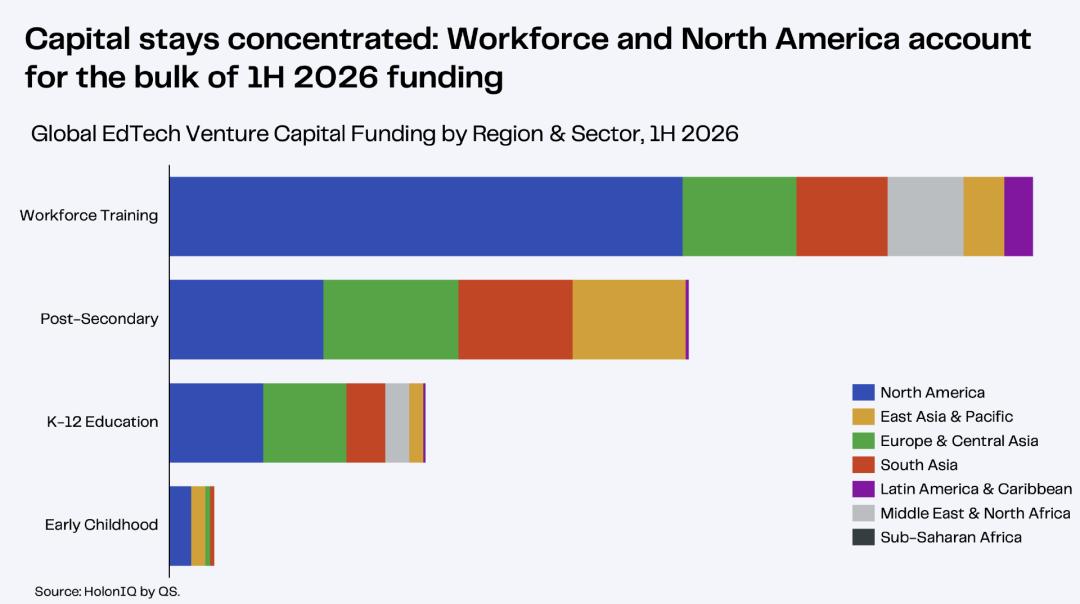
Figure 3. Global Edtech Venture Capital by Region and Sector, H1 2026
While overall funding in higher education has declined, areas such as alternative credentials, professional certifications, and work-integrated learning continue to attract sustained attention. This means the ability to connect universities and the job market is becoming a new key focus for investment institutions.
Another notable data point comes from early childhood education. Although the overall scale of this track is still relatively small, the number of deals has more than tripled compared to 2025, making it one of the fastest-growing niche segments. From the distribution of deals, capital is mainly concentrated in early learning content, learning delivery, and support services, indicating that investment institutions are starting to refocus on the early childhood education market.
Looking at the sub-sectors, whether it is K-12, higher education, or vocational training, support services, content curricula, and system infrastructure are almost always the most concentrated areas for deals. This means that compared to the past when capital chased edtech platforms and traffic growth, today's capital is more willing to invest in fundamental capabilities that can truly improve teaching efficiency, optimize learning experiences, and underpin the digital operation of education.
03
As Venture Capital Deals Shrink,
Capital Priorizes Proven Business Operations and Tangible Returns
In addition to venture capital, the M&A and private equity markets are also sending new signals.
In the first half of this year, the number of M&A deals for vocational training companies remained largely stable, but their share of total M&A deals dropped from 37% to 25%. Meanwhile, the M&A share of K-12 education, higher education, and early childhood education all increased to varying degrees.
Several representative deals also reflect distinct investment logics. KKR's $1.3 billion acquisition of XCL Education largely represents consolidation in the K-12 education services sector; Wiley's roughly $450 million acquisition of Emerald Group Publishing reflects consolidation in the academic publishing industry; and AWS's acquisition of the George Washington University Virginia Campus is largely regarded as a data infrastructure and real estate transaction, rather than a move to deploy higher education businesses themselves.
At the same time, while the total value of private equity investments fell from $445 million in the same period last year to $290 million, the number of deals increased from 10 to 17, indicating that long-term capital continues to pay attention to edtech, albeit with a more prudent investment pace. K-12 education remains the primary investment direction for private equity, with Zum completing a $100 million financing, Minga securing $65 million, and BibliU in the higher education sector also obtaining $55 million in funding. Capital is starting to diversify across more niche segments.
Entering H2 2026, investment institutions will still wait for returns to materialize from the large-scale investment projects made during the pandemic, so the overall funding environment will be difficult to recover quickly in the short term. However, long-term driving forces such as education digitalization, AI applications, and global skill upgrading demand have not changed.
The edtech companies that will truly win capital favor in the future are those that can create measurable value for schools, teachers, and learners — they can not only improve learning outcomes, but also enhance operational efficiency, and help learners better achieve employment and development. From AI-powered personalized learning, to immersive learning experiences, to skill upgrading and reskilling platforms, the core focus of capital has shifted from "whether there is AI" to "whether AI truly creates value."
Original Link:
The Edtech Industry Secured $1 Billion in Venture Capital in the First Half of the Year
https://www.holoniq.com/notes/1b-in-edtech-venture-capital-to-date-funding-falls-short-of-last-years-midpoint-asia-mena-buck-the-trend
This article is from the WeChat Official Account "Duojing" (ID: DJEDUINNO), written by Duojing Compilation, and published with authorization from 36Kr.