The robotics circle is no longer pretending
Earning revenue from enterprise clients while nurturing the ambition of creating a viral consumer-facing hit product.
On July 17, the 2026 World Artificial Intelligence Conference (WAIC) kicked off at the Shanghai World Expo Exhibition & Convention Center. For the first time, the exhibition area of this year's event exceeded 100,000 square meters, with over 1,100 participating enterprises showcasing 349 debut and first-exhibition products, all hitting record highs in the event's history.
Even more palpable than these figures is the "bustling energy" on site: a long, winding queue snaked around the entrance of the H3 Embodied Intelligence Pavilion, where visitors packed the venue so tightly that one could barely stay in the middle of the aisle for more than three seconds.
After touring the H3 pavilion, one distinct impression emerges: the robotics exhibition has transformed.
The humanoid robot performances that wowed crowds with flips and dances last year have been relegated to corner displays this year — still lively, but no longer the main attraction. Taking center stage are simulated factory production lines, pharmacy shelves, restaurant bars, and home living rooms. Exhibitors no longer ask "Aren't I cool?" Instead, they state "Watch me perform this task, and see how much cost I can save you."
The robotics booths at WAIC 2026 bear witness to a major divergence in China's embodied intelligence industry, offering the most intuitive footnote to the sector: Working, Diversifying, and Building Foundations — three key words corresponding to three profound ongoing transformations in the industry. Below are first-hand observations we brought back from the exhibition.
I. The B-side Fork in the Road: Enter Factories, or Enter Stores?
"Working" is the main theme, and differentiation is the core feature. A closer look reveals that even within the B2B space, development paths are drastically different. One faction dives deep into factories to take on the most tedious, dirty, and strenuous tasks; another surges into supermarkets, pharmacies, and restaurants to find a foothold in spaces closest to people.
The factory-focused faction adopts a straightforward strategy: they replicate real production lines 1:1 at their booths, letting robots "report for duty" in public to complete highly repetitive, monotonous tasks.
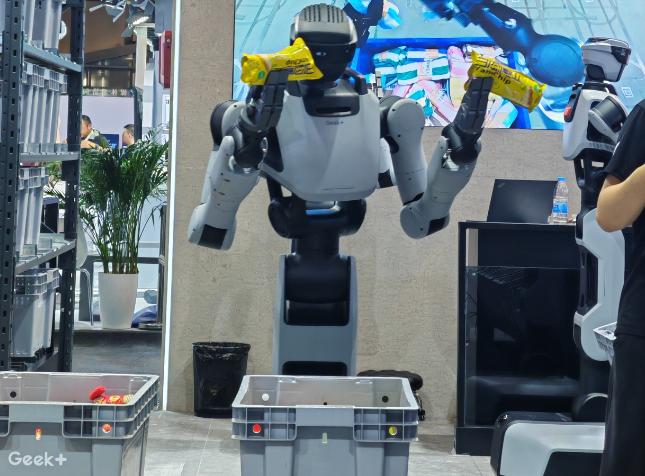
Leading warehouse and logistics robotics firm Geek+ unveiled its first general-purpose humanoid robot Gino1. Equipped with full-body parallel control capabilities that enable coordinated movement of its hands and feet, Gino1 can team up with mobile robots and picking workstations to complete the entire order-picking process. It is reported that the single-task operation time is reduced by approximately 30%.
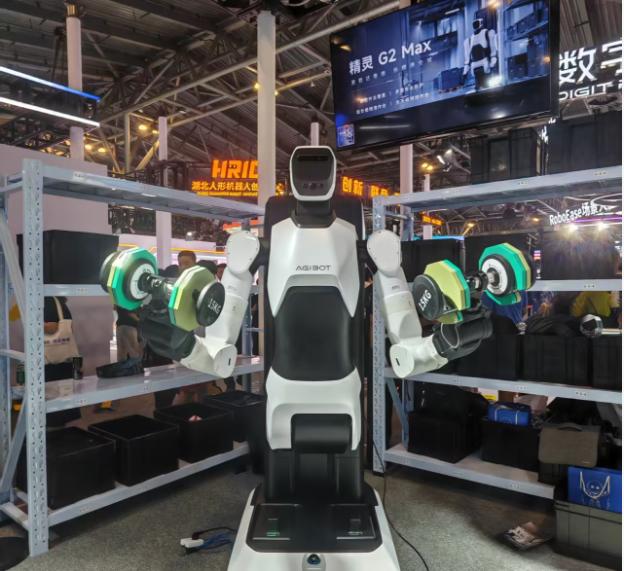
Agibot launched five new products at once, including the Expedition A3 Ultra, Elf G2 Max, Lingxi X2 EDU, Critical Point OmniHand 3 Ultra-M, and the Cooltop Riding Robot. The company also brought the warehouse handling and palletizing scenarios of the Elf G2 Max, developed in partnership with JD Logistics, to its booth, recreating the deployment state of the tray loading and unloading production line. On site, Agibot also collaborated with PIA Automation to build a full chip processing production line, which continuously completed long-sequence operations including material loading, boxing, and transportation, verifying stable performance without human intervention.
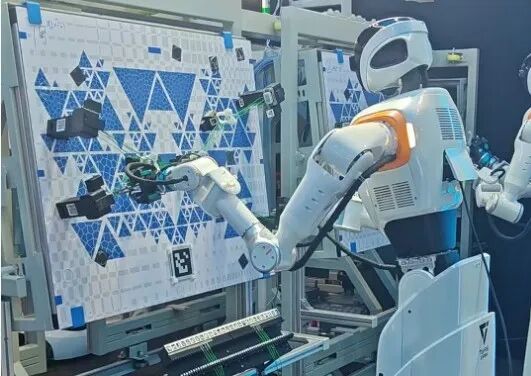
Stone Robotics brought the automotive wiring harness circular assembly line to its exhibition booth. Its A1 intelligent wiring harness robot solution is purpose-built for full-process automation of wiring harness production, equipped with a self-developed embodied large model that can simulate human flexible operations and seamlessly integrate into existing production lines. It is reported that this solution has been deployed at scale at Tianhai Electronics since June this year.
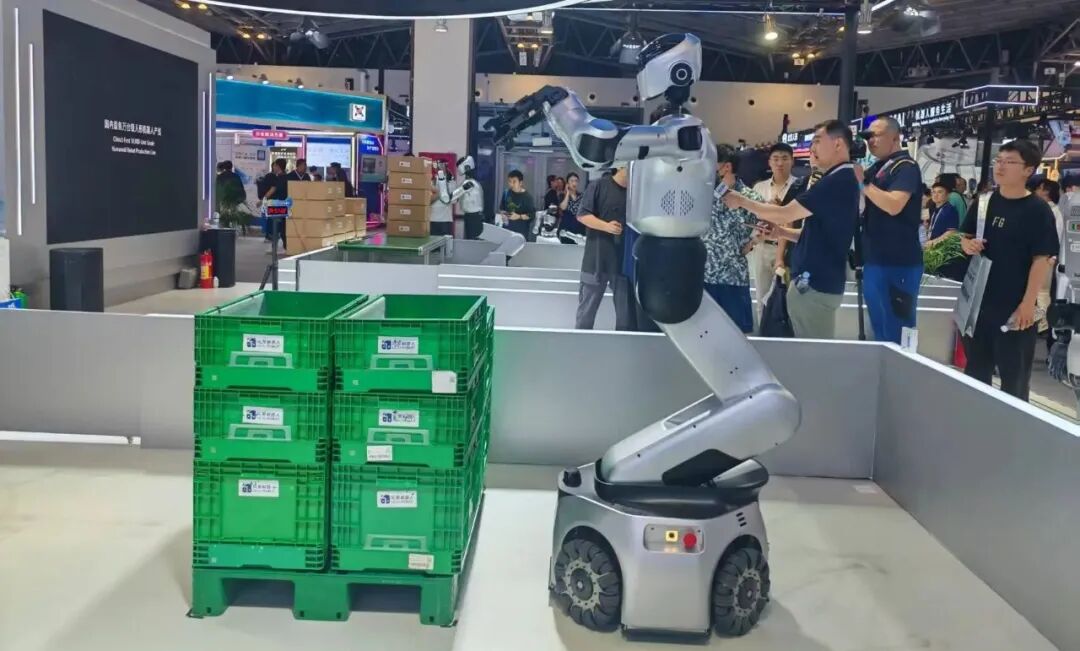
Ubtech Robotics demonstrated fully automated, multi-station flexible operation capabilities in scenarios such as depalletizing, transportation, and material loading. The system operates non-stop throughout the exhibition without any manual intervention, delivering performance identical to that of real industrial production lines.
The industrial scenarios feature high structuralization, clear task boundaries, and quantifiable ROI — this is the shared judgment of the factory-focused faction. Robots do not need to be "all-rounders"; it is enough to excel at one specific task at a dedicated workstation.
The commercial service faction faces a completely different set of challenges: more open environments, more random interferences, and smaller error tolerance margins.
Galactic Universal Robotics showcased two clearly positioned robots at the event: the interactive service-focused general-purpose robot Galbot G1, and the industrial-oriented heavy-load robot Galbot S1. All movements of both products are driven in real time by the self-developed "AstraBrain" embodied large model.
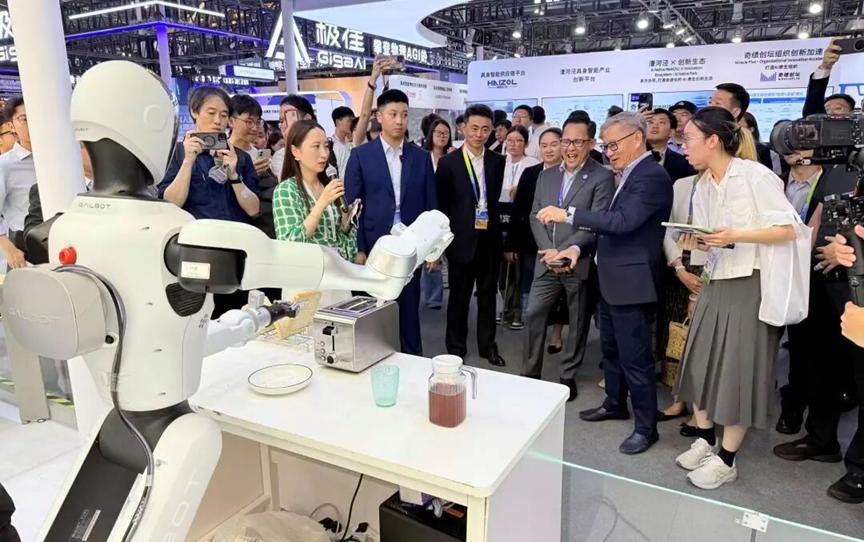
The G1 demonstrates versatility in both consumer and enterprise service scenarios, covering applications such as breakfast preparation, smart retail, and visitor reception; the S1 focuses on more "heavy-duty" industrial scenarios, fully demonstrating the logistics operation chain from depalletizing and transportation to stacking.
The newly evolved AlphaBot 2 (Aibao) from RoboSpace adopts a different strategy. It acts as a shopkeeper to make coffee, cocktails, and ice cream on site. Beyond "working", it delivers emotional value and consumer experience that cannot be ignored in B2B commercial services.
While these two companies take different paths, they share the same business logic: the more open the scenario, the higher the technical difficulty, but the more urgent the market demand and the stronger the willingness to pay. As long as reliability is proven in specific scenarios, a closed commercial loop can be achieved. This is also why most enterprises choose to deploy both industrial and commercial service scenarios simultaneously in the B2B space.
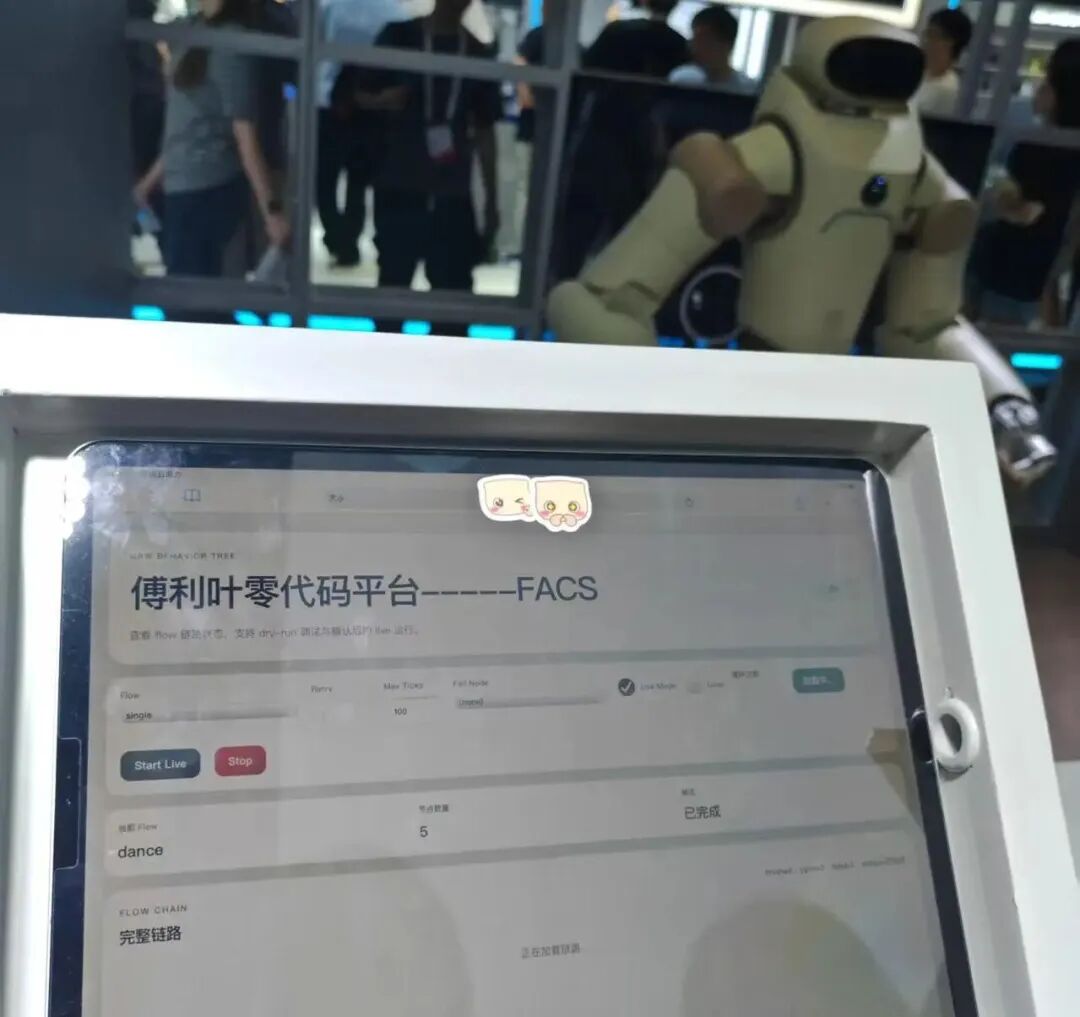
Notably, Fourier Intelligence unveiled its high-load wheeled dual-arm robot GRW, which boasts a stable maximum load capacity of 16kg, an ultra-large 2-meter working space, and flexible mobility. Focusing on high-load human-robot collaboration scenarios such as warehousing logistics, industrial manufacturing, and elderly care, this robot is reportedly equipped with Fourier Intelligence's no-code development platform, further lowering the operation threshold.
In addition, cultural and entertainment tour guide services have become a relatively mature niche track. During WAIC, Agibot partnered with Qingtian Rental to deploy 60 various embodied intelligent robots at the main venue and two sub-venues, providing services such as wayfinding and guidance in core public areas. Models including the A3 and Lingxi X2 not only offered guidance services but also demonstrated highly difficult movements and group-controlled dances on site, drawing crowds of spectators who stopped to watch and cheer.
Agibot co-founder Peng Zhihui stated in an interview that the most obvious transformation in the industry is the shift from tech-showcase demonstrations to deployment-ready and productivity-focused solutions. "Everyone is paying more attention to whether these robots can truly enter factories and commercial service environments."
Factories or stores, different paths but the same core challenge — how to secure the first "survival ticket" in the commercialization process. Every enterprise is answering this question in its own way, waiting for the market to validate their efforts.
II. Sell for the Present, or Bet on the Future?
Divergent Time Perspectives Among Consumer-Facing Players
The differentiation in the consumer market is far less clearly defined than in the B2B space. When factories purchase robots, they calculate ROI, payback periods, and how much labor the robots can replace. Individual consumers make far more complex decisions: some place orders for "fun", some compare prices based on "practical capabilities", while others expect both companionship and functionality. Most of the time, consumers value all three factors.
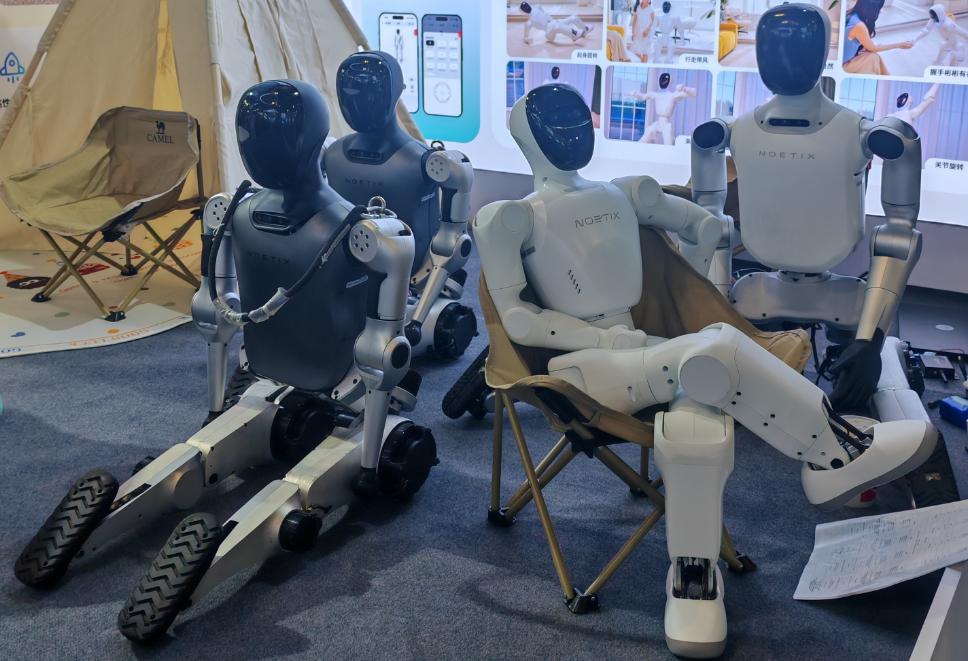
From observations on site, even among companies targeting household and individual consumers, different approaches emerge: some position their robots as "playmates" or "learning companions" that play chess and chat with users, selling emotional value; others position their robots as "housekeepers" that focus on household chores, selling the value of "getting work done"; while others attempt to strike a balance between companionship and practical functionality.
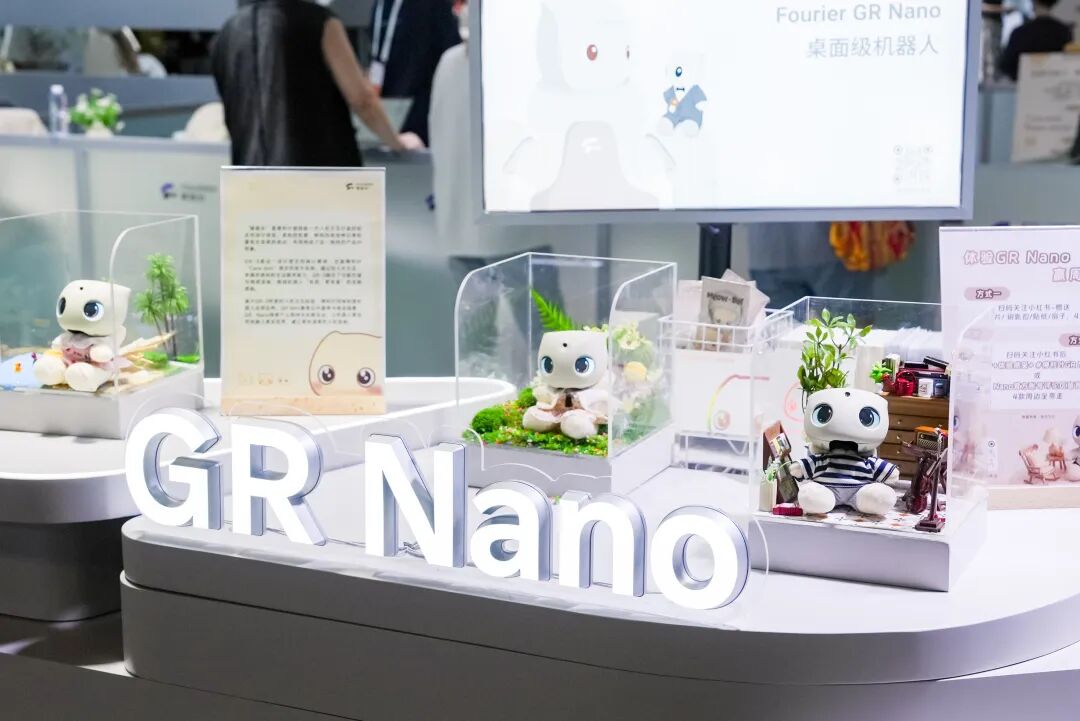
Fourier Intelligence's "cat-head" robot family takes "emotional value" a step further: the desktop-level GR Nano focuses on personal emotional companionship, producing subtle emotional changes when touched, and users can even customize a unique personality for it. The GR Mini, with its cute appearance and anthropomorphic dance moves, empowers scenarios such as exhibition tour guiding and elderly companionship. The GR Nano has not yet been launched on the market, but Fourier Intelligence's clear bet on "emotional connection" in the consumer space is already evident.
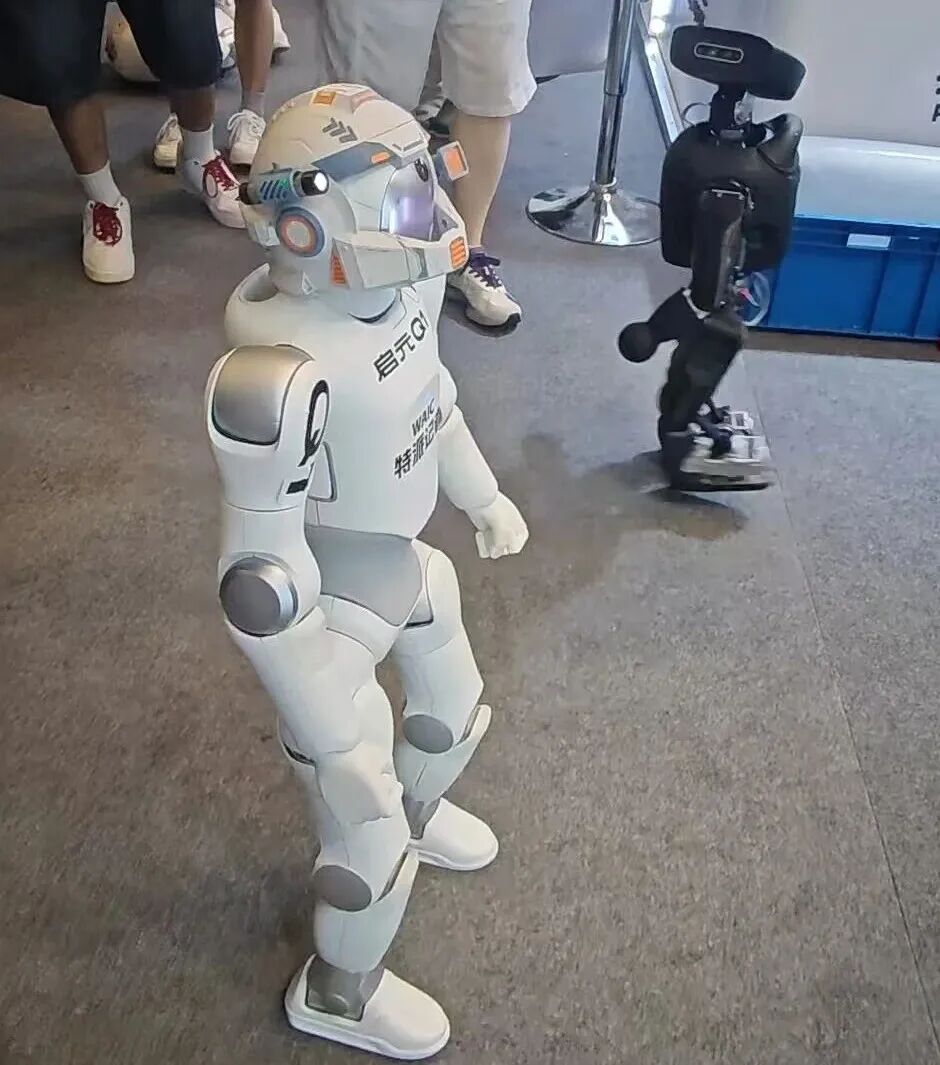
The Qiyuan T1 and Q1 are focused on delivering family companionship and science education experiences. The T1 is the world's first transformable personal robot, freely switching between wheeled-foot humanoid and quadruped forms; the Q1, with its lightweight design, also prioritizes family companionship and science education experiences. The booth interaction rhythm is led entirely by robots, and the company has reportedly opened offline flagship stores in commercial districts.
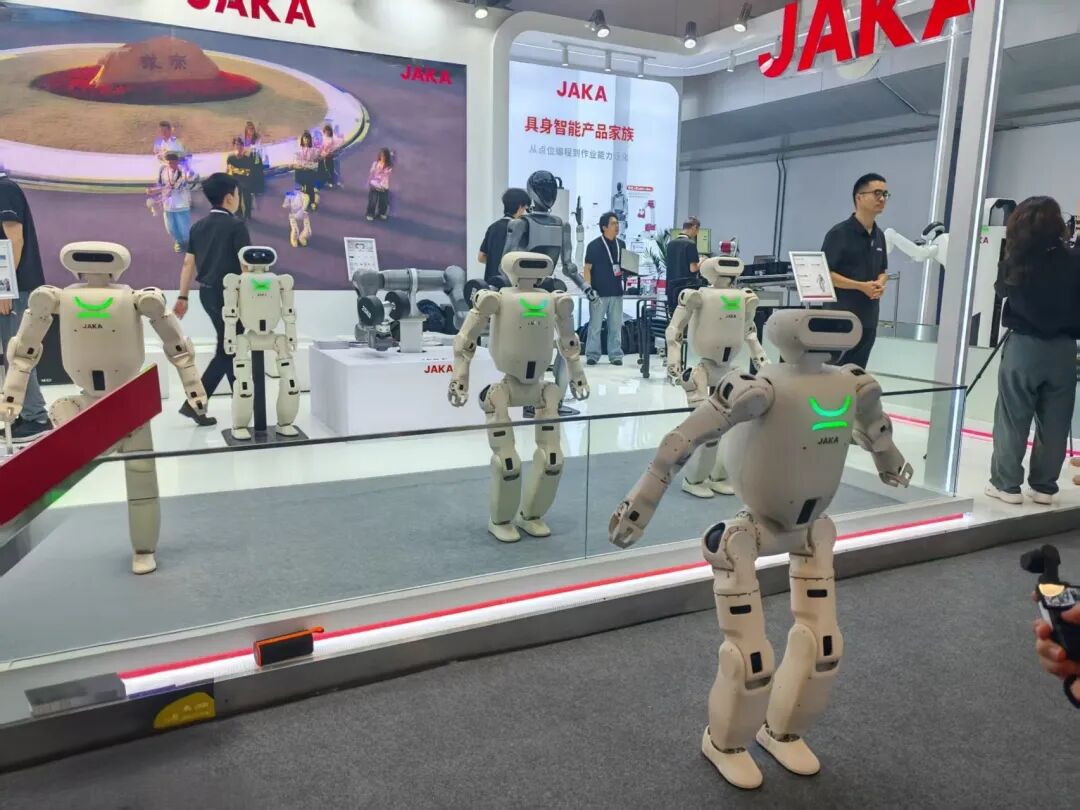
The small humanoid robot JAKA π ("Pi-Zai") launched by JAKA stands at only 1.22 meters tall, making it one of the most compact humanoid robots in its class. Equipped with a fused "brain + cerebellum" architecture, it performs at the booth and interacts with visitors. While JAKA's main battlefield remains industrial robotics, the arrival of "Pi-Zai" shows that even industrial-focused players cannot ignore the appeal of the "cute and playful" product route.
The female-version Luna humanoid robot from ExRobotics is a standout, attracting large crowds with its soft fabric design and smooth, expressive dance moves. It moves nimbly and naturally with elegant gaits, and the supporting iPad control terminal supports one-tap video dance learning and drag-and-drop action choreography.
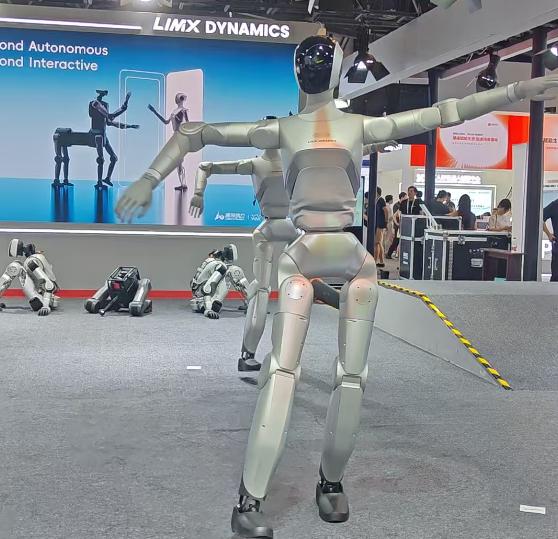
Weta Dynamics brought a robotic dog to the JD.com exhibition area that can autonomously play and chat with users without remote control.
A closer look at these "playmate-focused" players reveals clear task boundaries, controllable interactions, and relatively mature technology. They do not need to understand the complex physical world, only to make correct responses within limited rules. These scenarios are essentially "closed problems": users are willing to pay for products that are sufficiently fun and provide companionship, without requiring them to perform heavy labor.
The "work-focused faction" takes a completely different path. They aim to enter homes to perform household chores such as folding clothes, tidying up toys, and organizing rooms. This is an almost "hell-level difficulty" challenge for robots: fabrics are soft, wrinkles are random, and the same T-shirt can be placed in different shapes every time.
Fourier Intelligence's "Embodied Home" is one of the most technically advanced demonstrators from the work-focused faction. The booth built a complete simulated home space called "A Day in the Life of a Robot Butler". When a user gives a vague instruction like "I'm thirsty", the GR-3 robot can autonomously understand the demand, locate the target, and complete the task of fetching and delivering the item without