RoboSense Unveils 2nd-Gen All-Solid-State Perception Platform, Aiming to Become the Physical AI Data Entry | Frontline
Author|Huang Nan
Editor|Yuan Silai
The embodied intelligence track is currently undergoing a critical transformation. Previously, a large number of the industry's R&D and demonstrations focused on stage displays of humanoid and quadruped robots. Nowadays, the industrial evaluation criteria have shifted to the long-term stable operation capabilities in real scenarios such as factories, parks, and households.
However, a practical problem is: most foundation models are only trained on 2D images and simulated virtual data, lacking native high-precision information about object distances, materials, force conditions, and dynamic interactions in the real 3D space. As a result, robots can only perceive visual frames but struggle to truly understand the operating laws of the physical world.
Simple visual sensors are highly susceptible to interference from strong light, occlusion, rain and snow, with inherent errors in ranging and spatial structure measurement; the physical rules constructed in the simulation environment differ drastically from real working conditions, which directly leads to a lower success rate of tasks such as complex grasping and long-sequence inspection after robots leave the exhibition hall, making large-scale implementation difficult all along. In this process, LiDAR was only regarded as a supporting navigation accessory for robots, performing a single obstacle avoidance function.
It was not until the industry began to realize that high-precision 3D perception is the core data source for the continuous iteration of Physical AI.
RoboSense has attempted to put forward a distinct judgment. The RoboSense team pointed out that high-precision 3D perception hardware is not just the "eyes" that allow robots to "see" the world, but also an indispensable data source for the operation of Physical AI. To fully close the complete loop of "perception-understanding-decision-making-iteration", it is necessary to reconstruct the generation logic of spatial data from the underlying chip, and continuously output real physical information that can be used for the continuous evolution of the model.
From July 17 to 20, the 2026 World Artificial Intelligence Conference (WAIC 2026) was held in Shanghai. RoboSense officially released the second-generation all-solid-state perception platform E2 based on its self-developed "Peacock" SPAD-SoC chip, systematically demonstrating its technical layout from underlying chips to spatial perception products.
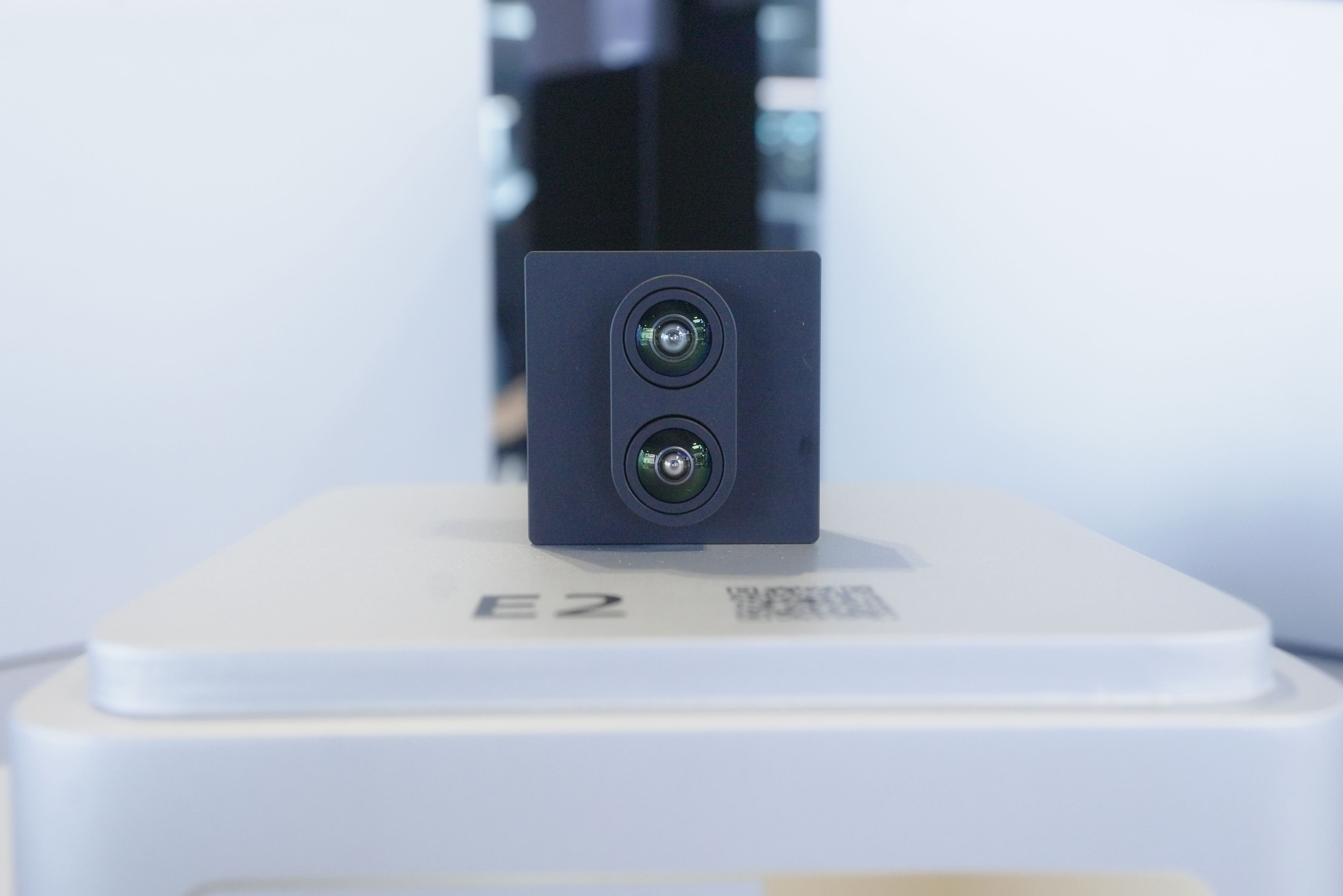
The second-generation all-solid-state perception platform E2 (Image source/Enterprise)
The E2 platform is based on the self-developed ultra-large area array SPAD-SoC "Peacock" chip and 2D VCSEL chip, adopting an all-solid-state architecture where signal transceiving and data processing are all completed at the chip level. Compared with the previous generation of products, the E2 series features a wider field of view, with the highest accuracy 3 times that of its predecessor. The resulting high-precision spatial perception data supports robots to perform precise operations in complex environments.
Targeting complex scenarios such as households, industry, and inspection, E2 has been deployed in products including lawnmower robots, humanoid robots, quadruped robots, and drones, and has secured cooperation orders from enterprises in the sectors of courtyard robots, smart hardware, and consumer electronics.
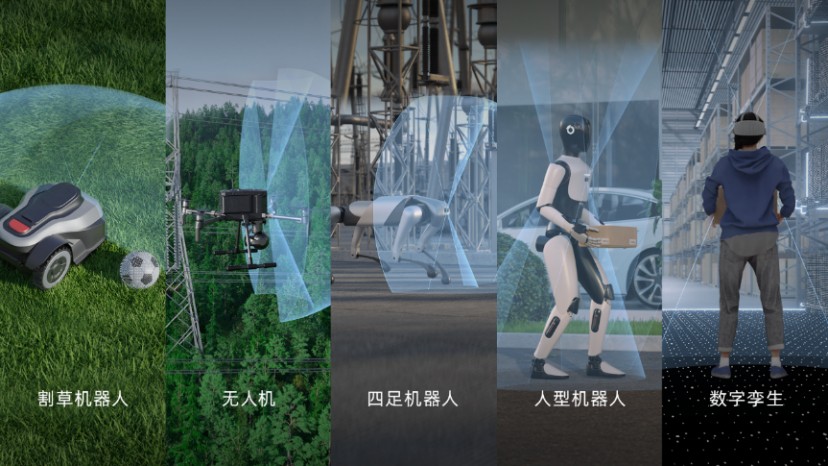
E2 has entered the stage of large-scale application (Image source/Enterprise)
The data required by Physical AI is fundamentally different from the text and image data of the Internet era. Xie Tiandi, Marketing Director of RoboSense, pointed out in a public interview: "Traditional video data is actually relatively rough for embodied large models. They require a more complete spatial data structure and more accurate depth information, which places extremely high demands on sensors. Traditional single cameras or ordinary video footage are no longer sufficient."
In the process of embodied intelligence moving towards practical application, the productivity of robots not only relies on intelligent models and their mechanical bodies, but also on high-quality spatial data continuously generated in the real world, which is transformed into training materials that robots can learn and reuse.
"All companies working on Physical AI will eventually realize that accurate depth information is necessary to enable robots to understand the real world and the structural relationships of front, back, left, and right," Xie Tiandi said. As a result, high-quality spatial data has become a key production factor in the Physical AI era.
Leveraging its self-developed 3D spatial detection chips and digital perception product matrix, what RoboSense aims to build is not just the "eyes of robots", but a data access point that connects the real world with intelligent models.
During WAIC 2026, RoboSense announced that it will cooperate with enterprises including Zhizai Wujie, Jianzhi Robot, Origen, and Guanglun Intelligence, focusing on links such as robot spatial perception, real-world data collection, data processing, model training, and application verification, to build the perception infrastructure for Physical AI.
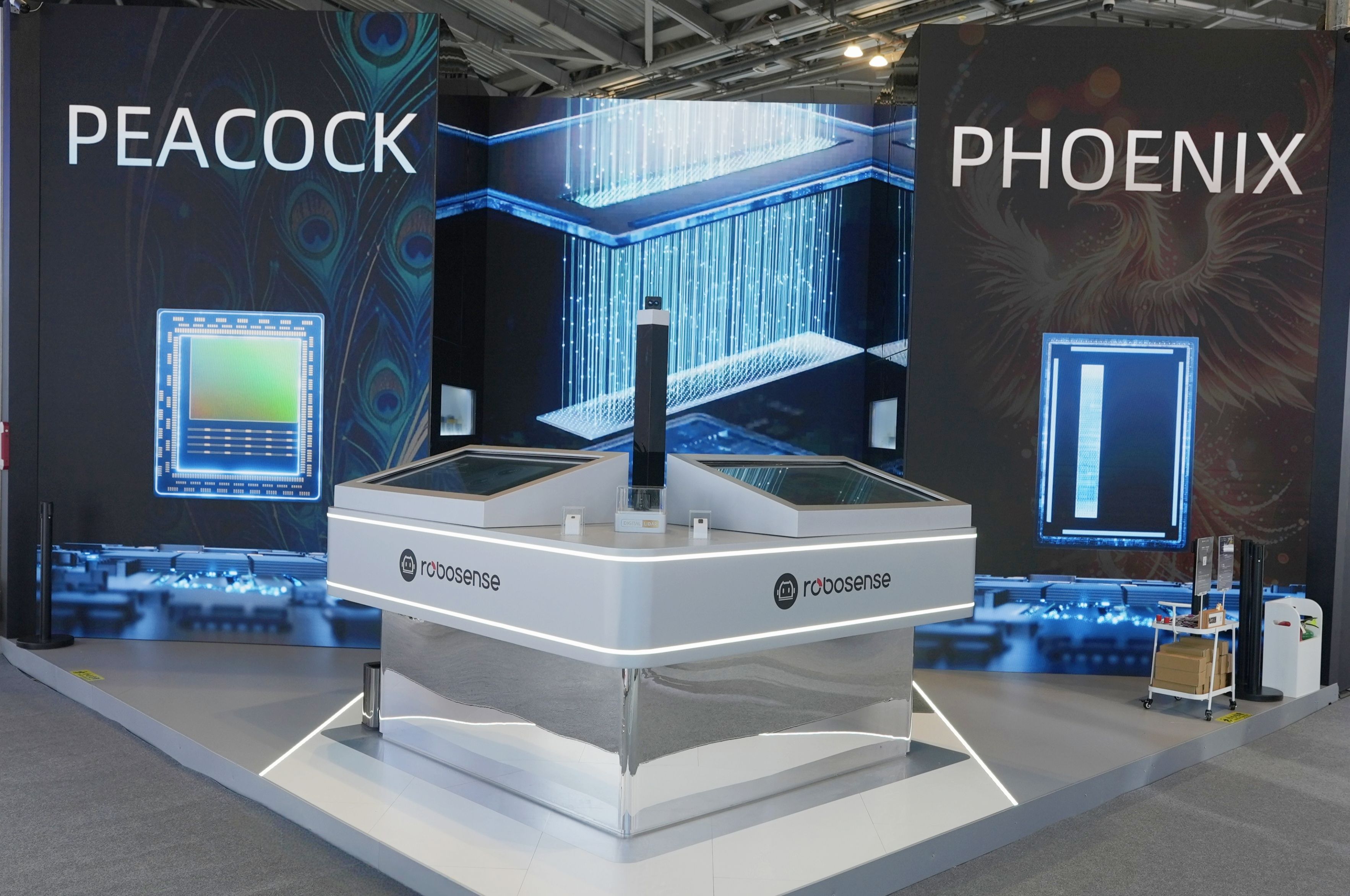
RoboSense's booth at WAIC 2026 (Image source/Enterprise)
Facing the critical stage of embodied intelligence advancing towards large-scale application, RoboSense is building a robot technology platform for the Physical AI era centered on three core capabilities: self-developed chips, AI data closed loop, and automotive-grade mass production.
Chips are the foundation for the continuous iteration of perception technology. Different from the industry's common practice of assembling sensors with externally sourced discrete components, RoboSense has chosen the full-stack self-research route for SPAD-SoC. As a standardized digital perception base, the self-developed "Peacock" chip can uniformly define detection accuracy and point cloud output specifications at the source of chip design, fundamentally avoiding the performance loss caused by the combination of discrete devices.
In terms of AI integration, at the initial stage of product and chip design, RoboSense has targeted the high-precision spatial data collection requirements of physical large models. After various robots are equipped with its perception devices, data assets will be generated synchronously during processes such as movement and grasping operations, which can be used for model iteration, providing high-quality training materials for the capability iteration of Physical AI.
From providing the "eyes" for robots to becoming the data access point for Physical AI, RoboSense is transforming from a hardware supplier to an infrastructure service provider. In the process of Physical AI moving towards large-scale development, whoever takes the lead in solving the supply problem of high-quality spatial data is likely to occupy a more fundamental position in the industrial chain.