Hard Krypton Exclusive | An 80cm-tall plush humanoid robot equipped with a future-oriented self-developed operating system
How much imagination can a plush humanoid robot standing 80cm tall contain?
"Although it is not completely human-like, it is equipped with a full set of sensors that allow it to interact with you, analyze your expressions, and detect whether you are happy or down. As long as the computing power meets the requirements, it can provide a wide range of functions, and the possibilities for incremental software development are unlimited."
Zeng Jun, CTO of Qingxin Yichuang, told Hard-Krypton. He was talking about Amoo — the first intelligent robot product launched by Qingxin Yichuang, which stands 80cm tall, features an anthropomorphic bipedal design, and is fully covered by rounded plush material.
Zeng Jun previously served as a core model scientist at Cruise, the global autonomous driving giant, leading his team to achieve multiple industry-leading results. He holds a doctorate from the University of California, Berkeley, and graduated as an elite student in the Department of Applied Mathematics and Mechanics under the joint training program of Shanghai Jiao Tong University and École Polytechnique in Paris, France. He has published more than 20 top-tier international conference and journal papers on robotics in the fields of reinforcement learning control for bipedal robots and safety-critical systems, and has repeatedly received top citation counts and best paper awards.
He admitted that the technical challenges of autonomous driving and robot R&D are completely different. "Vehicles have nearly unlimited power and computing power, but essentially only two outputs: the steering wheel and the accelerator. Robots, however, have far more outputs — they need to speak, perform movements, and interact with their environment. While they have a certain tolerance for errors, their computing power is relatively limited, and they are constrained by battery life and capacity." As Zeng Jun put it metaphorically, "The amount of water is already fixed, and you have to put the selected amount of flour into it."
Therefore, in Zeng Jun's view, the requirements for underlying capabilities for B-end and C-end products are not on the same level. For mature C-end products, the technical chains of both software and hardware are extremely long. "To truly deliver the product to users, your offering must be capable of continuous upgrades and remain sufficiently attractive to users."
However, without a unified underlying system, the continuous iteration of C-end robots is nothing but a castle in the air. This is also the problem that Zeng Jun has been constantly thinking about.
On July 14, Qingxin Yichuang officially launched Dino OS to solve this very problem. According to Zeng Jun's introduction, Dino OS consists of three layers: Infra, Brain, and Module. It supports perception, decision-making, and behavior orchestration at the upper level, and connects to motion control, security, and hardware abstraction at the lower level.
"Companies often launch one feature today and another tomorrow, with no coupling relationship between them. The chain is disconnected, and there is no unified brain to operate everything. The robot might be able to dance today, but it could fall over tomorrow. Sometimes the problem lies in the communication channel — the channel is not fixed, it is competing with others for bandwidth, and it works properly only when it grabs the channel, otherwise it breaks down."
He believes that developing an OS is meant to prevent hardware connection errors, fix communication channels, and provide a unified control and interruption mechanism to ensure the stable operation of the robot. "Let it operate in a clear environment, so that no matter how many new features are added, it can still run stably."
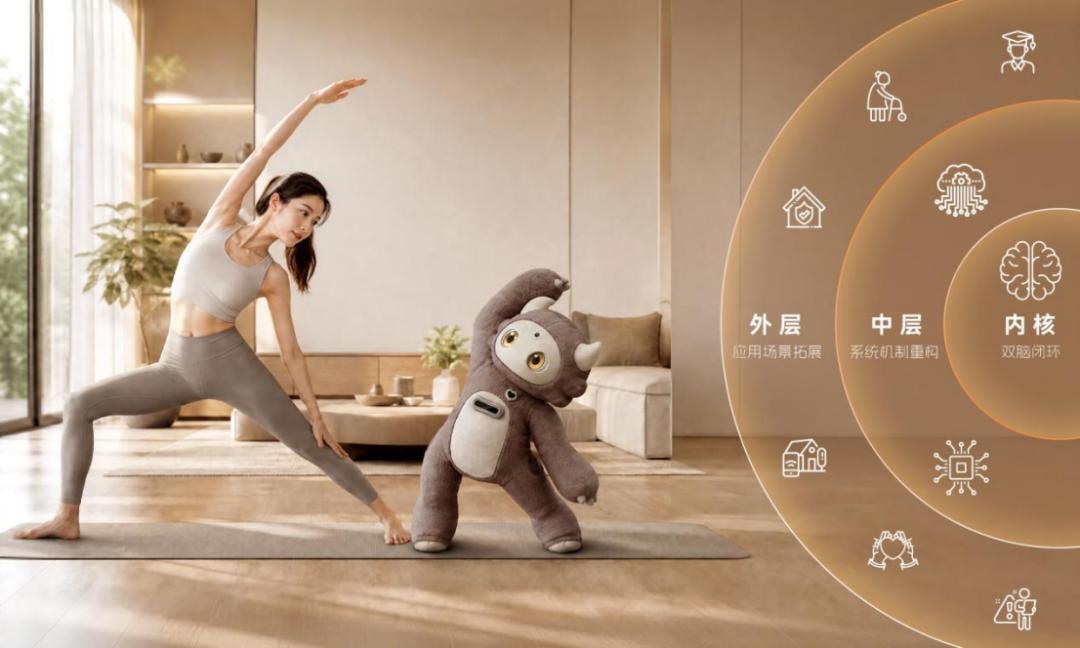
Different from the mainstream fragmented architecture approach, Dino OS transforms all core modules from a "patchwork" to an "integrated whole" at the underlying logic level. Based on the Dino Infra layer, through zero-copy data serialization and shared memory communication mechanisms, all capability layers directly share the same set of data, accessing it on demand. Multiple data streams for perception, decision-making, and execution flow in parallel, making the robot's movements natural, coherent, and smooth. The system has a built-in computing power isolation mechanism, which opens up dedicated channels for key tasks such as obstacle avoidance and force control: emergency stop commands will not be delayed by the model's "deep thinking".
To give the robot a truly vivid "sense of life", smooth operation alone is not enough — it must also have human-like interactive feedback. At the Dino Brain layer, Dino OS has created a unique "dual-brain closed-loop" design, which combines the division of labor system of the "cerebrum and cerebellum" with the biological responses of the "fast and slow brains". The "slow brain" understands scenarios, breaks down tasks, and judges context, while the "fast brain" provides immediate social responses with a shorter reflex arc. The self-developed cerebellum, as the execution layer for "both fast and slow responses of the cerebrum", takes over motion control, force feedback, and safety boundaries in real time to ensure millisecond-level physical execution.
(Image source / the enterprise)
For example, if the user says "Come to the living room to do exercises with me, play the music first", a traditional robot will stay motionless for a few seconds to process the audio before stiffly walking towards the living room. Driven by Dino OS, the robot's physical movement is no longer just the "output result" of decision-making, but part of cognition: the moment it hears the command, the "fast brain" has already driven it to turn towards the user, while the "slow brain" synchronously breaks down the task; as it steps towards the living room, the system has already linked up with the smart home system to play music — its slow brain is thinking, its fast brain is acting, and its cerebellum is sensing balance.
On the other hand, the patchwork architecture of traditional solutions also brings another hidden trouble: a large number of heterogeneous modules and complex third-party dependencies mean that every time a new scenario is expanded, developers have to manually rework the underlying links, which slows down the scenario scalability of the robot.
"Robots need their own operating system, otherwise everyone will be developing separately and reinventing the wheel over and over". Repeating redundant development means that in the absence of a truly unified OS, the R&D cost of robots is considerable, and developers have to spend a lot of energy on trivial tasks such as handling underlying hardware connections, post-processing data, network failures, and communication between various components, leaving no time to polish the real user emotional value and emotional interaction experience.
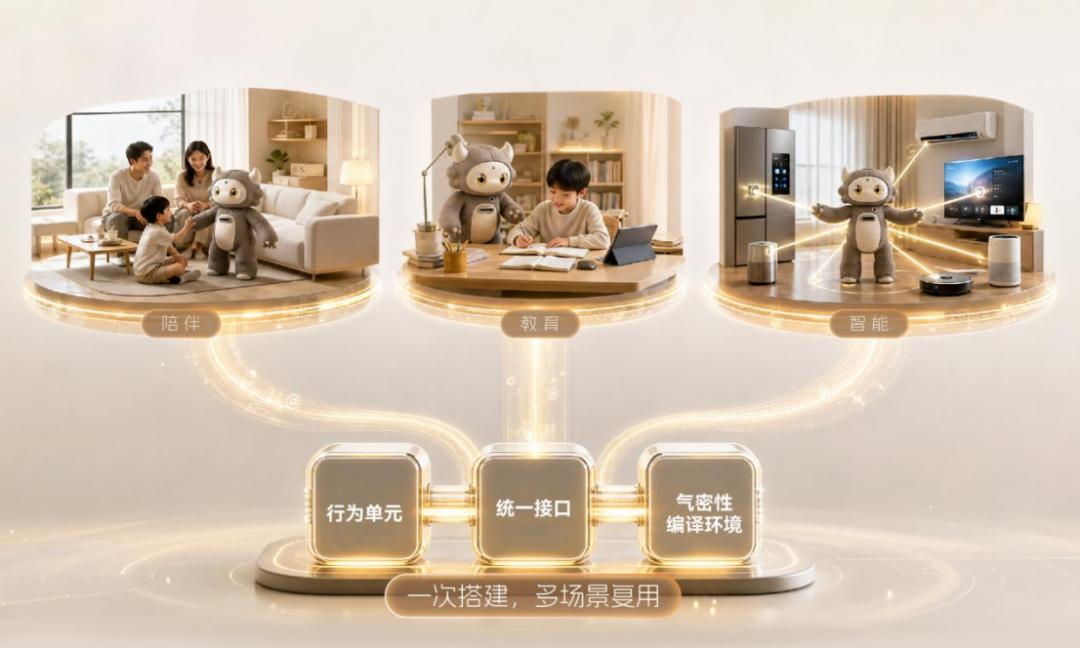
Through the Dino Module layer, the robot can expand its scenarios just like building with blocks, breaking this vicious cycle. On the one hand, it has created an airtight compilation environment to ensure that the same set of code can achieve completely consistent and stable performance in different programming environments. On the other hand, it has precipitated the entire complex chain from perception to execution into reusable behavior units and unified interfaces, which are encapsulated as system capabilities. Developers can use them directly without having to manually build underlying links from scratch.
(Image source / the enterprise)
Therefore, self-developed OS is also conducive to longer-term product R&D. "A unified front end, a unified back end, operated by a single brain. Once you have an OS, incremental development will be extremely efficient." Zeng Jun said. This cross-entity porting capability compresses the development cycle from years to months.
In the long run, what Qingxin Yichuang hopes to develop is not a smarter device, but "an intelligent agent with vitality and dynamism". This is also the challenge that most consumer robots have to face. The first half of the competition focuses on hardware and models, while in the second half, what determines whether the product can truly enter the physical world is the human-robot interaction experience.