The city with the fastest-growing population of primary school students in China is unexpectedly this one
What makes a city attractive? What should we look at?
GDP? That's not comprehensive enough. Population figures? Not necessarily accurate either. The annual permanent resident population data (excluding census years) are estimated from sample surveys, which inherently carry certain margins of error.
However, there is one indicator that more accurately reflects a city's true appeal — that is, the number of primary school students.
Why? Because primary education is nearly 100% universal, every child has a student status record, and the statistics are far more precise.
More importantly, changes in the number of primary school students in a city represent the inflow of families. Where young parents settle down, their children usually attend school.
Therefore, the number of primary school students is actually a "barometer" of a city's long-term population attractiveness.
01
Let's start with the key points: Chongqing firmly ranks as China's top city for primary school student population, with a leading position that leaves other cities far behind. However, in terms of growth rate over the past decade, Xi'an is the city with the fastest-growing primary school student population, while Chengdu takes the first place in terms of net increment.
Cities including Chengdu, Guangzhou, Shenzhen, Beijing, Changsha, Wuhan, Hangzhou, Foshan, Hefei, Jinan, Kunming, and Guiyang have also seen growth in their primary school student numbers.
So, which city has the largest primary school student population nationwide?
In 2025, the top five cities with the largest number of enrolled primary school students are: Chongqing (1.9846 million), Chengdu (1.351 million), Guangzhou (1.3406 million), Shenzhen (1.2431 million), and Zhengzhou (1.2035 million).
It can be seen that among the top 10 cities with the largest number of enrolled primary school students, there are 4 municipalities directly under the central government (Chongqing, Beijing, Shanghai), 4 provincial capitals (Chengdu, Guangzhou, Zhengzhou, Xi'an), 1 separate planning city (Shenzhen), and 2 prefecture-level cities (Linyi, Suzhou).
It is worth noting that: Chengdu has overtaken Guangzhou to become the second-largest city for primary school students nationwide. Chongqing's enrolled primary school students have exceeded 2 million, still maintaining a leading position far ahead of others, firmly ranking first in China, nearly 1.5 times the number in Chengdu or Guangzhou.
02
Over the past 10 years, which city has seen the fastest growth in its primary school student population? Xi'an ranks first, Wuhan second, and Jinan third.
Looking at the growth rates, in 2025, the 10 cities with the fastest-growing primary school student population are: Hefei in first place with a 2.93% increase; Chengdu in second with 2.82%; Hangzhou in third with 2.54%; Kunming in fourth with 2.04%; and Wuhan in fifth with 1.89%.
But if we extend the timeline to the past 10 years, which city has the fastest-growing primary school student population? The answer is unexpected: the top spot goes to Xi'an.
In 2025, the number of primary school students in Xi'an reached 1.0189 million, a net increase of 452,700 compared to a decade ago, with a growth rate of up to 80%!
Wuhan ranks second in growth rate, with a net increase of 376,300 and a growth rate of 79.4%. Jinan ranks third in growth rate, with a growth rate of 78.81%.
It is worth mentioning that in 2025, Shaanxi Province has 2.91 million enrolled primary school students, and Xi'an alone accounts for 35% of the province's total. The proportion in Wuhan is 23%, and 12.4% in Guangzhou, which fully demonstrates Xi'an's extremely high primacy in its province.
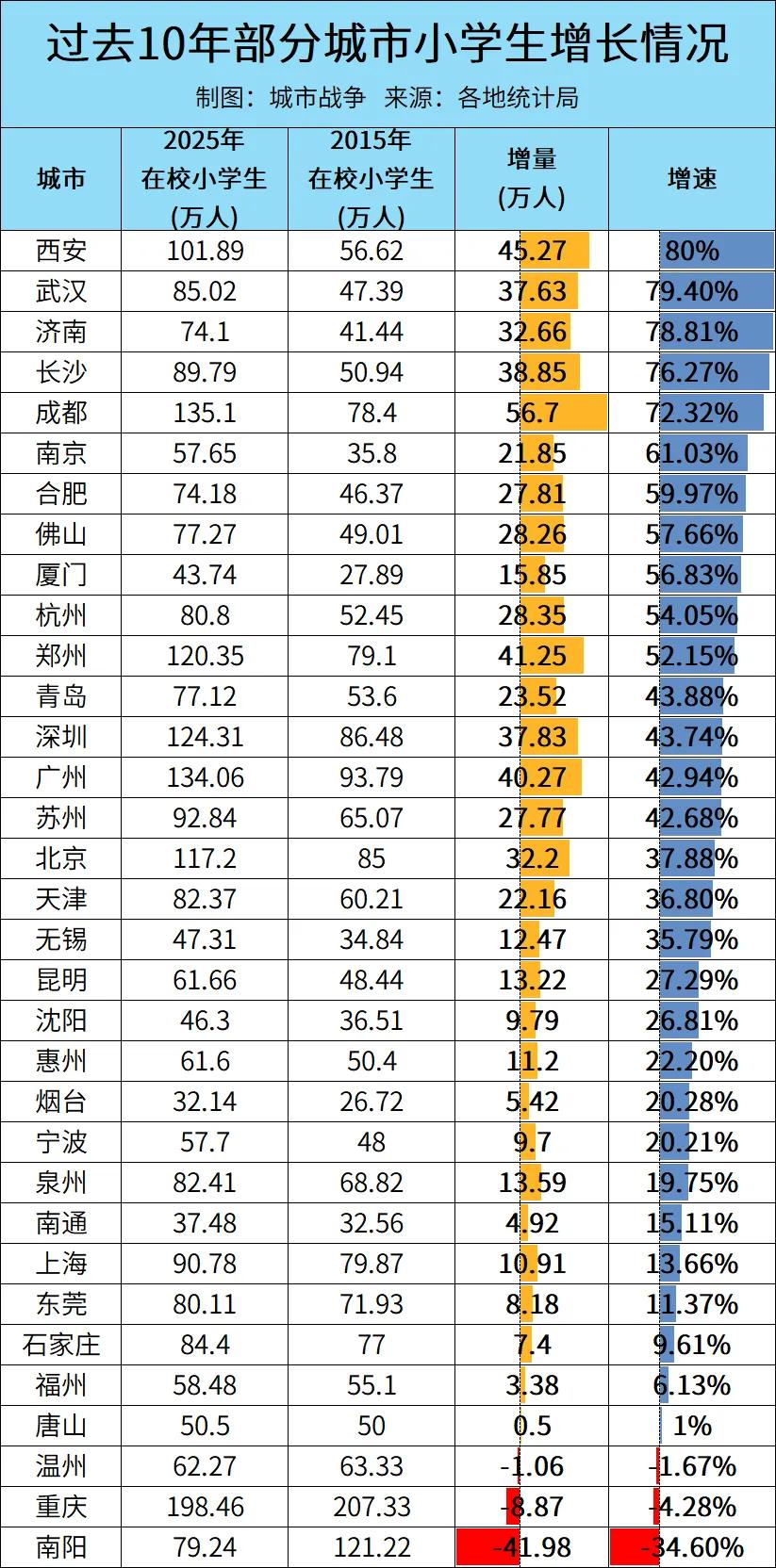
As shown above, the top 10 cities in primary school student growth rate are Xi'an, Wuhan, Jinan, Changsha, Chengdu, Nanjing, Hefei, Foshan, Xiamen, and Hangzhou. Among them, provincial capitals occupy 8 seats, and the remaining two are Xiamen and Foshan.
03
Over the past decade, among the 10 cities with the fastest-growing primary school student populations, one city is rather special: Foshan. Because among these 10 cities, 8 are provincial capitals, one is a separate planning city, and only Foshan is an ordinary prefecture-level city.
Over the past 10 years, the number of primary school students in Foshan has increased by 57.66%, ranking 8th nationwide in terms of growth rate. This growth rate even exceeds that of Guangzhou and Shenzhen. This shows that Foshan has had a very significant appeal to young families over the past decade, making it an exception among prefecture-level cities.
The number of primary school students is redefining urban competitiveness.
In the past, when we looked at urban competitiveness, we used to focus on GDP, industries, and listed companies. But in the future, there is another indicator that will become increasingly important: how many enrolled primary school students does a city have?
Because behind this indicator lies the choices of young families.
Looking at the growth of primary school students over the past decade: among coastal cities, Guangzhou, Shenzhen, and Hangzhou still have strong appeal, while strong provincial capitals in central and western regions are becoming new choices for more and more young families. At the same time, the appeal of municipalities directly under the central government, separate planning cities, and ordinary prefecture-level cities to young families has declined to some extent.
The growth of primary school students is the most intuitive barometer of a city's population vitality, and to a large extent determines the development potential of a city.
This article is from the WeChat public account "City War", authored by Sun Bushu's team, and published with authorization from 36Kr.