AI memory explosion, a Shanghai team has become a hit
You may have experienced this moment when using AI: closing the conversation clears the context, opening a new window requires restating your goals, not to mention that the AI cannot remember your preferences from past conversations. Every time you start a new conversation, the AI has to get to know you all over again, which is far from a comfortable experience.
Without long-term intelligence, AI can only remain a one-off tool, and this is exactly the gap that the memory track is trying to fill. Now, this track has welcomed a landmark financing round —
PE Daily learned that MemTensor has completed a 100 million-yuan Pre-A round of financing, jointly invested by Hubble (Huawei), Glory Strategic Investment, SenseTime Guoxiang Capital, SZVC, and Yu Capital. Previously, the company closed a nearly 100 million-yuan angel round, which gathered well-known institutions including Fusion Capital, Suanfeng Information, and CICC Capital.
Two years ago, based on the judgment that large language models lack long-term memory capabilities, XIONG Feiyu, founder and CEO of MemTensor, led the team to establish the company, focusing on exploring the next-generation general AI foundation model and long-term intelligence infrastructure, becoming one of the early teams in China to step into the AI memory field.
"Memory is becoming the new infrastructure in the Agent era." The second half of the AI era is coming head-on.
Founded in Shanghai, the rise of an AI team
Founder XIONG Feiyu once served as the head of data intelligence for the business platform of Alibaba Group and the head of the data platform for Taobao and Tmall, leading the construction of a hundred-billion-level digital business knowledge graph and China's first knowledge-interaction large model for the retail industry.
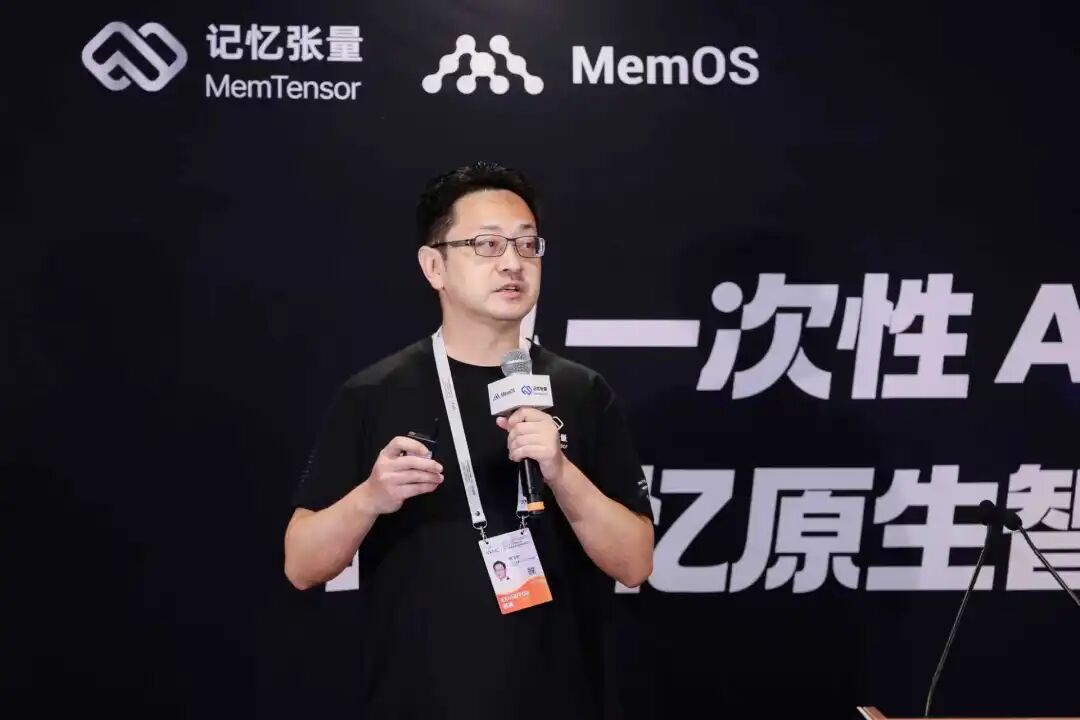
XIONG Feiyu, Founder and CEO of MemTensor
In July 2023, XIONG Feiyu took the lead in establishing the Large Model Center at the Shanghai Algorithm Innovation Research Institute. Starting from the first principles of artificial intelligence, the team gradually developed a research methodology that starts from fundamental principles, runs through architectural innovation and foundational model training, and is reversely verified by real-world applications. The Memory³ layered memory theory and related foundational model training were one of the core work areas of the team during their time at the research institute.
In November 2024, XIONG Feiyu led the Large Model Center team to found MemTensor in Shanghai. The company starts from memory, the current systemic gap of large models, and positions itself as a foundational model and infrastructure company for long-term intelligence: building long-term intelligent infrastructure for Agents at the system layer, exploring memory-native general foundational models at the model layer, and continuously promoting model architecture innovation related to long-term intelligence.
To match this goal, MemTensor has assembled a team with both basic research and engineering implementation experience. Chief Scientist YANG Hongkang graduated from Princeton University, studying under Academician E Weinan; CTO LI Zhiyu holds a doctorate degree from Renmin University of China, and was previously responsible for algorithm R&D and commercial implementation at Alibaba and Xiaohongshu; the advisory team includes Academician E Weinan and multiple professors from the School of Artificial Intelligence of Shanghai Jiao Tong University.
The average age of the team is under 30, and most of the members come from top domestic and international universities such as Princeton University, Peking University, Shanghai Jiao Tong University, and well-known technology enterprises, including many post-2000s members. What attracts them is not just a specific product opportunity, but the possibility of participating in underlying model architecture innovation and exploring long-term intelligence.
"Extremely smart, full of passion, and willing to bet the best years of their lives on a truly underlying problem." In XIONG Feiyu's eyes, the MemTensor team has a romantic touch. This generation of young people has no path dependence, and they often bring unexpected surprises in AI entrepreneurship.
From Memory³ to MemOS, and then to the memory-native foundational model codenamed Metis, MemTensor has gradually formed a technical route of "Theory — System — Model".
The MemOS memory operating system is the first engineering deliverable of this route. Starting from the carrier and read-write mechanism of AI memory, Memory³ divides it into parametric memory, active memory, and explicit memory: parametric memory is responsible for the internalization of model capabilities and long-term knowledge, active memory carries the dynamic state in context and reasoning processes, and explicit memory stores external facts and experiences that can be explicitly read, written, updated, and governed.
This layering is not for the sake of classification itself, but to give different forms of memory more appropriate mechanisms for writing, invocation, updating, scheduling, and governance. Based on this, MemOS manages the three types of memory through a unified runtime, enabling long-term states to be isolated, reused, and continuously maintained across tasks and reasoning processes.
MemTensor summarizes this set of methods as "Memory Engineering": transforming memory from an auxiliary function of the model into a definable, measurable, verifiable, schedulable, updatable, forgettable, and auditable system resource. What it tries to answer is not how to cram more historical information into the context, but how to maintain long-term states, update facts, accumulate experiences, and control error propagation and permission boundaries at a reasonable cost.
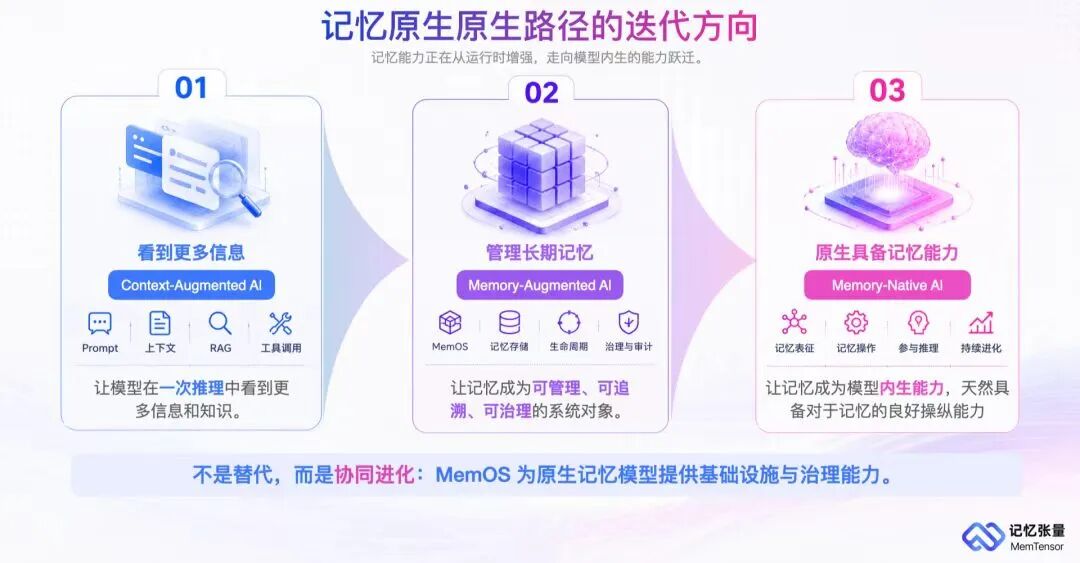
MemOS and "Memory Engineering" are both trying to answer a practical question — when we can no longer simply rely on scaling up, how to make agents have long-term usable capabilities through a more reasonable system structure and engineering mechanism, instead of only seeming smart for a short period of time.
XIONG Feiyu shared a set of data with us: in a comparison covering 14 mainstream memory frameworks, MemOS ranked first in overall performance; in long-distance complex Agent tasks, Token consumption was reduced by nearly 70%, "cutting costs by nearly 70% while delivering better business performance". At present, MemTensor's products have been deployed in end-side hardware, finance, industry, and other fields.
MemOS and Metis are not sequential alternatives, but two collaborative routes for long-term intelligence at the system layer and model layer. MemOS is responsible for the generation, scheduling, and governance of external long-term states; Metis attempts to further internalize the reading, writing, and updating mechanisms of memory into the model architecture, training objectives, and reasoning processes.
"Traditional models are like studying before an exam, and stop learning once the exam starts. We hope that model capabilities not only come from one-time pre-training, but also continue to accumulate from long-term interactions and feedback in real tasks." XIONG Feiyu said.
What Metis is exploring is not to let the model update itself online without constraints, but to let validated and governed effective experiences gradually precipitate into reusable long-term capabilities. Taking memory as the entry point, a technical path from system infrastructure to memory-native foundational models is becoming clear.
Weathervane
The figure of SZVC emerges
Once upon a time, a large amount of capital flooded into large models and vertical applications; but now, solving AI's pain point of being "genius yet forgetful" is increasingly regarded as a crucial step towards AGI, spawning a wave of intensive financings in the memory track.
The math is easy: the traditional "more is better" path of stacking computing power, parameters, and data is becoming less and less cost-effective. The performance improvement obtained by multiplying resources may not be as cost-effective as introducing long-term memory capabilities.
As a result, MemTensor's financing has gradually heated up. Last May, the company completed a nearly 100 million-yuan angel round of financing, with Fusion Capital, Suanfeng Information, and CICC Capital jointly placing their bets. At that time, MemTensor had already achieved tens of millions of signed contracts.
The latest move, with the participation of Hubble (Huawei), Glory Strategic Investment, SenseTime Guoxiang Capital, SZVC, and Yu Capital, is even more of a weathervane signal.
The SZVC team believes that the large model industry is moving from competition over parameter scale and single-point applications to a new stage of systematic implementation and industrial-level deployment. With the development of Agents, AI terminals, embodied intelligence, and enterprise agents, whether models can run for a long time, accumulate experiences, continue learning, and form governable state assets in real business scenarios is becoming an important proposition for AI infrastructure in the next stage.
The value of MemTensor is not just adding an "AI Memory" function to terminals, but promoting AI from a passive responsive tool to a personal agent that can continuously understand users, accumulate experiences, and evolve, providing new system-level support for the future human-centric all-scenario smart life.
In other words, as foundational model capabilities become increasingly popular, whoever can better manage long-term memory, state assets, and governance issues during the continuous operation of agents will have more opportunities to become the key system layer in the next-generation AI application ecosystem.
Quietly, more and more industrial capital and professional investment institutions are entering the AI memory track.
A landmark moment
Long-term intelligence begins to enter real scenarios
What really pushes memory to the position of infrastructure is not some grand narrative about AGI, but the fact that Agents are evolving from single-call execution to long-term operation.
After a Q&A session ends, the system can clear the state; but an Agent that executes tasks across several days, multiple people, and multiple business systems must know what changes have happened to the goals, how far the task has progressed, which judgments have been verified, which facts need to be updated, and what data and tools it can call. When an error occurs, the system also needs to be able to locate, correct, and roll back.
This means that the memory required by Agents is not just "remembering what the user said before", but transforming task states, business facts, personal preferences, and action experiences into long-term assets that can be continuously updated, authorized for invocation, and traced for governance.
For enterprises, whether the model can generate a well-formed answer is just the starting point. Whether it can maintain state consistency in long-term tasks, reuse the effective experience formed in one task for the next, and ensure that every write, invocation, and modification has a clear permission boundary, determines whether the Agent can truly enter the production environment.
"Large models still lack several underlying capabilities to reach real AGI: first, long-term memory; second, stable world modeling; third, closed-loop learning from actions and feedback." XIONG Feiyu said. Memory is not all of AGI, but it is a gap that can be clearly decomposed and engineered to solve when current models evolve from one-time response to long-term cognition.
The industrialization of Agents is accelerating. According to Gartner's forecast, by the end of 2026, 40% of enterprise applications will integrate task-based AI Agents, while this proportion was less than 5% in 2025. As Agents enter real workflows such as customer service, R&D, financial analysis, and industrial operation and maintenance, long-term state management will gradually evolve from an auxiliary function to a system-level requirement.
Another line of change is taking place on the end side.
Mobile phones, PCs, vehicle infotainment systems, and robots carry the most continuous and personal usage data and behavior states. Compared with uploading raw data to the cloud every time, end-side memory can maintain user habits, device states, and task contexts locally, reducing latency and cloud invocation costs while preventing sensitive data from leaking out.
"End-side AI naturally carries personal memory and behavior preferences. After the memory-native small model is deployed on end devices, it can reduce reliance on the cloud, continuously understand user states, and complete personalized information invocation." XIONG Feiyu said.
In the end-cloud collaborative architecture, the end-side model does not have to undertake all complex reasoning independently, but can be responsible for continuously perceiving, filtering, and maintaining personal long-term states; the cloud-side model provides stronger general reasoning and task execution capabilities. The two collaborate through controlled memory exchange, enabling the agent to understand users, adapt to scenarios, and retain preferences for a long time.
This also means that in the future, customers do not need to distinguish which is the model's internal memory and which is external memory. For customers, the more important question is: whether a task can be completed at a lower cost and in a more stable way, and whether the accumulated state and experience can be continuously used, while always remaining controllable, migratable, and traceable.
For MemTensor, memory is the entry point to long-term intelligence, but not the end of technological exploration. The company hopes to advance collaboratively through the two routes of system infrastructure and memory-native foundational models, and eventually become a foundational model company and infrastructure service provider for long-term intelligence.
Models can be replaced, applications can be changed, but the long-term accumulated memory and experience of individuals and organizations should not be lost as models switch. Perhaps this is exactly the infrastructure that the Agent era really needs to make up for.
This article is from the WeChat Official Account "PE Daily" (ID: pedaily2012), author: YU Mengying, authorized for release by 36Kr.