ChatGPT can finally "search its own memory": conversations accumulated over nearly 4 years can be retrieved with one click
It's almost four years since ChatGPT was launched.
Over these four years, you've probably lost count of how many conversations you've had with it, how many images you've shared, and how many projects you've created together.
But there's one pain point you definitely remember: trying to retrieve a conversation from three months ago was basically a game of luck.
The search box in the sidebar was practically useless. Once you accumulated enough chat history, finding old conversations became nearly impossible.
In the OpenAI developer community, users have long complained about this broken search function:
"Finally, I can find that message — why did it take so long?" "That old search bar never worked properly." "With so many chats, searching for old conversations became impossible." "Digging up past history turned into a total nightmare..."


This isn't just a handful of scattered complaints.
ChatGPT can generate almost anything, but as your drafts, discussed code, created images, and collected resources pile up in the chat history, looking for past records becomes more and more like searching for a needle in a haystack. You could scroll the sidebar until your hand aches and still not find that critical discussion from three weeks ago.
But now, everything has changed.
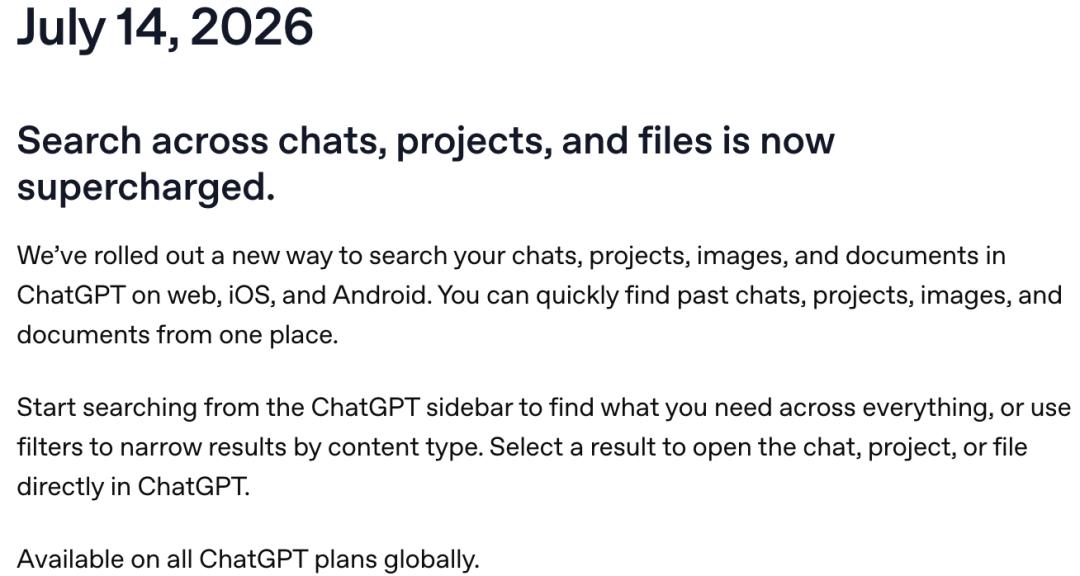
On July 14, OpenAI rolled out a brand-new unified search system for ChatGPT, putting everything you've ever interacted with on ChatGPT into a single access point: past chats, projects, uploaded documents, and generated images — all searchable.
The update is synchronized across Web, iOS, and Android, and is available to all plans worldwide, from the free tier to the Enterprise version.
Once you go through all your accumulated content from the past few years, you'll realize: this is the first time ChatGPT can truly "search itself."
And this is far more than just adding a new search box — it makes your data far more valuable than before.
For every individual, the most valuable asset in the AI era isn't the model itself, but the massive amount of data you've built up through interactions with AI.
One Single Access Point
Search Through Your Entire ChatGPT
This update doesn't let ChatGPT search the internet — that's a feature it's had for a long time.
What this new search targets is all the content stored in your personal ChatGPT account.
The entry is located right in the sidebar.

The search covers four categories: Chats, Images, Documents, and Projects, and supports filtering by content type.
Once you find what you're looking for, just click to jump directly to the target content, no more endless page-by-page scrolling back.
This is completely different from the previous ChatGPT Search web search function. The old one helps you find information across the world, while this new one helps you find information in your own accumulated content.
However, there's a clear boundary here: cross-content search only covers content that you've uploaded to ChatGPT, or content generated within Projects and Workspaces.
Connected external apps like Google Drive are not searchable for now, and the official hasn't announced a timeline for extending this capability.
Therefore, what ChatGPT can access is still only the content you've personally submitted to it.
But even that amount of content is already quite substantial.
From a Chatbot
To Your Personal Knowledge Base
How important can a single search box be?
Don't underestimate it. It fills in the missing piece of the puzzle that ChatGPT has lacked for almost four years.
Over the past four years, ChatGPT has essentially been a "conversation tool." Everything you've discussed with it was locked away in isolated, disconnected chat sessions.
The value of each conversation peaked the moment you finished it, and after a week, it was basically lost to the depths: you clearly remembered discussing a certain solution, but you could never retrieve it again.
Beneath this update lies a far bigger shift: ChatGPT is evolving from a "chatbot" into a "personal knowledge base."
To put it more plainly, it's starting to develop its own dedicated "file system."
Notion and Obsidian manage your personal notes, and Google Search handles information across the entire internet.
What ChatGPT aims to take over, however, is a completely unmanaged space that no service has ever specialized in before: all the content you and AI have co-created over the years.
That content is the actual asset you've built up in the AI era.
Models will keep iterating and being replaced, but the conversations, projects, and materials you've built together with AI can't be taken away or copied by anyone else.
And now, all this data can be easily accessed and retrieved at any time directly within ChatGPT.
Your Data
Grows More Valuable With Every Search
Search makes your data far more usable. It also makes the index OpenAI holds more complete and valuable — but at the same time, far more sensitive.
The easier it is for you to retrieve a conversation from three years ago, the clearer that record becomes. But here's the problem: it's very difficult for you to fully control where the boundaries of this data lie.
First, let's look at a default setting most people don't notice.
For consumer plans (Free, Plus, Pro), your conversations are, by default, used to train the model — unless you manually go into Data Controls and turn that option off. And most users have never even opened that settings switch.
Then there's another important point to consider.
On January 5 this year, in the copyright lawsuit filed by The New York Times and other media outlets against OpenAI, a U.S. federal court upheld a ruling that compelled OpenAI to hand over 20 million de-identified ChatGPT chat logs to the plaintiffs.
These 20 million records account for only 0.5% of the total logs OpenAI has stored, which totals in the tens of billions.
OpenAI tried to argue on the grounds of user privacy, but the court rejected the claim. One key reason given was that these conversations were "voluntarily submitted" to OpenAI by users.
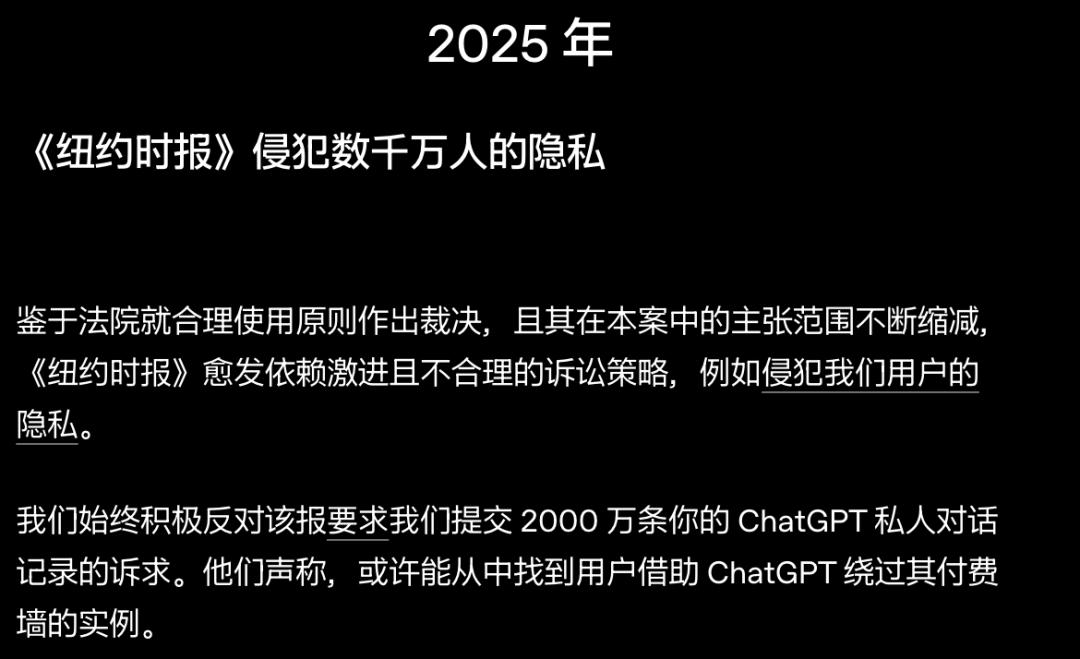
OpenAI's official response page: Publicly opposing The New York Times' request to access 20 million user chat records. (Source: OpenAI official website)
What's even more noteworthy is that, according to TechCrunch reports, the plaintiffs previously accused OpenAI of repeatedly lying that it "couldn't search" these logs.
And now, OpenAI has suddenly given every user a fully functional "search anything" feature.
This search upgrade itself doesn't modify any privacy policies, and the official hasn't announced any new data usage terms — but it makes all the content you've accumulated over the years far more significant.
Every single thing you've said to ChatGPT is an asset, but under certain circumstances, it could also be retrieved and presented in a court of law.
Why Did ChatGPT Suddenly Need a Search Box?
Because it hasn't just been a chatbot for a very long time.
If you connect all of OpenAI's moves over the past year or two together:
File uploads, Projects, Memory, then ChatGPT Work which can run multi-hour long tasks, Sites that directly generate websites and lightweight apps, the new desktop app that merges Chat/Work/Codex, and the successive three tiers of GPT-5.6 models.
The direction couldn't be clearer: OpenAI wants to make ChatGPT your primary workspace for getting things done.
And most of these major developments all happened within the half of July.
Once you start pouring all your project materials, writing records, code discussions, and generated images into ChatGPT, the amount of content stored there will only keep growing. The more content you accumulate, the more crippling the problem of "not being able to find things" becomes.
As a result, search has become the final missing piece to complete this closed-loop system.
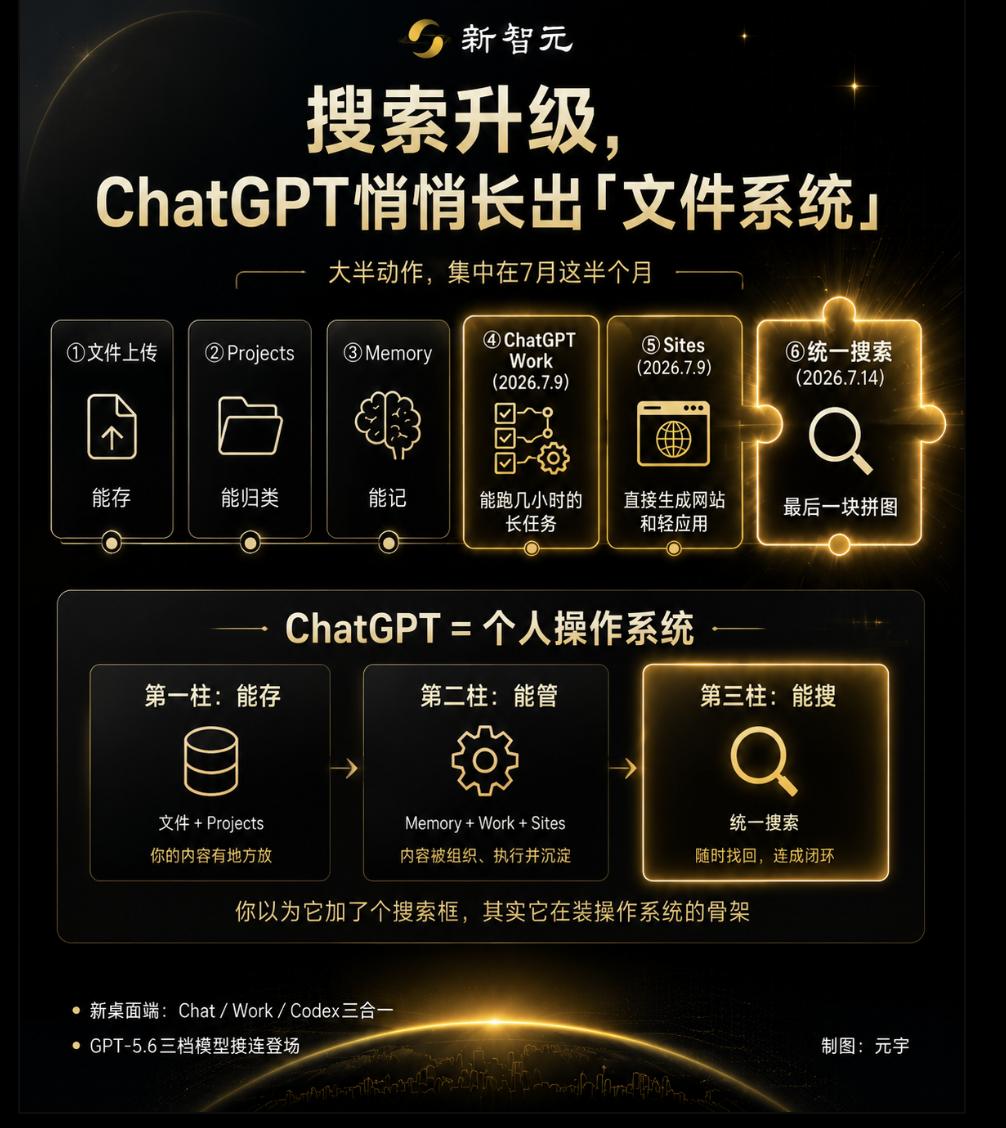
In short: ChatGPT is starting to build out its own dedicated "file system."
You might think they just added a simple search box, but in reality, they're building the foundational framework that a proper operating system should have: capable of storage, management, and full search.
This Isn't OpenAI's Innovation
It's a Long Overdue Fix for the Entire Industry
To some extent, fixing this gap also means making up for a long-unaddressed shortcoming across the entire AI industry.
How terrible the old search function was has long been a widely recognized fact within the community.

As soon as the update went live, users in the comment section immediately called out: "Hope Anthropic copies this right away — Claude's current search is absolutely terrible."
What's interesting is that in 2026, the three major players in the industry are all working on the exact same thing at nearly the same time, though their approaches are different.

On July 7, Sam Altman appeared at the Sun Valley Conference. A week later, OpenAI launched Work, Sites, and the unified search function all within half a month. (Source: Kevin Dietsch via Getty Images)
ChatGPT is taking the personal assistant route, consolidating all the content you've created with it into a single access point;
Gemini leverages Google's full product ecosystem to fully integrate emails, cloud storage, and calendars;
Claude, on the other hand, is betting on long-term memory and Skills features to gradually accumulate your entire context over time.
They're taking different paths, but heading toward the exact same destination: organizing your data properly, making it fully retrievable, and accessible whenever you need it.
If the first half of the large model competition was all about making responses sound as human-like as possible, the new focal point in the second half is quietly shifting to a different area: who can effectively manage and activate your data.
Over the past two years, AI companies have been frantically competing to build more powerful models, but almost no one has seriously considered how to make the massive amounts of data users accumulate actually useful.
This is exactly the key to the second half of the competition: whoever can unlock the full value of user data will be the one who truly wins over users.
At the end of the day, a product that's been online for almost four years is only now letting you "search back to find the things you've said." It's not just this search box that was late — it's the entire industry that's only now realizing this critical truth:
The data you've accumulated together with AI is your most valuable asset.
References:
https://x.com/testingcatalog/status/2077132529270743286
https://x.com/btibor91/status/2077079848678555932
https://help.openai.com/en/articles/6825453-chatgpt-release-notes
https://openai.com/zh-Hans-CN/new-york-times/
This article is from the WeChat public account "AI Era", author: ASI Reveal, editor: YUAN Yu, published with authorization from 36Kr.