Andrew Chi-Chih Yao × Gilles Brassard: Two Turing Award Winners Look Back on the Quantum Magic Moment
On July 18, at the "Science of Intelligence in the Physical World" themed forum of the 2026 World Artificial Intelligence Conference (WAIC 2026), Prof. Andrew Chi-Chih Yao, 2000 Turing Award laureate and academician of the Chinese Academy of Sciences, engaged in a dialogue with Prof. Gilles Brassard, the 2025 Turing Award laureate.
Starting from their respective quantum "magic moments", Yao and Brassard conducted in-depth discussions on how quantum mechanics can infuse new computational paradigms and theoretical depth into artificial intelligence.
This marks the second consecutive year that Yao has held a peak dialogue with a Turing Award laureate on the WAIC stage, following his conversation with Geoffrey Hinton last year.
In recent years, Yao has continuously promoted the forward-looking layout of quantum artificial intelligence, advocating that "although quantum artificial intelligence is in its initial stage, it is scientifically rich and a direction worthy of promotion".
This echoes the research field that Brassard has long dedicated himself to. In 1984, the quantum key distribution method proposed by Brassard and Charles Bennett pioneered the entirely new field of quantum information science.
Over the past four decades, quantum information science has continuously expanded its boundaries. From quantum cryptography to quantum computing, and then to quantum artificial intelligence, quantum mechanics is no longer merely a set of theoretical foundations, but has gradually been transformed into a new way of information processing.
When classical computing is constrained by the bottlenecks of computing power, energy consumption and data, the parallelism, superposition and entanglement characteristics represented by quantum computing are regarded as a "constant source of vitality" that brings new underlying capabilities to AI.
Yao proposed that whether and how quantum information science can bring new computational paradigms to AI is one of the most thought-provoking propositions at the moment.
Brassard holds an optimistic attitude. In his view, quantum computing is expected to achieve exponential acceleration on certain tasks. Although the exact timeline for its full realization remains unknown, the question of "whether it is possible" is no longer an issue, and the future is bright.
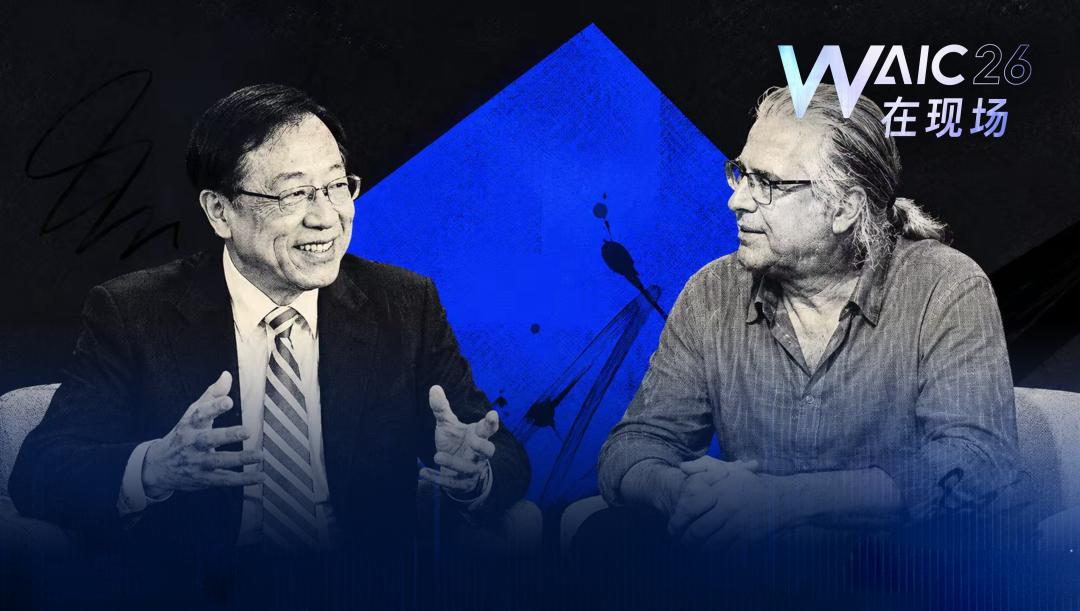
The dialogue between Turing Award laureate Andrew Chi-Chih Yao and Gilles Brassard. Image generated with AI assistance
The full text of this peak dialogue is as follows:
Andrew Chi-Chih Yao: Good morning everyone. It's a wonderful experience to have the opportunity to talk with my old friend today. I think we have known each other for more than 30 years, maybe 40 years.
You may be curious, why are we talking about "quantum magic" at an AI conference?
In fact, at today's forum, we particularly want to take a panoramic look at the AI field, extending from perspectives such as commercial applications, intelligent robots and practical affairs all the way to the highest level.
Everyone is talking about AI empowering science, but we want to start thinking from "science empowering AI". Although AI seems very powerful, it may not be the end of intelligence.
Let's think about the significance of mathematics and physics to AI: one explores the depth of human reasoning in abstract and structured ways; the other questions whether we have exhausted the means to extract knowledge from the world. Therefore, today's physics-focused AI and quantum AI are still emerging fields, and there is no large-scale demonstration of their capabilities yet. But we know that pure quantum itself is already considered more powerful than classical methods.
I would like to start the forum by exploring the power of quantum in computing and communication, so we invited Prof. Brassard, a top researcher in the field of quantum information science. As far as I know, he is probably one of the first mainstream computer scientists to seriously engage in quantum information research, isn't he?
Gilles Brassard: I think so.
Andrew Chi-Chih Yao: I believe that no matter whether we are engaged in physics, mathematics or computer science, our initial driving force is curiosity. Long before we understand the world and develop other motivations, curiosity is the reason why we devote ourselves to this field.
What makes us spend decades studying problems that are difficult and painful for most people? Because we occasionally get huge rewards.
Whenever we hear that someone has accomplished something seemingly impossible, or we ourselves discover something surprising, that is a "magic moment" — our reward. Compared with machine learning, it's like learning to play golf or a game, and eventually you know you've won.
When you experience several "magic moments", you will get addicted. That's why we keep doing research for decades without stopping. I would like to ask Brassard first, what was your "magic moment" when you encountered quantum? Let's take one example.
Gilles Brassard: I think the most magical moment was when I was swimming on a beach in San Juan, Puerto Rico, and a complete stranger swam over to tell me that a friend of his had found a way to make unforgeable banknotes using quantum mechanics. It was completely unexpected — literally an "in the ocean" surprise.
That stranger was Charles Bennett, whom I had never met. It was that conversation on the beach that made me fascinated by quantum information, because what he told me was so amazing and exciting that I almost put down everything else I was doing and started researching quantum information.
That was 1979. I truly believe I was the first computer scientist to grasp this unknown field.
Andrew Chi-Chih Yao: That's a wonderful story. Let me also talk about my first "magic moment" with physics. When I was an undergraduate in Taiwan, I was exposed to the concept of quantum mechanics for the first time when I studied nuclear physics in my junior year. That was in the 1960s, when good physics textbooks were rare. The books we used were very rigid, focusing only on mathematics and calculations, and occasionally we would come across some very obscure annotations, such as "the uncertainty principle exists" and so on.
I couldn't find a reasonable explanation, which troubled me a lot. So I looked up books in the library and pondered over it. Finally, I thought I finally understood what they were talking about.
At that time, I needed to submit a course report, so I wrote a report about why this discovery was so counterintuitive yet true. After submitting the report, I skipped a class to play golf, which used to be a common thing for me.
But soon my classmates told me that the teacher was looking for me frantically. It turned out that he read my report and thought it was amazing that I had gained such an insight. I timidly went to see the teacher, expecting to get a C for skipping class, but he was very generous and didn't punish me. In the end, I got an A in that course. That was a major "magic moment" I remember.
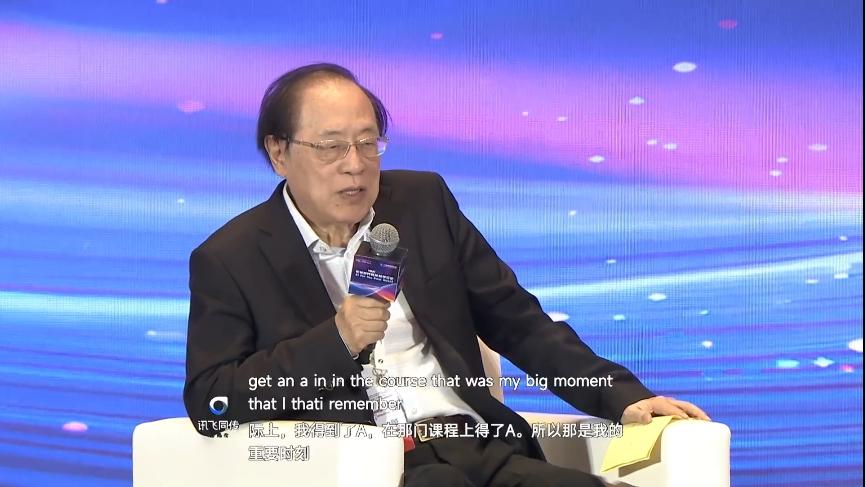
Later, I switched to computer science, and everyone said I wasted 8 years of my undergraduate and postgraduate studies. But eventually I had other "magic moments" and returned to quantum computing research. So I think as long as you sincerely pursue self-improvement, your efforts will not be in vain.
Gilles Brassard: If I may add, I totally agree that you didn't waste those years studying physics. The best proof is that in 1984, Charles Bennett and I invented quantum cryptography, but at that time we couldn't give a complete security proof against all attacks allowed by quantum physics. And you were the first person to find the tools to help us get that proof — although it was finally completed by my student ten years after our invention, your insight into physics was fundamental to proving that quantum cryptography is absolutely secure.
So thank you, you didn't waste your time. And you didn't waste your time later when you switched to computer science, because you have done so many remarkable things.
Andrew Chi-Chih Yao: Yes, you are quite right. This is exactly the power of interdisciplinarity. Not only did my physics background give me an advantage in rigorous proofs, but in fact, the other side of studying physics also helped me a lot — when I was pursuing my PhD in physics, I truly realized that the criteria for being an excellent physicist are different from technically rigorous proofs. The goal is to discover truth and understand it in a way that embraces it.
Gilles Brassard: If I may add more, I am also a firm believer in interdisciplinary research. Back to my example, the discovery of quantum cryptography was the product of the intersection of two very separate fields at that time: physics and computer science (specifically, classical cryptography, which was my main research focus at the time).
It was precisely because physics and cryptography met again, on the beach, between Charles Bennett and me, that the entirely new field of quantum information was born. Neither Bennett nor I could have achieved this alone, because each of us was only proficient in one field.
Andrew Chi-Chih Yao: What is the current state of quantum key distribution? I know that China is very interested in quantum key distribution. The multi-billion-dollar real industry you launched back then has truly brought cutting-edge science into the real world. I think that's amazing.
When you and Charles discovered the quantum key distribution method, you were trained as a complexity theorist, doing the most abstract things. Do you think that abstract complexity training helped you advance this technology?
Gilles Brassard: Absolutely helpful. My training as an abstract classical complexity theorist under John Hopcroft was crucial to grasping these ideas. But I also want to emphasize that this is a perfect example of the importance of basic research.
Basic research is not done because we have thought of applications or want to change the world, but purely for the pleasure of understanding the world. Just like when Einstein invented the theory of relativity, or when Bohr and others developed quantum theory, they had no idea that their discoveries would have such a far-reaching impact on society. They were just trying to understand nature.
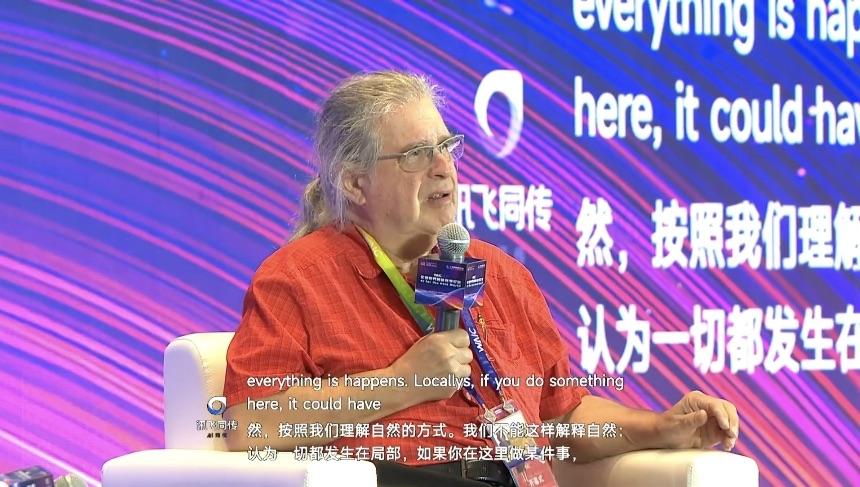
This is curiosity-driven basic research.
When Charles and I started doing this, it wasn't our daily work. We never thought it would become so huge and practical.
40 years later, especially in China, it has become very practical. So we were just having fun, throwing crazy ideas at each other, trying to understand nature. Now, it's very real. So I think this is a good example of the importance of basic research.
You shouldn't ask what your research is useful for. If it's interesting, what matters is that what you do excites you; if it can be applied, that's even better, but the key is that you have to be excited about what you are doing.
Andrew Chi-Chih Yao: One of the major topics in China right now is how to discover and cultivate young talents in the field of science. You have trained some very excellent students. Based on your experience, what is the best way to do this? Can you share some stories from your process of mentoring students?
Gilles Brassard: About myself? Well, I think you need to stay open to what might come your way. Whether it's ideas or surprises. For example, another major "magic moment" for me was the invention of quantum teleportation, which I co-invented with three other people.
We weren't aiming for that at all. We were working on a less interesting problem, but while researching that problem, the teleportation state appeared before us like magic.
If we had tried to invent it from the very beginning, we would never have succeeded. It came to us magically, but to make that happen, you have to stay open, let ideas come to you, instead of forcing them. I believe this is one of the main secrets of my success.
Andrew Chi-Chih Yao: I have had similar experiences. It seems that talents cannot be deliberately shaped. For young people, usually as long as they are provided with a very good environment, giving them the opportunity to draw from various sources, and at the same time having a high-quality peer group, they can grow naturally.
Gilles Brassard: Exactly, just as you said, grow naturally. In fact, another element of my success is to surround myself with very smart students and let them do things that excite them. I never let students work on my projects, which is also my principle. I give them complete freedom to find things they are interested in and work on them, and then discuss with me.
For example, there was another "magic moment": every year in my quantum information class, I would present the criterion of non-locality in nature. I taught that proof, and the next day, one of my smartest students came to me and said he had found a counterexample, proving that what I had explained year after year was wrong, and that in fact nature could be explained in a completely local and realistic way.
In just five minutes, this student changed my entire perception of reality. It was amazing.
Andrew Chi-Chih Yao, quantum information technology and AI are the two hottest fields. So what do you think will happen in 5 years? Will we witness some dramatic breakthroughs in quantum technology, or will it still take a long time?
Gilles Brassard: I think the future of quantum technology is extremely interesting and full of promise. I don't make specific predictions about timelines and events, but what is certain is that several aspects of quantum technology will become increasingly important: one is cryptography, and China is far ahead in the deployment of quantum cryptography.
Quantum information has three subfields: quantum communication, quantum computing, and quantum sensing — using quantum effects to make better measurement devices for time, temperature, etc. For example, the best clocks we use now already use quantum effects.
Back to quantum computing, it is probably the most eye-catching, because it can allow us to achieve exponential speedup in certain calculations, such as factoring large numbers. But I want to emphasize that this has not been proven. There is no proof that quantum computers are more efficient, nor is there proof that classical computers cannot simulate quantum computers in real time.
But we do know that amazing things can be done with quantum computers, it's just that the machines haven't been built yet. The question is when and how? I think the question of "whether it is possible" is no longer an issue, because technological progress has been tremendous in the past few years.
In the future, quantum computers will be in operation, bringing both good and bad impacts. I can't say for sure when, but the future is very bright, and I am very optimistic about it.
Gilles Brassard: Finally, I would like to ask you, what do you think will happen to AI?
Andrew Chi-Chih Yao: Thank you for the question, because it's a simple one. I think in 5 years, AI will be very different from what it is now. We are in such an exciting era: applying AI to any field can get amazing results. I think this phenomenon will last for a while.
But the good times won't last that long, not because AI will stop progressing, but because AI will raise the bar for publication or recognition to a level that we can hardly imagine today.
If you want to become a professor and get tenure, it will be much more difficult in 5 years. Why? Because we are in a paradigm shift, and we are all groping for the best way to collaborate between "humans + AI tools".
The old order will no longer work. No matter if you are from MIT or Tsinghua University, you may not be able to stay at the top of the world in 5 years. It depends on how hard the faculty and students work to innovate. Those top schools may even be at a disadvantage, because they are used to a certain success model. But ambitious startups, which may be driven by desperation to take risks, could achieve amazing results instead.
I often remind myself that as long as I am still in this industry, I must maintain the spirit of adapting to the world.
Gilles Brassard: If I may insist on one point, it is that no matter what research you do, what matters is that you personally find it exciting, not because it is fashionable.
This article is from the WeChat