At most half of the AI bubble will burst.
In recent days, global markets, especially the South Korean stock market, have suffered consecutive declines, with an extremely oppressive atmosphere hanging over trading floors.
Panic over the bursting of the AI bubble has been intensifying among all market participants.
Yet it is critical to clarify: Is this collapse the actual AI bubble, or the speculative mania of "AI-chasing traders"?
At the end of May, South Korean regulators approved more than a dozen 2x single-stock leveraged ETFs tied to Samsung and SK Hynix in one go.
When prices rose, the ETFs passively bought assets to maintain their leverage ratio, drawing a flood of retail investors; when prices fell, over 1.2 million leveraged retail accounts triggered margin calls, with 62% of traders aged 20-30 facing full liquidation of their positions.
This situation further led to a vicious violent incident:
On July 13, a South Korean man in his 20s stabbed a popular stock influencer in his 40s with a knife.
Police reports stated that the suspect followed the influencer's recommendations, poured all his savings into a heavily leveraged position in SK Hynix, only to be completely liquidated and left with massive debts.
He tracked down the influencer's offline office address and stabbed him multiple times.

What is even more ironic is that positive news has turned the market into a slaughterhouse the moment it is confirmed.
Recently, Micron and Samsung released their financial reports one after another, showing their performance surged more than tenfold, yet their stock prices peaked and then headed downward.
This undoubtedly amplified market panic: When performance is this strong and prices still fall, what comes next?
In essence, this is a stampede of massive leveraged capital trapped in extremely overcrowded positions, a self-perpetuating panic among retail investors and speculative institutions amid the cyclical fluctuations of chip production capacity.
How much does this actually relate to the real-world practical application value of the AI industry?
01
Has Core Demand Shifted?
Whether the AI bubble will burst hinges on two critical layers of demand: the computing power demand of AI enterprises, and the end-user demand for AI applications.
Earlier this month, Meta announced it would lease out its surplus computing resources, sparking market concerns that a computing power glut could lead to sharp cuts in future capital expenditure by AI giants.
But why is Meta leasing out its computing power? We have already discussed this in our previous articles.
For the training of next-generation large language models, leading tech giants are competing for next-generation cluster computing power based on chips like Blackwell and Rubin.
Using last-generation chips solely for inference tasks and routine business operations would be a massive waste of resources; it makes far more sense to package them as cloud services for lease to generate steady cash flow.
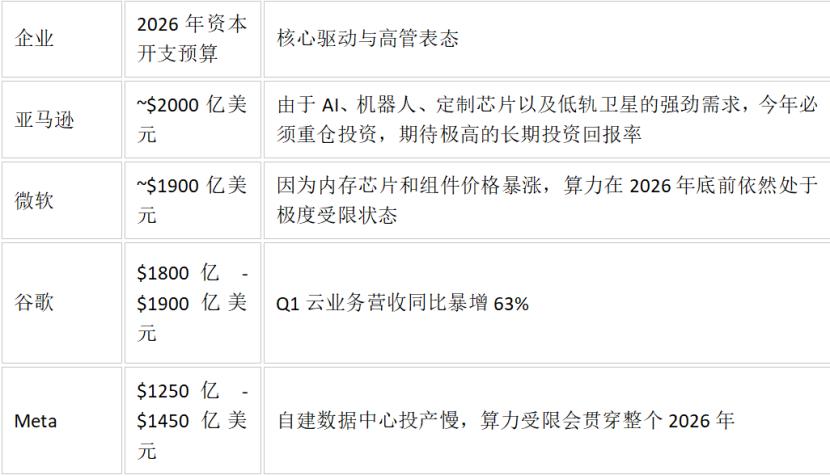
The reality is that Meta's total 2026 AI capital expenditure has not decreased at all — instead, it has been raised to a range of $125-145 billion. The company also recently signed a 5-year, $60 billion partnership deal with AMD, and is set to procure nearly $50 billion in additional external computing power resources.
Just four companies — Amazon, Microsoft, Google, and Meta — are projected to see their combined capital expenditure hit $725 billion this year, marking a 77% increase over last year.
Of course, full details will only be gradually disclosed by the end of the month, so no definitive conclusions can be drawn right now.
Nevertheless, Goldman Sachs has put forward a strikingly bold forecast:
"If the development trajectory of AI infrastructure follows the pattern of the golden eras of railways and automobiles in human history — where incremental investment reaches 2%-3% of GDP — the total capital expenditure of global hyperscale cloud providers will easily surpass $11 trillion by 2027; in an extreme optimistic scenario, that figure could even surge to $14 trillion!"
In other words, the computing power demand of AI enterprises will most likely continue to rise.
But does this explosive level of expenditure correspond to sufficient real market demand?
The genuine demand for AI has quietly integrated into every capillary of global B2B SaaS services and consumer-facing smart hardware, just like water, electricity, and internet access.
Moreover, specific users for specific AI services are indeed spending real money to pay for these offerings.
Let's first look at the two most high-profile players in the space.
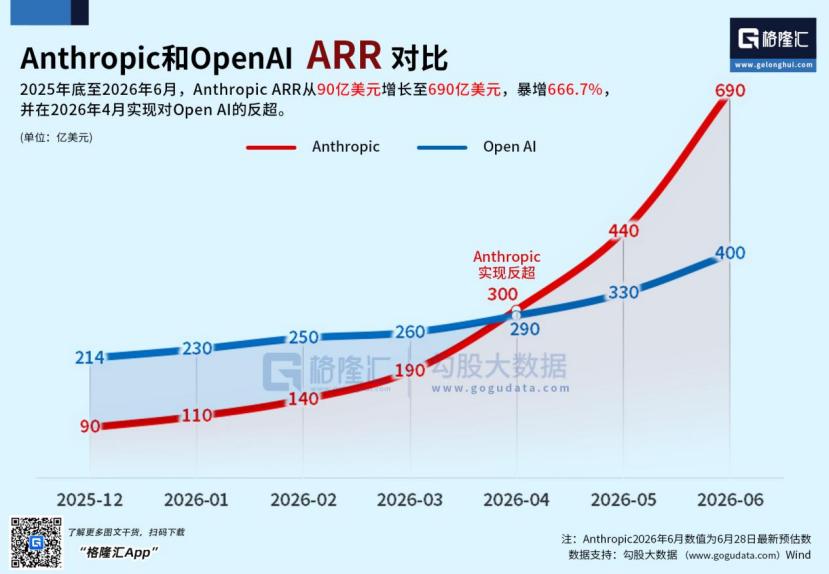
On May 28, Anthropic closed its $65 billion Series H funding round, pushing its valuation to $965 billion.
Underpinning this staggering valuation is its jaw-dropping revenue growth rate.
70% of the Fortune 100 are its clients, with over 1,000 customers paying more than $1 million annually. The gross profit margin of its inference infrastructure has skyrocketed above 70%.
Among its products, Claude Code — a development tool for programmers and enterprises — generated a $10 billion annualized revenue just six months after launch, a figure that exceeded $25 billion by February this year.
OpenAI, which boasts the largest user base, has struggled to capture high-margin share in the B2B market, yet it has now secured a steady $40 billion in annualized revenue.
Let's now examine other industry players.
On the B2B front, Microsoft 365 Copilot is the most profitable AI product.
As of April 2026, its paid enterprise seats have exceeded 20 million, with a net addition of 5 million seats in a single quarter. It continues to erode the traditional office software market at a quarterly growth rate of over 30%.
Currently, more than 60% of Fortune 500 companies have at least 10,000 Copilot seats, and the number of large enterprise clients with over 50,000 seats has quadrupled compared to the same period in 2025.
For example, Accenture — the world's largest consulting giant — has deployed Copilot across its entire workforce of 743,000 employees in 120 countries worldwide.
This service does not come cheap, costing $30 per seat per month.
Why is Accenture willing to pay such a huge sum? Because in its early gray-scale test with 200,000 employees, 97% of participants reported that AI accelerated the completion of their daily tasks by up to 15 times.
Next up is Salesforce, the leading CRM giant, whose latest financial report shows record-breaking revenue of $41.5 billion.
Its agent platform has delivered 2.4 billion "agent workload units" to enterprise clients worldwide across its lifecycle, processing a cumulative total of 19 trillion tokens.
"In the past, we sold software licenses, and clients had to hire personnel to operate the software. Now we are selling 'AI employees'. We no longer charge per seat, but based on how much work the AI completes (per workload unit). This has completely unlocked demand from enterprises looking to cut costs on human customer service and manual sales support."
On the consumer-facing side, let's start with Apple.
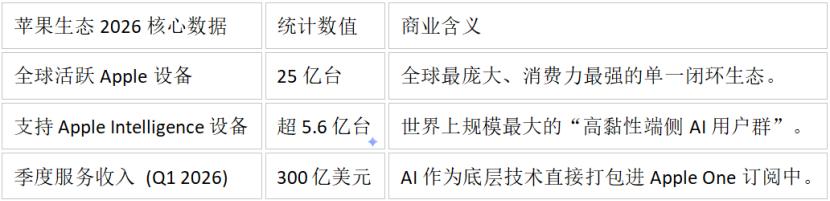
As of May this year, the total number of active installed Apple devices worldwide reached 2.5 billion, with over 560 million of these devices supporting Apple Intelligence.
Furthermore, as more than 800 million older iPhones globally are incompatible with on-device AI, a multi-trillion-dollar "iPhone upgrade supercycle" driven by AI has already begun to erupt in 2026.
This level of demand is completely tangible and real.
Another notable player is AI search engine Perplexity AI.
Following the launch of its new product lines and enterprise-grade Pro tier, its annual recurring revenue surged 50% in a single month, and its monthly active user count has exceeded 30 million.
From office software and enterprise services to developer tools and consumer search, the pyramid of the entire AI application industry has been largely established.
Users have already voted with their wallets: As long as AI can genuinely solve real problems, there will definitely be people willing to pay for it.
This is a sweeping "productivity repricing" across all industries, and it is by no means a bubble.
AI application companies are aggressively capturing market share from traditional software vendors.
Based on this well-defined trend, we can even carry out some extreme scenario analyses.
02
Even If Computing Power Becomes Oversupplied
Many people have overlooked a key fact:
AI does not actually need to become any more intelligent.
This is not a question of technical capability, but that the vast majority of enterprises and ordinary people simply do not need higher levels of AI intelligence.
Logistics sorters, delivery couriers, food delivery workers, restaurant servers handling food and table cleanup, assembly line parts installers, construction site surveyors, crane operators, forklift operators, manual porters, copywriters, graphic designers, proofreaders, subway security inspectors...
Do these roles truly require higher levels of intelligence?
Let's make the most extreme hypothetical assumption:
Even if computing power becomes completely oversupplied tomorrow, and the scaling laws of AI fail entirely, leaving the logical reasoning and language capabilities of LLMs permanently frozen at the level they reached in the summer of 2026...
With the current level of AI intelligence, as long as we equip it with a "physical body", it will still be sufficient to trigger an unprecedented liberation of productivity in human history.
This so-called AI bubble will still not completely burst.
According to McKinsey's long-term tracking research on work automation:
Around 60%-70% of working hours in the global economy can be automated with existing technologies. In industries with high-frequency physical operations such as manufacturing, logistics, retail, and catering, this proportion exceeds 90%.
Demand for automation across the market and even the whole society is being realized at an accelerating pace.
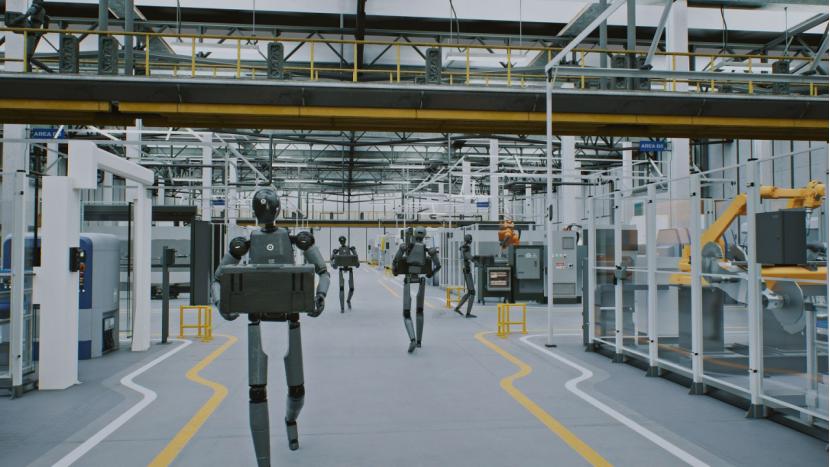
Source: EvgeniyShkolenko / Getty Images
On the warehousing and logistics front.
As of June 2026, Amazon's globally deployed robot fleet has surpassed 1 million units.
These robots assist in handling 75% of all Amazon parcel deliveries worldwide. Its latest "Sequoia" warehousing system, powered by embodied AI, can identify and store goods 75% faster than previous systems.
On the autonomous delivery front.
The autonomous delivery robot fleet operated by Starship Technologies has completed more than 8 million real commercial deliveries this year.
Over 2,000 of these small robots cross more than 125,000 roads every day to deliver food to end users.
And in the most high-profile sector of industrial manufacturing.
Taking China as an example, the current labor gap in its manufacturing industry is nearly 30 million workers, while the talent gap in the embodied intelligence industry is as high as 95%.
McKinsey has put forward a bold prediction: By 2030, up to 800 million jobs worldwide will be replaced by robots and automation.
Yet today, less than one-tenth of this potential has been realized.
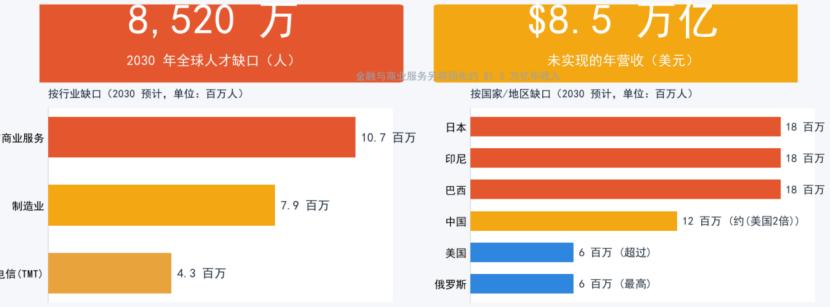
Global Labor Gap
So, even if computing power becomes severely oversupplied, what will happen next?
The price of tokens will plunge off a cliff.
For NVIDIA — which sells GPUs — or for companies like Microsoft and Google that constantly calculate depreciation costs, this would indeed be bad news.
But application-side demand will not be significantly affected, and for the embodied intelligence industry and society as a whole, this would be an enormous positive development.
Wealth will rapidly shift from the virtual "cloud computing power hegemony" to the "hardware control nodes" in the physical world.
Whoever can build the most stable, most durable, and lowest-cost robots, and who can best integrate AI "brains" with excavators, cleaning machines, and assembly lines, will capture the excess profits from 90% of the global labor force in the physical world.
This is the real market demand.
This also partly explains why those South Korean stocks that were artificially pumped up purely by leveraged ETFs have suffered a chain of stampede sell-offs.
Those stocks simply are not worth their current valuations.
Capital is not abandoning AI — it is rotating between high and low segments within the AI industry chain.
Funds are flowing out of midstream manufacturing links that have seen excessive price hikes and overhyped stories, and moving toward more defensible sectors such as advanced packaging, high-end computing power leasing, and large software enterprises with proven and viable