Clock chips have suddenly become a highly lucrative business.
Recently, two notable developments have emerged in the clock chip niche: On June 30, 2026, Canadian MEMS clock chip company Stathera announced the completion of a $55 million Series B financing. On July 1, SiTime officially finalized its acquisition of Renesas Electronics' timing business, bringing a 30-year-old traditional clock chip division (IDT) that has served over 10,000 customers under its wing.
As AI infrastructure evolves from single-node computing power competition to cluster collaboration of thousands, tens of thousands, or even larger scales, the clock chip, once a hidden semiconductor supporting component tucked away on server motherboards, is being redefined. It is no longer merely an electronic component generating a fixed frequency, but has begun to serve as the underlying timing foundation connecting GPUs, CPUs, DPUs, switch chips, PCIe Retimers, and high-speed optical modules. The more chips there are, the higher the interface speed, and the more complex the system architecture, the more all components need to exchange data under a more precise and stable timing reference.
Clock chips are striving to carve out an increasingly valuable business from this underutilized computing potential.
Why Are Clock Chips Gaining Prominence in the AI Era?
As is widely known, a modern AI server does not perform its tasks independently with a single GPU. On a GPU substrate, in addition to the GPU itself, PCIe switch chips, Retimers, network cards, DPUs, memory interfaces, and multiple power management chips may be integrated. In larger systems, dozens of computing boards need to exchange data with other accelerators in the same rack or even across different racks via switches, optical modules, and network interfaces.
These components operate at different frequencies but must transmit, sample, and process signals in a precisely coordinated rhythm. Clock generators are responsible for producing reference signals of various frequencies, clock buffers distribute signals to multiple components, jitter attenuators filter timing noise from signals, and network synchronization chips and high-stability oscillators help different devices establish a unified timing reference.
In traditional servers, minor deviations in clock signals might only result in reduced signal margin or degraded link performance. However, in AI clusters with thousands or tens of thousands of GPUs, local errors are amplified as the number of nodes and data exchange cycles increase, ultimately manifesting as extended waiting periods, link retries, reduced data transmission efficiency, and in extreme cases, even triggering timeouts and system reboots.
On the flip side, interface protocols are evolving at a frantic pace. PCIe lanes are advancing rapidly from Gen5 and Gen6 to Gen7, and data center networks are undergoing generational leaps from 800G to 1.6T and even 3.2T. Each doubling of lane speed narrows the system's "timing window" for signal errors, imposing stricter requirements on reference clock phase jitter, output skew, power supply noise rejection, and temperature stability.
For a long time, the timing foundation of the electronic world has been built on silicon dioxide (quartz). Leveraging its maturity, stability, and highly competitive cost advantages, quartz crystals have dominated almost every corner of consumer electronics, communications, and automotive applications. However, in this semiconductor tsunami driven by AI, the traditional solution of external quartz crystals paired with clock chips is revealing increasingly obvious architectural limitations. Quartz crystals typically need to be soldered onto the motherboard as independent components and matched with load capacitors, oscillator circuits, and clock chips. Traces between components introduce parasitic parameters and noise, and engineers must also address issues such as crystal impedance, startup time, electromagnetic interference, and component-to-component matching across different batches.
As large model training moves toward connections of thousands or tens of thousands of GPUs, the physical limits of quartz have been reached, making MEMS silicon timing a necessity.
MEMS silicon timing, based on semiconductor manufacturing processes, not only breaks free from the physical constraints of mechanically cut quartz, but also deeply integrates miniature MEMS resonators, high-performance analog circuits, phase-locked loops (PLLs), high-precision temperature sensors, and advanced compensation algorithms through wafer-level packaging. Timing is transforming from a discrete "passive component" into a fully programmable, highly integrated semiconductor system.
SiTime is currently the MEMS timing manufacturer with the largest scale and most complete product portfolio; Microchip also has a presence in the MEMS oscillator field, and Murata is listed by SiTime as a major competitor in the MEMS resonator segment.
Taking SiTime's first-generation Chorus series launched in 2024 as an example, this product integrates MEMS resonators, oscillators, and clock generators into a single Clock-SoC for the first time. Compared with traditional discrete designs, it can directly replace up to four independent oscillators, reducing the board-level area occupied by timing-related components by over 50% and fundamentally eliminating the long-standing impedance matching and noise issues between external crystals and clock chips. With the evolution to Chorus 2, this integration and replacement scope has expanded exponentially, capable of replacing up to 8 to 12 timing signal sources in one go.
This indicates that the impact of MEMS timing on traditional quartz solutions is advancing from material replacement at the component level to timing tree reconstruction at the system level.
Why Did SiTime Invest Heavily in Acquiring Renesas?
As the absolute leader in the MEMS timing field, SiTime's acquisition of Renesas' timing business can be regarded as a masterstroke in both commercial and technological dimensions.
According to the agreement disclosed by both parties when the transaction was announced, SiTime will pay $1.5 billion in cash and approximately 4.13 million shares of the company's stock. Calculated based on the stock price range set in the agreement, the total transaction consideration is approximately $2.77 billion to $3.22 billion; SiTime has also secured $900 million in committed debt financing for this deal. For a company with full-year revenue of approximately $327 million in 2025, this is almost a high-stakes gamble betting on its future.
What SiTime has truly acquired first and foremost is a business with extremely high financial quality.
The acquired Renesas timing business (with core assets originating from IDT, which Renesas acquired for $6.7 billion in 2019) has historically maintained a gross margin of around 70%. SiTime estimates that this acquisition will bring in at least $300 million in incremental revenue within 12 months of completion. For comparison, SiTime's own full-year revenue in 2025 was $326.66 million, representing a 61% year-on-year increase. In other words, the revenue generated by Renesas' timing business is already close to more than half of SiTime's original business, and this steady stream of cash flow will support its accelerated progress toward the $1 billion revenue target.
More importantly than revenue and gross margin, Renesas fills a long-missing piece in SiTime's puzzle.
SiTime excels at manufacturing resonators (the source of timing signals), while Renesas' timing business specializes in clock ICs, which are responsible for distributing and buffering timing signals. After the merger, SiTime will cover the complete timing signal chain, ranging from MEMS resonators and oscillators to timing generation, timing distribution, jitter cleaning, and network synchronization. This is the true meaning behind SiTime's claim of "a tenfold expansion of the product portfolio."
SiTime's ambition is to completely eliminate external crystals on motherboards. SiTime and Renesas signed a memorandum of cooperation in February 2026 to explore packaging SiTime's Titan MEMS resonators in bare die form together with Renesas' MCUs or SoCs within the same chip package. This way, the external crystal that originally needed to be placed on the motherboard can be moved inside the chip package, reducing board-level components, shortening signal paths, and simplifying system design.
In the short term, this cooperation is likely to first be applied to MCUs, automotive, industrial, and IoT chips. Future computing chips may not only integrate CPUs, GPUs, HBM, and I/O, but also co-package the micro-mechanical structures that generate the timing reference.
This transaction has three layers of impact: 1) Increased market concentration: Customers will place greater emphasis on secondary suppliers and supply chain redundancy. 2) Platformization of product competition: It will become increasingly difficult for standalone oscillator companies to compete with vendors that offer a complete timing signal chain. 3) Restructured industry valuation: High-end timing products will gradually shift from being valued as traditional components to being valued on par with analog chips and system platforms.
SiTime's latest mass-produced Chorus 2 supports PCIe Gen7, with typical SerDes jitter below 110 femtoseconds. A single component can replace up to 8 or 12 independent oscillators and other timing signal sources. Multiple timing components that were previously scattered across the motherboard are gradually converging into a single programmable, multi-output system-on-chip capable of managing complex timing trees.
Why Did Capital Choose Stathera?
With SiTime's acquisition of Renesas further consolidating its industry dominance, downstream buyers such as NVIDIA, Google, and Microsoft will always need a backup in their supply chain. Therefore, the significance of Stathera's establishment lies in capital proactively nurturing an independent MEMS timing supplier.
Stathera pointed out in its financing announcement that the silicon timing market is becoming increasingly concentrated around a single dominant supplier, while AI data center and hyperscale cloud customers are seeking independent next-generation alternatives. This $55 million Series B financing was led by Maverick Silicon, with continued participation from Celesta Capital, BDC Capital, MediaTek Ventures, TXC Corporation, and Ultratech Capital Partners, bringing the company's total financing to $75 million.
MediaTek represents large fabless chip companies that require smaller, more easily integrated timing solutions to meet the needs of consumer electronics, communication chips, and future AI computing products. As the global leader in traditional quartz crystal oscillators, TXC fully understands the inevitable trend of quartz being gradually replaced by silicon. Investing in Stathera is the traditional quartz giant's ticket to securing a position in the future market.
Stathera's differentiated technology is its DualMode MEMS architecture, which enables a single MEMS structure to generate both kHz and MHz frequency signals simultaneously.
However, Stathera and SiTime are not currently at the same commercial stage.
It is reported that the $55 million raised by Stathera will be used to push its GEN2 32.768kHz silicon timing products into mass production. Targeting the mobile, wearable, and IoT markets, the company claims that these products can reduce the footprint by up to 85% compared to standard surface-mount quartz packages and eliminate the need for external load capacitors.
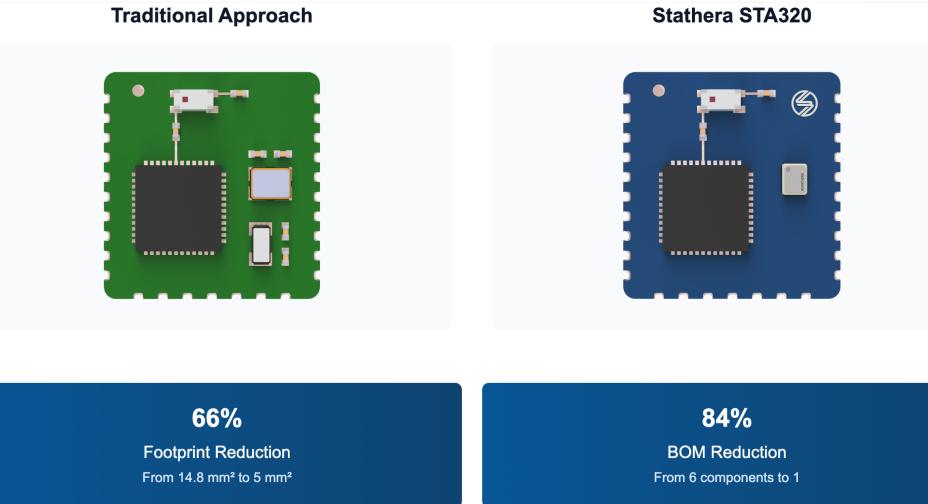
Image source: Stathera
In traditional electronic devices, 32.768kHz is typically used for real-time clocks and low-power timing, while MHz clocks are used for processors, communications, and data transmission. Stathera aims to replace two independent resonators with a single one, thereby reducing component count, board footprint, and power consumption. Its related patents describe generating different frequency signals through two vibration modes (in-plane and out-of-plane) of the same MEMS structure.
The higher-performance GEN3 platform has just launched dedicated R&D, targeting the nanosecond-level synchronization challenges of tens of thousands of GPU clusters and 1.6T optical modules under extreme temperature differences and mechanical vibrations. Stathera will use the financing to establish an office in Silicon Valley to engage with AI chip, data center, and hyperscale cloud customers, with plans to deliver GEN3 samples to its first major AI and data center customers in 2028.
Stathera cites industry data indicating that as data center synchronization accuracy evolves from microseconds to nanoseconds, the cumulative market size of the AI data center timing synchronization segment alone will reach $1.5 billion by 2030.
What Stage Is the Domestic Timing Industry In?
This wave of "timing de-quartzification" has also opened a rare window of opportunity for local Chinese semiconductor companies.
On one hand, after SiTime completes its acquisition of Renesas' timing business, the global high-end timing market will become more concentrated, motivating server, communications, and automotive customers to cultivate secondary and tertiary suppliers. On the other hand, AI servers, 800G and 1.6T interconnections, smart vehicles, and robots are generating a large number of new timing tree designs, providing domestic manufacturers with the opportunity to bypass the solidified traditional product platforms and enter customer solutions at the system definition stage of the new generation.
At this stage, the domestic timing industry has roughly formed three distinct breakthrough paths.
The first path is to start with high-performance timing signal chain chips. For example, Aura Semiconductor has already deployed clock generators, jitter attenuators, differential clock buffers, and IEEE 1588/SyncE network synchronization chips.
The second path is to extend from traditional quartz timing-frequency products to MEMS and full-stack timing platforms. In this regard, Dapu Technology has begun to launch MEMS differential clocks. Its publicly available DP98xx series supports frequency configuration from 100MHz to 1GHz, with the official rated phase jitter reaching 25 femtoseconds under certain operating conditions above 400MHz, targeting 800G and 1.6T optical modules and high-speed data transmission scenarios. The company also provides PCIe timing solutions for AI servers and autonomous driving, including high-frequency low-jitter clocks and multi-channel clock generators. In the automotive sector, Dapu Technology's RTC, TCXO, and timing products have covered scenarios such as battery management, smart cockpits, in-vehicle infotainment, and ADAS.
The third path is to directly develop MEMS resonators and MEMS oscillators. MSTA is one of the few domestic startups that simultaneously works on MEMS resonant structures and timing ASICs. Its publicly released MST8011 supports frequency configuration in the range of 1MHz to 180MHz and adopts dual-port output, aiming to replace traditional fixed-frequency crystals with higher programmability and integration.
In addition to chip design companies, the improvement of domestic MEMS manufacturing capabilities also forms the underlying foundation for this competition. MEMS chips contain three-dimensional micro-mechanical structures, and different products often require different materials, cavities, etching depths, packaging, and release processes. Their manufacturing is not as highly standardized as that of mature logic chips. Even if timing companies have resonator designs, they must find MEMS fabs that can co-develop dedicated processes, control component consistency, and achieve mass production.
Silex Microsystems, under Naura Technology, has long been engaged in pure MEMS wafer manufacturing and has mature MEMS production capabilities in Sweden. Its Beijing FAB3 is an 8-inch MEMS manufacturing line with a planned monthly capacity of 10,000 wafers in the first phase, and it has already achieved commercial production of products such as MEMS microphones. This provides a potential manufacturing foundation for domestic MEMS timing products.
From the perspective of the industrial chain, the domestic timing field is no longer a blank slate. Domestic companies have established individual capabilities in clock generators, buffers, jitter attenuators, network synchronization, and MEMS oscillators, but a complete platform-level vendor is still lacking.
It is worth noting that the qualification cycle for timing products is typically long. SiTime discloses that its customers' design cycles usually range from 6 months to 3 years, and product lifecycles can extend up to 10 years or more. Once a timing product is designed into a customer's platform, it is usually not easily replaced within the same generation of products. In the complex timing trees of tens of thousands of GPU clusters, the main clock generator has the highest barrier to replacement and is almost locked in by overseas vendors. However, peripheral timing buffers, multiplexers, and low-speed timing sources have relatively lower qualification thresholds, as they do not directly participate in the extreme timing synchronization of the core bus.
Conclusion
The incremental demand brought by AI is concentrated in "precision timing" rather than all crystal oscillators. AI is driving the timing industry from a low-cost discrete component market toward a system platform market characterized by high gross margins, strict qualification requirements, and the integration of software and hardware. It is important to emphasize that MEMS will not eliminate quartz. What is truly being challenged is the traditional external, fixed-frequency, discrete timing architecture. Quartz will continue to exist for a long time in scenarios that require low cost, high stability, and a mature supply chain.
This article originates from the WeChat public account "Semiconductor Industry Observer" (ID: icbank), authored by Du Qin DQ, and published with authorization from