WAIC robots are rushing to land: segmented tracks are exploding, and VLA and world models are competing to be the "brain"
On July 17, the 9th World Artificial Intelligence Conference (WAIC) officially kicked off at the Shanghai World Expo Center. As an annual flagship event for the AI industry, this year's conference still brought together domestic and international large model companies, AI application developers, hardware manufacturers, and robotics firms. Leikeji (ID: leitech)'s new AI media outlet "Leikeji AGI (leikejiagi)" also dispatched a reporting team to Shanghai for on-site coverage.
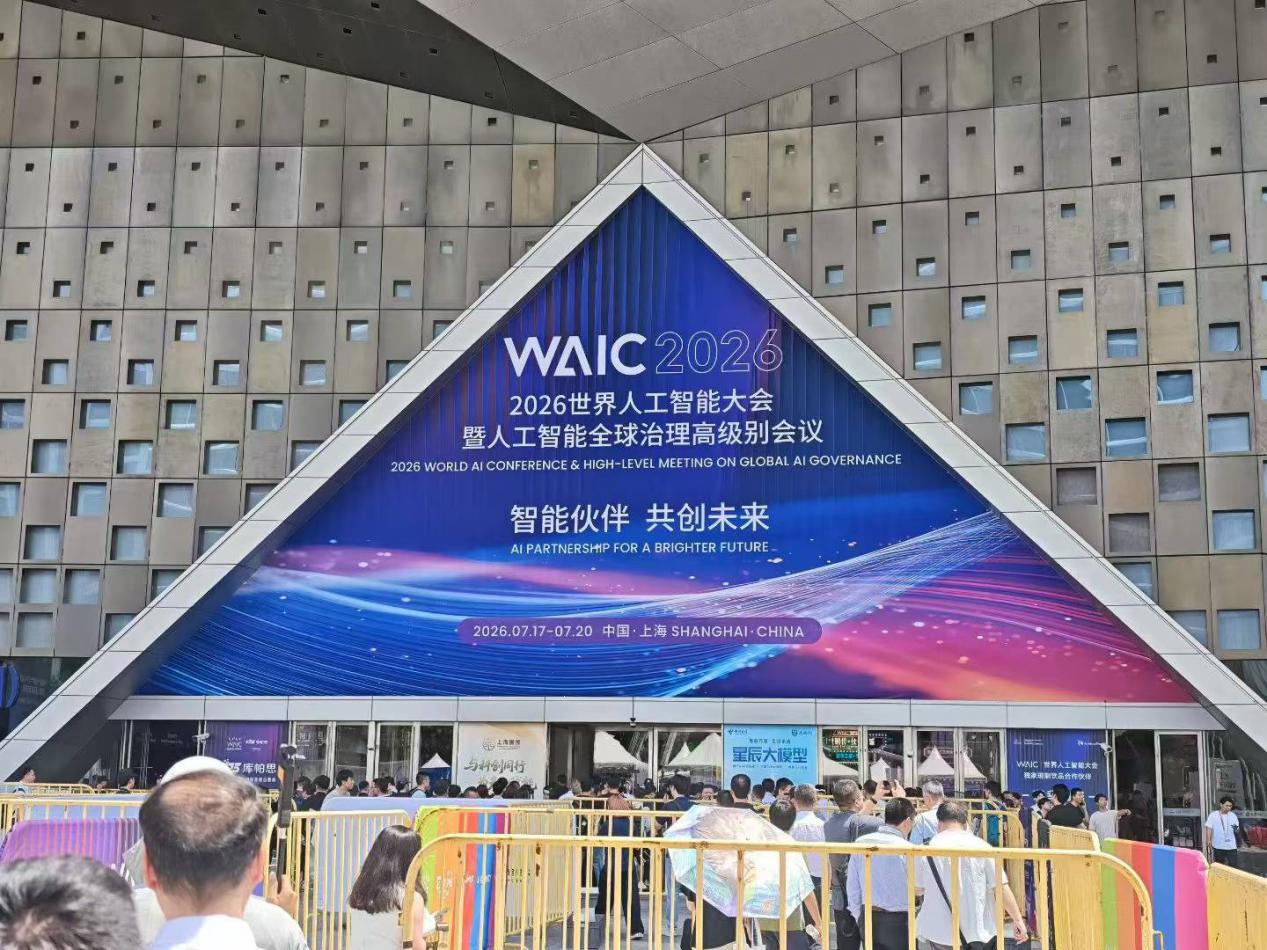
Image Source: Shot by Leikeji
At this WAIC, it is obvious that the humanoid robot industry has completely transformed its development trajectory.
In previous exhibitions, robots were mostly designed for ornamental purposes, performing somersaults, dances, boxing, and other shows. At WAIC 2026, robots act as both products and on-site staff. Various humanoid robots are scattered across every corner of the venue, specifically guiding visitors and managing unmanned retail points. This marks the first time in the industry that full-size humanoid robots have been deployed on a large scale for commercial use in public areas of a major exhibition.
Flashy performances are gone, replaced by mass production and real-world implementation, which have become the core theme of this year's event.
The industry shifts to practical implementation, with robot manufacturers adopting their own unique strategies
Agibot: The "highlight exhibit" of WAIC 2026, defining the first year of deployment-oriented operations
Agibot is one of the few companies in the current humanoid robot industry that has delivered tangible results in both technological capabilities and product delivery. It is not only the most popular booth on-site, but also the fastest to achieve real-world scenario deployment.
Agibot set a core theme for this year's WAIC: "The First Year of Deployment-Oriented Operations". To align with this theme, Agibot brought multiple deployment-ready products and scenarios, including the Expedition A3 Ultra, Elf G2 Max, Lingxi X2 EDU version, OmniHand 3 Ultra-M by Critical Lab, and the world's first riding robot developed by Kuotuo.
The Expedition A3 Ultra is the only humanoid robot among the 10 most notable exhibits at this WAIC. Standing 174 cm tall, it has over 50 degrees of freedom across its entire body, a dual-arm payload of 38 kg, is equipped with the latest dexterous hand, and integrates an end-to-end VLA large model, enabling it to stably perform highly complex operational tasks in real industrial scenarios.
Entering the operational deployment zone at Agibot's booth, the company recreated a deployment scenario for material tray loading and unloading production lines. The Elf G2 robot can independently identify, grasp, and transport chip trays, accurately completing the entire loading and unloading process to meet the cleanroom and high-repeatability operational requirements of semiconductor workshops. The on-site area also features a full chip processing production line from PIA Automation, demonstrating the robot's ability to continuously complete extended operational tasks including chip loading, finished product boxing, and full-case transportation.
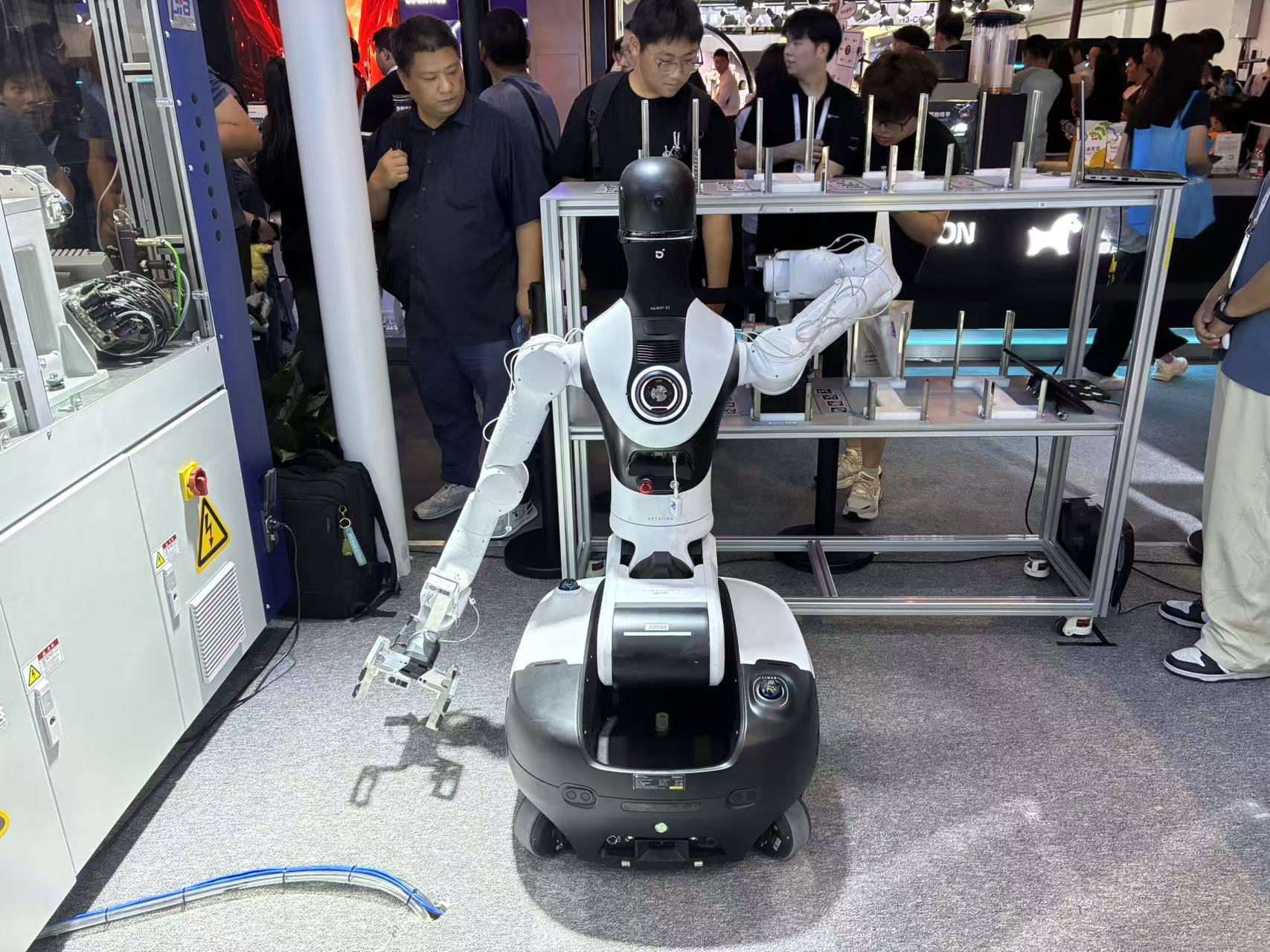
Image Source: Shot by Leikeji
In the interactive deployment zone, Agibot brought the real operational scenario of Guangzhou Metro to the WAIC site, where the Elf G2 can independently perform regular tasks such as security check guidance and consultation services. A "miniature version" of the visitor service center at Chengdu Kuanzhai Alley was also set up at Agibot's exhibition area.
For inspection scenarios, Agibot's subsidiary brand Kuotuo introduced two self-developed core engines, "Lingyue" and "Lingtu", to address the capability gaps of quadruped robots. The Lingyue all-terrain motion engine, built on a dual perception and motion control architecture, enables unobstructed traversal of complex terrain in industrial stations; the Lingtu global navigation engine solves the common problem of positioning loss in inspection robots. Combined with automatic charging, it supports months of unattended operation, and this solution has already been deployed in inspection projects for power, chemical, and campus security scenarios.
In terms of technical foundation, Agibot uses the self-developed GO-2 embodied foundational large model as its decision-making brain, proposes a chain of motion thought and an asynchronous dual system to connect planning and execution. Its world model GE-2 won the overall championship in the 2026 World Arena World Model Track, upgrading from "world simulation" to "world learning".
Around the perimeter of the exhibition area, Agibot arranged 60 robots to serve the WAIC event, managed by Agibot's RaaS platform, Qingtianzu.
The 60 robots operated continuously for several days, with no human intervention required for shift changes, charging, or fault handling. Deploying 60 full-size humanoid robots to run continuously in the public areas of a large-scale exhibition is itself a rigorous stress test.
D-Robotics: A 560TOPS computing power foundation that drastically shortens development cycles
What makes D-Robotics stand out is that it does not manufacture robots. While everyone else is focusing on the humanoid robot body, it has chosen a different path: becoming a foundational infrastructure provider for the industry.
As a result, the content displayed by D-Robotics may seem highly technical to ordinary users.
Among its products, the Sunrise 600 is a high-computing-power SoC designed for embodied intelligent robots. It integrates computing units such as CPU, DSP, GPU, NPU, and ISP, and is specifically built for intelligent tasks including representative robot operations, manipulation, planning, perception, and control, providing strong computing power, high reliability, and low-latency responses for humanoid robots and embodied intelligent systems.
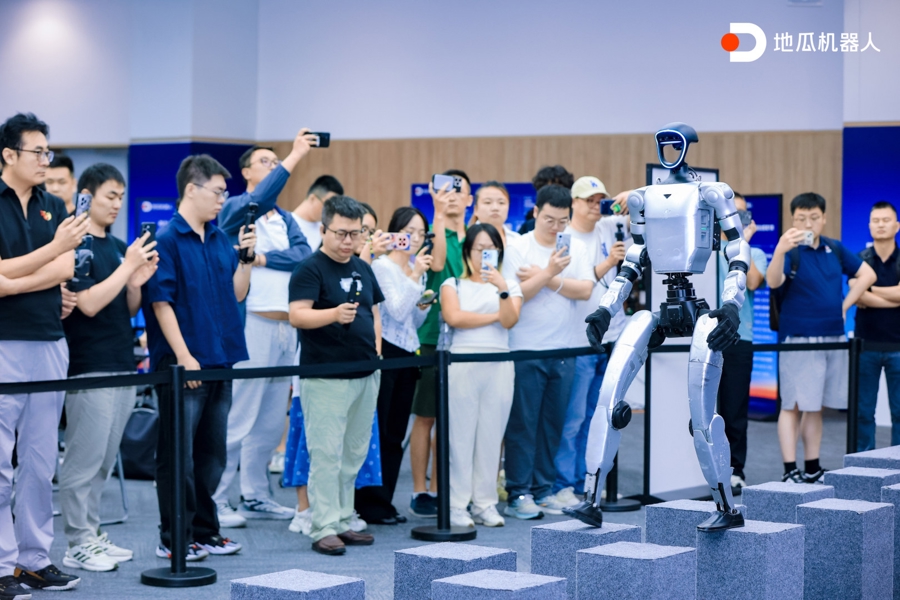
Image Source: D-Robotics
Specifically, the Sunrise S600 delivers 560TOPS (INT8) of computing power, is equipped with a 4-core BPU NPU, and supports efficient model inference. Its 18-core A78AE CPU features a high-performance CPU cluster for flexible task scheduling, while the 6-core R52+MCU is designed for real-time control scenarios to ensure stability and reliability. It also adopts 256-bit LPDDR5x high-bandwidth memory with a bandwidth of 204.8 GB/s, providing high-bandwidth data support for end-side computing of embodied robots.
To reduce robot development time from months to weeks, D-Robotics introduced a three-layer toolchain: the cloud-based RoboGo manages data generation, training, quantization, and release; the PC-side RDK Studio handles device connection and real-machine deployment; the on-board Moss system manages task execution, with unified scheduling across all three layers via the Moss AgentEngine.
Notably, the Sunrise S600 has already received recognition from over 20 leading customers and entered mass production verification. D-Robotics has also collaborated with more than 100 industry chain partners to complete coordinated adaptation, covering segments such as chips, modules, sensors, robot controllers, and data collection.
Magic Atomic: Three models covering full scenarios, moving from stage performances to real-world practical applications
Magic Atomic globally launched three new strategic products at WAIC: the flagship full-size MagicBot X1, the industrial wheeled MagicBot D1, and the light-industrial quadruped MagicDog T1. It also simultaneously exhibited nine scenario solutions and its self-developed general embodied large model Magic-VLA K02.
The three products have distinct roles: the X1, standing 180 cm tall with 31 active degrees of freedom and a peak joint torque of 450N·m, can stably complete highly dynamic tasks such as dunking, table tennis, and fencing, focusing on pushing the limits of general capabilities. The D1 has already been deployed in Dreame's smart manufacturing factory. Equipped with a wheeled chassis and humanoid upper limbs, it uses unguided autonomous navigation and cluster scheduling to form a fully unmanned closed loop for warehouse material retrieval, cross-zone transportation, and production line loading/unloading. The T1 fills the gap for decentralized scenarios in light industry and campus environments.
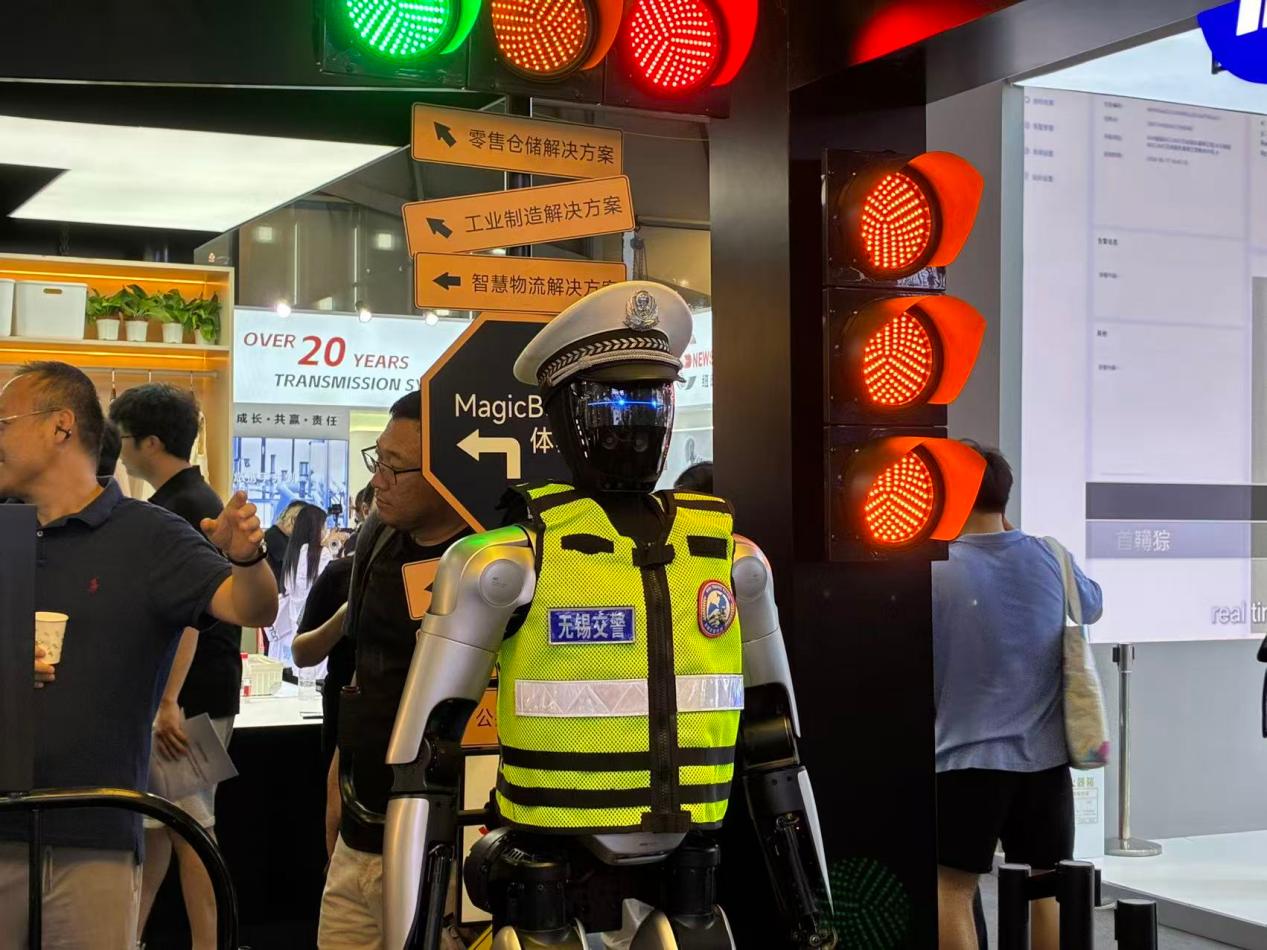
Image Source: Shot by Leikeji
The self-developed Magic-VLA K02 model demonstrated complex extended tasks such as box stacking and sealing, flexible clothing sorting, and full suitcase organization on-site, with the success rate of the entire integrated operation exceeding 90%.
This model adopts a two-layer collaborative logic: the upper layer first understands the complete task objective, and the lower layer continuously executes a series of precise actions. It completely breaks away from the old limitation where robots could only rigidly replicate single steps, and can independently plan the entire operation process directly oriented towards the final delivery result.
In terms of commercial implementation, Magic Atomic is a highly experienced player in the industry. In the past, its hundred-unit robot clusters have appeared on the CCTV Spring Festival Gala and performed welcome ceremonies for overseas events. This April, it directly entered the public safety sector, reaching a cooperation agreement with the Wuxi Public Security Bureau. Its self-developed traffic management humanoid robot "Xiaomai" was deployed on-site at the Wuxi Marathon to direct traffic, marking the formal entry of humanoid robots into government scenarios for practical operations.
Ubtech: Actually deployed in factories to handle material transportation, with over 95% of the robot's components domestically produced
Ubtech set up a prominent "material handling zone" in the exhibition area, 1:1 replicating a real production line. Three humanoid robots work continuously to unload cartons, unload plastic boxes, and load small parts. They automatically calibrate when boxes are tilted, requiring no human intervention throughout the process. These solutions have been deployed and operating in factories for 3 to 4 months, with a customer list covering leading enterprises across more than 10 industries including FAW, ZTE, and Changhong.
Ubtech also exhibited a full-link development toolchain that drastically shortens the deployment cycle: a standard exhibition scenario can be deployed in 1 to 2 days, an industrial scenario in 1 to 2 weeks, and a customized scenario in 1 to 2 months. The logistics solution developed in collaboration with Ant Lingbo only used 300 pieces of data, completed fine-tuning in 1 to 2 days, and achieved a handling success rate of over 80%.
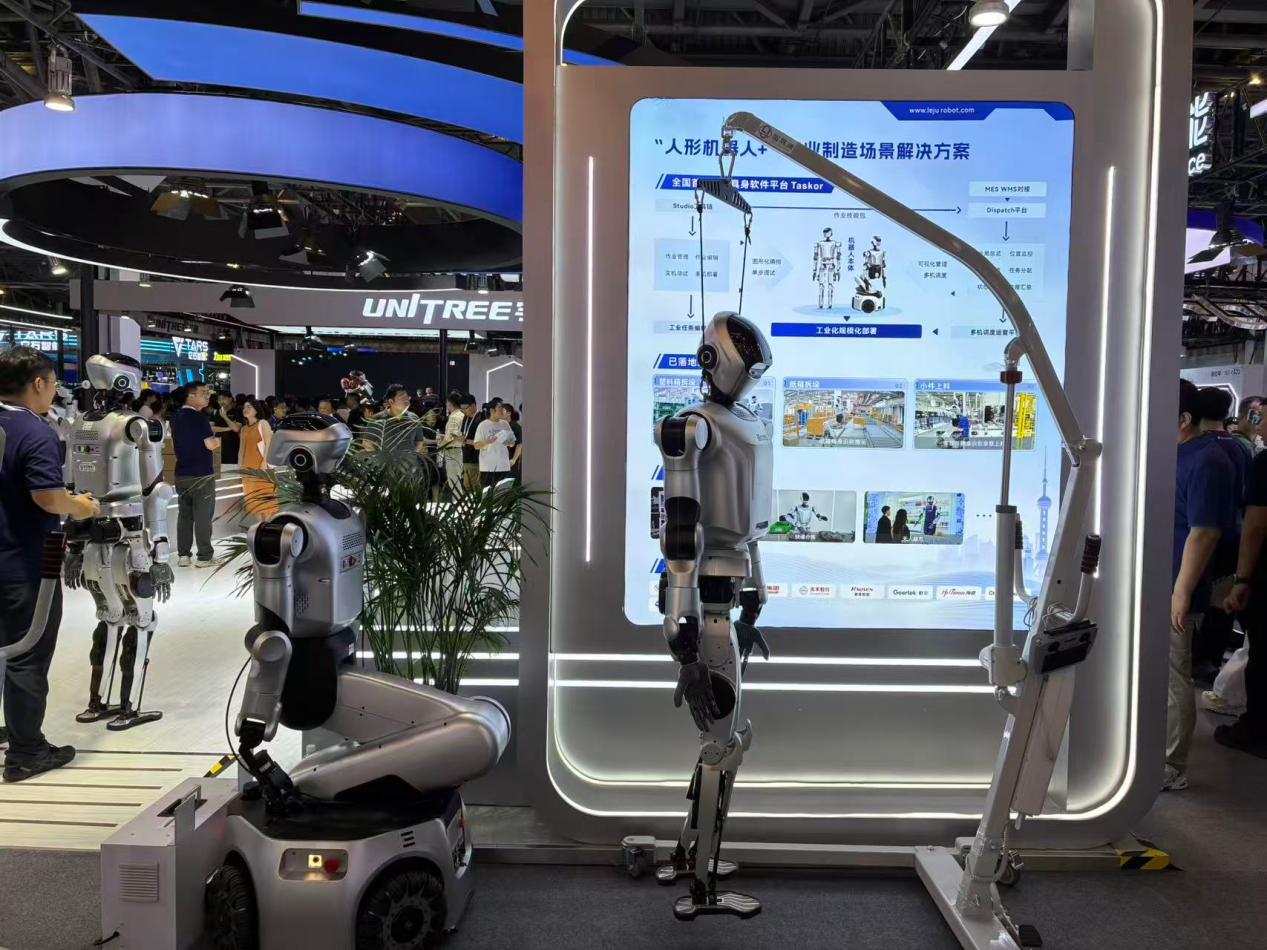
Image Source: Shot by Leikeji
Notably, the localization rate of Ubtech's Kuafu series has exceeded 95%. The domestically developed high-computing-power main control solution jointly developed with Horizon Robotics fills the last gap in the full-stack domestic production of humanoid robots. Meanwhile, Ubtech's solution for "intelligent picking and transportation of humanoid robots oriented to automotive manufacturing scenarios" has also been selected as a typical case of artificial intelligence applications by the Ministry of Industry and Information Technology.
Qijue Robotics: Enhancing tactile perception, capable of distinguishing the authenticity of sneakers through touch
Qijue is one of the most easily overlooked companies at WAIC, but what it does precisely addresses the shortest board of the industry. It aims to solve the more fundamental physical problem of robot tactile perception. When robots come into contact with objects, they can still "see but not touch accurately, and cannot control precisely" without tactile feedback, making it impossible to cross the threshold of refined operations.
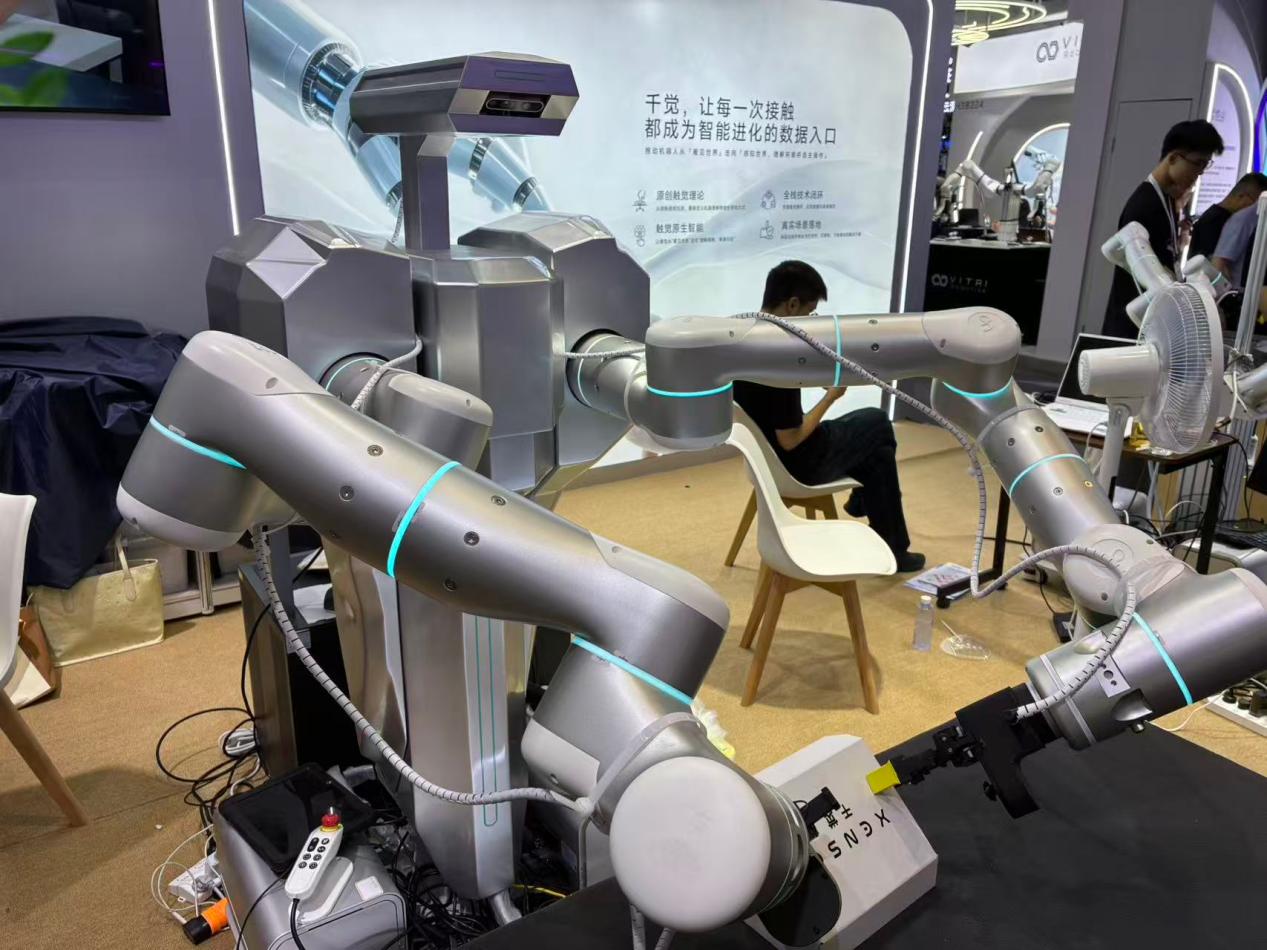
Image Source: Shot by Leikeji
During WAIC, Qijue Robotics launched X-TouchMind V1, the first VTLA embodied tactile model oriented to tactile intelligence, along with a thousand-hour visual-tactile multimodal dataset TacVerse 1k.
Two demos are displayed on the booth: a long-sequence dual-arm carton forming process and a precision headphone assembly process. The former allows the robot to continuously complete the full set of actions including grasping, unfolding, aligning, folding, and compacting on flexible cardboard; the latter targets the 3C assembly scenario, enabling the robot to independently complete precise alignment and dynamic correction through tactile feedback during precision operations.
This tactile intelligence system is already in operation at the Dewu App's booth. Equipped with Qijue's self-developed VTLA and tactile sensors, the robot completes fully automated quality inspection of shoes within 5 seconds, with an identification consistency of over 99.9999% compared to human experts.
This data cannot be obtained through pure vision at all. Qijue's force perception accuracy reaches the millinewton level, and surface topography perception reaches the micrometer level. The entire clamping and pressing process is flexibly adaptive, causing zero damage to footwear products.
In addition, Qijue also exhibited its self-developed XTac UMI G1 wearable visual-tactile data collection gripper, which can convert contact changes, force feedback, and slip trends during real human operations into high-quality embodied datasets. Its full-hand tactile solution builds a global tactile feedback network from fingertips to the palm through fingertip sensors and electronic skin modules.
Qiyuan Robotics: A Transformer-style robot that enters living rooms, focusing on open-source DIY modification gameplay
Qiyuan Robotics, a subsidiary of Sino New Materials, made its public debut of the Qiyuan T1 at WAIC, the world's first deformable personal robot. Built on the Transformer cross-form integrated architecture, it can independently switch between wheel-legged humanoid and quadruped forms: it acts as a humanoid assistant indoors, and transforms into a robotic dog outdoors. It can connect with action cameras such as Insta360, supporting voice-controlled shooting, intelligent following, and trajectory-based camera movement.
The Qiyuan Q1 Explorer version was also released simultaneously. Its appearance won the international A' Design Award Gold Award, with all structural components fully open-source, supporting 3D-printed personalized modifications.
Qiyuan sells not just a single robot, but also a hardware platform that allows users to modify the shell, add accessories, and adjust