Turing Award winners and AI leaders gather at WAIC: What ordinary people need to hold onto is more than just their jobs
From July 17 to 20, 2026, the main forum of the 2026 World Artificial Intelligence Conference and the Global Governance High-Level Meeting on Artificial Intelligence (WAIC 2026) was officially held. As an annual grand event for the AI industry, this year's conference still gathered large model companies, AI application and hardware manufacturers from home and abroad. The AI new media "Lei Tech AGI (leikejiagi)" under Lei Tech (ID: leitech) also dispatched a reporting team to Shanghai for on-site coverage.
On the first day of the conference, the most frequently discussed topics on stage were undoubtedly models, agents, world models, and embodied intelligence. However, when these experts, scholars, and business leaders pushed the conversation further, they repeatedly arrived at the same question:
As machines become increasingly capable, what should humans do? This is probably the question that ordinary people most want to ask today, yet find it hardest to get an answer to at a technology conference.

Image source: Lei Tech
Over the past few years, the most common answer from the industry has been "AI will not replace humans, but people who can use AI will replace those who cannot." This statement is not wrong, but by 2026, when agents can perform tasks continuously and AI has begun to enter scientific research and the physical world, it is no longer sufficient. The real changes have long gone beyond just learning an extra tool. More and more responses, operations, and even decisions that originally required human effort can now be taken over by machines.
Of course, humans cannot outperform machines in every single link. But this does not mean that ordinary people can only learn the latest tools while waiting for their work to be revalued. After reviewing WAIC's public speeches, roundtables, and on-site conversations, I would rather summarize the answer into four things:
1. Stop competing with machines for answers, and hold onto problems and goals;
2. Do not give back all the time saved by automation to work;
3. You can authorize AI to perform tasks, but you cannot outsource values and responsibilities;
4. Finally, always leave yourself a path to pivot.
Humans No Longer Need to Compete with Machines for Answers
"Asking good questions is probably very important, even more important than having the answers."
At the AI for Science roundtable of WAIC, QIU Xipeng, a professor at Fudan University, condensed his advice for young people into this sentence. It sounds like a cliché, but in today's world where AI can write code, conduct research, and call tools, this sentence has taken on new weight.
In the past, the threshold for many professions was built on "knowing the answers." If you remembered more knowledge, were familiar with more processes, and could produce a document faster, you could get a higher position in an organization. But the first thing large models do is to make standard answers and standard outputs quickly become cheap.
Turing Award winner Richard Sutton also reminded that today's AI is mainly using human knowledge and then delivering that knowledge back to people. It can write, draw, and calculate, but it still lacks first-person experience of acting around goals and continuously improving through real-world feedback. He even stated bluntly that current AI is still "relatively weak and unreliable."
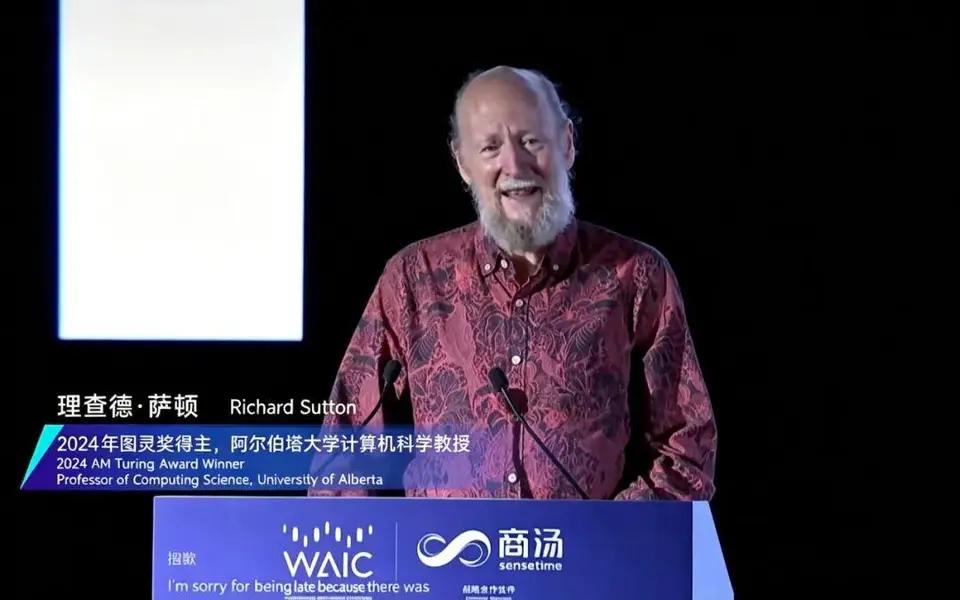
Image source: WAIC
The problem is that Sutton does not believe this limitation will exist forever. AI is moving from the static "era of human data" to the "era of experience" where it can learn through action. Once machines can predict, act, get feedback, and adjust on their own, the advantages that ordinary people build by memorizing knowledge and executing processes proficiently will continue to shrink.
At this point, the most worth-training human ability must move one step forward: first decide what problem to solve, what conditions the results should meet, what costs are unacceptable, and then judge whether the answers given by the machine are meaningful.
This also explains why at the same roundtable, Omar M. Yaghi, the Nobel laureate in Chemistry, affirmed that AI has greatly accelerated some chemical research that used to take weeks or months, while also worrying that if scientists do not take the initiative to try and verify, eventually agents might end up telling humans "how science should be done."
AI brings more answers, but it also shifts the difficulty to selection: what is worth asking, which direction is worth investing in, and which results should enter the real world.
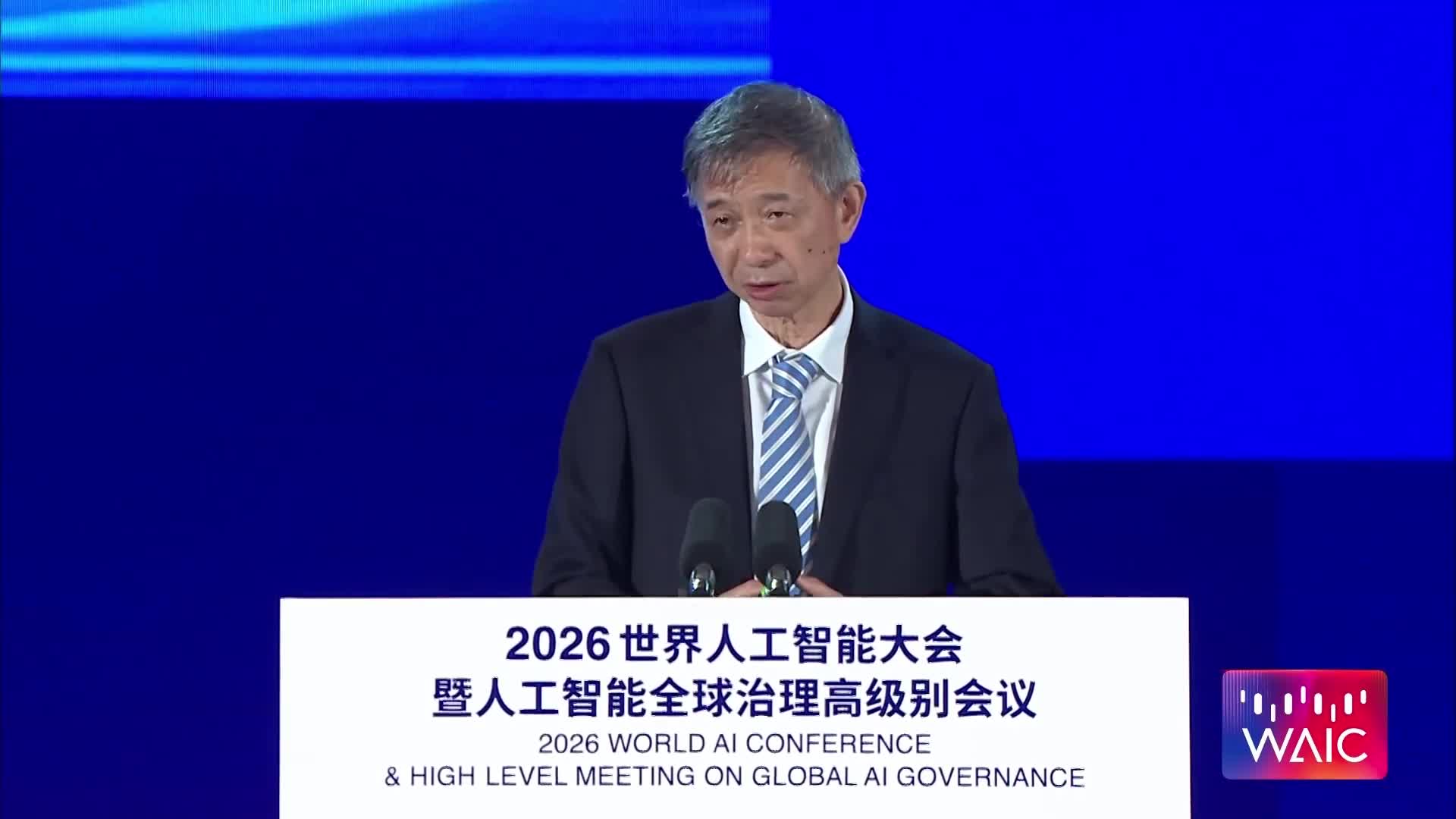
WANG Jian, an academician of the Chinese Academy of Engineering, founder of Alibaba Cloud, and director of the Zhijiang Laboratory, talked about similar changes from another perspective. Today's large models have read a large number of papers, books, and web pages, but much of the knowledge of the natural world is actually hidden in spectra, remote sensing data, seismic waves, gene sequences, and experimental data.
WANG Jian, Image source: WAIC
If the next generation of scientific foundation models can directly understand these data, AI will not just repeat the conclusions written by humans, but may also discover new problems from old data.
On that day, humans may no longer monopolize discoveries. But at least for quite a long time, humans will still need to answer which discoveries are worth pursuing, how to verify them, and where they should be applied.
Therefore, the first way for ordinary people to get along with AI is to let go of the anxiety of training themselves to become a faster machine, moving from "can I do it" to "why this thing needs to be done." Being able to write a plan is certainly useful, but being able to define the real problem that the plan needs to solve is more important; it is easy to get AI to generate ten answers, but knowing what the eleventh question is is increasingly rare.
The Freed Time Should Not Only Be Used to Take On More Work
"The mission of physical intelligence is to give humans back to humans." So said SU Hao, Dean of the Institute of General Physical Intelligence at Fudan University.
In his vision, robots take on tasks such as turning over elderly people, carrying heavy loads, and performing dangerous operations in high-altitude, underground, and high-temperature environments; humans step back behind the safety line and continue to take on companionship, care, judgment, and creation. This division of labor is ideal and easy to recognize.
But in today's offices, things often go in another direction. When AI saves an hour for a person, the organization may not necessarily return that hour to life; instead, it is more likely to add two more tasks. When one person, with the help of agents, has the output capacity of a past team, the company may in turn question why the original team is still needed.
This is the most easily overlooked other side of "AI liberating humans." Technology can eliminate some repetitive labor, but it cannot automatically decide who the saved time belongs to, nor can it automatically ensure that workers live better as a result.
YIN Qi, Chairman of StepStar, judged that in the future, engineers, designers, and researchers may all have exclusive agents, so that "one person has the capabilities of a team." As a business leader, he sees the opportunity for personal capabilities to be amplified tenfold. But from the perspective of ordinary people, this judgment needs to add the second half:
When personal output is amplified ten times, how will the benefits be distributed, and will the work intensity also be amplified ten times?
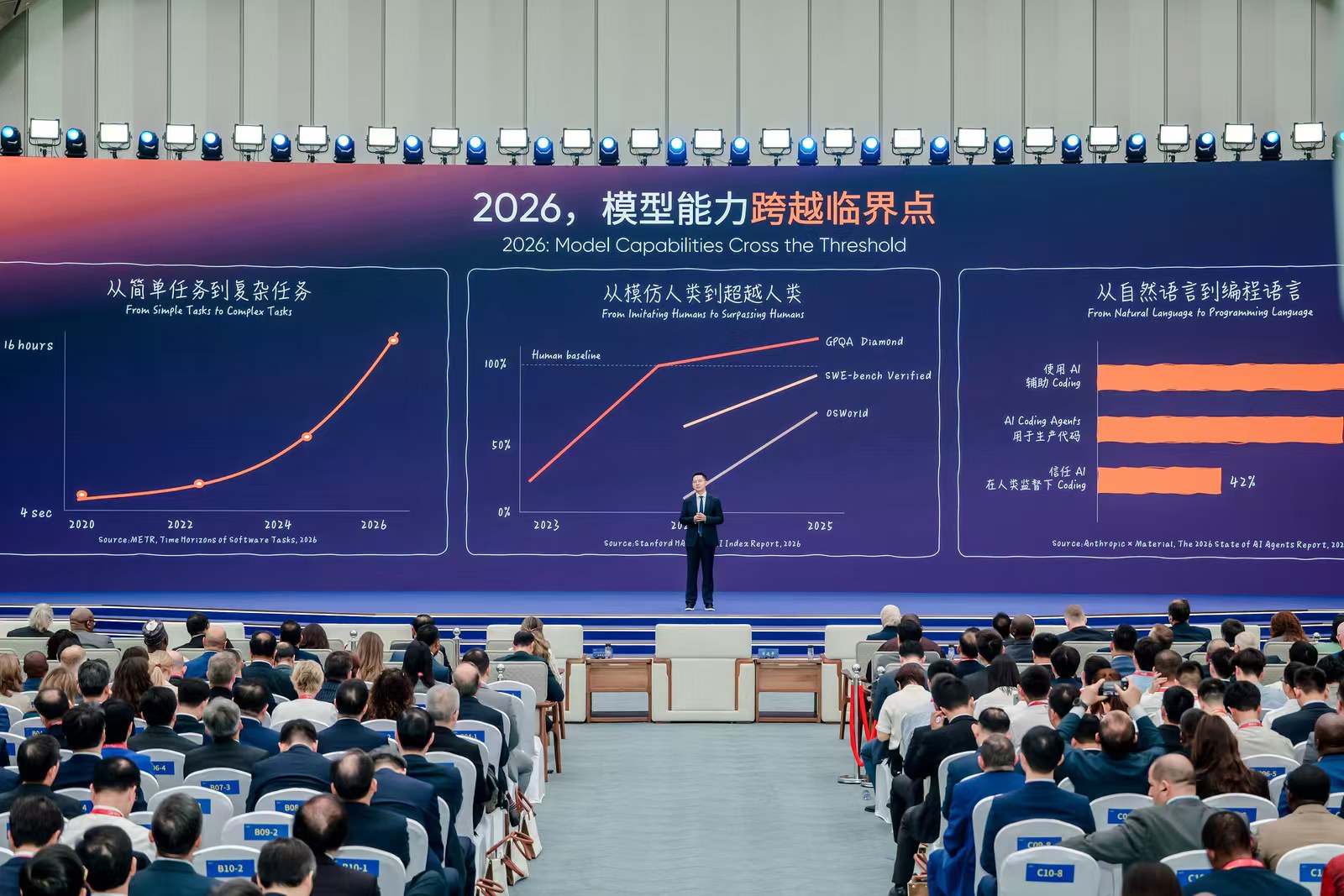
Image source: StepStar
Good AI should enhance human capabilities, expand human boundaries, and let people gain knowledge, abilities, and growth in the process of use, rather than making people dependent on the product. This standard is not only suitable for judging products, but also for judging your own work. After using AI for a period of time, you can go back and ask three very specific questions:
Without this tool, do I understand the original problem better? Have I mastered a set of transferable methods as a result? Has the time it saved turned into new creations, relationships, and rest, or has it only brought more tasks?
If the answer is always the latter, then AI has indeed improved efficiency, but it has not given humans back to humans.
When Turing Award winner John Hopcroft talked about education on site, he also said that the most fundamental mission of universities is to help students discover their own interests and find career paths that can demonstrate their self-worth. In an era where the next technological shift cannot be accurately predicted, a more reliable strategy than chasing short-term popular skills is to cultivate people who can adapt to changes.
Interest here is not some literary term. It means that when a skilled skill is quickly automated, you still have the motivation to keep asking questions, learning, and reorganizing your work. AI can help people complete more and more processes, but where a person is willing to place their long-term attention will still determine what they eventually accumulate.
You Can Let AI Execute, But Don't Hand Over Responsibility Along With It
If large models mainly change "who answers," agents change "who executes." In his speech, YIN Qi proposed that computers, mobile phones, cars, and robots will become the "bodies" of the same agent in different scenarios. Agents can not only call tools, but may also have identities, capabilities, and credit, independently find partners, organize collaborations, and even complete transactions.
The questions are: who the agent acts on behalf of, who is responsible for the consequences, whether the identity is credible, whether permissions can be controlled, and whether behaviors can be traced.
These issues sound a lot like industry governance, but they are not far from ordinary people. Letting AI rewrite a piece of text can be redone if there is a mistake; letting it send an email on your behalf, operate an account, submit an application, or arrange medical advice, errors may enter real relationships, money, and systems, and it is even very difficult to withdraw them.
XUE Lan, Dean of Tsinghua University's Schwarzman College and Dean of the Tsinghua University Institute for AI International Governance, put it more directly at the main forum: "Issues involving value judgment cannot be handed over to AI."
After humans make mistakes, we can distinguish between intent and negligence, and people can also be held accountable and punished; AI itself does not have a subject personality that can bear legal and moral consequences. In the event of an accident, the responsibility will ultimately fall back on specific people and organizations along the complete chain of development, deployment, operation, and use.
Therefore, when ordinary people use agents, it is not that important how beautifully the prompt is written. What matters more is whether boundaries are set. When it comes to public release, identity, privacy, money, medical care, and legal matters, permissions should be as small as possible, key steps should retain confirmation, the process should be viewable, and operations should be revocable.
This is not excessive caution about technology. At the opening speech of the conference, President pointed out that agents are new forms of artificial intelligence products and services. It is necessary to clarify decision-making authority and behavioral boundaries, establish behavior traceability and risk warning mechanisms, focus on improving the endogenous security capabilities of agents, and resolve application-derived risks.
Ultimately, authorization means only handing over a task to the machine, not throwing judgment and responsibility along with it. The more AI behaves like a partner that can handle things for you, the clearer humans must be about when they have to show up in person.
Always Leave Yourself a Path to Pivot
Ordinary people certainly still need to learn AI.
But what is really worth learning is not the buttons of a certain model, a certain prompt format, or even just the most popular workflow at the moment. Tools are iterating faster and faster. Binding yourself to a single platform and a single process may lead to the need for a complete redo as soon as you get familiar with it.
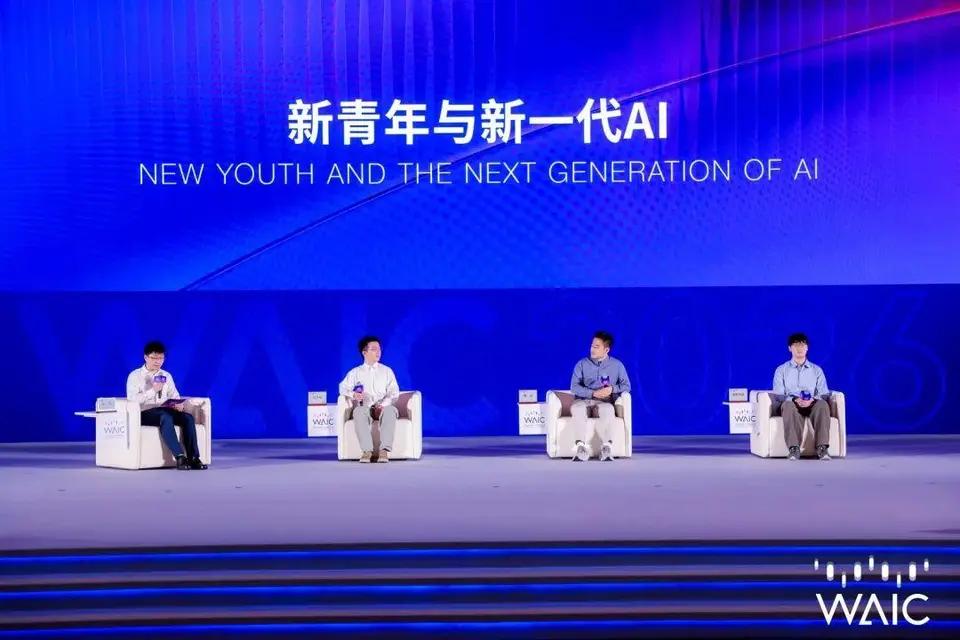
"All existing inertia and dependence on original experience are now decreasing." CAO Yue, a researcher at the Beijing Academy of Artificial Intelligence and founder of Sand.ai, summarizes the characteristics of the new generation as being better at abandoning old experiences. The depth and ability of young people to use new tools largely depend on whether they are "willing to believe and dare to believe."
Young Scientists Dialogue, Image source: WAIC
In the WAIC Young Scientists Dialogue, LIU Ziming, an assistant professor at Tsinghua University's School of Artificial Intelligence and Chief Scientist of MetaRing Intelligence, added: The "new generation" has nothing to do with age. The key is whether you will use expired experience to mechanically handle new problems. ZHUGE Mingchen, a founding member of Recursive, also pointed out that AI five years ago is completely different from today. "You must always keep a new path for yourself" instead of passively responding when new things begin to have an impact.
The so-called keeping a new path does not necessarily mean quitting your job and switching careers. It can be proactively integrating AI into a real job to see where it works and where it goes wrong; it can be maintaining the ability to keep learning outside of your main business; it can also be not locking all your materials, processes, and personal knowledge into a single platform, leaving yourself room to switch tools.
More importantly, don't only learn AI in the dialog box. Sutton regards experience as the source of intelligence, and SU Hao says the physical world is the "most honest examiner." The underlying truth is the same: any seemingly beautiful output must ultimately be tested by reality.
Whether the plan is willing to be used by someone, whether the code can run, whether the content can withstand fact-checking, and whether the decision will harm specific people—these feedbacks cannot be completely replaced by asking the model a few more rounds of questions.
In the AI era, ordinary people's sense of security does not come from mastering all new tools, which is impossible anyway. It more likely comes from a set of non-expiring abilities: being able to ask questions, verify results, try and make mistakes in reality, know which judgments cannot be outs