Red Bear AI has completed hundreds of millions of yuan in Series A+ financing, extending its business from To B services to To C applications based on AI "memory science" | 36Kr Exclusive
36Kr learned that RedBear AI announced today the completion of a Series A+ financing of several hundred million RMB, with a post-money valuation approaching 3 billion RMB. This round of financing was jointly invested by Zhejiang Jiuwei Private Equity Fund, Jiaxing Zhangyuan Venture Capital, and existing shareholder Graceful Peak Capital. This marks the 6th round of financing that RedBear AI has completed in just 15 months.
It is understood that the funds from this round of financing will be mainly used to continuously deepen human-brain-inspired fundamental research on AI memory science, accelerate the deep integration of the OpenBear general large model and the MemoryBear memory science system, and expand the market coverage of four core application scenarios: intelligent customer service, intelligent marketing, ChatBI, and intelligent education.
After the early-stage competition focusing on the parameter scale and computing power of large models, the industry is gradually stepping into the deep commercialization zone where "applications define success". At present, technologies centered on the "Memory layer" of large models have become a key breakthrough priority.
Financing events have occurred frequently this year with a clear accelerating trend: Engram, a 13-person team valued at 600 million USD whose investors include Andrej Karpathy, who led Claude pre-training at Anthropic, has officially debuted; Clipto, positioned to connect personal data and the memory layer of the agent ecosystem, has received multiple follow-on investments from HSG, GL Ventures and other institutions; domestic startup "Memory Tensor", which has completed a nearly 100 million RMB angel round and focuses on developing the open-source memory operating system MemOS, and MemoraX AI, which successively completed the seed round and seed+ round in spring 2026 with total financing of over 100 million RMB across the two rounds, have both secured funding in this technical direction.
Since its founding in April 2024, RedBear AI has established the technical path of "Memory-Driven AGI". How to closely integrate technological innovation with the actual industrial needs of enterprises, and break the memory barriers of traditional foundational large models in real-world deployment, is the core proposition that RedBear AI is trying to address in this wave of AI development.
I. Why does AGI need a dynamic "hippocampus"?
In the past two years, the phenomenon of "prioritizing model training over application deployment" has been widespread in the industry. A large amount of computing power and resources have been consumed in the pre-training of foundational large models, but when these models are deployed for enterprise-level applications, they often encounter multiple practical bottlenecks.
Due to the limitations of their underlying architecture, traditional foundational large models commonly suffer from disconnections or context loss in long dialogues caused by token constraints in real business scenarios; at the same time, due to the high knowledge forgetting rate, it is difficult for the models to maintain service consistency and stability. In addition, the token consumption of large models usually grows linearly, directly increasing the computing power cost of enterprises running AI systems for a long time, and the lack of causal logic verification also makes the models prone to "hallucinations", undermining business reliability.
The RedBear AI team believes that simply relying on the improvement of the capabilities of foundational large models is not sufficient to solve the practical problems of enterprises. Targeting these common pain points across the industry, RedBear AI took the lead in proposing the concept of "AI Memory Science" in 2024.
For large models to achieve real cognitive intelligence and meet the requirements of enterprise-level large-scale deployment, their information processing method must be upgraded from "static information piling" to "dynamic organism management". In 2026, RedBear AI completed a key step in its technical ecosystem: carrying out a second round of deep integration between the OpenBear large model and the self-developed MemoryBear memory science system, and building a native Agent architecture on this basis.
This technical logic that deeply binds the "cerebral cortex (responsible for reasoning)" and the "hippocampus (responsible for memory)" has promoted the gradual evolution of enterprise-level AI applications from the passive tool state of "one question, one answer" to a new stage of "memory-driven reasoning".
II. RedBear AI Technology Map: The Triangular Matrix of OpenBear, MemoryBear, and Native Agent
The core capability built by RedBear AI is a closed-loop ecosystem where the OpenBear general large model, the MemoryBear memory science system, and the native Agent architecture are interdependent.
1. OpenBear General Large Model: Underlying Capability Base Designed for Memory
OpenBear is a new-generation AGI model independently developed and pre-trained by RedBear AI, which adopts the MoE (Mixture of Experts) sparse mixed-expert architecture at the underlying layer.
From the perspective of design philosophy, OpenBear is one of the earlier pre-trained large models in the industry to adopt the "built for memory" logic. At the initial stage of model architecture design, RedBear AI designed a dedicated memory interface and attention mechanism optimization module inside it, enabling it to carry out high-frequency, low-latency information interaction with the external MemoryBear memory science system, and achieve seamless connection between the model's reasoning capability and memory capability. This large model system emphasizes features such as cross-domain generalization, long-term memory, and self-reflection, and can understand a variety of professional and complex real-world tasks without requiring special customized optimization.

OpenBear Product Interface
2. MemoryBear Memory Science System: Hierarchical Dynamic Memory and Brain-inspired Mechanism
If the large model itself is responsible for logical reasoning, then MemoryBear is its memory hub. Drawing on the cognitive mechanism of the human brain, MemoryBear integrates technical theories such as the ACT-R dual-memory architecture, the Ebbinghaus Forgetting Curve and activation model, an intelligent semantic pruning algorithm, and a 3D self-reflection engine.
In terms of structure, MemoryBear has established a hierarchical dynamic system ranging from instantaneous to permanent memory, including a working memory layer, a short-term memory layer, and a long-term memory layer. To support the efficient operation of this hierarchical architecture, MemoryBear has overcome a number of core technologies at the underlying layer:
Temporal Memory Technology: Enables AI to identify the event occurrence time contained in information and build a complete timeline, endowing AI with a sense of historical perspective.
Dynamic Semantic Network Technology: Automatically extracts key entities and core viewpoints from massive long texts or unstructured data to construct a dynamic knowledge graph.
Intelligent Semantic Pruning Technology: Based on the principle of the Ebbinghaus Forgetting Curve, it automatically identifies and periodically deletes redundant, outdated, or incorrect information, maintains the accuracy of the memory library, and reduces the token consumption of large model operation.
3D Self-Reflection Engine: When the system is in a low-load phase, it automatically re-verifies existing memories and corrects potential errors, so as to counteract the hallucination flaw of large models.
Minimized Memory Sharing Technology: Establishes a unified memory hub in multi-Agent collaboration scenarios, where each agent only retains the key memories required to complete its own tasks, and other agents call relevant memories on demand, reducing overall computing power consumption.
According to the technical indicators disclosed by RedBear AI, with the support of MemoryBear, the knowledge forgetting rate of its basic large model is controlled below 1%; token consumption is reduced by 25 times; the industry ambiguity preprocessing rate is controlled below 1%; and the model hallucination rate is reduced to around 0.2%.
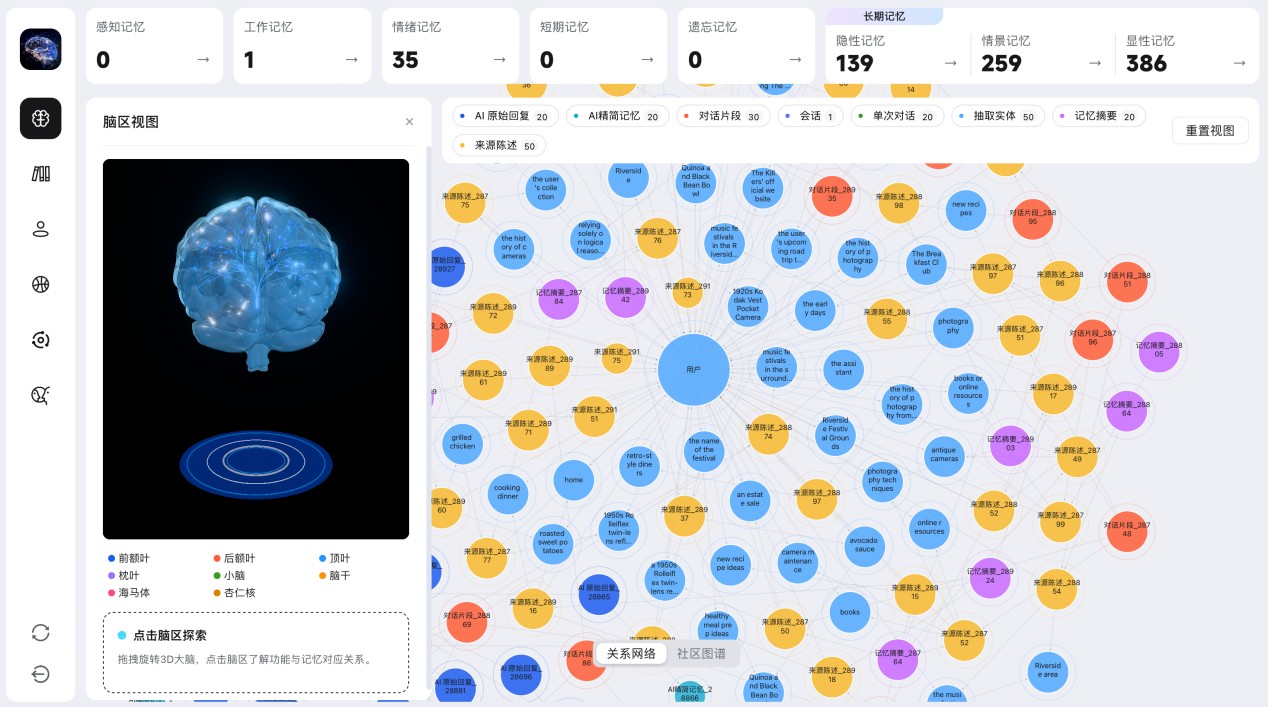
MemoryBear Product Interface
3. Native Agent Architecture: Evolution from Passive Tool to Active Collaboration
At the junction of the OpenBear large model and the MemoryBear memory system, RedBear AI has encapsulated its native Agent architecture. The core feature of this architecture is "memory-native", which means that the Agent system has built-in memory capability from its inception: it can remember every interaction detail with a specific user and the final execution result of tasks, and use this as input for subsequent optimization. In addition, this architecture supports autonomous planning and multi-Agent collaboration, allowing agents to implement dynamic task execution and automatic resumption under a safe and controllable permission management system.
Furthermore, based on the technical foundation of the MemoryBear memory system, RedBear AI has further extended memory capabilities to the field of developer tools, launching CodeBear, a memory-enabled programming large model platform. Different from traditional AI code assistance tools, the core differentiation of CodeBear lies in "memory-driven development". In real development environments, CodeBear can autonomously understand requirements, plan technical solutions, write code, and run verification. Leveraging the MemoryBear hierarchical memory system, it continuously accumulates project experience, code specifications, and business logic from each interaction, forming reusable personalized development knowledge deposits, effectively solving the pain points of context disconnection and high repeated communication costs in traditional programming tools, and significantly improving the development efficiency and coherence of complex projects.
III. Breakdown of Four Application Scenarios: A Real Record of Large Model Application Deployment
Based on the above "model + memory + agent" technical ecosystem, RedBear AI has currently launched four core application products in the market, striving to verify the commercial value of AI memory science in different niche tracks.
1. Intelligent Customer Service: Personalized Retention Under Long-cycle Interaction
The main bottleneck of traditional intelligent customer service systems lies in the "one case, one closure" model, which lacks the capability to retain customers' long-cycle historical interaction trajectories. RedBear AI's intelligent customer service product, through the MemoryBear system, can remember customers' historical dialogues, purchase records, complaint records, and service preferences. When a customer reconnects, the system can provide targeted personalized services based on historical memories. Official data from RedBear AI shows that this product has increased the one-time resolution rate of customer issues for partner enterprises by over 60% and reduced the workload of human customer service representatives by 70%.
2. Intelligent Marketing: From Shallow User Portraits to Personalized Experiences for Every User Across the Full Behavior Chain
In the field of intelligent marketing, systems usually need to process massive amounts of dynamic data. RedBear AI's marketing product uses AI memory technology to capture and remember users' browsing, cart-adding, purchasing, and historical interaction behaviors, so as to build more comprehensive user portraits. By analyzing users' interest preferences and consumption habits, the system can adaptively generate personalized marketing copy, emails, or SMS messages, enhancing the content appeal of marketing campaigns and their return on investment (ROI).
3. ChatBI: Natural Language Data Dashboard with Contextual Habit Awareness
Traditional BI (Business Intelligence) tools usually have high operation thresholds, requiring professionals to write SQL statements. RedBear AI's ChatBI product combines natural language processing with memory science, allowing non-technical business personnel to obtain required data analysis results through daily conversations. The differentiation of this product lies in its ability to remember users' query history and analysis habits, automatically associate the constraint conditions from the previous round, and eliminate the need for users to repeat background explanations, thus improving the circulation efficiency of complex data-driven decision-making.
4. Intelligent Education: Teaching Students in Accordance with Their Aptitude Based on Historical Error Records and Learning Habits
Intelligent education focuses on personalized learning and planning services for higher education and vocational education. In the intelligent education scenario, the RedBear AI system uses the long-term memory layer to remember each student's historical learning curve, mastery of knowledge points, learning habits, and learning style. Based on these historical deposits, the system can customize personalized learning plans and question difficulty gradients for students, realizing a truly personalized teaching workflow.
Among the four business segments, intelligent customer service and intelligent marketing are RedBear AI's most important business segments and sources of revenue. ChatBI has already generated revenue, but its proportion in total revenue is relatively low; the intelligent education business is in progress, with 2 universities signed so far, and it is estimated to generate a total revenue of about 20 million RMB in transactions this year.

RedBear AI Product Interface
IV. Commercial Performance Results: Recognized Revenue Exceeds 170 Million RMB in the First Half of 2026, with ARR Breaking Through 50 Million RMB
Judging from the commercial progress disclosed by RedBear AI this time, its operating data shows a clear growth trend:
Customer Expansion Scale: In the first quarter of 2026, RedBear AI achieved the result that the number of new customers exceeded the total number of customers for the whole of 2025. As of now, the total number of its enterprise customers has surpassed 500, including multiple Fortune Global 500 companies and well-known domestic listed enterprises, with business coverage spanning multiple mainstream industries such as finance, retail, manufacturing, education, and healthcare.
Financial Revenue Recognition Performance: In the first half of 2026, RedBear AI reached the total performance level of the whole year of 2025, with its recognized revenue exceeding 170 million RMB, showing significant growth both quarter-on-quarter and year-on-year.
ARR (Annual Recurring Revenue) Indicator: As of now, RedBear AI's ARR has broken through the 50 million RMB mark. According to the team's forecast, ARR will account for about 30% of the full-year performance expectation for this year.
V. Extension of Business Territory: Expanding from Pure B-end to the C-end
RedBear AI plans to officially launch the C-end-oriented "memory-driven general large model" OpenBear at the press conference on July 31, and simultaneously launch CodeBear, an AI programming assistance tool for PC/Client.
When asked whether the increasingly crowded "AI Memory" field will bring greater pressure, Wen Deliang, founder of RedBear AI, said: "Indeed, the number of investment institutions approaching us actively has increased significantly recently, and the valuation ceiling of the track has risen noticeably. But at present, the standardized technical path for AI memory in the industry has not been fully determined, and everyone is in the verification stage. RedBear AI will also accelerate its exploration pace."
Graceful Peak Capital stated:
"We are very optimistic about the development prospects of RedBear AI. RedBear AI is one of the few AI companies in China that owns original core technologies. The AI Memory Science concept it proposed has seized the core pain points in the current development of large models, and has broad application prospects. RedBear AI not only leads in technology, but also has extremely strong commercialization capabilities, achieving explosive growth in just over a year. We believe that RedBear AI will become a core infrastructure in the AI era."