The world's first "Transformers" was created by a Chinese enterprise
The term "Transformer" once referred to the shape-shifting robots on the big screen, and later became the technical foundation of the large model era.
Now, it has finally returned to its most literal meaning: a robot that can truly transform.
On July 14th, Qiyuan Robotics, a personal robot brand under Sino Composite, officially launched the Qiyuan T1, billing it as "the world's first transformable personal robot."
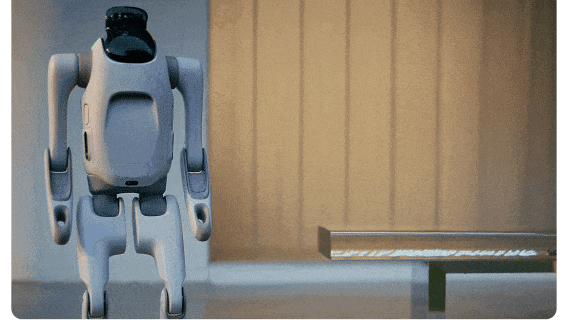
Qiyuan shares not only a nearly identical name with Agibot, but also the same core team behind it. Peng Zhihui, co-founder of Agibot and a renowned "Huawei Genius Youngster," is also the chairman of Sino Composite, Qiyuan's parent company.
From this perspective, Qiyuan and Agibot can be regarded as two "fellow apprentices" in the robotics industry.
Right after the announcement, related topics quickly went viral on social platforms. Qiyuan also invited Tim (Pan Tianhong), the founder of Film Tornado, a top influencer with millions of followers who boasts phenomenal popularity in the tech circle, to participate in pre-launch promotion, lavishing praise on the robot's capabilities.
However, while Qiyuan has set extremely high expectations for the T1 robot, the product itself remains shrouded in mystery. The T1 will make its first public debut at the World Artificial Intelligence Conference, with no pricing information or official launch date announced yet.
Nevertheless, this robot, fully named Transformer 1, is indeed a rare product that seamlessly integrates the three concepts of *Transformers*, large AI models, and transformable robots.
Could it be that the era of *Transformers* has finally arrived?
Stands as a "Human," Crouches as a "Dog"
Unfortunately, the Qiyuan T1 might disappoint many *Transformers* fans.
The Qiyuan T1 certainly cannot transform into a car or an airplane. What it can do is switch between a wheel-legged humanoid form and a quadruped robot form: it stands upright like a human, and crouches down to resemble a robotic dog.
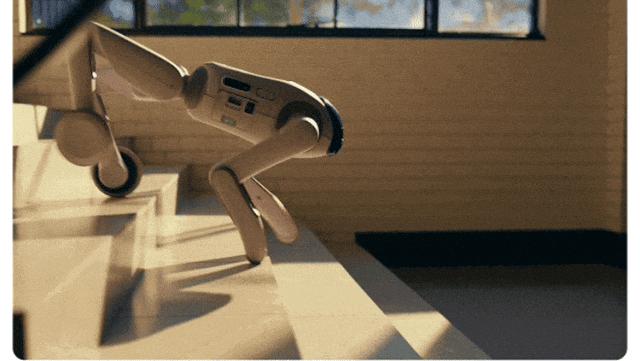
In the humanoid form, the T1 maintains an upright torso, supported by two legs, with wheel assemblies on its feet providing movement. Instead of taking steps to move forward, it mostly glides using the wheels, and can even achieve zero-radius turning to flexibly adjust direction in narrow indoor spaces.
When transformation begins, the T1 lowers its torso, repositions and folds its limbs, bringing down the center of gravity of the originally upright body to switch to a quadruped support structure. The robot's movement pattern changes accordingly, shifting from movement on two wheeled legs to being supported and moving on all four limbs.
Throughout the entire process, the T1 does not require part replacement, nor does it need to be disassembled and reassembled from two separate robots. Both forms are integrated into a single body, which Qiyuan calls the "Transformer Cross-Form Integrated Architecture."
The core of this so-called "cross-form integration" is to enable a single robot body to accommodate two distinct body structures and movement modes. The robot's main body, joints, and control system must remain functional under both configurations, and after the form changes, the support method and movement logic will also switch accordingly.
However, despite how effortless the transformation appears to be, implementing it in practice is far from simple.
The support points, body center of gravity, and joint forces are completely different between the humanoid and quadruped forms. According to Qiyuan, the T1 will also autonomously select the appropriate form based on changes in the environment. From an engineering perspective, during transformation, the control system must continuously assess the robot's posture, coordinate the rotation sequence and range of each joint, ensuring the center of gravity stays within the range that maintains balance. Any joint moving too fast or too slow could cause the robot to lose balance mid-transformation.
The difficulty level increases further when the robot falls from a height. The robot needs to determine its body orientation in a very short time, adjust joint forces and landing posture to absorb the impact of the collision. In the official promotional video, the T1 demonstrates this dynamic balance capability by remaining stable after falling from the height of a tabletop.
Interestingly, the name "Transformer Cross-Form Integrated Architecture" carries a coincidental double meaning. In the robotics field, the Transformer algorithm has already been used to process visual, linguistic, and other information, and further generate motion commands for robots; with the Qiyuan T1, it returns to the literal meaning of "transformation." Large models, robot control, and *Transformers* are perfectly connected by this single term.
Traditionally, a robot's form is largely determined at the factory, whether it is designed to stand, walk, crouch, or run; the Qiyuan T1 attempts to make the robot's form a variable that can be adjusted at any time.
But for a robot, what exactly is the necessity of switching between two different forms?
Robots Transform Not for Fun
The reason Qiyuan put so much effort into developing a transformable robot lies in the inherent differences between robots of different forms.
The advantage of humanoid robots is their body structure that closely resembles humans. When standing upright, their field of view, arm reach, and operating height are similar to those of humans, allowing them to directly use furniture, tools, and spaces designed for people, and facilitating more natural human-robot interaction and collaboration.
However, mimicking human bipedal locomotion is one of the most challenging problems for humanoid robots to solve.
The limited support range provided by two legs means the robot must constantly shift its center of gravity and maintain dynamic balance with every step. They typically move slowly and easily lose balance when encountering collisions or uneven terrain; the higher the robot's center of gravity, the greater the impact when it falls.
Quadruped robotic dogs perfectly make up for this shortcoming.
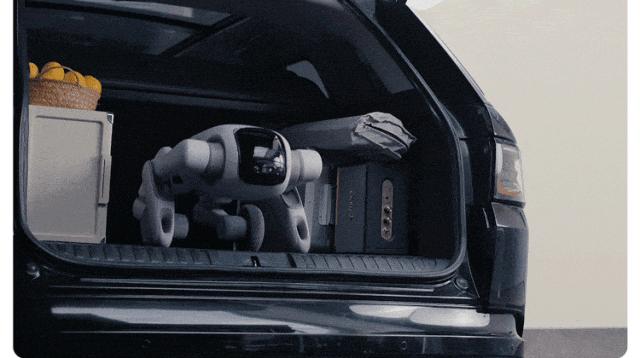
Four legs provide more support points, and the robot has a lower center of gravity, making it easier to maintain stability when navigating steps, slopes, and uneven ground, while also being able to perform tasks such as following users and carrying loads. However, their low profile makes it difficult to achieve the same level of performance as humanoid robots when interacting with people and manipulating objects.
One form excels at standing up to perform tasks, while the other is better at crouching down to travel efficiently. Following this line of thought, the ideal robot form seems to be a "centaur": the upper half resembles a human for interaction and manipulation, while the lower half has four legs for stable movement.
The robotics industry has indeed explored this direction. The CENTAURO robot developed by the Italian Institute of Technology mounts a humanoid upper body on a quadruped wheeled chassis, aiming to combine human manipulation capabilities with the terrain adaptability of quadruped robots.
However, stacking two forms together not only brings the advantages of both, but also inherits their respective disadvantages.
The quadruped chassis appears bulky and cumbersome indoors, while the upright upper body raises the overall center of gravity when operating outdoors. More joints and motors also mean greater weight, higher power consumption and cost, and a more complex control system.
As a result, the "centaur" design, which seems capable of doing everything, is far from being a practical personal robot suitable for most use cases.
That is why the Qiyuan T1 adopted a different approach: splitting the "centaur" into two alternating forms.
According to Qiyuan's vision, the T1 in humanoid form can handle tasks such as home companionship, voice reminders, and hand-holding interactions; when switched to quadruped form, it can follow users outdoors, adapt to complex terrain, and assist with carrying items.
In this way, transformation changes more than just the robot's appearance. It effectively adjusts the center of gravity, support mode, and movement logic, allowing a single body to leverage the strengths of both humanoid robots and robotic dogs.
This is exactly the core value that the Qiyuan T1 aims to demonstrate: in the past, users had to adapt to the robot's fixed body structure, but now the robot can proactively modify its own form to adapt to the user's scenario.
At least from a product logic perspective, this idea makes perfect sense.
However, after adding more joints, structural complexity, and control challenges to enable transformation, whether the Qiyuan T1 can remain stable, durable, and affordable remains an open question.
Who Will Pay for the "Transformers" Robot?
In fact, transformable robots are not a newly emerging concept. Research institutions and robotics companies have conducted many similar attempts in the past. However, moving from technical demonstrations to the personal consumer market, truly mature and practical products are still rare.
Ultimately, this is because transformable robots face a huge number of technical challenges that need to be resolved.
The first test to pass is durability.
A robot with a fixed form only needs to ensure its joints move within a predefined range; a transformable robot must repeatedly fold its body, shift its center of gravity, and redistribute the forces on each joint.
Successfully completing several transformation demonstrations is already a notable achievement, but there is still a huge gap before it can be used in the long term. After several years of continuous operation, it remains unknown whether the joints will become loose, whether the cables can withstand repeated bending, and whether the transformation speed and accuracy will gradually degrade.
A failure in any component could leave the robot stuck halfway through its transformation from "human" to "dog."
The second problem is whether both forms can achieve practical usability.
To enable transformation, the same set of joints and body structure must accommodate two different movement modes, which inevitably requires certain trade-offs.
From the publicly available demonstration footage, the ends of the T1's two arms also need to perform support and movement functions in the quadruped form, so no dexterous hands typical of traditional humanoid robots are showcased. While it can complete interactions such as hand-holding and touching when standing upright, there is currently no evidence to show whether it can grasp and manipulate objects.

If in the upright form, its interaction and manipulation capabilities are inferior to regular humanoid robots, and in the crouching form, its terrain adaptability and load capacity are worse than dedicated quadruped robotic dogs, then the so-called "two functions in one device" may fall into the opposite extreme of "being mediocre at everything."
The third problem is how much cost users have to pay for the transformation feature.
More joints, motors, and sensors will increase the overall manufacturing cost of the robot; two sets of movement logic and a constantly shifting center of gravity will also raise the difficulty of algorithm development and debugging. The transformation process itself consumes power, and the complex mechanical structure means higher maintenance costs.
As of now, the Qiyuan T1 has not announced key specifications such as pricing, official launch date, battery life, and the maximum number of reliable transformation cycles.
Therefore, what we can confirm at present is only that Qiyuan has built a transformable robot. Whether it can become a practical personal robot still lacks validation from the market and long-term real-world use.
However, this does not mean that transformation is nothing more than a gimmick.
The Qiyuan T1 at least provides a new line of thinking: a robot's body can be reconfigured like software, adapting to different tasks and environments.
It is too early to dismiss the Qiyuan T1 as a mere showcase of technical prowess, and it is equally premature to call it a revolution in the robotics industry.
But at least, there are manufacturers starting to explore this path from a commercialization perspective. Perhaps, the door leading to real-world *Transformers* has already been opened.
This article is from the WeChat official account "Blue Word Project", authored by Blue Word Project, and published with authorization from 36Kr.