KrAsia | China Unicom and Huawei Unveil the World's Largest 5G-A Network with 100 Mbps Uplink
[Beijing, China, July 15, 2026] Today, China Unicom Beijing Branch, in collaboration with Huawei, has launched the world's largest 5G-A massive uplink commercial network. This innovative network delivers continuous 100 Mbps massive uplink coverage across all key areas of Beijing, with over 10,000 deployed base stations. During on-site drive tests, seven invited third-party media outlets acting as experience officers jointly witnessed the network's "excellent coverage and stable service performance" — the 100 MHz uplink activation rate reached 83%, while the proportion of poor uplink edge points (<20 Mbps) stood at only 0.1%. These outstanding real-world test results mark that China Unicom's premium network in Beijing has entered a new development stage, shifting from full-city 5G-A activation to comprehensive massive uplink deployment.
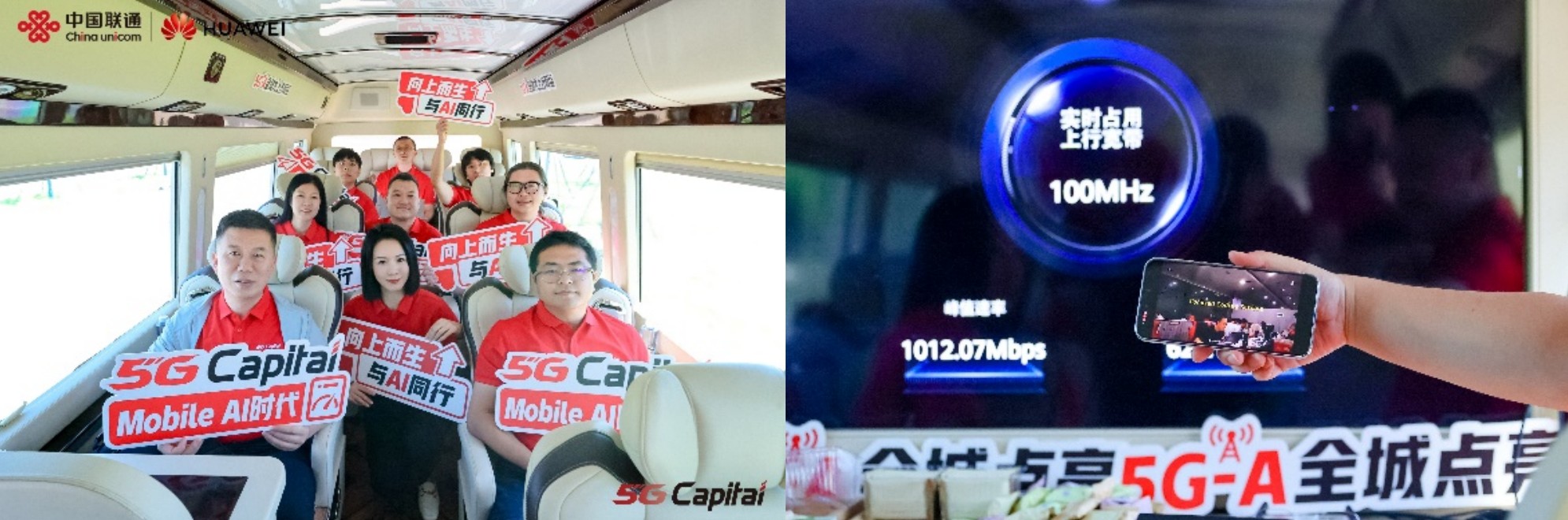
"5G Capital" On-Road Media Drive Test
During the on-site drive tests, China Unicom Beijing Branch leveraged the 3.5G+2.1G coordinated networking to support massive uplink network performance evaluation and AI terminal service experience validation. Along the 34-kilometer test route, the network achieved an 83% 100 MHz uplink activation rate, a 1 Gbps peak uplink rate, an average uplink rate of 397 Mbps, a 72% proportion of premium uplink experience (>300 Mbps), and only 0.1% of poor uplink edge points (<20 Mbps). These exceptional uplink performance metrics fully enable seamless experiences for applications in vehicular mobile scenarios, including millisecond-level backhaul and frictionless interaction for AI glasses, smooth AI phone interactions with intelligent agents, and real-time backhaul to the cloud for AI analysis and content generation with instant upload upon capture for AI smart cameras.
Miao Shouye, Vice President of China Unicom, stated: "Currently, artificial intelligence is accelerating its integration into production and daily life. New services such as AI phones, AI glasses, intelligent robots, industrial vision systems, and low-altitude applications are continuously emerging, driving profound transformations in network connection targets and service models. In the past, mobile networks primarily focused on 'download speeds' and information acquisition efficiency; as we enter the Mobile AI era, an increasing volume of data is generated on-site, requiring real-time backhaul to the cloud for analysis and processing. Networks must not only 'deliver fast downloads' but also 'ensure stable and accurate transmission'. Massive uplink capabilities are becoming a critical foundation supporting real-time interactions in the AI era, enabling networks to better connect, perceive, and serve the physical world."
Li Jie, President of Huawei's Wireless TDD Product Line, remarked: "As the 5G Capital project enters its sixth year — from global large-scale 5G-A demonstration, full-city commercial activation and the launch of the world's first 5G-A three-dimensional intelligent network, to today's unveiling of the world's largest 5G-A 100 Mbps massive uplink commercial network — I am deeply honored that Huawei's innovative 3.5 GHz + 2.1 GHz SUL solution has supported China Unicom in maintaining its network leadership. Huawei will continue to innovate in technical domains including multi-frequency pooling, uplink enhancement, and three-dimensional coordination, supporting China Unicom in building a user experience-centric high-quality 5G-A network, embracing the opportunities and challenges of the Mobile AI era, and achieving industry-wide win-win outcomes."
For the Mobile AI era, networks are undertaking new missions. Huawei will collaborate with China Unicom to continuously advance network capability evolution, strengthen industry ecosystem cooperation, and leverage more intelligent, reliable, and deterministic network capabilities to serve industrial innovation, urban development, and better livelihoods, jointly opening a new era of intelligent connectivity.