WAIC Observation: The competition in embodied intelligence has begun to shift from the "body" to the "brain"
At this year's WAIC, the most striking takeaway is that the field of embodied intelligence has undeniably grown increasingly vibrant.
Humanoid robots with steady gaits can be seen walking everywhere across the exhibition halls, robotic arms precisely perform delicate tasks such as tightening bottle caps and inserting connectors, and quadruped robots are capable of running, jumping, and even conducting heavy-load inspection missions. Players from all links of the industrial chain gather at various booths, discussing joint motors, debating motion foundation models, and calculating mass production costs, all dedicated to equipping robots with stronger "physical capabilities."
After walking through the entire venue, I felt there was still a missing piece. These robots are performing ever more skillfully, yet the way humans interact with them seems to have no fundamental difference from what it was a decade ago. Either engineers pre-write motion scripts, or operators guide the robots step by step using a teach pendant, and consumer-grade products mostly rely on voice commands. While robots are becoming more adept at moving, humans still have to go through many detours to get them to complete a task.
However, standing at the BrainCo booth, I witnessed a different scenario. The experiencer put on a lightweight EEG headband, without raising a hand, speaking, or even leaning forward—simply by imagining a grasping action in their mind, the robotic arm in front of them slowly started moving, accurately grabbed a water cup, and smoothly delivered it to the designated position.
Throughout the entire process, there were no traditional interactive media at all; what drove the machine to operate was nothing but pure brain intent.
Many people on site regarded this as a highly futuristic technical demonstration, but in my view, there is far more noteworthy information behind it.
This world's first integrated brain-controlled robot AI research platform released by BrainCo addresses a critical issue: when a robot's physical body is sufficiently capable, what truly determines the upper limit of human-robot collaboration will be the efficiency of intent interaction.
To put it more plainly, the next stage of embodied intelligence—advancing from "being able to move" to "understanding humans"—is being redefined.
After years of rapid development, what embodied intelligence lacks is not a capable "body" but an interaction entry point
Over the past two years, almost all resources in the embodied intelligence track have been focused on "ontological capabilities." From the localization of core components, to the optimization of motion control algorithms, to the improvement of general capabilities empowered by large models, the entire industrial chain has been solving one single problem: how to make robots move more steadily, accurately, and flexibly.
In fact, progress in this area has been faster than many expected.
Two years ago, we were still debating whether humanoid robots could walk stably, but this year, products from mainstream manufacturers can already complete complex tasks such as climbing up and down stairs, avoiding obstacles, and manipulating small objects. In industrial scenarios, the repeat positioning accuracy of robotic arms has long reached the hair strand level, and quadruped robots have already been deployed in scenarios like inspection and security. When it comes to the physical execution capability alone, many robots are already competent in a considerable number of real-world tasks.
However, when applied to real human-robot collaboration scenarios, their shortcomings immediately become apparent.
On industrial production lines, most robot movements are pre-programmed and fixed. When switching to a new task or a different workpiece, professionals are required to re-debug and re-teach the robot, which is a long, high-threshold process that cannot meet the demands of flexible production at all.
In daily scenarios, voice interaction is the most mainstream method, but its recognition rate drops in noisy environments, complex commands require repeated decomposition, and it has to go through a long chain of "language organization - speech recognition - semantic understanding - command conversion," with persistent latency and errors. As for physical interactions like handles and buttons, they inherently require operators to free their hands and focus on the operation, which is simply not feasible in many scenarios.
The root cause of these problems boils down to one single fact: all traditional interaction methods require humans to convert their inner intentions into standardized instructions that machines can understand. This conversion process inherently causes efficiency loss and raises the usage threshold. Not to mention people with physical impairments, who are excluded from many interaction methods from the very beginning.
Brain-computer interfaces (BCIs) offer a completely different solution path. They skip all intermediate media, directly read human motion intentions from the source, and convert them into execution commands for machines. Between humans and machines, there is no longer a need for "translators" like language, movements, or buttons—human thoughts can flow directly into the physical world.
This direction is by no means a new development. At the 2014 FIFA World Cup in Brazil, a paralyzed youth kicked off the game using a brain-controlled exoskeleton, showing the public the potential of this technology for the first time. In the subsequent years, research results published by the BrainGate team in Nature and Neuralink's clinical volunteers achieving mind writing have continuously pushed the boundaries of the technology. However, most of these cases are concentrated in medical scenarios, relying on customized laboratory systems that are extremely costly and difficult to replicate for general robot research.
I once discussed this topic with university researchers in relevant fields, and they told me that to build a usable brain-controlled robot experimental system, one has to simultaneously tackle three completely different technical domains: EEG hardware, signal decoding algorithms, and robot control interfaces. Ordinary teams often spend months on hardware adaptation, writing low-level code, and debugging the entire link, leaving very little time for core research and scenario exploration. Most solutions available on the market are scattered code libraries or algorithm demos, with no complete productized system formed, so the threshold remains high.
This is exactly the problem that BrainCo's platform aims to solve. Instead of stopping at single-point technological breakthroughs, it integrates EEG acquisition, experimental paradigms, neural decoding, control mapping, and robot execution terminals into a standardized software process, packaging the setup work that would have taken an interdisciplinary team months to complete into an out-of-the-box tool. As a result, even developers with no prior BCI background can complete the entire process from wearing the device to controlling the robot within 10 minutes.
Specifically, from a product detail perspective, this platform covers the complete research chain of brain-controlled robots.
On the hardware side, it is compatible with both wet and dry electrode devices, supports multiple sampling rates from 250Hz to 1000Hz and 32-channel configurations, which can meet research needs of different precision levels. On the software side, it natively supports two classic BCI paradigms: motor imagery and steady-state visual evoked potential (SSVEP), with built-in mature decoding algorithms such as FBCSP+SVM and EEGNet whose parameters can be flexibly adjusted, and it also allows researchers to access self-developed algorithms. On the execution side, it has already connected with multiple mainstream devices such as the Unitree G1 Edu humanoid robot, the Realman 6-DOF robotic arm, and the Deep Robotics Lite 3 quadruped robot, so the decoded EEG intentions can be directly mapped to corresponding robot movements.
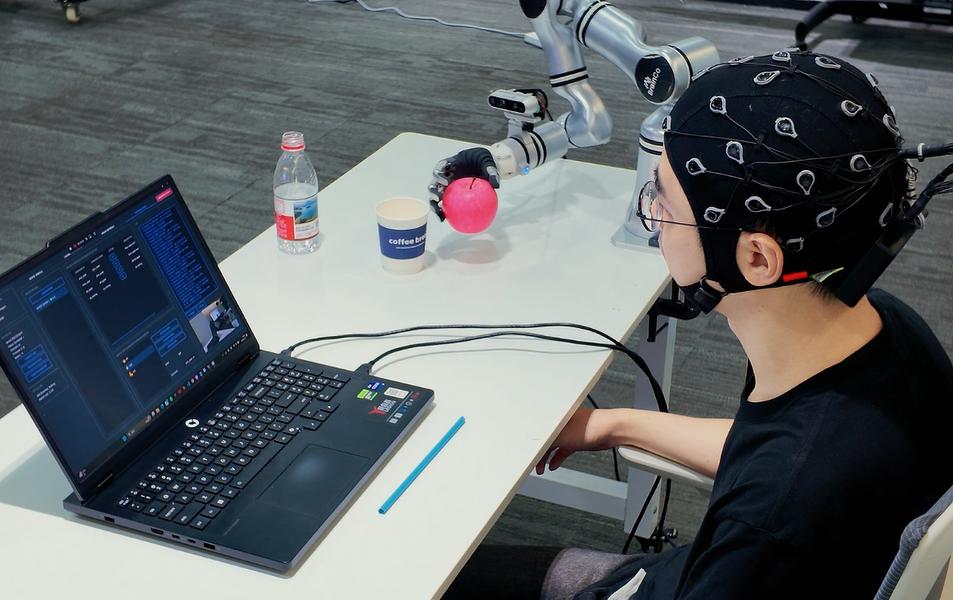
The entire platform adopts a graphical interactive interface, with all processes from impedance detection, data acquisition, offline training to online reasoning fully visualized, eliminating the need to write low-level code from scratch.
Many people may not understand the significance behind this. For researchers in the embodied intelligence field, this means they no longer need to spend massive amounts of energy building up BCI technology stacks, and can directly carry out application innovation on a mature foundation.
From another perspective, this platform is more like a development infrastructure in the brain-controlled robot field. It brings technologies that were previously only accessible to top-tier laboratories within the reach of ordinary research teams. As more people participate in the research, the iteration speed of the entire field will truly increase.
Ternary intelligence is not just a concept—it has already achieved a closed loop in practice
The industry has been discussing "ternary intelligence" for quite some time. The synergy of brain-computer interfaces, artificial intelligence, and embodied intelligence is regarded by many as the ultimate form of human-machine fusion: the BCI reads human intentions, AI decomposes task sequences, and embodied intelligence completes physical execution, ultimately forming a complete perceptual feedback closed loop.
However, for a long period of time, the three have been developing independently in their respective tracks, with very few landing products that truly connect the entire chain.
BrainCo's brain-controlled robot training platform is one of the few integrated products that has turned ternary intelligence from a concept into reality. It is not simply adding an EEG module to a robot, but has connected the full technology stack from neural signals to physical movements at the underlying level, enabling the three to generate real synergistic effects.
In terms of specific parameters, the EEG sensing device of this system uses a mass-production-grade hardware solution, with 24-bit data precision, supports WiFi 6 wireless transmission, has a battery life of 6-8 hours, and its stability has been verified by the market. The neural decoding algorithm is optimized based on years of clinical data, which can complete the conversion from intention to action instruction within 200 milliseconds, and its motion intention recognition accuracy is at the leading level in the industry.
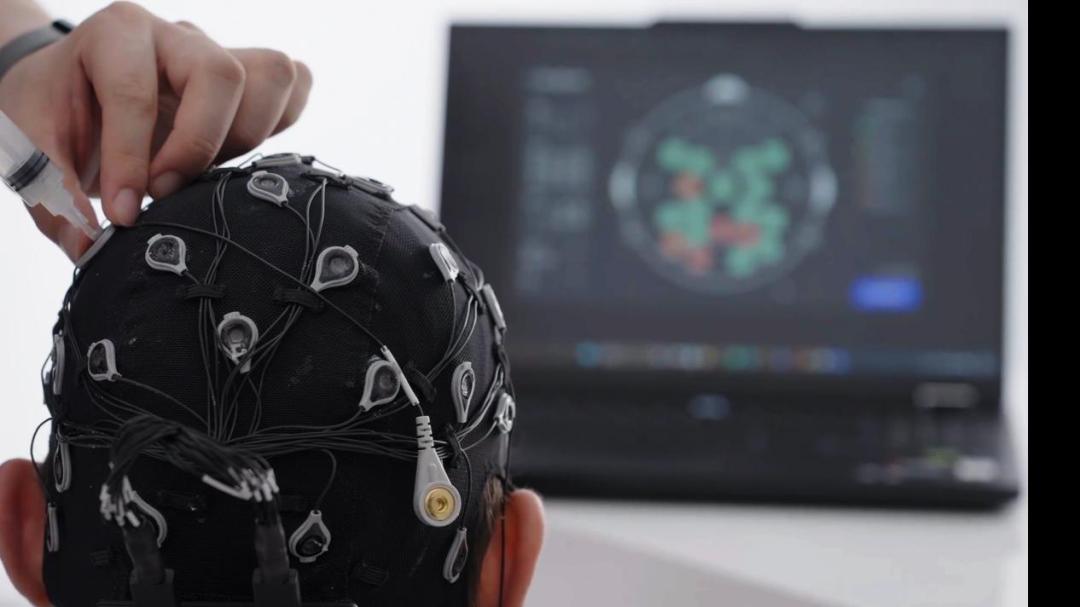
Artificial intelligence plays a key connecting role between brain-computer interfaces and embodied intelligence. The traditional machine learning and deep learning algorithms built into the platform extract features and recognize intentions from complex EEG signals on one hand, and decompose abstract motion intentions into specific executable action sequences for robots on the other. When a user imagines a grasping action, the AI not only recognizes this intention, but also schedules the robot to complete a series of coherent operations such as visual positioning, path planning, and finger closing—all of which are done automatically without manual step-by-step instructions.
Interestingly, they did not choose to develop robot ontologies themselves, but instead adopted an open and compatible approach. In addition to the multiple third-party devices already connected, the platform also opens standard access interfaces, allowing robot manufacturers to register their own action and task libraries for rapid adaptation of brain control capabilities. This positioning makes it more like an operating system for brain-computer interfaces, rather than a single end product, and it is precisely this platform attribute that can support the ternary intelligence ecosystem.
The data acquisition solution released alongside the brain-controlled robot platform is easily overlooked, but it precisely fills another critical gap.
Targeting the data gap in dexterous operation training for embodied intelligence, this solution provides large-scale, high-quality real-scenario training data through hardware such as a dual-arm wheeled real-machine data acquisition platform and high-precision data acquisition gloves.
If the brain control platform solves the problem of how humans send instructions to machines, the data acquisition solution addresses the problem of how machines learn to perform actions. The two, starting from the two dimensions of human-machine interaction and ontological capability, jointly support the technical system of embodied intelligence.
The combination of the three forms a mutually enhancing closed loop. The intent data brought by brain-computer interfaces can enrich AI's understanding of human behavior patterns; the improvement of AI capabilities can in turn optimize the accuracy of EEG decoding and the execution effect of robots; in the future, tactile and force feedback from the embodied intelligence end can also be transmitted back to the brain through the BCI, forming true two-way human-machine collaboration.
This is fundamentally different from traditional human-machine interaction. In the past, the model was that humans unilaterally sent commands to machines, and machines executed them; under the ternary intelligence architecture, humans and machines form a two-way collaborative relationship, where intentions can flow to machines and perceptions can be fed back to the brain, with the two jointly completing tasks.
The next stop for BCIs: from hospital wards to industrial scenarios
After years of development, the main commercialization field of brain-computer interfaces has always been medical rehabilitation. Exoskeletons and bionic hands that assist paralyzed patients, training systems for neural function rehabilitation, and sleep intervention devices—these scenarios have clear demands and strong willingness to pay, making them the first stop for technology landing. BrainCo's own commercialization path also started from medical health, and gradually expanded to fields such as consumer electronics.
However, the medical market has a limited scale. For BCIs to grow into a general technology that influences the entire information industry, they must find broader application scenarios. The outbreak of the embodied intelligence industry has precisely opened the door to the general market for BCIs.
There is a clear industrial logic behind this.
The more embodied intelligence develops, the stronger the physical execution capabilities of robots become, the more tasks they can undertake, and the frequency and complexity of human-machine interactions will rise exponentially. When robots evolve from fixed equipment on production lines to collaborative partners for flexible production, and from scientific research tools in laboratories into daily work and life, the bottlenecks of traditional interaction methods will become increasingly prominent. At that point, the value of BCIs, as the most direct method of intent interaction, will be gradually unlocked.
From this perspective, the launch of products like the brain-controlled robot training platform is not only targeting the current scientific research market, but also seizing the industrial dividend from the future integration of BCIs and embodied intelligence. As a platform-type product for scientific research and development scenarios, its primary goal is not to achieve large-scale C-end monetization immediately, but to establish industry infrastructure and cultivate the entire ecosystem first.
For universities and scientific research institutions, this platform has significantly lowered the research threshold in the brain-controlled robot field, allowing teams to focus on algorithm innovation and scenario exploration instead of reinventing the wheel. For robot manufacturers, accessing brain control capabilities through standard interfaces can quickly add differentiated interaction methods to their products, expanding their application scope in scenarios such as medical treatment and special operations. For the entire industry, a unified platform also facilitates the formation of data and technical standards, accelerating technological iteration across the entire track.
This path is very familiar, as it mirrors the development of smart terminal operating systems in the early years. Only by maturing the underlying foundation and lowering the development threshold can application innovations at the upper level emerge in large numbers.
Similarly, with continuous technological iteration, the application scenarios of brain-controlled robots will gradually expand from laboratories to the industrial end.
Just imagine: in industrial manufacturing scenarios, workers can use their minds to control robotic arms to complete high-risk, high-precision operations, freeing their hands to handle tasks that require more judgment; in medical rehabilitation scenarios, people with physical impairments can not only restore their mobility through brain-controlled bionic hands, but also use brain-controlled humanoid robots to complete more daily activities and improve their life autonomy; in special rescue scenarios, rescuers can remotely control robots with their minds to enter dangerous areas, with response speed several times faster than traditional manual control. These scenarios are not science fiction—they are inevitable outcomes as the technology roadmap continues to evolve.
Evolving from niche applications in medical rehabilitation to general interaction methods for embodied intelligence, brain-computer interfaces are steadily entering a broader industrial world. China's 15th Five-Year Plan has listed BCIs as a key future industry direction for development, and embodied intelligence is regarded as the core carrier of next-generation smart terminals. The in-depth integration of the two is not only an inevitable trend of technological development, but also aligned with industrial policy guidance.
This step is not the final destination of brain-controlled robots, but the starting point of a brand new track.
This article is from the WeChat official account "Xinmou" (ID: xinmouls), written by Sang Mingqiang, and published with authorization from 36Kr.