Relying on "rehashing old themes" to target 3 billion yuan, *Kung Fu Girls* becomes more popular despite criticism, with 24 capital players behind it reaping huge gains
Total box office forecast exceeds 3 billion yuan, Stephen Chow's "nonsense comedy" is a smash hit again!
Recently, Stephen Chow, who has been silent for 7 years, made a surprise release of Kung Fu Women's Soccer with zero promotion. Its iconic humorous lines, paired with the nostalgia for Shaolin Soccer from 20 years ago, immediately ignited public opinion upon release, blowing up the otherwise dull summer movie season.
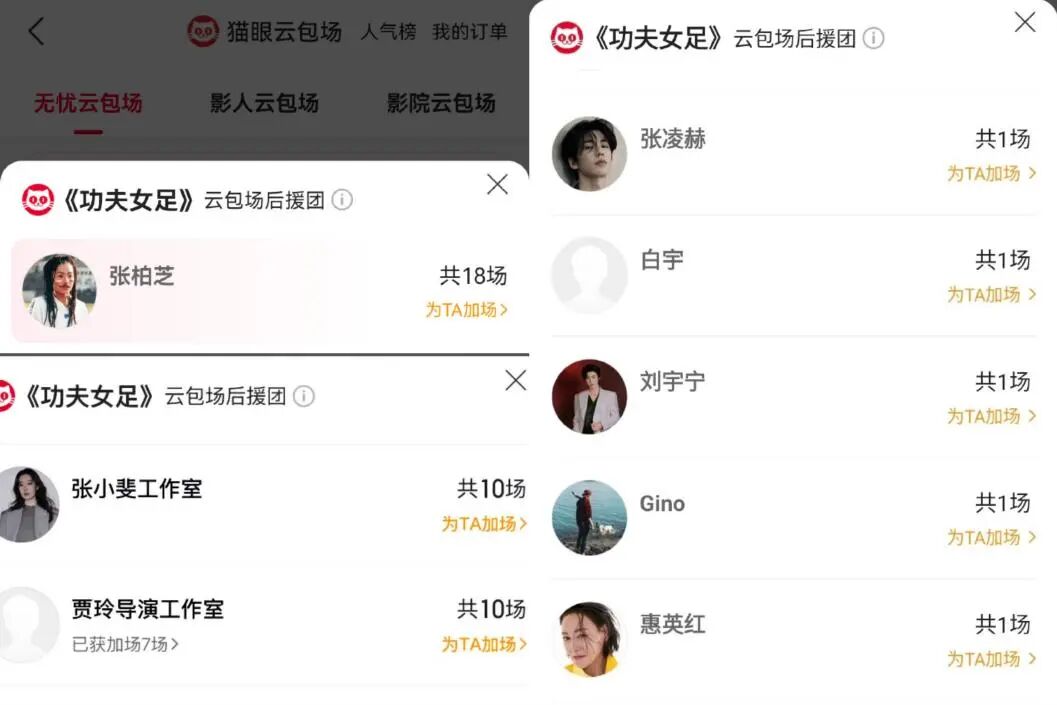
Even celebrities have come out in full force: Stephen Chow's former "Star Girl" Cecilia Cheung booked 18 screenings in one go, while Lin Yun, Xin Zhilei, Zhang Xiaofei, Jia Ling, Zhang Linghe, Liu Yuning and many others have shown their support, creating an unprecedentedly grand scene that the Chinese entertainment industry hasn't seen in a long time.
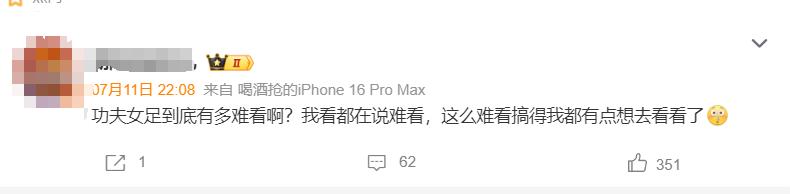
But as soon as the movie became a hit, controversies followed. The two trending topics "Kung Fu Women's Soccer is great" and "Kung Fu Women's Soccer is bad" hit the hot search list one after another, sparking fierce debates in the comment section. Some people said, "Thank you Stephen Chow for still making fairy tales for adults", while others complained:
"Stephen Chow is just rehashing old ideas";
"Now Stephen Chow owes me a movie ticket";
However, no matter how loud the controversies are, they don't stop the movie from making money. As of July 17, the box office of Kung Fu Women's Soccer has exceeded 970 million yuan, and the total box office forecast on Maoyan Professional Edition has soared to 3.023 billion yuan, making it a strong contender for the annual box office champion.
With the box office exploding, the capital that bet on the movie has become a big winner. Behind Kung Fu Women's Soccer stands a "capital dream team" composed of 24 production companies. The question is, who is the ruthless player making a fortune quietly behind the scenes?
From film director to behind-the-scenes "backer", with the massive box office success of Kung Fu Women's Soccer, has he earned over 300 million yuan?
On July 11, Kung Fu Women's Soccer was suddenly released in theaters with zero promotion, breaking multiple summer season records one after another, and its box office went completely wild! Let's take a quick look at the numbers:
Box office exceeded 100 million yuan 2 hours and 33 minutes after release, with first-day earnings of 260 million yuan far exceeding the expected 190 million yuan;
Total box office surpassed 700 million yuan four days after release, with over 17 million admissions;
The two major ticketing platforms Maoyan and Beacon raised their forecasts three times in a row, from 1.428 billion yuan to 2.505 billion yuan, then to 3.023 billion yuan...

This film, directed and written by Stephen Chow and starring Zhang Xiaofei, Dilraba Dilmurat and Lay Zhang, tells the story of the Chinese women's soccer team "Emei" competing in the Women's Soccer AFC Champions League, going from being underestimated to achieving an underdog victory. It is a classic Stephen Chow-style comedy plot about ordinary people turning their lives around.
With the massive box office success of Kung Fu Women's Soccer, many people online have started to wonder:
With the forecast total box office soaring to 3 billion yuan, how much money can the capital behind it make?
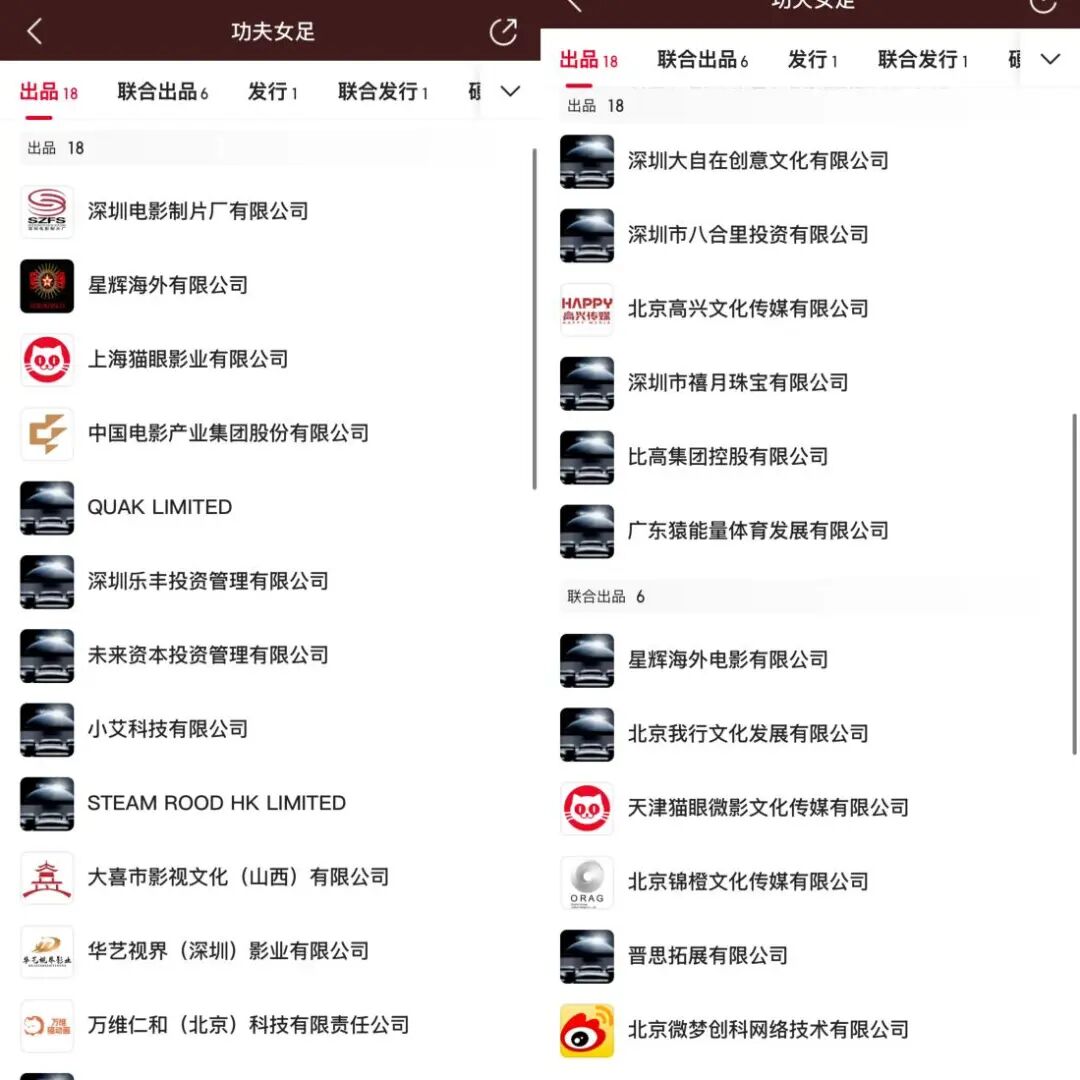
According to Maoyan Professional Edition, Kung Fu Women's Soccer has a total of 18 production companies and 6 co-production companies, spanning multiple fields such as film production, AI special effects, theater distribution, and consumer brands, forming a truly luxurious lineup.
But what many people don't know is that as the film's director and screenwriter, Stephen Chow not only took charge of the creative work, but is also the "biggest backer" of Kung Fu Women's Soccer.
Among the 24 production companies, three are directly related to Stephen Chow: Star Overseas Limited, Bingo Group, and Star Overseas Pictures Limited.
Founded by Stephen Chow in 1996 and registered in Hong Kong, Star Overseas is not only the core of his film production and investment business, but also the holder of his IPs. Classic works such as The King of Comedy, Shaolin Soccer, Kung Fu Hustle and CJ7 were all produced by this company.
According to reports from multiple media outlets, Star Overseas is the leading production company and main controlling investor of Kung Fu Women's Soccer, having overseen the total investment of 380 million yuan, with a combined investment proportion of no less than 40%.
So how much money can Stephen Chow actually make? Some people have done the math: if the final box office is estimated at 3.023 billion yuan, after deducting taxes, theater revenue share and distribution fees, the actual revenue share for the production side is about 1.14 billion yuan, leaving a net profit of about 760 million yuan after subtracting the production cost. Calculated based on an investment proportion of no less than 40%, Stephen Chow's side can receive approximately 300 million yuan.
Other forecasts suggest that if the box office reaches 3 billion yuan, the production companies are expected to receive 990 million yuan. With Stephen Chow's 40% stake plus additional bonuses for his work as director and screenwriter, his total income would be around 350 million yuan.
Seven years without a new project, but as soon as he makes a move, he makes a huge fortune by "rehashing old ideas" — Stephen Chow has hit the jackpot completely.
Another production company, Bingo Group, is a Hong Kong-listed company under Stephen Chow's capital empire. The company was formerly known as Dynamic Group. In 2010, Stephen Chow completed a backdoor listing by acquiring shares, but its operating conditions have been unsatisfactory, with consecutive years of losses. As of the end of March this year, its debt ratio reached as high as 177%, with negative net assets — it's no exaggeration to say the company was "desperately in need of a cash infusion".
However, Bingo Group has not yet publicly disclosed the investment amount, investment proportion, and box office revenue sharing arrangement for Kung Fu Women's Soccer. Some analysts point out that without disclosing the specific investment proportion and given the company's high debt, the box office share can only temporarily ease cash flow pressure, and cannot fundamentally reverse its insolvent financial situation.
But in the past two years, Bingo Group has clearly shifted its focus to "AI + Content + IP". Last year, it made a strategic investment in Hangzhou Jiyi Artificial Intelligence, and in June this year, it reached a deep "AI + IP" cooperation with Volcano Engine, a subsidiary of ByteDance. Therefore, the biggest significance of Kung Fu Women's Soccer is that it provides the capital market with the best example of the "AI + Film" narrative.
It is worth noting that on May 28 this year, Stephen Chow converted all 19 million Hong Kong dollars of previously issued convertible bonds into shares, raising his stake from 39.47% to 62.97% in one go.
It's important to know that compared to the small share of box office revenue, the capital market is the real "money printer". If Bingo Group's stock price really takes off, Stephen Chow, who holds over 60% of the shares, will naturally see his net worth rise along with it.
Behind the entry of mysterious capital, is a post-80s finance professional the real biggest winner?
However, there is another theory circulating in the market that the biggest winner of Kung Fu Women's Soccer is not Stephen Chow, but a post-80s finance professional who made a massive, high-stakes bet on the film.
Among the 24 production companies, two mysterious capital entities joined in, named "QUAK LIMITED" and "STEAM ROOD HK LIMITED".
These two companies are regarded as the overseas investment vehicles of the "Ruyi Capital" system. According to public reports from multiple media outlets, the majority of the funds for Kung Fu Women's Soccer came from Hong Kong-listed China Ruyi —
One of the largest cash contributors during the filming stage, it jointly covered the full 380 million yuan filming cost with Star Overseas.
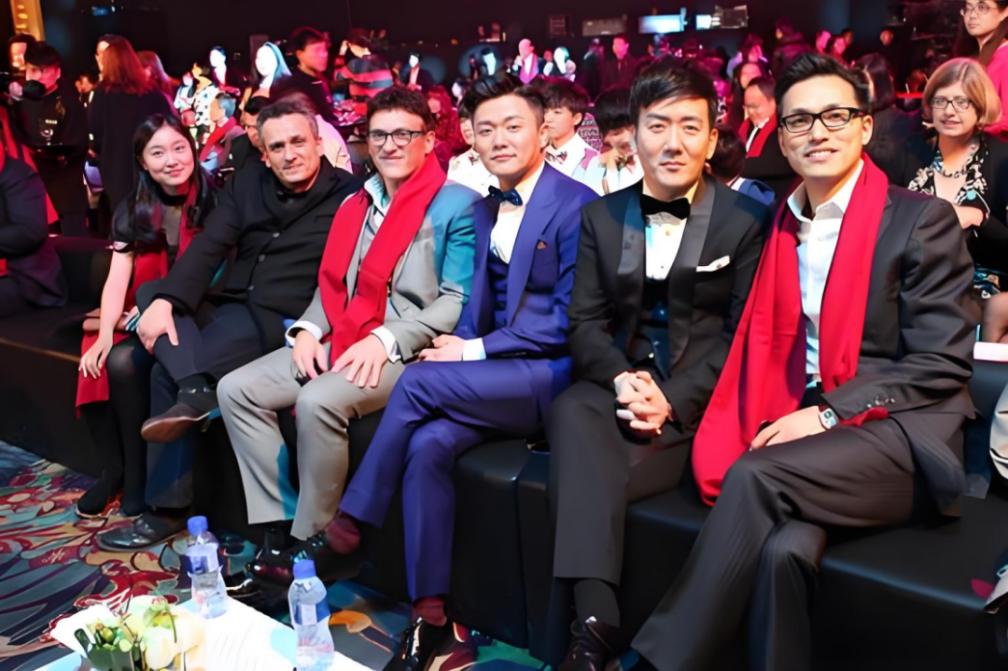
The mastermind behind China Ruyi is none other than Ke Liming, the "film industry tycoon" who has been making waves in recent years.
▲
Ke Liming is not a professionally trained filmmaker. In his early years, he worked as an analyst at a hedge fund in Hong Kong for five years before moving north to enter the film industry. While others were competing to sign top directors and celebrities, he first hoarded IPs — for example, the later blockbuster works So Young, Nirvana in Fire, The Legend of Mi Yue and All Quiet in Peking were all acquired by him at low prices early on.
But what truly allowed Ke Liming to secure a seat at the capital table were two textbook-style "bottom-fishing" moves.
The first was in 2020, when he injected Ruyi Pictures into Hong Kong-listed company Hengten Network for HK$7.2 billion, completing a reverse backdoor listing. Right after Evergrande faced its debt crisis, he decisively stepped in to acquire shares from Xu Jiayin, and renamed the company "China Ruyi".
The second was in 2023, when Ke Liming made two moves, spending a total of 4.417 billion yuan to become the actual controller of A-share listed company Wanda Film. In April 2024, the control of Wanda Film was officially transferred, with Wang Jianlin stepping down and Ke Liming becoming the new owner of over 700 directly operated cinemas and more than 6,000 screens across the country. This April, "Wanda Film" was officially renamed "Ruyi Film".
With this full industrial chain layout from content to distribution channels, Ke Liming's strategy for Kung Fu Women's Soccer becomes very interesting.
The total investment of Kung Fu Women's Soccer is about 380 million yuan (excluding promotion costs). The production budget is about 190 million yuan, accounting for nearly 50% of the total investment, mainly allocated to special effects production — the film contains over 1,200 CGI special effects shots, all of which were completed by China Ruyi's self-developed C-live AI visual team.
This forms a sophisticated closed business loop: part of the money Ruyi invested as a backer flows steadily back into its own pockets in the form of technology service fees.
At the same time, on the distribution side, Ruyi controls the former Wanda Film's theater resources offline, which can give priority screening slots to films it invests in; online, it uses its streaming platform "Pumpkin Movie" to conduct promotion and subsequent copyright operations.
As a theater operator, it can also take a solid share from the box office revenue of every movie ticket sold.
Looking at it this way, Mr. Ke has woven a huge capital network behind the scenes, making money from every link — content, technology, and distribution channels. It's really hard to say who is the real biggest winner of Kung Fu Women's Soccer.
24 companies in the "capital dream team" joined in, and all behind-the-scenes players hit the jackpot
26 years ago, when filming Shaolin Soccer, Stephen Chow had to beg everywhere to secure investment. Back then, the Hong Kong film industry was in a downturn, and no one was willing to bet money on a movie that mixed kung fu and soccer.
But 26 years later, the production company list for Kung Fu Women's Soccer is densely packed with 24 companies. Looking back at the capital game behind Kung Fu Women's Soccer, besides Stephen Chow and Ke Liming, many other capital players are also involved.
Some capital entities are just along for the ride. For example, China Film, which ranks fourth on the production company list, explicitly responded on its investor relations platform that it did not participate in the investment of Kung Fu Women's Soccer, and only retained the production company credit because it participated in the project's filing and registration, while also serving as a co-distributor.
But other capital players have reached deeper into the profit zone. Maoyan is a typical example: Shanghai Maoyan Pictures is both a production company and firmly holds the film's distribution rights; Tianjin Maoyan Weiying is listed as a co-production company. It can take a share from every link — box office revenue, distribution commissions, ticketing services...
Another interesting phenomenon among the "capital dream team" behind Kung Fu Women's Soccer is that a group of cross-industry capital entities that have nothing to do with the film industry have also joined in:
For example, Shenzhen Baheli Investment Co., Ltd., one of the production companies, is ultimately controlled by Lin Haiping, the founder of the well-known Chaoshan beef hot pot brand "Baheli" — a well-known figure in the catering industry.
Some people may wonder: Why would a beef hot pot restaurant owner invest in a movie? At first glance it seems out of place, but if you think about it carefully, Mr. Lin's plan is very shrewd: a top-grossing movie means hundreds of millions of social media discussions