Recently, investors are all researching how to "feed" robots.
The competition in embodied intelligence has evolved far beyond making robots strike poses; the real race now centers on building robots that can perform practical, useful tasks. Data is emerging as the invisible threshold that determines whether these robots can truly become intelligent.
Embodied intelligence investors are shifting their focus to data, and even old Silicon Valley capital is accelerating its entry into this space. In mid-June, XDOF emerged from stealth mode, securing $70 million in a single funding round with backers including Thrive Capital and a16z. Encord, a company focused on robotic data infrastructure, closed a $60 million Series C round led by Wellington Management, bringing its total funding to $110 million. New York-based Mecka AI also raised $60 million across two tranches, led by Framework Ventures.
This shift reflects a key industry realization: when both hardware and algorithms are advancing rapidly, the party that first enables models to truly perform practical tasks will hold the next critical market entry point.
The Invisible Foundation of Physical AI
Embodied intelligence has exploded into the mainstream, with robots now appearing across every scenario — greeting customers in shopping malls, performing assembly tasks in factories, and dancing at commercial events...
But when we talk about embodied intelligence, we should be focusing on the real driving force behind enabling robots to operate in all kinds of physical environments: data.
Unlocking any single use case requires dedicated data specific to that scenario.
Unlike the large language model era, where text and image data were scraped from existing sources, robots learn to perform actions like twisting bottle caps, folding clothes, and carrying plates not from text corpora, but from the complete information captured when humans perform these tasks: how hands move, the amount of force applied, how objects are grasped and placed, and at what points an action is considered successful or failed. This information must be recorded by specialized devices, then processed into data that robots can learn from. This entire collection and processing pipeline forms the foundational fuel production line for embodied intelligence.
So how do you collect such massive volumes of data?
There are four common methods in the market:
1. Real Robot Teleoperation: A human operator controls a physical robot to execute tasks, simultaneously capturing motion, state, and sensor data. 2. Embodiment-Free Collection: A human directly demonstrates the task, with motion captured via motion tracking systems, gripper mapping, first-person cameras, and other devices, no robot required. 3. Simulation Synthesis: Generating large batches of robot interaction data in a virtual environment for model training. 4. Internet Video Distillation: Extracting human action knowledge from online videos and converting it into data that embodied models can learn from.
"Over the past one or two years, both users and investors have focused heavily on the two ends of embodied intelligence: hardware form factors and model architectures. But as these two areas begin to converge, data is becoming the core bottleneck limiting further improvements in model capabilities," explained Lu-Hong Zhou from the Investment Banking Division at China Renaissance.
Within the broader narrative of Physical AI, the value of data and model infrastructure is being redefined. It is no longer as simple as a single camera and a recording — it is a complete engineering system that transforms scattered human operations from the real world into structured assets that robots can understand and learn from. This foundational layer, rarely discussed independently before, is now becoming an unavoidable threshold for the entire embodied intelligence industry to move forward.
What Constitutes a Sustainable Moat
There is a common consensus in the embodied intelligence data supply ecosystem: the most critical intangible asset is "high-quality, vertical domain data." However, different players have their own approaches to defining and acquiring this "high-quality" data.
Lu-Hong Zhou from China Renaissance offers a concrete comparison: from our conversations with clients in related fields, we understand that 10,000 hours of clean, effective data with complete task pipelines can improve model performance more than 1 million hours of unprocessed raw data.
The logic behind this statement is straightforward: the quality of data supplied across the industry varies widely, rooted in the fact that data providers often do not understand what model developers actually need. This leads to missing modalities, incomplete annotations, unclear action mappings, and fragmented task processes, resulting in very low densities of truly useful data. In other words, volume has never been the barrier in this industry — the real barrier is whether the data can actually be used to improve model performance.
This observation explains why vertical scenario data is repeatedly emphasized. Zhou notes that data collected from real operational scenarios is often more effective than data generated in standardized data collection facilities. Especially in specific sectors like logistics, retail, industry, and warehousing, the object distributions, operational workflows, edge cases, and long-tail tasks in real environments provide more direct benefits to improving model performance in targeted scenarios. But he also stresses that embodied models must ultimately solve the problem of generalization across different scenarios and tasks long-term. This means data cannot only pursue high-quality samples in a single scenario — it also needs sufficient diversity and scalable production capabilities. This is why traditional real-robot teleoperation collection, which is high-cost, low-efficiency, and easily tied to a single physical robot platform, is being re-evaluated across the industry.
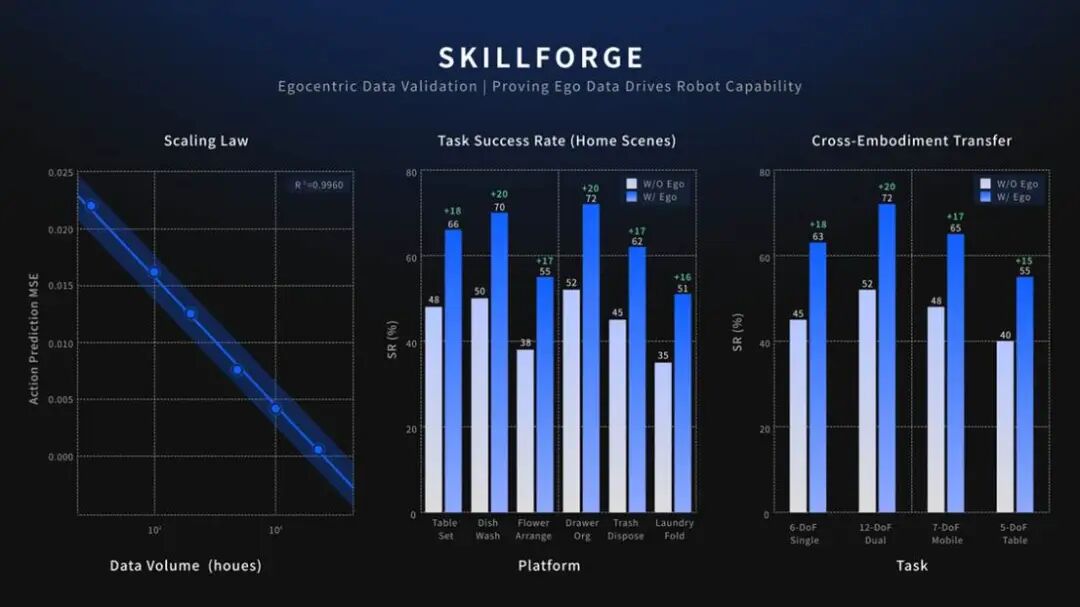
Image source: Scansky Tech
Da Huo, CEO of Scansky Tech, a universal embodied intelligence data and model infrastructure provider, puts it very directly: "The ultimate proof of high-quality data is not how many petabytes you have stored, but whether the model's capabilities have seen real, tangible improvements."
To make this "model capability improvement" achievable, verifiable, and scalable for delivery, Scansky has built a three-layer product system: the data-model integrated platform WorldEngine, the self-developed generative unified world model GENESIS-Robotics, and the data asset engine SkillForge.
The three components form a self-reinforcing positive flywheel: real-world collected data and customer feedback continuously feed into the system. WorldEngine handles data governance, quality inspection, and closed-loop validation. GENESIS-Robotics continuously evolves its world understanding capabilities based on real data and generates synthetic data to expand production capacity. Finally, all achievements are consolidated into richer, more precise standardized skill packages in SkillForge for delivery to customers.
The three layers do not operate as a linear pipeline, but as a continuously self-reinforcing flywheel. Real data calibrates the model's physical cognition, the model in turn generates synthetic data to expand boundaries, the platform connects both ends to complete closed-loop validation, and the end result is an increasingly robust library of skill assets. For this flywheel to operate successfully, one prerequisite exists: GENESIS-Robotics' physical cognition is not built from scratch. Scansky's core team comes from the No. 001 data R&D team formed at the founding of WeRide, built on the massive real physical data accumulated by WeRide over nearly a decade of large-scale autonomous driving deployments.
Huo states, "You must first calibrate the model with the real world, then use the model to generate data — this order cannot be reversed." Regarding the common industry question of whether autonomous driving experience can be transferred to robotic manipulation, he argues that what is transferred is not the features of driving scenarios, but the underlying modeling capabilities for 3D space, object interactions, and physical relationships. Physical laws are universal, and these capabilities have already been fully validated in embodied scenarios.
Returning to the original question: what exactly is the moat for embodied intelligence?
The answer is not necessarily excelling in a single link, but possessing a complete closed-loop capability spanning from data to model: enabling models to define data standards, validate data value, and continuously drive appreciation of data assets. Once this system is fully operational, every component widens the competitive gap — a gap that outsiders most often overlook, but which is the hardest to catch up to.
An Industry Chain Still Taking Shape
In the embodied intelligence data supply space, players can be broadly categorized into three groups: robot OEMs that develop data capabilities in-house, model companies building their own data teams to power embodied AI brains, and independent third-party infrastructure service providers.
When robot OEMs develop their own data supply capabilities, their natural priority is internal use: data exists to make their own robots smarter, with incidental efficiency gains and cost optimization as secondary benefits. External data output is never their primary objective. Large model companies building in-house data teams do so primarily to meet customized and confidentiality requirements during their own model iteration processes — after all, core training data is central to competitive barriers, and entrusting it to external parties introduces unavoidable trust costs. The common trait of these two types of players is that their data services serve their own business closed loops, and their scale is naturally constrained by the size of their own operations.
The market opportunity for third-party data collection companies lies precisely in this gap.
On this topic, Lu-Hong Zhou notes: data companies and model companies have fundamentally different core competencies. Model companies excel at algorithms, training systems, and model iteration, while data companies require capabilities in large-scale delivery, standardized operations, quality control, scenario organization, and understanding customer requirements. These are two entirely distinct capability models. Over a longer industrial cycle, this division of labor is not a temporary workaround — it is a natural outcome driven by efficiency. A company that develops both models and data, constrained by competitive concerns and data neutrality issues, will find it difficult to sell its most critical data to industry peers. Third-party providers face no such constraints: a single high-quality dataset can theoretically serve multiple model developers and robot customers, and the scale effects created by reuse are impossible for in-house teams to match in the short term.
For this logic to hold true, teams must possess sufficient industry experience spanning autonomous driving, geographic information, and AI data — previously disconnected domains — with expertise in both hardware calibration and a clear understanding of what model training actually requires.
The rationale for customers choosing third-party providers is equally clear. Building a complete data-to-model closed loop in-house typically takes years, requiring alignment across hardware, facilities, teams, and workflows — every step carries significant costs. Partnering with a company that has already refined this system allows customers to skip the entire infrastructure building phase, and focus resources on robot R&D and real-world deployment. Many global benchmark customers have proactively reached out even without significant marketing efforts, as word of mouth has proven the most effective customer acquisition channel.
Compared to the data supply ecosystem in the large language model era, the embodied intelligence data and model industry chain is clearly still immature. Data standards for language models have converged after years of iteration, but embodied data is different: multiple technical approaches are still being explored in parallel, and the industry has not yet reached a unified consensus on what "truly effective embodied data" means. This state of non-convergence represents short-term uncertainty, but in the long run it means the power to define industry standards has not yet been locked in. The first party to clearly define industry standards through products and real-world deployment outcomes will have the opportunity to occupy the most upstream position in this industry chain.
The current state of data and model infrastructure is somewhat analogous to cloud computing in the early mobile internet era: while it is foundational, it is the prerequisite for all upper-layer applications to operate. The concept of Physical AI is being discussed more and more, and the stories around robot hardware and model algorithms have been compelling — but what ultimately determines whether these stories become reality is whether this most easily overlooked infrastructure layer can be successfully built first.
The race to control this infrastructure entry point has only just begun. The first party to fully realize the complete closed-loop system will secure the next critical industry ticket.
This article is from the WeChat public account "TheCapital (ID: thecapital)", author: Jingzhi Lyu, editor: Wuren, published with authorization from 36Kr.