A16Z's Latest Judgment: 80% of Tokens Are Circulating Idly, Managing AI Is the Next Trillion-Dollar Opportunity
Many people believe that artificial intelligence should replace human jobs.
The reality has turned out to be the exact opposite.
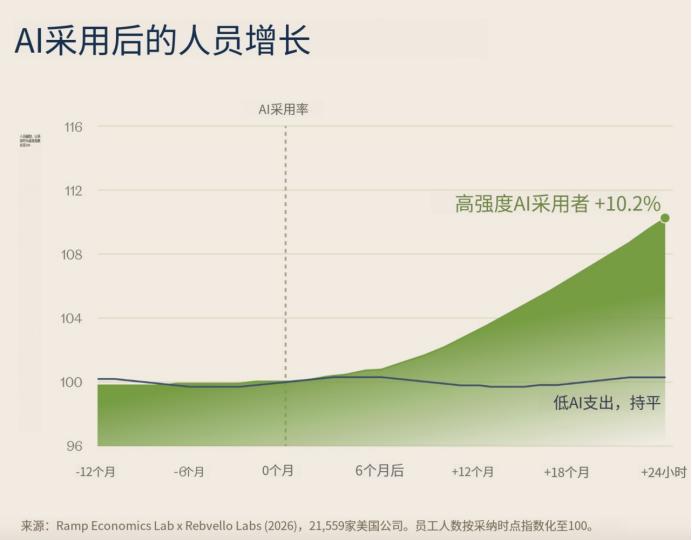
Instead of eliminating jobs, AI is creating them. A study by RampEconomicsLab of 21,000 U.S. companies shows that two years after AI adoption, headcount at enterprises with high-intensity AI usage grew by 10.2%, while firms with low AI spending saw virtually no growth in their workforce.
The reason is simple: human labor costs are lower than AI costs.
Ramp data shows that among leading enterprises, AI spending per employee is projected to rise from roughly $20,000 per employee in early 2025 to $225,000 per employee by the end of 2026 — far exceeding the average annual salary of a typical U.S. worker, and even the compensation of software engineers.

Why does this phenomenon occur?
Recently, George Sivulka, CEO of Hebbia — an a16z portfolio company — published an essay that offers a surprising diagnosis for this trend: 80% of AI budgets are idling, generating no real value.
And the solution he proposes is surprisingly simple: a time-tested discipline born 185 years ago — management.
This article is adapted from Hebbia CEO George Sivulka's piece "You just hired a million bad employees," published on July 15, 2026. Below is the curated content:
/ 01 / Piling up Tokens is the digital-era equivalent of piling up headcount
When organizations run into problems, their most common reaction is not to redefine the issue — it is to throw more resources at it.
In the past, that meant hiring more people. Today, it means adding more Tokens.
If a model's response is unsatisfactory, if a single inference pass is insufficient, you just run several more rounds. On the surface, this seems to boost "intelligence density." In essence, it is no different from the "human wave tactics" of traditional companies: using resource investment to cover up poorly defined tasks.
Tokens themselves are never the problem. The real problem is that most people do not know what information is actually worth feeding to AI.
Truly high-quality context is what clearly lays out workflows and defines the objectives of a task — and that is fundamentally a management capability.
Without a clearly defined task, more Tokens do not deliver more intelligence — they only deliver more expensive chaos. As a result, many companies face a stark irony: their AI budgets keep growing, but the number of problems actually solved does not rise proportionally.
They have purchased more "digital employees," but failed to build the corresponding management capabilities to oversee them.
/ 02 / Agent loops are nothing more than holding meetings for AI
Many Agent systems feature a seemingly clever design: the model executes a task first, then reviews the result, revises it based on identified issues, and repeats the cycle until the target is met.
This mechanism works well when tasks are clearly defined and evaluation criteria are unambiguous. But in real-world business scenarios, these loops often turn into just another form of unproductive meetings.
The reason models keep retrying over and over is usually that we never gave them clear objectives from the start. The AI can only keep generating, reflecting, discarding, and regenerating — using more computing power to compensate for vague goals.
How expensive is this? a16z shared a set of calculations: for the exact same codebase migration task, a well-written instruction set costs $4 to complete; tossed into a vague, unguided loop, the cost balloons to $310.
During the first-day testing of Fable 5 in June 2026, the gap in unit completion cost for the same task reached as high as 17x. What does $310 mean? That is nearly the fully loaded labor cost of a full day's work for an average U.S. employee.
And what it delivers — for both the $310 run and the $4 run — is the exact same task outcome.
To put it plainly, this is no different from a group of people holding endless meetings around a vague topic. The first meeting yields no conclusion, so they decide to schedule another; the second meeting's conclusion is that more people need to attend a third.
Humans burn work hours on meetings; Agents burn Tokens on loops. The root problem behind both is identical: managers have failed to do the work of defining the task clearly.
/ 03 / Wasted Tokens represent a new form of organizational bloat
A common phenomenon in large corporations: processes that were originally created to solve problems eventually become problems that need to be maintained for their own sake.
One approval node spawns another; one department proves it needs more headcount; one middle management layer keeps manufacturing complexities that only it can coordinate. In the end, the organization consumes massive amounts of resources just to keep itself running.
AI systems are prone to this exact same kind of bloat.
One Agent is assigned to break down tasks, a second to execute them, a third to check the results, and a fourth to evaluate the inspector's work. Each added layer seems to make the system more complete — but without strict validation of value, they may just be generating busywork for one another.
People create the need for more people; Tokens create the need for more Tokens.
This means the core metric for managing AI in the future will be how much verifiable business value each unit of Token actually generates.
In the future, great AI managers will excel at cutting out unproductive inferences, unnecessary loops, and redundant context. Token efficiency will become the new organizational efficiency.
/ 04 / Finding the efficiency leverage point of AI
The truly irreplaceable advantage of AI boils down to one thing: scalability.
Replicating the capabilities of a top-performing employee was nearly impossible in the past. You had to recruit, train, grant authority, and accept the unavoidable variations between individual people. But a well-tested AI workflow can be duplicated ten thousand times in an instant.
This is where the claim that "humans are cheaper than software" is most often misunderstood.
For a single isolated task, an experienced human might be cheaper than an AI that repeatedly stumbles through trial and error. But at scale, once a company identifies truly effective context, workflows, and evaluation systems, the marginal cost of high-quality Tokens will quickly drop below that of human labor.
The key here is for companies to find AI scenarios that deliver 100x leverage.
The previous generation of tech companies fought over "10x engineers." The next generation will compete for the business contexts and management systems that can boost AI efficiency by 100x.
/ 05 / No one trains their own replacement for free
Another vastly underrated challenge in managing AI: a company's most valuable knowledge almost always lives inside its employees' heads.
A seasoned salesperson knows exactly when to offer a discount; a customer service supervisor can tell from a single sentence whether a customer is about to file a complaint; a supply chain manager knows which suppliers are quickest to promise delivery but most unreliable at fulfilling it.
This knowledge is hard to codify into standard procedures, yet it defines a company's real competitive edge.
AI transformation, however, requires employees to formalize this experiential knowledge into context that models can understand and act on. This is no mere technical exercise — it directly touches the internal interests and power structures of the organization.
For centuries, holding exclusive knowledge others lack has been a form of job security. Medieval guilds guarded secret recipes; modern corporate employees guard their proprietary "experience." Now, companies expect employees to hand over their unique, proven methods to AI — while telling them AI is just an efficiency-enhancing assistant.
Employees know exactly what that implies.
No one will unconditionally nurture a successor who could replace them. That is why corporate AI transformation inevitably wades into the deep waters of organizational politics: who owns the knowledge, how contributions are measured, how gains from efficiency are redistributed, and why employees should cooperate at all.
For this reason, designing proper incentive mechanisms for knowledge transfer will be the linchpin of successful AI implementation.
/ 06 / Evaluation is the new OKR
Why has AI made the fastest progress in the field of programming? One critical reason is that code comes with built-in evaluation metrics.
But most real-world jobs do not have such inherent standards.
That is why the most critical task in AI implementation is building an evaluation system — or Eval for short. The degree to which AI is successfully adopted largely depends on making work "evaluable".
An Eval is essentially the OKR for AI — but far more granular than traditional OKRs, breaking down vague business judgments into machine-readable rules. The model sets the upper bound of AI capability; the Eval determines whether a company can translate that capability into consistent, tangible results.
/ 07 / AI transformation is the next trillion-dollar opportunity
In the past few years, most of the value in the AI industry has been concentrated in foundation models, computing infrastructure, and end-user applications. Everyone has been selling shovels, and debating which existing services will be remade by AI.
But these discussions overlook a far bigger reality: there are already more than enough models and applications. What is genuinely scarce is the capability to run them reliably within a company's core operational workflows.
A popular narrative in Silicon Valley claims that traditional enterprises are too organizationally complex, politically burdened, and process-rigid to ever complete real AI transformation — so future opportunities belong to new companies built around AI from day one.
This is only half the story.
AI-native companies are indeed leaner and faster to adopt new technologies. But traditional enterprises still hold the most valuable assets: real customer relationships, distribution networks, industry licenses, historical data, and the operational expertise that has never been written down in any document.
These assets will not automatically lose value just because a new model is released. On the contrary, whoever can translate these assets into AI-compatible workflows will unlock massive productivity gains.
Therefore, the largest AI companies of the future will not necessarily be another foundation model developer, nor an "AI-native service provider" trying to replace all traditional enterprises. They will most likely be companies that help organizations sustain their AI transformation journeys.
In essence, what they sell is a sustained management capability: mapping workflows, extracting knowledge, designing context, building Evals, controlling Token costs, defining boundaries between humans and AI, and continuously redesigning operations as model capabilities evolve.
This is exactly what makes Palantir such a noteworthy case. On the surface, it sells software. In reality, it sells the ability to turn complex organizations into computable systems. Software is just the delivery vehicle — transformation is the product.
The AI era will multiply this kind of demand tenfold.
Because AI transformation is not a one-time project. Every time a company deploys AI in one use case, ten more new use cases emerge. Every time a model gets more powerful, existing workflows are worth redesigning. The more you use AI, the more AI you need to manage.
This is a classic example of the Jevons Paradox: the more efficient a technology becomes, the greater the total demand for the resources and services surrounding it. In other words, managing AI will be the essential follow-up work after the boom of large models — and it is the most important industry of the next phase in its own right.
/ 08 / Conclusion
In the past, every major technological revolution eventually turned into a management problem.
In the 1830s, railroads expanded at a blistering pace, with U.S. track mileage growing roughly 120x within a decade. Technology pushed transportation capacity to unprecedented heights — and pushed old management methods to their breaking point.
In 1841, two trains collided in Massachusetts due to dispatching errors. The accident revealed not that steam engines were inadequate, but that once systems reach a certain level of complexity, relying on individual experience alone can no longer keep operations running safely.
Railroad companies responded by dividing territories, appointing dedicated managers, formalizing written responsibilities, and establishing clear reporting hierarchies. The modern corporate management we take for granted today was forged in the expansion of the railroad network.
Railroads first created transportation capacity — and only later created the methods to manage that capacity.
AI is now repeating that exact process.
Large language models have turned "intelligence supply" into a resource that can be scaled almost instantly. In the past, hiring ten more people required recruiting, training, and team integration. Today, spinning up ten thousand more Agents only requires a single adjustment to your invocation capacity.
But the easier it is to expand supply, the higher the cost of management failure becomes. That is to say, in the AI era, management is more important than ever.
This is a new discipline of management in the making — and it is the next trillion-dollar opportunity.
This article is from the WeChat public account "Silicon-based Observer Pro", written by Aqi, and published with authorization from 36Kr.