36Kr Exclusive | Core Former Members of NIO and Huawei Intelligent Driving Co-found Embodied World Model Startup, Secured Hundreds of Millions Yuan Financing Within Three Months
Author | Yujie Qiao
Editor | Silai Yuan
Hard Krypton learned that CoronaMind (Beijing Corona Robotics Co., Ltd.), a world model company for embodied intelligence, has recently completed two consecutive seed funding rounds, raising a total of hundreds of millions of RMB jointly invested by Peak Ventures, Future Chart, Baidu Ventures, Ventech China, WuYueFeng Capital, and Wanlin International. Meanwhile, a new round of financing is also in the process of closing simultaneously.
The previously raised funds are mainly used for the R&D and iteration of the self-developed world model LaMPA, the construction of the reinforcement learning system, and the continuous improvement of the data closed-loop and product delivery capabilities.
Founded in March 2026, CoronaMind focuses on the R&D of foundation models for the physical world, aiming to build foundation models that can understand the physical world, predict environmental changes, and drive robots to perform tasks, helping robots gradually evolve from single-scenario capabilities to cross-scenario generalization.
The founding team of CoronaMind all have backgrounds in autonomous driving from Tsinghua University, having led the R&D and deployment of the industry's first batch of intelligent driving world models as well as the first batch of embodied reinforcement learning and delivery projects. Founder Dr. Zhongyang Xiao once led the delivery of the world model for complex interaction scenarios in the intelligent driving industry, which has been deployed in over 700,000 NIO vehicles. Dr. Yuanxin Zhong, the head of the team's foundation model and a "Huawei Genius Youth", once led the design and mass production deployment of Huawei's new-generation intelligent driving world model base model. Dr. Yunlong Wang, responsible for model post-training and delivery from NIO's Super Spark team, once worked at Agibot Robotics on the R&D of large model and real-robot reinforcement learning algorithms, and promoted the delivery of the industry's first batch of "factory work" projects. Dr. Yaqi Dai, the head of marketing, formerly a partner at WuYueFeng Capital, has led investments totaling hundreds of millions of dollars.
As robots begin to enter complex scenarios, the industry is increasingly realizing that relying solely on imitation learning or task-level training is difficult to support robots to truly have generalization capabilities. Robots need to understand the operating laws of the physical world, predict future states and plan actions accordingly, which is why world models have become an important technical direction for embodied intelligence.
At present, much research in the industry refers to the JEPA theory proposed by Turing Award winner and "Father of Convolutional Neural Networks" Yann LeCun. Its core idea is to enable the model to learn more abstract and essential representations of the physical world, rather than staying at the pixel-level generation.
Zhongyang Xiao told Hard Krypton that JEPA provides a theoretical framework, but there are still two key issues that need to be addressed for the real deployment of robots: how to represent the physical world, and how the model can efficiently learn the causal relationships between these representations.
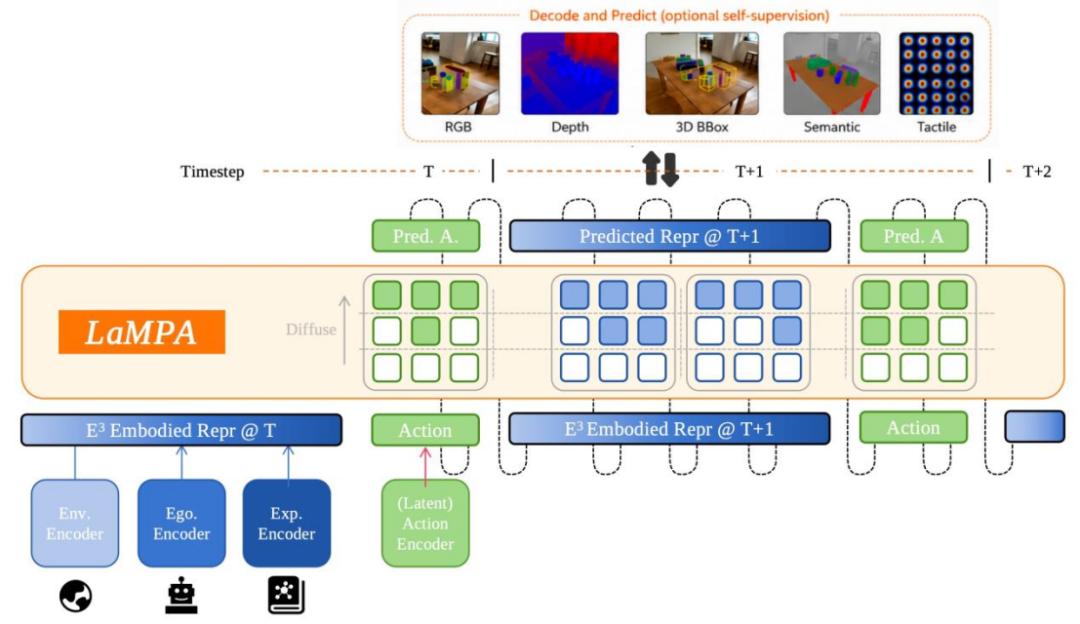
Focusing on this issue, CoronaMind has developed its own world model LaMPA. The first core innovation of LaMPA lies in the construction of a triple representation system oriented to the physical world.
Zhongyang Xiao explained that the reason why large language models can understand language is that they convert natural language into unified Tokens. Robots also need a "language" that can describe the physical world. LaMPA divides the information that robots need to understand into three categories. The first category is Environment Representation, which describes the positions, relationships, and spatial structures of surrounding objects. The second category is Ego Representation, which describes the robot's own state, including joint positions, force conditions, sensor feedback, and other information. The third category is Experience Representation, which is used to accumulate prior knowledge formed during the robot's long-term task execution, including basic object attributes and Affordance—for example, which parts of an object can be grasped, and what kind of operation sequences are usually adopted for different tasks.
The three types of information together form the Latent Space for robots to understand the physical world, which is then used by the foundation model to learn the causal relationships among the three, so as to predict future states and generate control actions for robots.
(Image source / Enterprise)
In addition to the representation method, LaMPA has also been redesigned in terms of foundation model architecture. The team adopted a Block Diffusion structure that is more suitable for world model training, aiming to balance inference efficiency while improving data utilization efficiency and model scalability, and reserve sufficient expansion space for subsequent large-scale training.
Apart from the foundation model, reinforcement learning is a critical link for robots to finally complete scenario delivery. Zhongyang Xiao said that many current reinforcement learning solutions rely on manual scoring. When scenarios change—such as changes in lighting, workstation layout, or environmental noise—it is often necessary to re-collect a large amount of data and perform post-training again, resulting in a long deployment cycle.
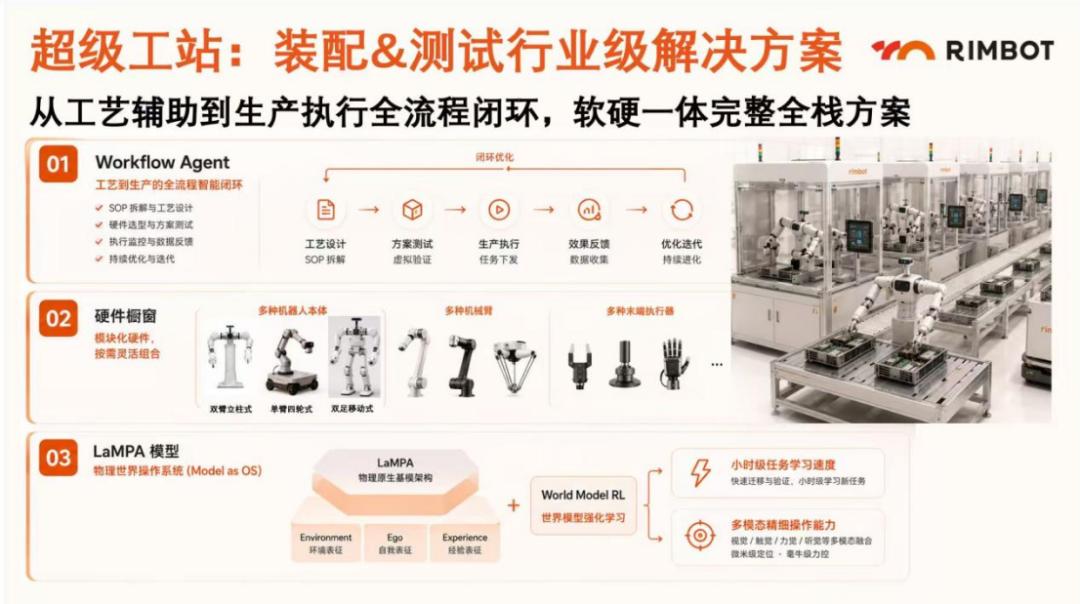
To address this problem, CoronaMind introduced a generalizable World Reward Model. Derived from the foundation world model, the foundation model can evolve into a dedicated "evaluation" model through distillation and post-training, which judges what is success and what is failure, providing stable and consistent feedback for reinforcement learning like a "critic". This allows the model to automatically judge action quality, greatly shortening the post-training cycle for new scenarios and accelerating the deployment efficiency in industrial scenarios.
It is understood that the company has reached a strategic cooperation with Future Chart, and will enter the high-precision industrial assembly scenario of server manufacturing. The company plans to start from the entire server manufacturing process, gradually extend to various pre-process and post-process procedures, and achieve cross-production line large-scale deployment across all scenarios.
(Image source / Enterprise)
In terms of data, CoronaMind adopts the strategy of "self-collection + crowdsourcing + model augmentation": on the one hand, it builds a self-contained accompanying data collection system to accumulate full-modal fine operation data with scenario barriers; on the other hand, it obtains high-quality, multi-scenario raw data through a data crowdsourcing platform to expand data distribution and reduce collection costs. In the data preparation stage, it uses world model-driven data augmentation (LCM) to further improve data utilization efficiency.
In the coming year, CoronaMind will focus on closing the data loop of the world model from scenario investigation, model training, on-site deployment to operation feedback, to achieve continuous model iteration.
In the long run, the company aims to continuously enhance Scaling capabilities around four dimensions: model, data, delivery, and business model, enabling the entire solution to be quickly replicated to more industrial scenarios and industries.
The following is an excerpt of the conversation between Hard Krypton and Zhongyang Xiao, Founder of CoronaMind:
Hard Krypton: How do you understand the relationship between CoronaMind's world model LaMPA and JEPA?
Zhongyang Xiao: JEPA is a very fundamental theoretical system proposed earlier, with many aspects worth learning and absorbing. We highly recognize its description especially of the latent structure. It emphasizes that the model should focus on the essential characteristics of things rather than being distracted by pixel-level and detailed information, which is very important for the development of world models.
Strictly speaking, CoronaMind's world model is a further extension based on this theoretical system. However, we did not first select a certain theoretical framework and then carry out technical implementation. Instead, we started from the question of "how a native world model should be constructed" to explore suitable methods. JEPA proposes an important direction that the model needs to learn a more abstract latent space, but it does not further answer how this latent space should be constructed. In addition, JEPA does not limit what kind of foundation architecture the model should adopt to understand and predict future states. Therefore, based on our own understanding of world models, we have explored a model paradigm more suitable for large-scale development.
Hard Krypton: The cooperation with Future Chart has been advancing rapidly. Why can the deployment from model to industrial scenarios be promoted so quickly?
Zhongyang Xiao: I think there are several main reasons. First, the model itself. Our world model and post-training system have good generalization capabilities, enabling rapid adaptation to new scenarios.
Second, the product-oriented thinking. We have attached great importance to productization since the very beginning of our entrepreneurship. What industrial customers need is not a robot replacing a single process, but a complete set of solutions that can be deployed quickly and operate continuously. We hope that after customers enter new scenarios, they do not need to rely on our engineers to stay on site for a long time, but can complete deployment through a small amount of post-training. In this way, what we deliver is not just automated equipment, but a "silicon-based worker" that can continuously learn and quickly adapt to different positions.
Therefore, what we provide is not just a model, but a standardized product, including the model, hardware, training system, and the Workflow Agent we proposed. It is responsible for connecting the model with the real production process, enabling robots to work in coordination with existing factory equipment, personnel, and production rhythms.
The cooperation with Future Chart is not just a customer-supplier relationship. Future Chart provides us with high-precision manufacturing scenarios such as server assembly to verify our solutions. At the same time, the two sides are jointly polishing industry-level solutions around the common needs and processes of assembly and testing, hoping to replicate this capability to more manufacturing scenarios.
Hard Krypton: CoronaMind previously released the world's first professional bimanual full-palm tactile operation dataset PalmDex from multiple scenarios. What considerations led you to open-source this dataset?
Zhongyang Xiao: The reason why we focus on full-palm tactile sensation is that we believe the understanding of force and tactile sensation is the cornerstone of fine manipulation, which is the most painful yet most valuable direction for current embodied intelligence. In addition, we believe that the development of world models will ultimately not rely on the data of a single company, but on the entire industry's data ecosystem. Compared with data volume, we pay more attention to data distribution. If a model only learns from a single scenario, its generalization capability will be limited no matter how much data there is; what is truly valuable is data covering different scenarios and tasks in industry, home, commerce, etc., which together form a rich data distribution.
The open-sourcing of PalmDex is based on such considerations. We hope to build an open data platform where governments, customers, data collection companies, and even individual developers can all become data providers and participate in the construction of the entire data ecosystem.
Secondly, one of the core capabilities of this platform is essentially the capability of data value discovery and pricing. As a model company, we are very clear about what data the model currently needs most, what data is already sufficient, and what data is still scarce. For truly scarce and high-value data, more reasonable incentives should be given to encourage more social resources to continuously participate in data collection. Only by forming such a market-oriented data supply mechanism can we truly achieve continuous expansion of data scale and data distribution, and ultimately promote the continuous iteration and generalization of world models.