Independently developed key materials for hydrogen energy catalysts, with a 50% improvement in stability. "Platinum Hydrogen Tech" completes tens of millions of yuan in Pre-A round financing | 36Kr Exclusive
36Kr learned that Suzhou Platinum Hydrogen Technology Co., Ltd. (hereinafter referred to as "Platinum Hydrogen Technology") announced the completion of a Pre-A round of financing worth tens of millions of yuan. This round of financing is led by Dongyun Venture Capital, followed by Xinhui Capital, and with additional investment from old shareholder Rongtuo Capital. The funds will be mainly used for the construction of new production lines for catalysts and membrane electrodes, as well as the expansion of R&D and operation teams.
Founded in May 2023, Platinum Hydrogen Technology focuses on the R&D, production, and sales of downstream products such as precious metal catalysts and membrane electrodes in emerging fields including hydrogen energy. Its product matrix covers two major categories: fuel cell catalysts (platinum carbon, platinum black, platinum-ruthenium black, platinum-based alloys, etc.) and water electrolysis catalysts (iridium oxide, iridium black, supported iridium oxide, iridium-ruthenium alloys, etc.), with more than 15 invention patents and utility model patents filed.
The company's head, Zou Liangliang, holds a doctorate from the University of Chinese Academy of Sciences, and currently serves as a professor and doctoral supervisor at Suzhou University of Science and Technology, with more than 10 years of experience in precious metal catalyst R&D. The core members of the operation team have long been engaged in project R&D and market expansion in the energy and materials sectors.
1. Solving Catalyst Efficiency Challenges Through Formulation and Structural Design Innovation
At present, China's hydrogen energy industry is at a delicate development juncture. On the one hand, according to GEP Research statistics, China's share in the global hydrogen fuel cell catalyst market will rise to 38.7% by 2026, reaching US$108.1 billion and making it the world's largest single regional market. Hydrogen energy has not only been incorporated into the national energy system by the Energy Law, but also listed as one of the six future industries in the 15th Five-Year Plan. However, on the other hand, the actual industrial demand has not kept pace with the capacity planning, and insufficient downstream orders have intensified upstream competition, continuously compressing the profit margin of the industrial chain.
In the hydrogen energy industry chain, catalysts are one of the core materials that determine the efficiency and cost of production systems. Among them, the essential precious metal raw materials such as platinum and iridium are in scarce supply and rely heavily on imports, making them the key to the localization and cost optimization of catalyst materials.
Zou Liangliang stated that Platinum Hydrogen Technology chose to enter the precious metal catalyst track, first based on its long-term accumulated technical expertise, and second, because it firmly believes that "precious metal catalysts will remain the mainstream choice in the hydrogen energy field for a long time to come."
Performance degradation and high cost are long-standing pain points for platinum-based catalysts during the reaction process. "This is mainly because platinum atoms migrate and agglomerate during the reaction, and the enlarged particles lead to decreased activity, deactivating the catalyst," Zou Liangliang explained.
To address this pain point, Platinum Hydrogen Technology enhances catalyst stability by regulating the structure of active particles. Compared with traditional platinum carbon catalysts, the Pt/C nanocatalysts from Platinum Hydrogen Technology can achieve a 40%-50% improvement in stability during durability tests, and the performance degradation after 30,000 cycles of accelerated aging tests is reduced by 10%.
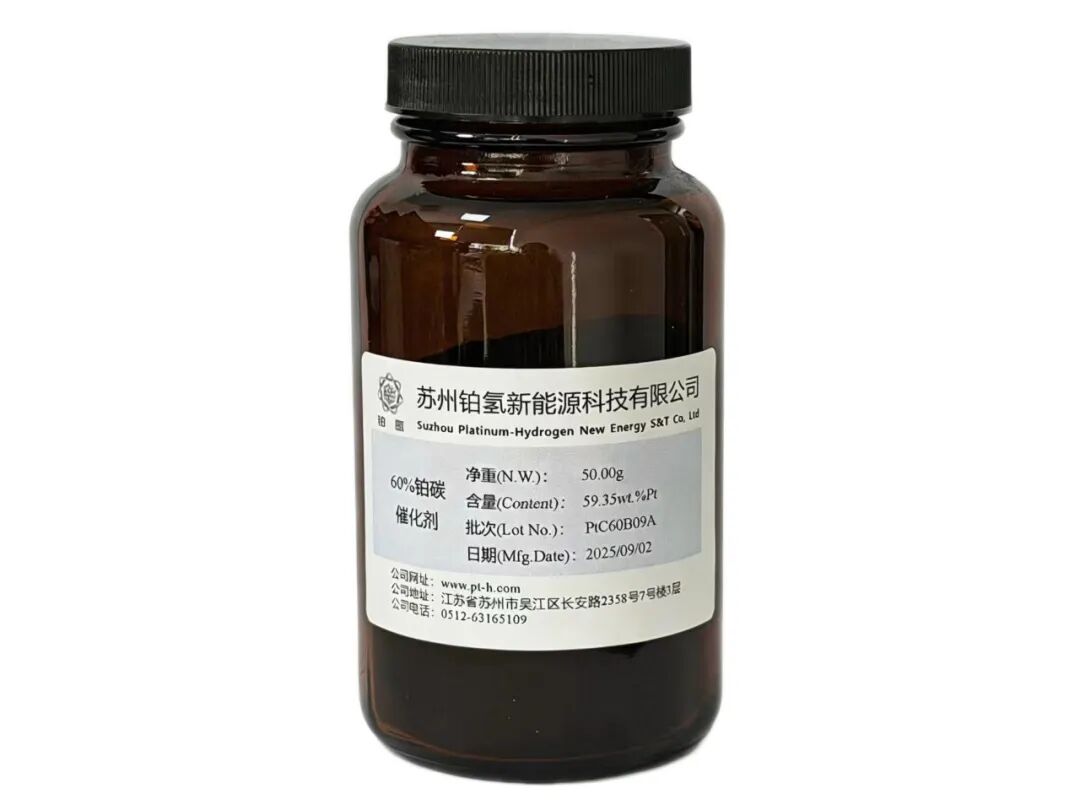
60% Platinum Carbon Catalyst from Platinum Hydrogen Technology
In addition, in the field of PEM water electrolysis for hydrogen production, Platinum Hydrogen Technology uses a "template method" to develop oxygen-rich nano-iridium oxide catalysts. By constructing a nanostructured template, it ensures that the catalyst particles always maintain a small size and uniform distribution, fully participating in the catalytic reaction. The precious metal consumption of this product can be reduced to 0.4mg/cm², which is one-third of the commonly used technology in the industry, the stack energy consumption is as low as 4.1kWh/m³, and the theoretical service life exceeds 80,000 hours.
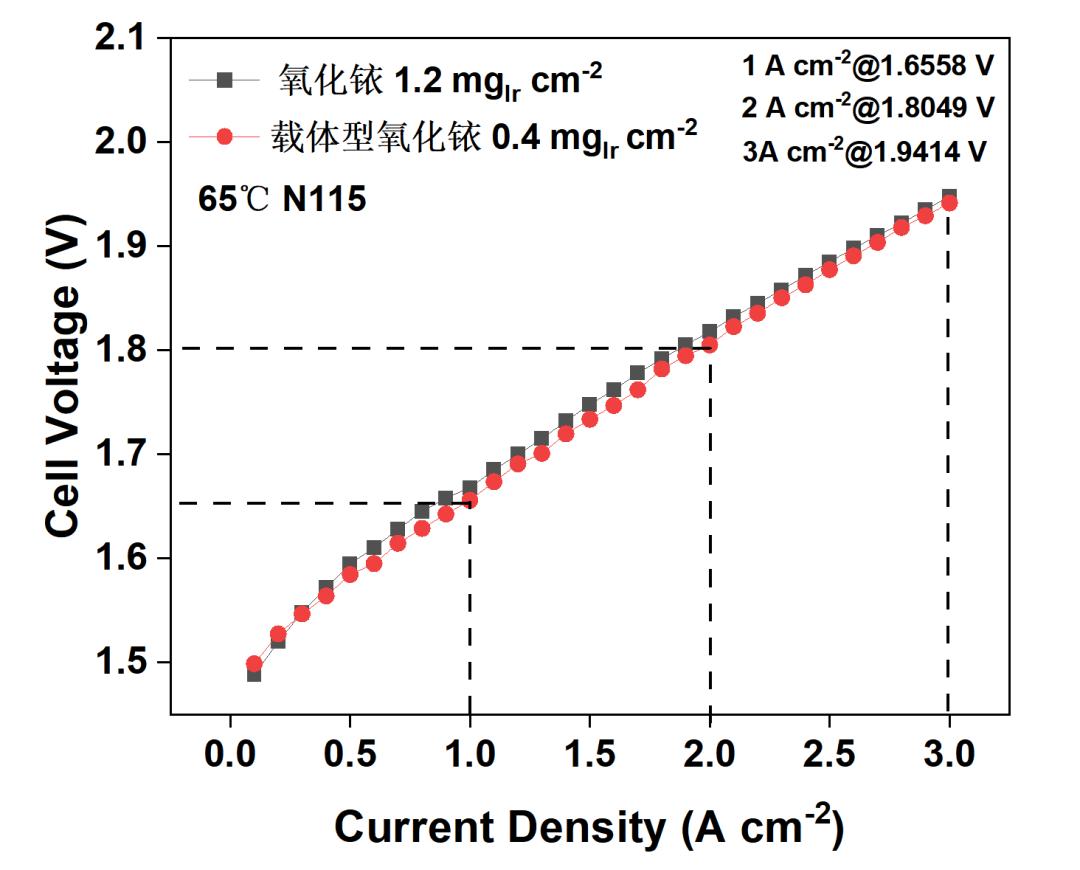
Performance Comparison Chart of Iridium Oxide
2. "Survive First, and Wait for the Opportunity"
In terms of commercialization, the direct customers of Platinum Hydrogen Technology cover fuel cell membrane electrodes, stack enterprises, as well as PEM water electrolysis hydrogen production membrane electrodes and electrolyzer manufacturers. The company has established cooperation with central state-owned enterprises in the energy, chemical, and fuel cell vehicle sectors such as China National Petroleum Corporation for hydrogen energy end applications, and formed horizontal collaboration with upstream and downstream partners in the industrial chain such as Kerun and Yunfan, to jointly provide customers with one-stop solutions from catalysts, membrane electrodes to stacks.
To reduce precious metal loss and lower raw material costs, Platinum Hydrogen Technology is also exploring recycling models for precious metal catalysts.
Zou Liangliang revealed that Platinum Hydrogen Technology achieved a revenue of 28 million yuan in the first half of 2026, and the full-year revenue is expected to exceed 40 million yuan.
On this basis, Platinum Hydrogen Technology plans to continue investing in R&D, launching 3-5 new market-competitive products every year, striving to double its revenue by 2027, serving more than 320 customers, completing the construction of two core production lines, and realizing large-scale and stable production of catalysts and membrane electrodes.
In the current industry cycle marked by rising prices of heavy metal raw materials and continuous involution in the upper reaches of the industrial chain, the short-term goal of Platinum Hydrogen Technology is not to blindly pursue scale growth, but to ensure that "when the industry opportunity arrives, we are still alive and fully prepared."