The first publicly listed surgical robot company acquires the leading orthopedic enterprise, bringing unprecedented competitiveness to the industry
Recently, TINAVI Medical Technologies, a leading domestic enterprise in the orthopedic surgical robot sector, announced a plan to acquire controlling equity in Shanghai MicroPort Orthopedics Co., Ltd. (hereinafter referred to as "Shanghai MicroPort Orthopedics") via share issuance, a transaction that is expected to qualify as a major asset restructuring.
This move has drawn widespread attention from the capital market. TINAVI holds a leading market share in China's orthopedic surgical robot market, while Shanghai MicroPort Orthopedics ranks among the top domestic players in terms of revenue scale. The strategic restructuring of the two enterprises marks a critical step in the industrial chain integration of China's smart orthopedics sector, which will exert a profound impact on the industry landscape.
This article analyzes the industry value and market significance of this restructuring from two dimensions: the core motivations behind the transaction, and the current development status and trends of the orthopedic surgical robot industry.
Core Logic of M&A: Building a Closed-Loop Ecosystem
As the "first surgical robot stock" on the Sci-Tech Innovation Board, TINAVI has been deeply engaged in the orthopedic surgical robot field for many years. Leveraging its core technological advantages and rich clinical application experience, it has firmly secured a position in the domestic industry's first echelon, with over 49,000 surgical procedures completed using its robots in 2025.
TINAVI's planned acquisition of controlling equity in Shanghai MicroPort Orthopedics is not a mere capital operation, but an inevitable choice aligned with the enterprise's long-term development strategy and industry trends. Its core motivations can be summarized into three major aspects, aiming to achieve multiple breakthroughs in business complementarity, model upgrading, and market expansion.
TINAVI's acquisition of Shanghai MicroPort Orthopedics signals its plan to create a closed-loop ecosystem integrating orthopedic surgical robots and implant consumables, shifting its focus from an open system to a closed system.
For a long time, the choice between a closed-system business model and an open-system model for orthopedic surgical robots has been a key concern in the industry.
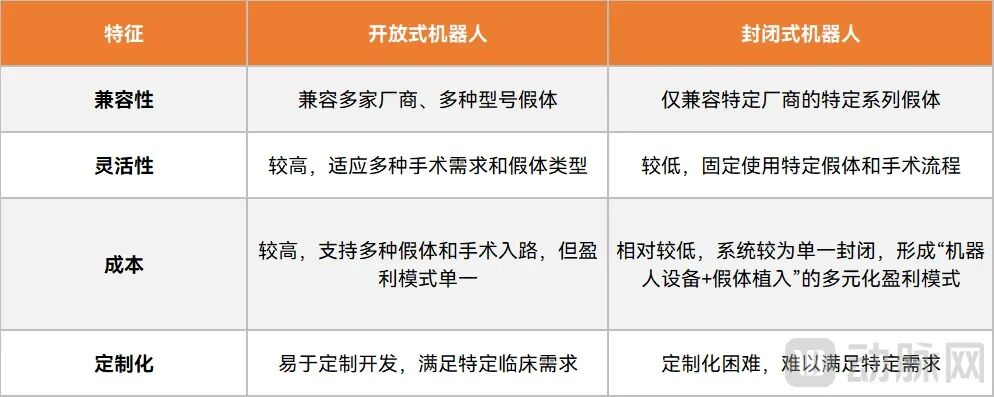
Comparison between Open and Closed Robots Data Source: White Paper on the Development of Orthopedic Joint Surgical Robot Industry
Most overseas orthopedic surgical robot enterprises are leading orthopedic consumables giants, and closed systems dominate the international market.
In contrast, almost all early domestic orthopedic surgical robots adopted open systems, as domestic orthopedic surgical robot enterprises operated independently from orthopedic consumables manufacturers, and an open system could be compatible with products from more manufacturers. TINAVI's products also chose the open system approach.
However, this long-standing industry practice is beginning to change. In recent years, more leading orthopedic consumables enterprises have entered the orthopedic surgical robot market, including Ak Medical, Chunli Medical, Sanyou Medical, Dabo Medical, and Weigao Orthopedics. These enterprises tend to favor closed systems. According to insights from Artery Think Tank, companies such as Natong, MicroPort Robotics, Chunli Medical, and Ak Medical have all prioritized compatibility with their own brand prostheses in the design of joint surgical robots.
As leading domestic orthopedic consumables manufacturers begin to launch integrated solutions, enterprises relying on open systems are put at a disadvantage, and their market space is inevitably compressed. Only by securing the supporting implant industrial chain can orthopedic surgical robot enterprises unlock greater development potential.
Improving the orthopedic product matrix to build a comprehensive solution of 'robot + implant + consumables + service' is exactly the core motivation for TINAVI's acquisition of Shanghai MicroPort Orthopedics.
As the core operating entity for MicroPort Medical's overseas orthopedic business, Shanghai MicroPort Orthopedics has over a decade of experience in the orthopedic field, with its main business focusing on the R&D, production, and sales of orthopedic implants such as hip and knee prostheses. It boasts a complete implant product matrix and millions of clinical implantation cases, with strong technical capabilities and a reputable product portfolio that are highly competitive in overseas markets.
Upon completion of this acquisition, TINAVI will formally fill its gap in orthopedic implants and consumables, evolving from a single surgical robot equipment supplier to a comprehensive solution provider covering "robot equipment + implant consumables + supporting services", and establishing a complete closed-loop ecosystem for orthopedic diagnosis and treatment. This ecological layout can better meet the one-stop procurement needs of medical institutions, enhance customer stickiness, and achieve technological integration through product synergy, providing more precise and efficient smart orthopedic diagnosis and treatment solutions for clinical practice.
M&A Drives Globalization of Products
Against the backdrop of increasingly fierce competition in China's orthopedic surgical robot market, expanding into overseas markets and tapping into global growth opportunities has become a key development direction for industry-leading enterprises.
While TINAVI previously held a leading position in the domestic market, its overseas market layout was still in the initial stage, lacking mature sales networks and market channels, and facing numerous challenges in its internationalization process.
Shanghai MicroPort Orthopedics is inherently global in its operations. The joint reconstruction business under Shanghai MicroPort Orthopedics' subsidiary Wright Medical has a history of more than 60 years, with products covering hip and knee implants and SuperPath minimally invasive hip surgical instruments. Its representative product, the medial-pivot knee prosthesis, has over 20 years of clinical application history, with more than 1 million cumulative implantations worldwide, boasting a solid clinical foundation and wide market recognition.
After years of layout, Shanghai MicroPort Orthopedics has established a mature and large-scale overseas sales network and customer system in developed countries and regions such as the United States, Japan, and Europe, maintaining stable cooperative relationships with numerous local medical institutions and distributors, and possessing in-depth understanding of overseas orthopedic markets' policies and regulations, clinical demands, and consumption habits.
The overseas orthopedic surgical robot market has broad room for growth, with a higher penetration rate of orthopedic surgical robots. According to IQVIA data, the penetration rate of orthopedic surgical robots in U.S. knee surgeries reached 34.0% in 2024, and 10% in hip surgeries.
Overseas orthopedic surgical robot products have also achieved remarkable commercial success. As of 2025, Stryker's star product, the "MAKO" orthopedic surgical robot, has been iterated to the fourth generation, integrating spinal and shoulder joint functions, with over 3,000 cumulative global installations and more than 2 million surgical procedures, effectively driving sales of its own prostheses.
Previously, the MicroPort Medical Group has verified the capability of driving surgical robot sales through implant channels in overseas markets. The overseas sales of MicroPort Robotics' Honghu orthopedic surgical robot have achieved steady growth, with cumulative global orders exceeding 65 units and cumulative commercial installations surpassing 50 units to date.
The rapid expansion of Honghu orthopedic surgical robot in overseas markets, as MicroPort Robotics stated in its annual report, is precisely attributed to the full utilization of synergies with the MicroPort Medical Group.
Through this restructuring, TINAVI will directly acquire Shanghai MicroPort Orthopedics' overseas channel resources and market experience, enabling it to quickly enter mature orthopedic markets in Europe, America, and Japan, and significantly shortening the overseas market expansion cycle. Meanwhile, leveraging the comprehensive product advantages of "robot + implant", TINAVI can better meet the overseas market's demand for high-end smart orthopedic products, enhance its international competitiveness, promote domestic smart orthopedic equipment to go global, and realize the leap from a "domestic leader" to an "international brand".
Breaking the Single Profit Model
From a business model perspective, orthopedic surgical robots are low-frequency, high-unit-price equipment products, featuring long sales cycles, high capital investment, and a relatively single profit model, making them vulnerable to fluctuations in industry policies and market demand.
In contrast, orthopedic implants and consumables are high-frequency, continuous consumer products. The demand for consumables during patients' post-operative rehabilitation is long-term, which can bring stable and continuous cash flow to enterprises, effectively balancing the cyclical fluctuations of equipment sales.
After the completion of this acquisition, TINAVI will realize the organic combination of "one-time equipment sales" and "continuous consumables and service income", optimizing its profit structure and enhancing the stability and sustainability of profitability. This business model upgrade will not only strengthen the enterprise's ability to resist market risks, but also align with the core operating models of international orthopedic giants such as Stryker and Johnson & Johnson, injecting new impetus into the enterprise's long-term performance growth.
Meanwhile, by integrating the R&D, production, and sales resources of both parties, the enterprise can also achieve economies of scale, reduce production and operating costs, and further enhance its profitability and market competitiveness.
Orthopedic Surgical Robots Enter a Golden Era
The restructuring move between TINAVI and MicroPort Orthopedics is essentially a microcosm of the rapid development of the orthopedic surgical robot industry and the accelerated integration of its industrial chain.
In recent years, driven by multiple factors including policy support, intensifying population aging, and technological iteration and upgrading, China's orthopedic surgical robot industry has entered a stage of rapid development, with continuous market expansion and optimized industry landscape, presenting a number of distinctive development features and trends.
Policies are accelerating the deployment of orthopedic surgical robots in medical institutions. In January 2026, the National Healthcare Security Administration issued a project initiation guideline, classifying surgical robot-assisted operations into four tiers: navigation, partial execution, precise execution, and remote surgery, implementing a coefficient-based charging model to guide the application of technologies in complex surgeries. Provinces including Hunan and Guangdong have taken the lead in publicizing charging standards, clarifying the surcharge levels and upper/lower price limits for each tier. These policies have cleared the final barrier for surgical robots to enter medical institutions.
Driven by both policies and market demand, China's orthopedic surgical robot market has grown rapidly. According to MedRobot statistics, the sales volume of orthopedic surgical robots in China in 2025 was no less than 168 units (compared to 94 units in 2024), with the statistical scope covering "public bidding data from domestic public hospitals + domestic sales data from some domestic manufacturers through other channels + overseas sales data from some domestic manufacturers".
At present, China's orthopedic surgical robot industry has formed a competitive landscape of "leading enterprises driving progress with breakthroughs across multiple players". As the first domestic enterprise to achieve commercialization of orthopedic surgical robots, TINAVI, leveraging its advantages in technological accumulation, clinical data, and market channels, holds a leading position in the fields of spinal and joint surgical robots, with its market share ranking first in the industry. In addition to TINAVI, domestic medical device enterprises such as Tuodao Medical, MicroPort Medical, Weigao Group, and Sanyou Medical have also entered the orthopedic surgical robot sector, launching related products through independent R&D and cooperative R&D, and gradually forming a competitive market.
From the perspective of industry development trends, industrial chain integration has become a key path to enhance the core competitiveness of enterprises. The orthopedic surgical robot industry involves multiple fields such as robotics technology, medical imaging, orthopedic implants, and clinical diagnosis and treatment. No single enterprise can form absolute advantages in all links. Therefore, enterprises in the industry are actively integrating upstream and downstream industrial chain resources through M&A, restructuring, and strategic cooperation, to achieve synergy across technology, products, and channels.
TINAVI's acquisition of controlling equity in Shanghai MicroPort Orthopedics is a typical manifestation of the industry's industrial chain integration trend. In the future, with intensifying industry competition, it is expected that more enterprises will improve their product layouts and enhance their overall strength through industrial chain integration, further increasing industry concentration and amplifying the advantages of leading enterprises.
From an industry-wide perspective, this restructuring not only reflects the industrial chain integration trend of the orthopedic surgical robot sector, but will also promote technological integration and product upgrading in China's smart orthopedics field, helping domestic high-end medical equipment enter the global market.
References:
White Paper on the Development of Orthopedic Joint Surgical Robot Industry — Artery Think Tank
Domestic Market Growth and Overseas High-End Breakthrough: The Golden Era of Orthopedic Robots Has Arrived — Northeast Securities
This article is from the WeChat Official Account "Artery Network" (ID: vcbeat), written by Yang Xue, and authorized for release by 36Kr.