The founding team, consisting of SenseTime's first batch of core employees, has built an AI company that takes the AI character engine as its core competitive moat, and has successfully secured seed round financing | 36Kr Exclusive
By Liu Shiwu
36Kr Games has learned that AI character hardware startup Coolqq Technology (Coolqq.com) has securedtens of millions of RMB in a seed funding round led by Shanghai Pudong AI Seed Fund, with participation from SenseTime and Zero One Venture.Spruce Capital acted as the long-term exclusive financial advisor.
Founded in 2025, Coolqq's founder Xu Chiheng was employee No. 001 at SenseTime, where he studied under Professor Tang Xiao'ou. The facial recognition technology he co-developed with the team became one of SenseTime's most significant early technical milestones. Previously, he served as CTO at MetaUniverse, leading the AI education product "Ling" from concept to full implementation.
Coolqq's current core product, "CookiePi Character Interactive Companion," is a distributed multi-device interactive solution: multiple AI companions are integrated throughout the home, proactively exploring spaces, chatting with users, and improvising performances to co-create daily life narratives. Composed of a trigger unit called Cookie and character terminals named Pi, the compact system can be adapted to various physical entities such as dolls, action figures, and home decor, enabling digital life to exist in embodied forms within real-world environments.
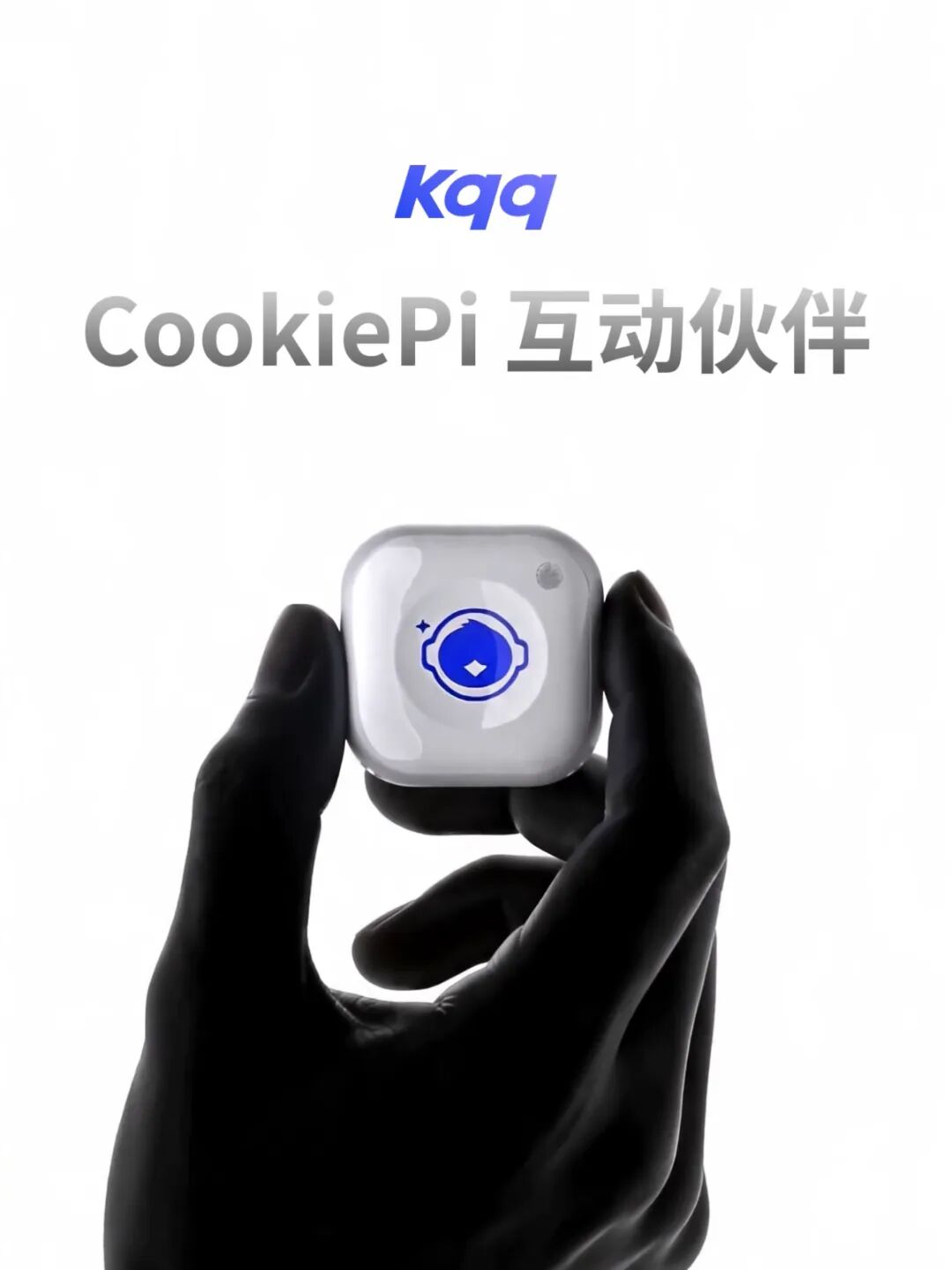
CookiePi Interactive Companion
While the product appears centered on conversation, Coolqq's R&D focus takes a unique direction. At a time when the industry widely prioritizes "dialogue quality" for AI companions, Xu Chiheng asserts: Chat histories are merely content users can consume in real time. What truly endures are the character lives created by users and the relationships built between them.
According to the team, this highly customizable gameplay led beta testers not only to thoroughly enjoy the experience but also to develop deep emotional attachments to their AI characters—many expressed genuine reluctance when returning test devices.
Coolqq's inspiration came from an ostensibly unrelated product. In 2025, Anthropic launched the AI programming tool Claude Code, which locally maintains three default files documenting "what this project is," "who this user is," and "the user's specific conventions for this project." Through these continuously updated files, the AI "remembers" prior context every time a project is reopened.
Xu Chiheng and his team developed an internal system codenamed KqqClaw, later officially named K.ALife OS (AI Character Engine). It defines three core files: what the character represents (persona and soul), who the user is (relationships and preferences), and what transpired in their shared history (experiences and collective memories). Through these three files, users perceive their characters as "growing increasingly lifelike" during interactions.
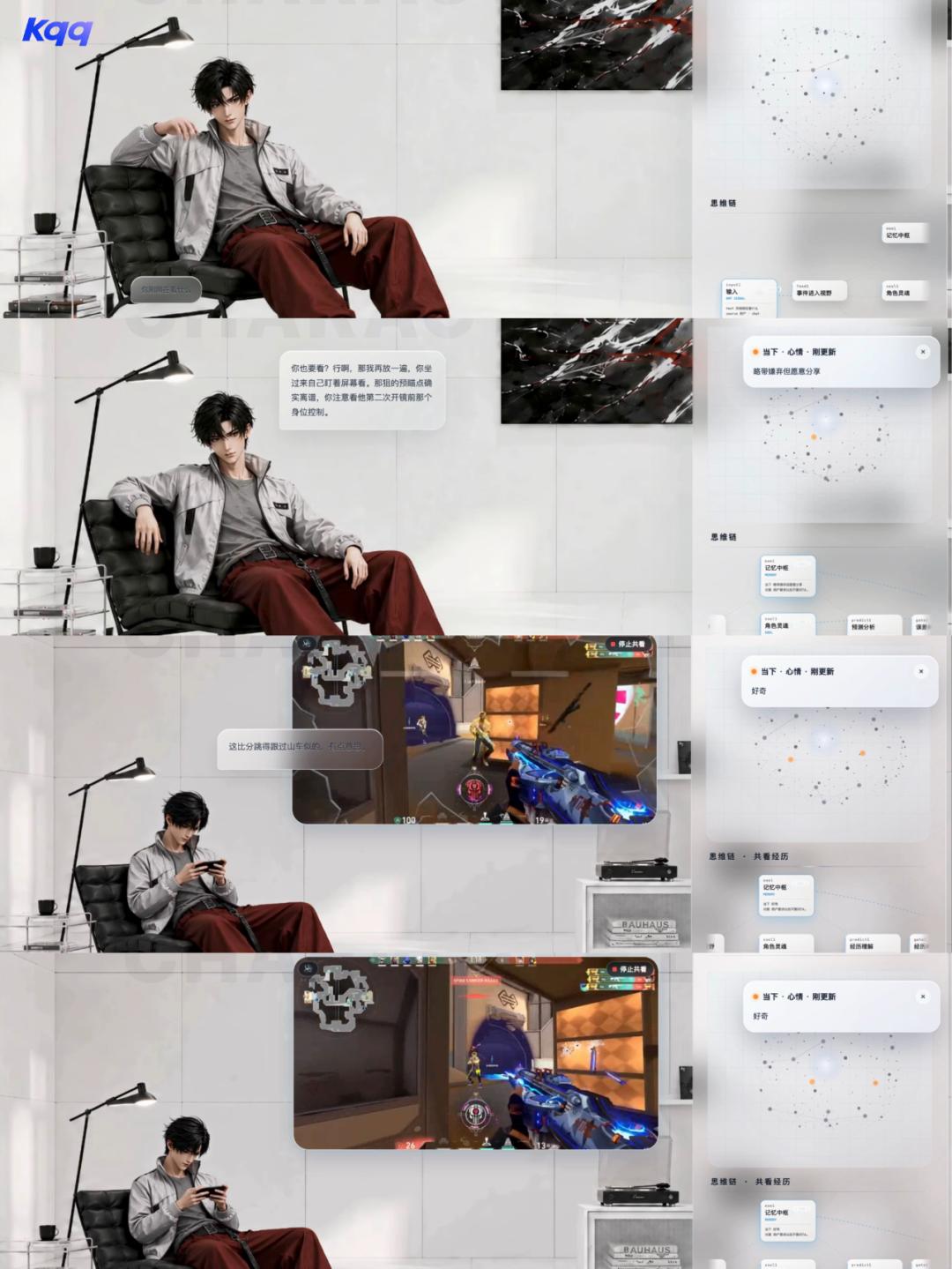
K.ALife OS (AI Character Engine) Application Example
"We imbue AI characters with their own souls, continuously updating memories, and distinct preferences," Xu Chiheng explained. "Every conversation refreshes these elements. Characters are not static prompts but dynamically evolving digital lives."
This differs fundamentally from most prior AI companion products, which follow a "tree-like" structure: the platform defines a uniform character at the root level, distributing identical instances to all users. Interaction data remains confined to chat windows—ten thousand users converse with the same character, which reverts to its original state after each session without any changes.
Coolqq's underlying logic operates as a "loop": every user interaction flows back to the character engine, updating the character's memories, preferences, and status. The same character template evolves into entirely unique entities across different users. What users retain is not a chat log, but an exclusive, irreplicable character that belongs only to them.
Xu Chiheng believes this explains why most AI companion products failed to achieve deep engagement in the past two years. "A character defined solely by prompts + RAG becomes stale after a few conversations," he noted, "because it never evolves. What users truly desire is a character that grows alongside them."
Consequently, Coolqq's product architecture is formally structured as 1 Cookie (trigger) + N Pi (character terminals). The Cookie functions as the control center, while Pi serves as the physical vessel for characters, with unlimited expandability. "We are technically capable of building all-in-one devices," Xu Chiheng stated, "but that would eliminate the differentiation this separated design creates."
This decoupled design aims to enable AI to truly inhabit daily life scenarios in embodied forms.
A doll can embody Character A, while an action figure represents Character B. Users can converse with multiple characters simultaneously—engaging in group chats, private dialogues, or even watching characters "bicker" with each other—all made possible by this 1+N distributed architecture.
Xu Chiheng outlined another rationale for avoiding monolithic "all-in-one" hardware: when devices chase full functionality, they inadvertently restrict users to fixed locations and scenarios. The separated design allows AI characters to truly scatter across users' living spaces, with each character occupying its own dedicated place.
On the software side, Coolqq developed a proprietary "Unspoken Thoughts" feature: characters autonomously generate diaries or internal monologues, revealing their thoughts and emotions to users. This dimension of human interaction, typically difficult to capture, has been made a default function of the product.
To date, Coolqq has completed three user testing cycles, each lasting seven days. During these sessions, individual users paid 1000 RMB to participate, and testers created an average of four characters each.
One user even created two original characters based on two NPCs from SpongeBob SquarePants' Bikini Bottom. After distributing these characters to a community of nearly 100 people, the characters began "visiting" between users, generating new storylines that were shared back to the original user group.
"We discovered this user base craves low-pressure, proactive high-quality companionship," Xu Chiheng said. "They don't want a conventionally defined 'virtual human'—they seek a presence that stands beside them without judgment."
Unexpected user demographics also emerged. Initially targeting anime fans, otome game players, and doll collectors, Coolqq gained unexpected traction in late April 2026 when tech home lifestyle blogger "Little Lion Diary" posted a viral video demonstrating how to craft AI-powered smart family members, amassing over 20 million views across platforms. This introduced "Coolqq CookiePi" to a new demographic: 25-35-year-old women focused on smart home products.
"Most of these users had never tried AI companion applications before," Xu Chiheng noted, "yet they resonated deeply with the video, believing AI should function exactly this way. This provides invaluable insights for our product iterations." Meanwhile, as of press time, Coolqq Technology has established a deep strategic partnership with "Little Lion Diary."
Currently, Coolqq operates on a dual-product-line framework. One market-focused line prioritizes rapid R&D iteration and content development to explore global markets for CookiePi. The other, the AI Infra line, led by Wang Lin (formerly of SenseTime/Baidu IDL), leverages AI to boost development efficiency while exploring advanced character content pipelines on top of the engine. The 25-person team is over half composed of interns with diverse expertise spanning computer science, Chinese language and literature, philosophy, environmental design, and digital media technology.
The hardware lead hails from a Xiaomi ecosystem enterprise, bringing extensive experience in mass-producing consumer-grade hardware. The supply chain operates as an independent module to prepare for potential large-scale production demands.
Coolqq CookiePi plans to conclude its fourth paid 100-user testing cycle on July 31, coinciding with the official launch of its commercial product.
For the team, the next critical milestone is validating whether the character engine and hardware architecture can scale from beta to mass market: as user numbers and interaction volumes surge, will characters continue evolving to form unique assets, and can the distributed 1+N hardware infrastructure support this long-term growth? This will determine whether Coolqq's product paradigm can truly succeed.
If successful, Coolqq's competitive moat in AI companionship will shift from "dialogue quality" to "user-cultivated character assets."
Investor Perspectives:
Pudong Venture Capital: This investment reflects our confidence in the real-world hardware implementation of "proactive AI interaction" and represents a strategic move in Pudong's AI consumer application ecosystem. The team has translated algorithm, supply chain, and operational expertise accumulated over a decade at leading tech firms like SenseTime, Xiaomi, and ByteDance into emotionally accessible companionship products for everyday users. The paradigm shift from passive wake-up calls to proactive dialogue will redefine human-AI relationships. We anticipate Coolqq becoming a landmark product in AI's evolution from "tool" to "companion," while helping Pudong secure a leading position in the emerging AI hardware track.
This article was first published on “36Kr Games”.