Post-2000s generation speculates on memory chips: Going through the mental journey that veteran investors take ten years in just one month
The memory sector, which just experienced an epic bull run, has suddenly descended into a state of widespread panic and despair.
A leading chip firm's 1099% projected earnings growth only resulted in a nearly 8% single-day decline; even component manufacturers were caught in the downturn, either hitting the 10% daily limit down or plummeting sharply. The profits accumulated little by little in the first half of the year were completely wiped out in just over ten days amid pullbacks of 30% to 40%.
However, while veteran investors are hurriedly cutting their losses and exiting the market, a group of post-2000s investors say they are "keeping their cool".
During the sharp rally, some of them made 170% returns, netting 170,000 yuan on a single stock; others entered the market just one month ago and grew their 30,000 yuan principal to 7,000 yuan in floating profits; even those who only invested spare cash in funds earned enough to cover several months of living expenses.
When the crash hit, they either exited completely or "stayed the course" with firm conviction, neither deterred by South Korean ETF circuit breakers nor swept up in the panic caused by Changxin Memory's IPO fundraising — and of course, the most critical point is that they haven't started losing money yet.
Below are their investment stories.
Two rounds of trading in memory stocks, netting 170,000 yuan in floating profits
Leek, 22 years old
With a principal of 75,000 yuan invested over three and a half years, my total return has exceeded 480%, and my most successful trade was in memory stocks, with roughly 170,000 yuan in floating profits.
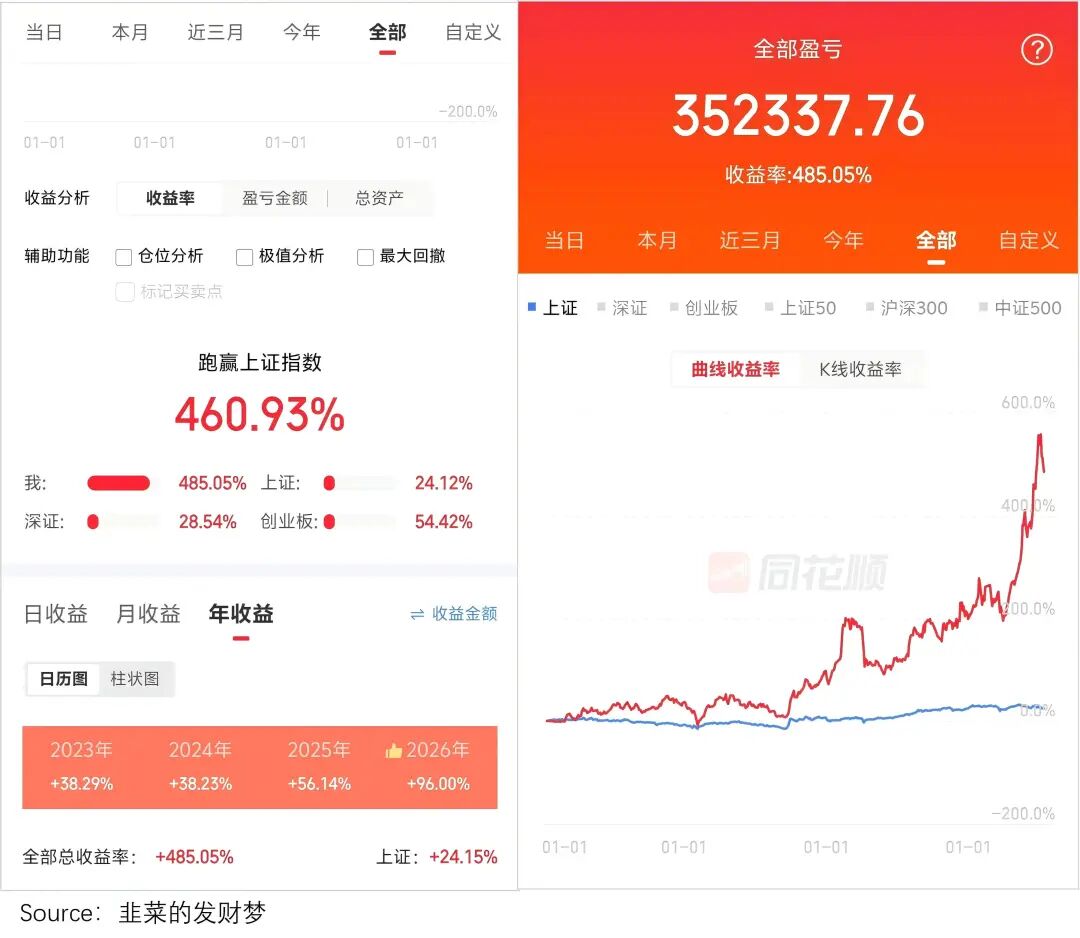
My attention to the memory sector started last year with the news that "SK Hynix's DDR5 prices doubled and still couldn't meet demand". This made me, who prefers investing in companies with low valuations and high technical barriers, sense an opportunity and take a position in a target firm.
It was the only domestic enterprise producing HBM wafer defect inspection equipment, deeply tied to SK Hynix, with its stock price at a low level — theoretically a perfect buying opportunity. But I overlooked that its shipment volume was too small to support earnings expectations. Combined with the impact of tariff wars, my holding only returned 10% after half a year, and I ended up selling in a hurry, missing the massive market rally in the second half of 2025.
I also missed out on a leading domestic chip stock: I bought it at 80 yuan per share, but when it rose to 200 yuan, I feared the high price and avoided it, only to watch it surge toward 300 yuan. I finally realized that I was overly focused on technical barriers, but in reality, industry leaders are the ones who reap the biggest gains during market booms.
After adjusting my mindset, I kept waiting for an entry point. In February this year, the three global memory giants exited the low-end market, and this leading firm perfectly filled the gap in the niche memory market, which boosted my confidence.
I finally decided to act after the first-quarter earnings report, when the company secretary implicitly confirmed that full-year profits would be four times the first-quarter figure. Compared to its 250-yuan stock price at the time, its P/E ratio was only in the 20s, making it "severely undervalued". I acted decisively, putting half of my total position, 100,000 yuan, into it.
Little did I know that holding the position would be the real test.
After the US-Iran conflict broke out, my account temporarily suffered a 10% floating loss. From March to April, component manufacturers rallied one after another, but this original equipment manufacturer's stock stayed range-bound — while others feasted, I could only pick up crumbs. Then came senior executive share reductions, with overwhelming bearish posts on stock forums claiming the products lacked technical value.
It would be a lie to say I wasn't nervous, but recalling my original investment rationale, I chose to ignore the noise and hold firm. The market didn't let me down: I fully captured a major uptrend in May; during the early June consolidation, I again held steady, selling half my position on the daily limit up, pushing my total account value to a new high of 400,000 yuan.
However, I sold at 610 yuan, which turned out to be a premature exit, and I re-entered at 620 yuan later. This time I only allocated one-third of my capital, since the stock was already very expensive, and mobile and PC manufacturers were dissatisfied with memory price hikes, while the data center market remained out of reach — there's still a long way to go.
During these past few days of independent market movements in A-shares, I'm glad I reduced my position in advance, but I still feel bad about the losses. Yet I will continue to hold firmly: most people around me lose money because they trade too frequently, always trying to sell high and buy low — that's speculation, not investment.
My account has been in the red for half a month, but I'm confident in my strategy
Tiancheng Yitu, 22 years old
In the first half of July, my account was only in the green for two or three days, and the over 10,000 yuan I earned in June is almost gone, but I'm not panicking.
In March this year, I officially entered the market with 10,000 yuan in savings. The reason was simple: as a finance student, no matter how high my scores were in classroom investment simulations, nothing beats putting real money to work in the actual market. That proved true immediately — I ran into a broad market correction right after entering, losing 10% of my principal in no time.
The taste of losses was unpleasant, forcing me to reflect: since I don't have exceptional stock-picking skills, I should invest in index funds like the STAR 50 to stabilize my position. If I'm confident in the sector I've chosen, I'll add positions on dips — buy heavily on big drops, moderately on small ones, to bring down my cost basis.
On a macro level, I avoided popular sectors like innovative drugs and lithium mining, and focused on technology. After researching the entire upstream and downstream chains of semiconductors, optical modules, and memory, I slowly grew my returns to 18% over two months.
Then I made a decision: add another 50,000 yuan.
At that point, the sector was already struggling to rally, but I thought about the long-term logic behind domestic chip substitution, CPO optical module computing infrastructure, and AI application rollouts. The consolidation was actually a chance to accumulate shares at lower prices.
But after I added half of my planned additional position, a new round of sharp declines hit, and my account return plummeted directly from 22% to 1.22%. Many online investors couldn't take it anymore and bailed out, but I refused to give up — the earnings logic hasn't changed, the policy environment hasn't changed, only market sentiment has.
I gritted my teeth and added more positions, centering my portfolio on semiconductor equipment, using CPO for steady returns, targeting ChiNext-listed AI stocks for extra gains, and holding STAR 50 as a defensive layer. Finally, in mid-June, the technology sector staged a major uptrend that lasted more than ten days, pushing my returns back to 21%.
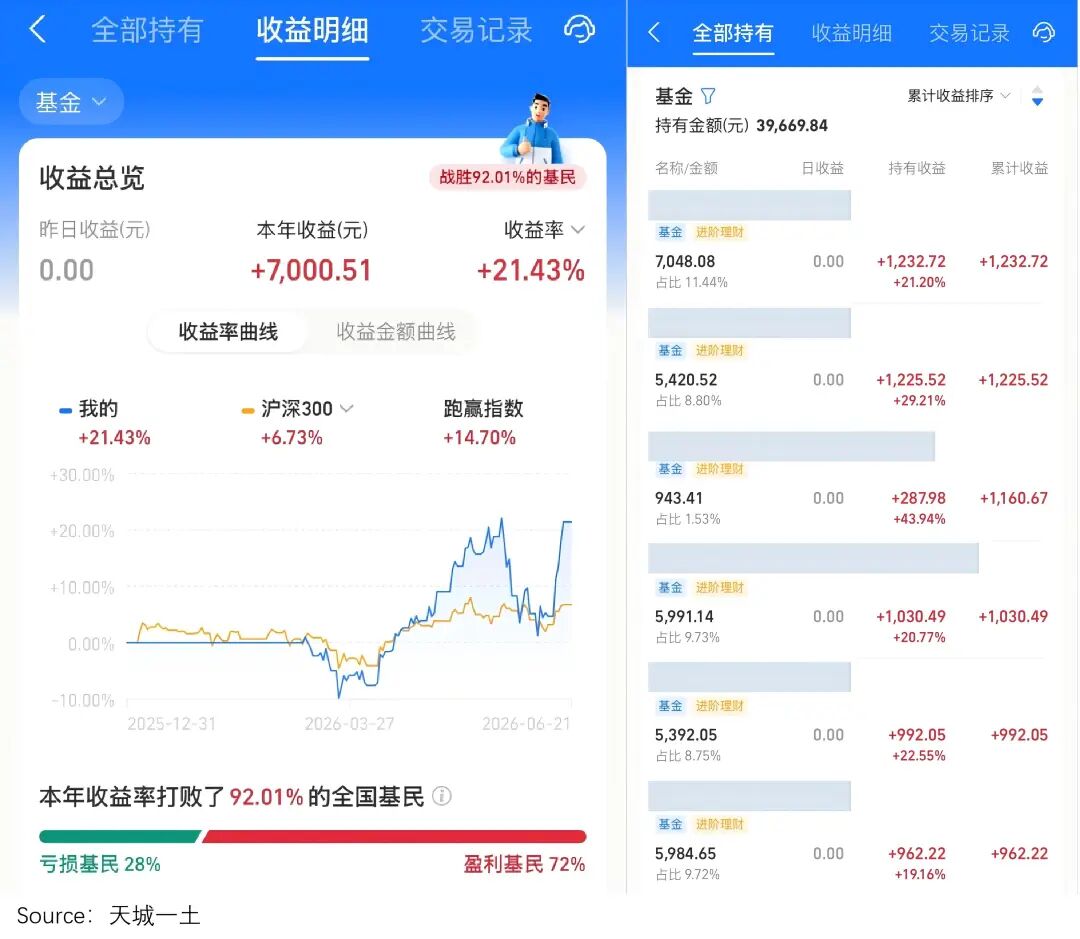
After experiencing two rounds of extreme ups and downs, I've come to understand the nature of the technology sector. It can stay in the red for half a month, but the two-day rebound afterward is extremely sharp, enough to erase all prior losses. That's why I stayed calm during the July decline, keeping my entire position in the market. In my view, large institutional investors who made enough profits in the first half are looking to exit, while new incoming funds want to push prices lower to buy at a better cost — retail investors just need to follow the trend.
But I've learned to be more cautious now. 60,000 yuan is no small sum for a college student, and watching semiconductor returns drop from +20% to negative was very stressful. Looking back, if I had taken profits at the late-June peak, I would be in a much more comfortable position now.
So I'm not adding any more principal, and I'm focusing on figuring out when to sell. I force myself to review my positions once a week, liquidate underperforming funds, and reallocate capital to stronger-performing assets.
At the end of the day, investment isn't about who's the bravest — it's about who can control their greed during rallies, and control their hands during crashes.
Lessons learned from gold investments helped me escape the memory sector crash
Can You Give Me 60? Not a Cent More, 23 years old
My first lesson in high-risk investing, which went from +30% to -30%, came at a very steep cost.
I'm no newcomer to the stock market — I started investing when I interned at a fund firm during my sophomore year. But as an extremely risk-averse person, I only dared to buy bond funds and time deposits that offered slightly higher returns than Yu'E Bao and Lingqian Tong. I stayed in this comfort zone for two to three years, earning a small amount of startup capital.
Last year, after starting graduate school, I suddenly wanted to try something new, and allocated a small portion of my capital to test gold investments. I caught a major rally at the beginning of the year, with returns peaking at 30% — a world apart from the 2% to 3% returns I got from bond funds before. Unfortunately, I was too caught up in the excitement to take profits, holding all the way until April, when I ended up with huge losses.
After this harsh lesson, I started studying like crazy, reading online trend analyses and market commentary every day. I followed two reliable financial bloggers to invest in commercial aerospace and lithium mining, earning 11% and 20% respectively right after entering. But greed got the better of me again — I held until the end of May without selling, ending up with 16% and 8% losses.
By then I was completely numb from losses, so when the blogger said with absolute certainty that "the main market theme in June will be memory", a glimmer of hope sparked in me. I checked other analyses, and everyone from the US to South Korea was talking about computing power and AI, which made the logic make sense. I thought to myself: holding my current positions is just losing money, so I might as well shift to the technology sector.
After moving to memory stocks, the market kept falling, making my already dismal account even worse. I refused to give up, adding positions until my total investment reached 14,000 yuan. Every time I added more, I swore at myself: "Never buy again — I'll sell as soon as I break even."
But in investing, you always think you bought too much when prices are falling, and too little when prices are rising. Before the Dragon Boat Festival, my returns on memory stocks rebounded from -10% to 2.3%. I wanted to sell, but seeing optical modules, CPO, and PCB stocks all rally 30%, I thought those 2 percentage points of returns were too little to justify exiting, so I decided to wait a bit longer.
During that period, the memory sector went crazy, gaining nearly 1,000 yuan in a single day, and my floating profits quickly climbed to 5,000 yuan. The thought of liquidating crossed my mind again — I would be busy with campus recruitment in the second half of the year, with no time to monitor the market. But when the blogger said "you have to wait at least until the mid-year earnings reports in mid-July", I decided to hold my position.
Then came July, and the consecutive declines began. On that epic crash day on July 2, my account lost 1,600 yuan in a single day, and the nightmares of my gold, aerospace, and lithium mining investments flashed before my eyes. This time, fear overcame greed, and I sold everything I could. With the memory sector plummeting across the board recently, I looked back at the market trends and realized if I hadn't exited back then, I would have suffered several more percentage points of losses — I felt a wave of relief that I got out in time.
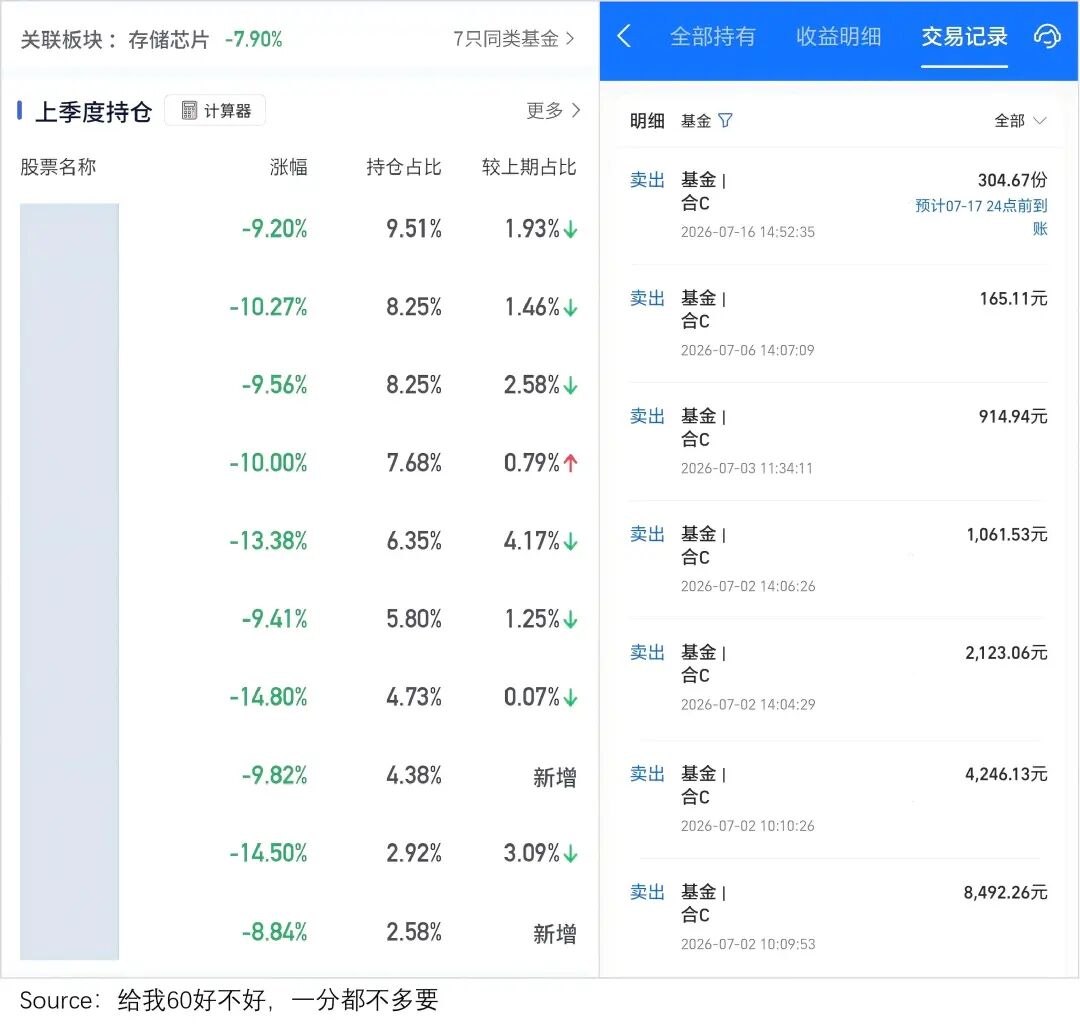
I used to be a firm believer in long-term investing, thinking I should hold funds for decades. Now I understand that in A-shares, you have to take profits when you make them. Once the market stabilizes, I might re-enter, but I won't lock myself into a single sector anymore — I'll follow wherever there are profits to be made.
After being burned by AI investments, I turned around to earn 50% cumulative returns in a year
Xiao Bao, 21 years old
Right after I started investing in funds, I fell into a trap set by AI.
As a total beginner, I didn't even know how to select funds, so my first instinct was to ask AI. I followed its recommendations for over a month, but my account was mostly in the red, with very few green days. I realized something was wrong, so I checked historical performance and trend charts, only to find that the AI recommended broad-based indices like CSI 300, which have too many mixed components, rising slowly but falling sharply.
Even more absurd, the data cited in the recommendation rationales for three or four of those funds couldn't be found in their official announcements at all — they were completely made up by AI! Suffering such a big loss right at the start was frustrating, but I didn't panic too much, since my principal was only 500 yuan, so I couldn't lose that much anyway.
Little did I know the real blow was still waiting for me.
I remember very clearly, on the day of the "global stock market crash" on April 7, I had no classes in the afternoon, and when I woke up, everything had collapsed: with 700 yuan in principal, I lost more than 100 yuan in a single day. I was completely stunned by such a severe pullback that I had never experienced before, and thinking about my previous floating losses, I was filled with regret.

My friends who invest advised me to pause first, figure out what was really happening in the market, and stop making blind trades. After that, I took a nearly one-month break from the market, systematically learning the basics of fund investing, tracking industry trends every day, and studying price hike cycles and sector rotation patterns.
Gradually, I completed the cognitive shift from "trading based on intuition" to "understanding market fluctuations", and established my own trading rules: focus on short-term trades, sell when prices hit my target level, add positions in batches during dips, and review my performance every week.
Last May, as market