Will agent smartphones make a comeback in shackles?
Some trends can be delayed, but never reversed.
In December 2025, the first-generation Doubao smartphone was released in a limited batch of 30,000 units, selling out on the first day and reaching its peak right at launch.
Unlike the various AI-branded smartphones on the market at that time, the core selling point of the Doubao phone was that AI could operate the device on behalf of users, cross-app price compare, check logistics across multiple platforms with one click, and automatically organize files. On December 5, ByteDance announced it would suspend AI automatic operations for scenarios including financial services, internet payments, and game score boosting, effectively crippling the Agent feature overnight.
A smartphone was targeted and suppressed in less than five days after its release.
But seven months later, this "deceased smartphone" is becoming the most compelling narrative in the smart hardware industry.
Right before this year's WAIC, smartphones centered on the Agent concept quietly entered the market. Step Star launched the world's first native large-model agent smartphone brand, Honor unveiled its Agentic OS framework, and nubia released its second-generation Doubao AI agent smartphone as its core strategic flagship. The concept of "agent smartphones" is rapidly becoming a new consensus across the mobile industry.
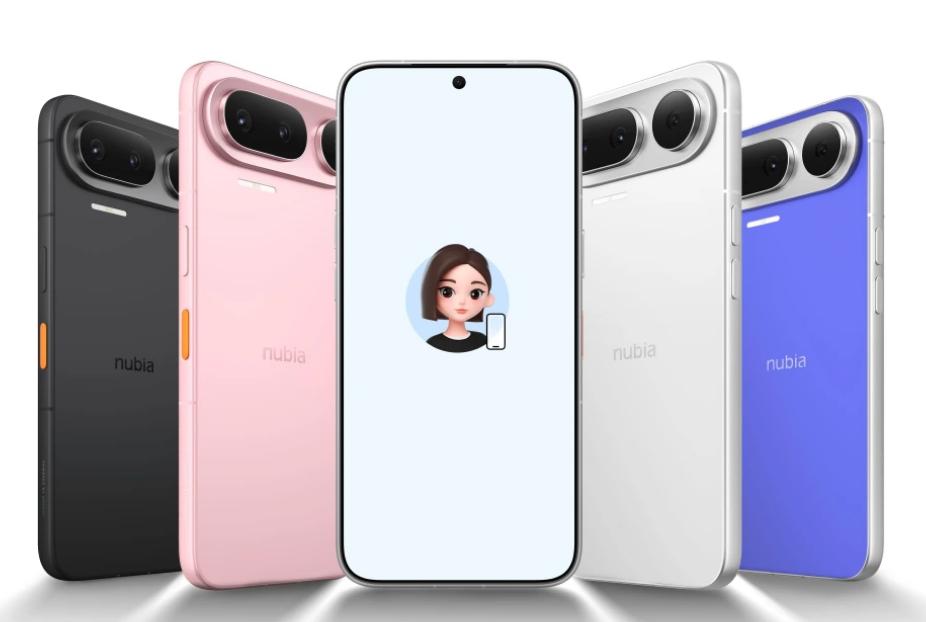
So will the new generation of "Doubao smartphones" be better than the 1.0 version?
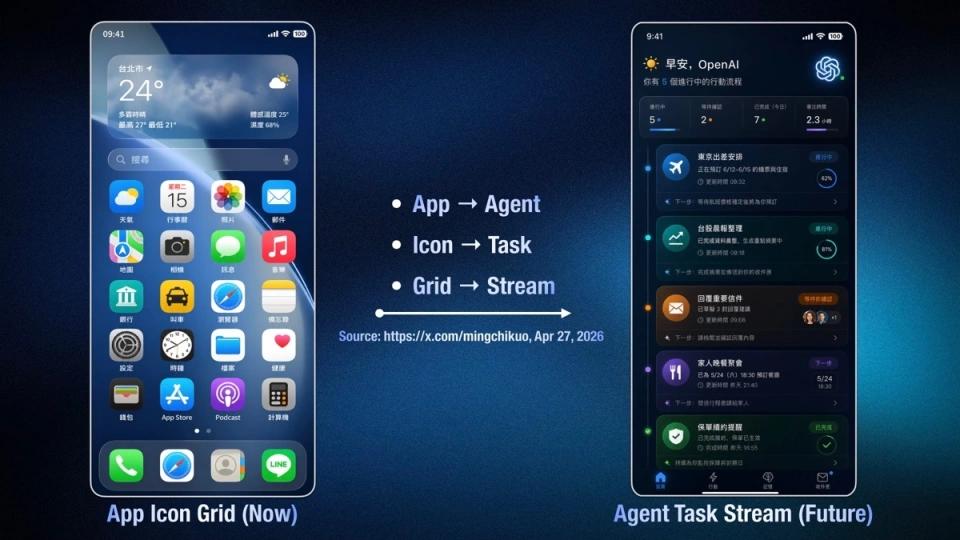
This question is surprisingly difficult to answer. Because when AI truly starts "viewing the screen, making decisions, and executing operations on behalf of users", it is not just hitting technical bottlenecks, but challenging the entire power structure of the mobile internet era. If an Agent can bypass app homepages, advertisements, search rankings, and payment funnels to directly deliver final user actions, it poses a structural threat to all platforms that rely on traffic monetization.
Now, the second wave of players has returned. They are smarter and more cautious, but the fundamental conflict between AI and the application ecosystem has not disappeared. The more powerful the Agent capabilities become, the more they need to bypass or restructure the existing app ecosystem; yet approaches that show more respect for the existing ecosystem only deliver underwhelming, unremarkable performance.
But will consumers buy into this new smartphone concept?
There are still opportunities, rather than stubbornly clinging to the status quo. According to IDC forecasts, due to rising memory prices, global smartphone shipments are expected to drop 12.9% year-over-year, hitting a new low in over a decade. IDC also warns that after memory prices stabilize, the era of sub-$100 budget smartphones has come to an end, meaning low-end volume-driven devices are facing structural elimination.
This industry downturn means smartphone manufacturers need to give consumers a clear justification for new pricing, while also drawing a clear line separating their new products from the 2024 wave of generic "AI phones".
Perhaps the current push for "agent smartphones" in the industry is not merely a technical race, but an ongoing battle for ecological positioning between smartphone makers and major internet giants.
A smartphone that once "died" has chosen to return to the stage, proving that some trends can be delayed, but never reversed.
Has AI Phone 2.0 truly arrived?
The AI phones launched since 2024 have been more hype than substance.
Over the past two years, AI features have become standard across all major smartphone brands. Automatic photo album categorization, computational photography, intelligent summaries, privacy computing, meeting minutes... the feature lists keep growing longer, but the generational difference users actually experience is far less noticeable than the marketing claims suggest.
To amplify the value of on-device AI computing, many manufacturers have advocated for cloud-edge collaboration. But in practice, users find these features are just extensions of cloud model capabilities — both new and old smartphones can access the functions via cloud calls. For example, the local value of AI photo editing is quite limited, because almost all devices are required to connect to the internet to perform this task, regardless of local AI support. The end result is manufacturers pouring massive resources into hardware, while users perceive little meaningful difference.
Yet sales figures make the AI phone concept look superficially viable.
According to IDC data, AI phone shipments reached approximately 234.2 million units in 2024, representing a 363.6% year-over-year increase. While the numbers look impressive, it's important to note that the definition of an AI phone here is a device with on-device generative AI capabilities. Corresponding to recent SoC iterations, essentially every smartphone with a new flagship chip qualifies as an AI phone. The so-called AI capabilities objectively exist in the hardware, whether manufacturers choose to leverage them or not.
If smartphone makers put extra effort into AI, the device can generate social media posts locally for users, and enable deeper integration between AI and app usage. For Agent functionality, the phone can "order coffee with a single sentence" or execute long-chain tasks across a small number of apps. But what they don't mention is that these demo scenarios represent the full extent of their Agent capabilities.
However, in December 2025, the first-generation Doubao smartphone completely broke this awkward impasse for AI phones.
In the first few days after launch, reviews of the Doubao phone were overwhelmingly positive. On the device, AI was no longer just answering questions — it was executing actions. For example, if a user said "Compare the same product on Meituan, Ele.me, and JD.com, pick the cheapest one and place the order", the phone would automatically switch apps, search, price compare, apply coupons, and pause at the payment page waiting for confirmation. Checking cross-platform logistics, batch organizing files, and even replying to messages in certain scenarios could all be done via voice commands.
Sales performance is the most direct quantitative proof of demand. All 30,000 limited units of the first-generation Doubao phone sold out on day one, and resale prices on secondhand markets once surged to over ten thousand yuan — clearly demonstrating strong user demand for automated complex long-chain tasks. If AI can actually perform tasks for people instead of just chatting, its value is completely transformed.
But at the same time, the Doubao phone immediately revealed that the real cost of realizing this demand is not technical, but commercial.
Shortly after the Doubao phone launched, apps including WeChat, Taobao, Meituan, Alipay, and banks such as China Construction Bank and Agricultural Bank of China began reacting. WeChat showed "abnormal environment" warnings, while Alipay and multiple banking apps experienced login failures, payment interruptions, or security alerts. On December 5, ByteDance officially announced it would suspend AI automatic operations for financial services, internet payments, game score boosting, and other scenarios, citing security and risk control concerns.
Admittedly, the Doubao phone's approach of using GUI-level underlying permission calls could technically be identified by apps as cheating tools. But looking at the timeline and intensity of the reactions, the "crackdown" cannot be fully explained by simple security concerns.
When an Agent can directly view the screen, make decisions, and execute actions, it bypasses the carefully designed app homepages, ad placements, search rankings, and payment funnels to directly reach user behaviors and choices. In this sense, AI is no longer an assistant within the existing mobile ecosystem, but a disruptive force above it. The Doubao phone model created a structural shock to the existing ecological power and resource distribution between the internet and smart hardware industries.
In short, the Doubao phone used the most radical approach to prematurely trigger a zero-sum game that had been latent in the AI phone space.
It didn't win, but it also didn't fade away quietly. Seven months later, new players who have learned from its mistakes are preparing to make a comeback. The question remains: can these "agent smartphones" resolve the conflicts that plagued the 1.0 era?
Agent Smartphones: Dancing in Chains
To answer this question, we first need to clarify the different technical paths for agent smartphones.
There are at least five distinct Agent implementation approaches currently on the market.
The most radical one is GUI simulation click operation, the exact path taken by the first-generation Doubao phone. It directly simulates user touch actions through underlying permissions, but carries the risk of being detected as a cheating tool.
The second-generation Doubao phone advocates the A2A protocol, which adds a deeply embedded Agent layer to the Android system foundation, allowing mutual invocation between Agents and apps that requires authorization from both parties. Compared to the first-generation model, the second-gen makes clear compromises in Agent capabilities: AI shifts from fully automatic operation to human-machine collaboration, changing from "I'll do everything for you" to "I'll coordinate the apps to help you, and you confirm every step". From a commercial perspective, this approach is more standardized and sustainable than pure GUI simulation, but the core issue remains whether major internet companies are willing to partially delegate their traffic entry and decision-making authority to external Agent orchestration.
Step Star's Step AOS adopts a hybrid model based on GUI and MCP. It breaks down underlying phone capabilities into atomic functions across four categories: communication, applications, files, and system tools, exposing these to the Agent through MCP standards for flexible orchestration, while retaining visual understanding as a supplementary capability. Notably, to deliberately differentiate from the previous pure GUI approach, Step states that at the interaction level, Step AOS introduces the NUI natural interaction mechanism, supporting multi-modal inputs including voice, vision, and text, and automatically completing user identity and preference information through contextual memory. This path has advantages in deployment speed and compatibility, but large-scale implementation still ultimately depends on whether app developers are willing to open interfaces or tolerate visual operations.
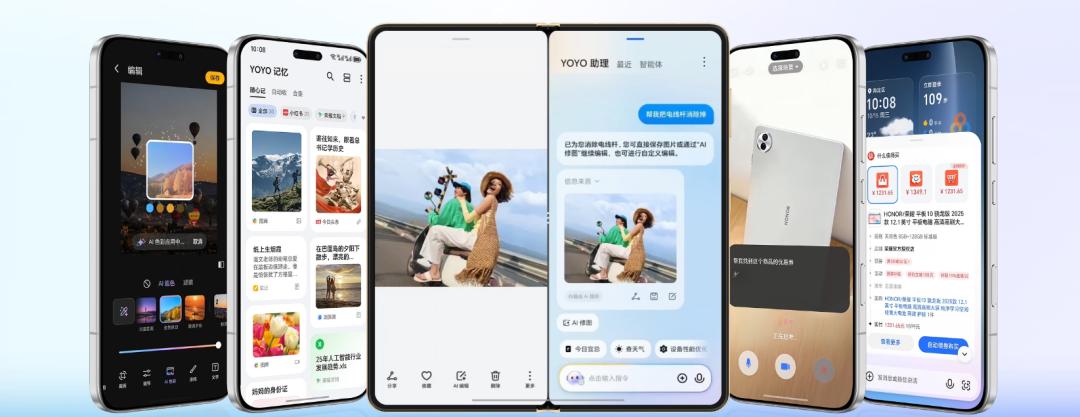
Honor's solution is to tightly integrate AI with the operating system. Based on Honor's presentation at this year's June MWC, the Agentic OS features four core traits: intent-driven, natural interaction, proactive intelligence, and inherent cross-device capabilities, with YOYO (Honor's agent) serving as the basic implementation of Agent functionality. In practical terms, the Agent acts as a system-level proactive executor.
When a user states a vague requirement, the Agent will proactively break down the task, call multiple system or application capabilities, coordinate across devices, and finally deliver results or execute directly. In this model, the Agent can indeed achieve the "task-performing" effect, but real-world performance still depends on the manufacturer's control and transformation capabilities over the existing application ecosystem.
The most thorough solution to date may be Huawei's HarmonyOS approach. HarmonyOS is currently the most comprehensively transformed system-level Agent implementation. Thanks to its microkernel architecture, AI Agent capabilities exist at the same level as other system service components, enabling direct invocation and orchestration of system-level APIs and distributed capabilities.
This means AI can natively call Agents and Skills uniformly within the HarmonyOS framework, without relying on GUI simulation or external protocols. This approach has clear advantages in execution efficiency, permission control, and cross-device collaboration, but it also imposes higher requirements on the existing app ecosystem. To integrate with the HarmonyOS ecosystem, app developers must provide standardized AI invocation interfaces, meaning the actual progress of the AI ecosystem depends on developer cooperation.
These different paths represent a progressive spectrum of approaches.
From the most radical method of direct simulation clicks ignoring app developer preferences, to the most conservative approach of rebuilding rules from the operating system kernel. No matter which path is chosen, the core challenge for smartphone manufacturers is balancing Agent capability strength with app ecosystem compatibility. The outcome is predictable: paths that require minimal app cooperation deliver stronger capabilities but face a higher risk of being blocked; paths that rely heavily on app cooperation are more sustainable but face enormous implementation barriers.
This means that under the influence of existing power structures, every smartphone manufacturer pursuing an Agent path is essentially "dancing in chains".
Every brand can promote how rational their Agent architecture is and how vast their future potential is. But a beautifully executed dance does not mean the chains will loosen on their own.
Can Agent Smartphones Reverse the Industry's Downturn?
In the long run, technical disputes can gradually be resolved through commercial compromises. But unfortunately, smartphone manufacturers may not have that much time to wait.
Driven by rising memory prices, the global smartphone industry is experiencing its most severe contraction on record in 2026. IDC's February forecast projects full-year shipments will drop 12.9% year-over-year to around 1.1 billion units, the lowest level in over a decade; firms including Counterpoint later revised the decline upward to roughly 13.9%. In the Chinese market, Counterpoint data shows smartphone sales fell 13% year-over-year during the one-month 618 shopping festival. Additionally, throughout 2026, many smartphone makers have announced price increases for their devices to offset rising costs.
So when will the memory supply shortage end? A reference point is that a HBM (high-bandwidth memory) manufacturer needs at least 3-5 years to expand production capacity.
Against this backdrop, some smartphone manufacturers see opportunities, while others are seeking new sales growth avenues.
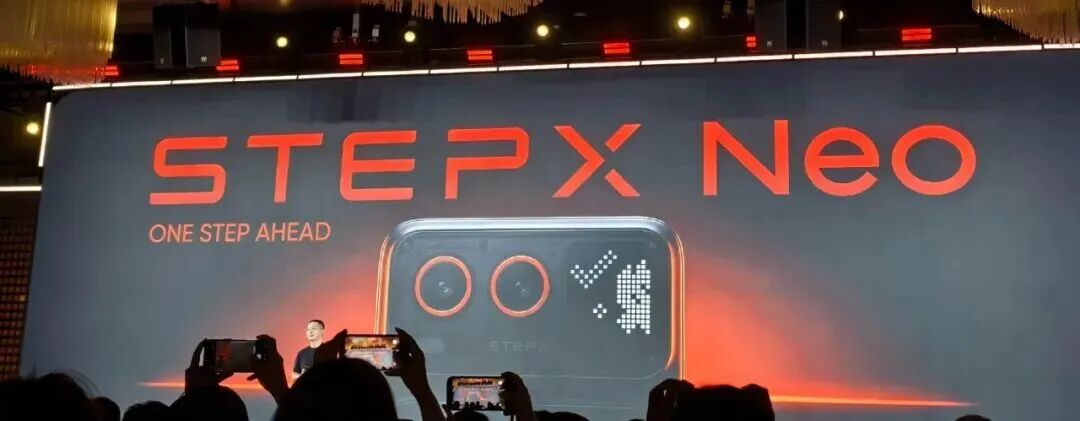
Step Star falls into the category of positioning players. According to Yin Qi, Chairman of Step Star, the first phase of their smartphone initiative will not purely pursue shipment volume, but "must achieve meaningful scale". For a pure AI company, using hardware reference designs to promote their own protocols and standards makes selling devices a secondary priority. If successful, the company could become a rule-setter for the new ecosystem. More critically, compared to established smartphone brands, Step Star carries far less legacy baggage.
For nubia and Honor, "agent smartphones" are directly targeted at driving new sales growth. While to some extent, this new form factor may not represent a major hardware upgrade from the 2024 "AI Phone 1.0" era, the software-level differences could create entirely new consumer demand. After all, the value proposition of system-level AI capabilities that can "perform tasks for users" was already proven by the market with the first-generation Doubao phone.
Regardless, the wave of technological progress is unstoppable, and Agent capabilities have become the core narrative for the next generation of AI smartphones.
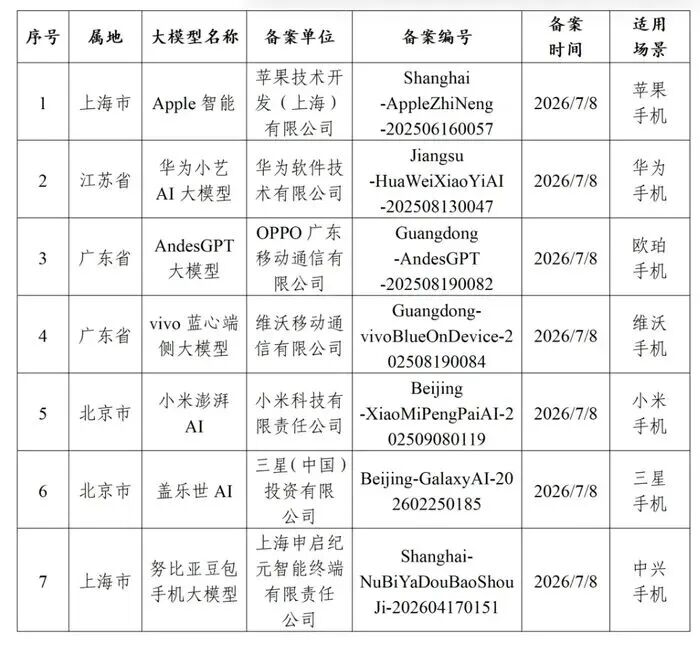
Based on large model filing information released by the Cyberspace Administration of China on July 15, a new round of smartphone AI model competition has already begun. Especially after Apple finally launched its year-long promoted Apple Intelligence, domestic smartphone manufacturers will inevitably launch a counteroffensive to prove their capabilities are superior.
On the other side, internet companies are gradually lowering their guard against Agents. This past June, WeChat announced it is collaborating with smartphone manufacturers including Huawei, Honor, Xiaomi, OPPO, and vivo to launch A2A assistant capabilities, allowing users to initiate WeChat audio and video calls or send messages to friends directly via the phone's voice assistant.
In the short term, "agent smartphones" are still far from reaching the performance heights of the first-generation Doubao phone. They have been forced to make compromises between capabilities and ecosystem compatibility, but as more participants join this dance, the chains will inevitably loosen over time.
The "Agent smartphone" category trend has already begun.
This article originates from the