From Shanghai to the World: WAICA is Rewriting the Rules of Top-tier Conferences with the "AI-Native" Paradigm

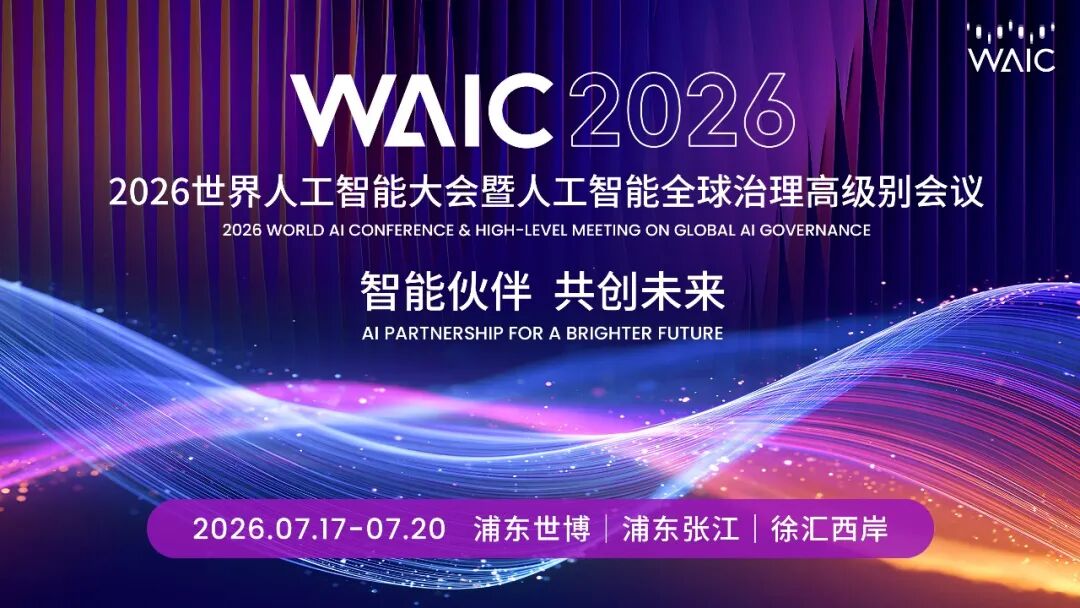
From July 18 to 20, 2026, the inaugural World Artificial Intelligence Conference · Academic (WAIC-Academic, abbreviated as WAICA), built on the eight-year profound heritage of the World Artificial Intelligence Conference (WAIC), will make its official debut. This is a top-tier global artificial intelligence academic conference independently initiated by China, and it represents a return to the essence of academia — ensuring that science is not swayed by external factors, and that every high-quality paper receives fair evaluation.
I. Science Without Borders: The "Shanghai Declaration" of WAICA
Guided by the ideal of borderless academia, WAICA came into being. It is an open academic public platform initiated by China and oriented to the world, firmly dedicated to building an innovative stage for global AI scholars that returns to the essence of academia. As emphasized by the conference organizers: Science knows no borders, and academia should return to its essence of openness, fairness, and freedom, free from interference by any external factors. Shanghai has taken proactive action, leveraging the rich experience accumulated over eight sessions of the conference and the mature industry-university-research ecosystem to establish such an international academic stage, ensuring that every scholar who conducts research diligently, regardless of their country or affiliated institution, can be treated fairly and their work can be heard attentively.
The caliber of the participating team itself is the best testament to its credibility. Mr. Andrew Chi-Chih Yao, a Turing Award winner and academician of the Chinese Academy of Sciences, serves as the Conference Chair; the Program Committee Co-Chairs are Academician Zheng Qinghua of the Chinese Academy of Engineering and Academician E Weinan of the Chinese Academy of Sciences. This top-tier team, which boasts both international prestige and professional influence, provides solid guarantees for the authority and academic standards of the conference from the very root. Academician Sun Ninghui, Chairman of CCF, will also attend and deliver a speech, further strengthening the endorsement of in-depth cooperation with CCF.
A set of data confirms the initial internationalization achievements of WAICA: The inaugural conference received 282 valid submissions that met the formal requirements, and finally accepted 57 papers, with an acceptance rate of approximately 20.21%, which falls within the strict conventional range of top international conferences. The authors of the accepted papers cover 12 countries around the world as well as Hong Kong, Macao, and Taiwan regions. Among them, there are 8 overseas submissions, from institutions including world-renowned universities such as Princeton, Cambridge, Imperial College London, and Nanyang Technological University, as well as top domestic universities like Tsinghua University, Peking University, Shanghai Jiao Tong University, Fudan University, Zhejiang University, the University of Hong Kong, and the University of Macau. The active submissions from top prestigious universities fully demonstrate the international appeal of the conference. It is worth noting that among the 57 accepted papers, the first author of one paper is from Wuhan Polytechnic University — this precisely embodies the fairness of WAICA's "quality-only" review principle, which does not judge by the institutional background, giving universities of all tiers the opportunity to have papers accepted. All accepted papers are officially published by Springer Nature and indexed by five authoritative retrieval databases: CPCI, Scopus, EI Compendex, Google Scholar, and DBLP, which can support academic confirmation scenarios such as degree application, project declaration, and professional title evaluation.
II. AI Reconstructing the Academic Review Mechanism: A "Native" Revolution in the Paper Paradigm
If openness and fairness are the spiritual cornerstones of WAICA, then systematic mechanism innovation is its real core competitiveness.
The reconstruction of the review system is the most disruptive breakthrough of WAICA. Traditional top-tier conferences adopt double-blind anonymous review, which suffers from large variance in review quality and hard-to-eliminate biases. WAICA has pioneered a three-dimensional review mechanism of "AI-assisted preliminary screening + full PC open comment + multi-party collaborative adjudication". In the preliminary screening stage, the locally deployed AI system verifies the format compliance, data reliability, and logical consistency of the submissions, effectively filtering out low-quality papers and precisely addressing the rampant problem of data fraud in the current academic circle. After entering the formal review phase, WAICA adopts a full PC review mode — all review work is completed by members of the Program Committee, which is different from the "submitter voluntary review" mode adopted by leading top-tier conferences due to the overwhelming number of submissions (where a large number of students participate in the review, resulting in large quality variance), thus ensuring the professionalism of the review from the mechanism level. More pioneeringly, during the Rebuttal phase after the completion of traditional peer review, the conference opens all papers to all Program Committee members, and any PC member can comment on papers that they did not review themselves, using collective wisdom to complement the perspective deviation of individual reviewers, so that the adjudication of every paper is well-documented and doubts can be properly addressed.
The "AI-native" submission and presentation paradigm breaks the decades-long constraints on academic expression. WAICA has independently developed a dedicated submission and review system: after authors upload their PDFs, the system automatically parses them into a Markdown-like format, supporting the embedding of multimedia content such as videos, audios, and interactive demonstrations at the original image positions. This design completely breaks through the presentation limitation of pure PDF format in traditional top-tier conferences, and is especially adapted to the achievement presentation of cutting-edge directions such as multi-modal AI and embodied intelligence, making it an academic conference design truly "born for AI".
Open-source verifiability and academic paradigm innovation are the long-term directions that WAICA is targeting. This year's conference has encouraged authors to attach codes along with their papers, and is in talks with Alibaba for cooperation; in the future, it plans to collaborate with Hugging Face to require authors to upload sample data and runnable codes. In the future, WAICA plans to build a unified algorithm verification platform to directly run the algorithms in the papers to reproduce the results, fundamentally avoiding the problem of data fraud. More forward-looking, the achievement presentation form of "short paper + runnable code" is under exploration, aiming to return to the academic contribution itself, change the industry inertia of equating "long paper" with "high contribution", and create a new AI-native academic publication paradigm.
III. The "Gold Content" of Papers: Closing the Value Loop from Top-Tier Conferences to Industry
Apart from academic influence, WAICA has also opened up the key path to industry recognition. A number of leading enterprises including Tencent, SenseTime, Xiaohongshu, Lightelligence, MiniMax, and Parallel Technology have reached a unified recognition standard: student first authors of papers accepted by WAICA enjoy the same bonus point recognition standard as CCF Class A papers in campus recruitment and internship recruitment. With the academic circle hosting the conference and the industry providing recognition, this two-way empowerment pattern makes WAICA far more than a three-day event, but a valuable bridge connecting academia and industry.
To support young talents, WAICA has put forward tangible commitments: all academic presenters whose first authors are students will receive a Student Travel Grant; Tencent will issue research bonuses to the authors of the Best Student Paper Award and the Best Student Paper Nomination Award; it is currently planned that future best papers will directly advance to the final evaluation of WAIC's highest honor, the SAIL Award; the conference is also linked with the "Hundred Groups and Hundred Projects" special project of Shanghai's Scientific Intelligence Initiative, opening up application channels for provincial and ministerial-level scientific research projects for authors of excellent papers. In the long-term plan, awards such as the Most Promising Newcomer Award, Open Source Contribution Award, and Application Practice Award will be presented in the next year, to fully test the practical implementation value of the achievements.
IV. The July Appointment: Let Young Ideas Resonate with Global Wisdom in Shanghai
In July in Shanghai, WAICA will also present a rich matrix of academic activities. The kickoff meeting on the morning of July 18 will be opened with speeches from leaders of the China Association for Science and Technology and the China Computer Federation, and Academician Andrew Chi-Chih Yao will deliver an on-site message to encourage young scholars; Academician Ling Wen, Academician Huang Dianzhong, and Academician Dacheng Tao of the Australian Academy of Sciences will also give speeches. The special selection for best papers on the afternoon of July 18 will select the best from the 57 accepted papers, with 5-7 domain experts scoring on site, and finally determine the Best Paper Award and the Best Student Paper Award. Five vertical Workshops cover directions including celestial intelligence satellite computing, multi-modal agents, quantum computing, embodied intelligent spatial interaction, and mathematics-related fields, which are organized by university professors through independent applications, serving as an important carrier of WAICA as an "academic incubator" — mature Workshops can be incubated into independent academic conferences in subdivided fields in the future. The Young Elite Summit on the morning of July 20, with the core concept of "Thinkers Walk Together, Innovators Co-Create, Industry-Investment-Research Coexist", invites Academician Wang Jianyu to give a keynote speech, and sets up a Young Idea Show and roundtable salon to deliver popular science-oriented sharing to the public, bridging the "last mile" between academia and industry.
From the reconstruction of the review mechanism to the innovation of the academic paradigm, from the realization of industry recognition to the support for young talents, what WAICA is writing is not only the birth story of an academic conference, but also a testament to the era when China's AI academic discourse is moving from following to leading. As an important component of Shanghai's effort to build an international science and technology innovation center, WAICA is redefining the rules and boundaries of international AI academic exchanges with an open, fair, and pragmatic attitude. And Shanghai, this city of innovation, will thereby gain the ability to define the academic frontier, and truly undertake the important mission of being a global innovation source.
This grand academic event belongs not only to China, but also to the whole world. At a time when global academic freedom is facing challenges, WAICA chooses to embrace global wisdom with a more open attitude — as emphasized by the organizing committee, no matter where you come from, as long as you are dedicated to research and pursue innovation, WAICA welcomes your participation and witness.