The unhyped new US open-source king Inkling: 975B native multimodal, matching NVIDIA's performance with only 1/3 of the tokens
By now, the global landscape of large language models has taken shape. Is there still a need to invest massive resources in training a new model entirely from scratch?
Thinking Machines Lab (TML), co-founded by former OpenAI CTO Mira Murati and researcher Li Weng (former VP of Applied Research at OpenAI), provided its answer today.

In the early hours of July 16, Beijing time, the company unveiled its first self-developed general foundation model, Inkling. Built on a Mixture-of-Experts (MoE) architecture, it features a total of 975 billion parameters with 41 billion activated per inference. The full inference weights are released openly under the Apache 2.0 license, including both BF16 and NVFP4 quantized versions.
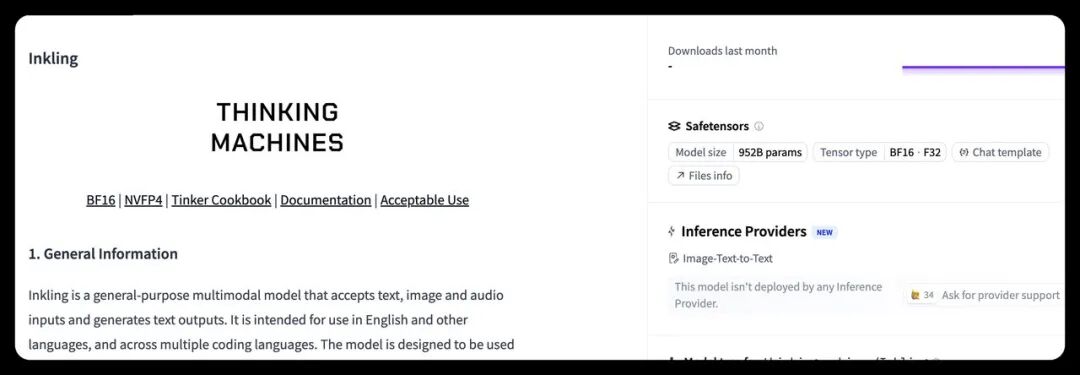
Hugging Face open source repository: https://thinkingmachines.ai/news/introducing-inkling
Founded in February 2025, Thinking Machines Lab secured a $2 billion seed round just five months after its establishment, reaching a $12 billion valuation and setting a new seed-round funding record in the AI industry. While Inkling certainly had every advantage to make a big splash on benchmark leaderboards, TML took a rarely seen candid stance across the industry and deliberately walked away from the SOTA narrative.
The team stated plainly in its official blog, "Inkling is not the strongest model in the world today — not among open source models, nor among closed ones." In their view, the primary value of an open source model does not lie in pushing performance to extreme limits, but rather in:
Striking a deliberate balance between capability, inference cost, native multimodality, and fine-tunability, and serving as a model backbone that enterprises can continuously adapt using their own data.
This deep insight into the "open source model market" comes from nearly a year of hands-on experience in the B2B trenches through their Tinker platform, a dedicated fine-tuning computing service for large models. That real-world experience is reflected in three core priorities for building a model optimized for enterprise secondary fine-tuning:
Token efficiency, a closed-loop system for deep customization, and native multimodality.
The All-Round Contender Tops the U.S. Open-Source Model Ranks
Inkling adopts the MoE architecture: 975 billion total parameters, 41 billion activated per inference, supporting a maximum 1 million-token context window. Its pre-training dataset totals 45 trillion tokens, spanning text, image, audio, and video modalities.
Caption: Inkling, whose name evokes hints and implications, is visually designed to resemble a fluid ink shape that can morph freely.
In terms of sheer scale, its 975 billion parameters place Inkling among the largest open source models in the world (surpassing Zhipu's GLM-5.2 at 753 billion parameters, while remaining below Kimi-K2's 1T parameters).
Inspired by DeepSeek V3's MoE design ("largely follows DeepSeek-V3"), Inkling activates only a subset of experts during each inference, keeping operational costs and latency well under control. This design path is widely adopted by leading models including DeepSeek, Kimi, and GLM.
Notably, a lighter preview variant called Inkling-Small is also in development, with 276 billion total parameters and 12 billion activated parameters. Its weights will be released after testing is completed.
According to independent evaluations from Artificial Analysis, Inkling achieved an overall score of 41 in general capability benchmarks, outperforming Nvidia's Nemotron 3 Ultra, Google's Gemma 4 31B, and OpenAI's GPT-OSS-120B to claim the top spot among U.S. open source models.
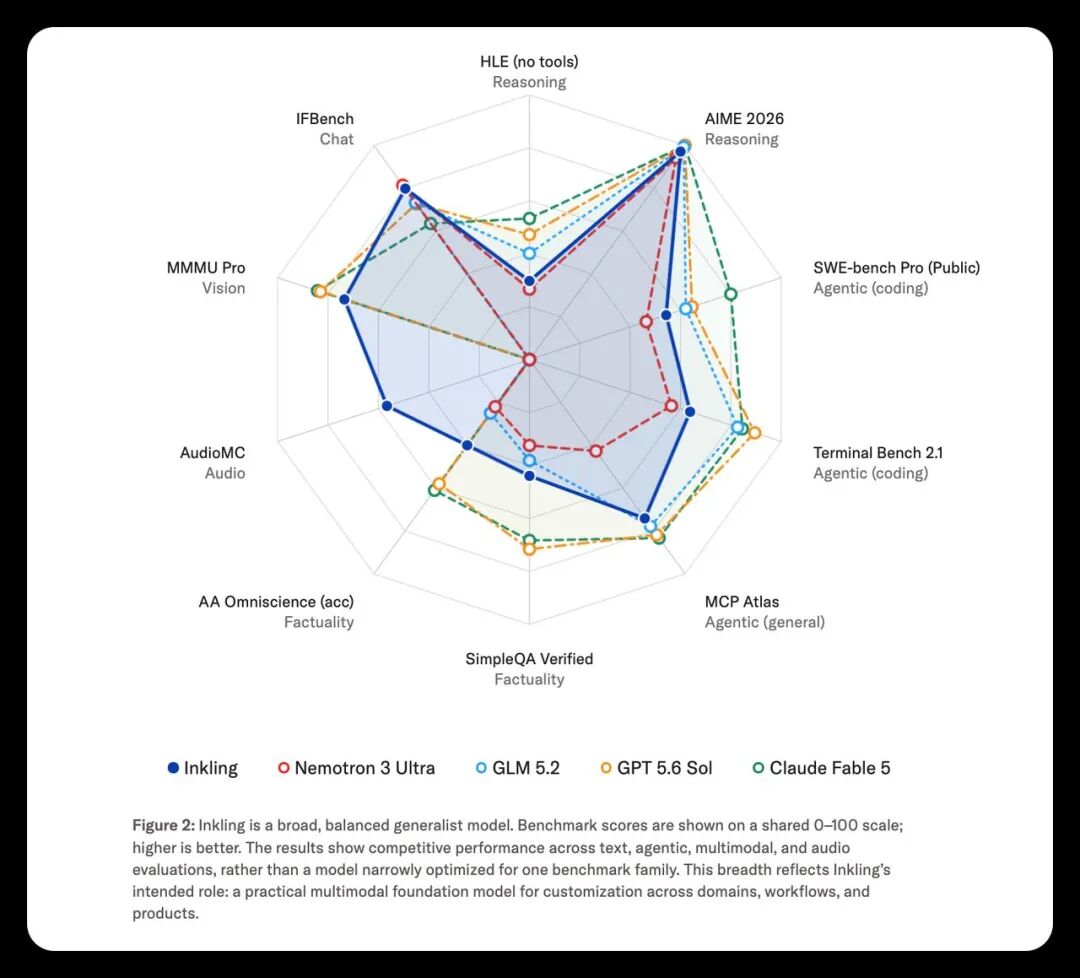
This broad capability profile is critical for model customization and real-world deployment. Instead of chasing peak performance in a single dimension such as pure logical reasoning, Inkling delivers strong results across a wide spectrum of tasks including agent orchestration, programming, instruction following, and multimodal understanding. Since enterprise workflows are inherently complex and interconnected, the base model must be a true generalist to support subsequent specialized fine-tuning.
To improve robustness in agent orchestration and tool usage — preventing the model from failing when moved outside its original test environment — TML deliberately shuffled tool sets and tool definitions during training, forcing the model to grasp the underlying logic of tool invocation rather than memorizing specific framework APIs.
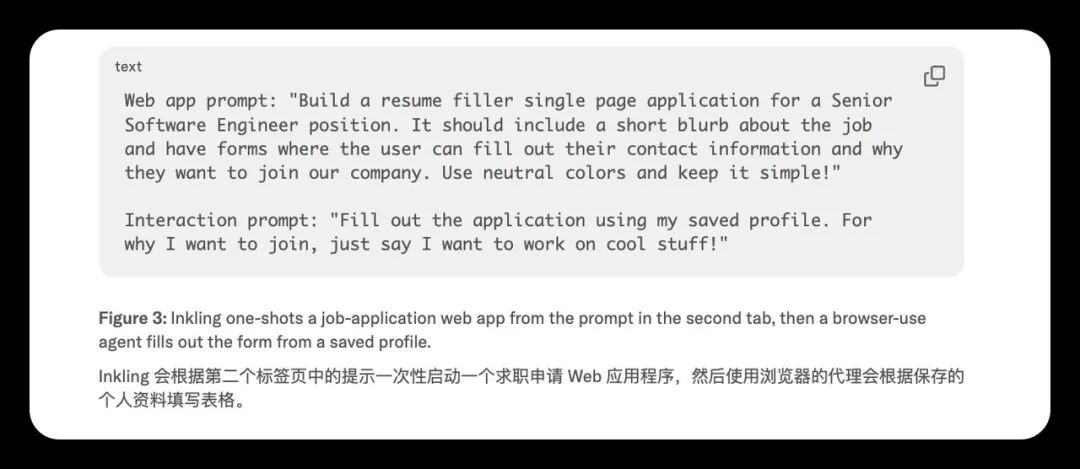
In practical demonstrations, Inkling can directly build a fully functional web application in a one-shot generation, embedding an AI assistant that allows users to control the interface through natural language. This leap from generating isolated code snippets to constructing fully interactive systems addresses one of the most sought-after capabilities in enterprise automation workflows.
In web development testing and multi-page construction, long-range consistency stands out as another key advantage of Inkling. In the blind, human-evaluated Design Arena benchmark, Inkling scored 1257 points, matching the performance of closed-source flagship Claude Opus 4.6, outperforming Gemini 3.5 Flash and Kimi K2.6, and ranking second only to Zhipu's GLM 5.2 among all open-weight models worldwide.
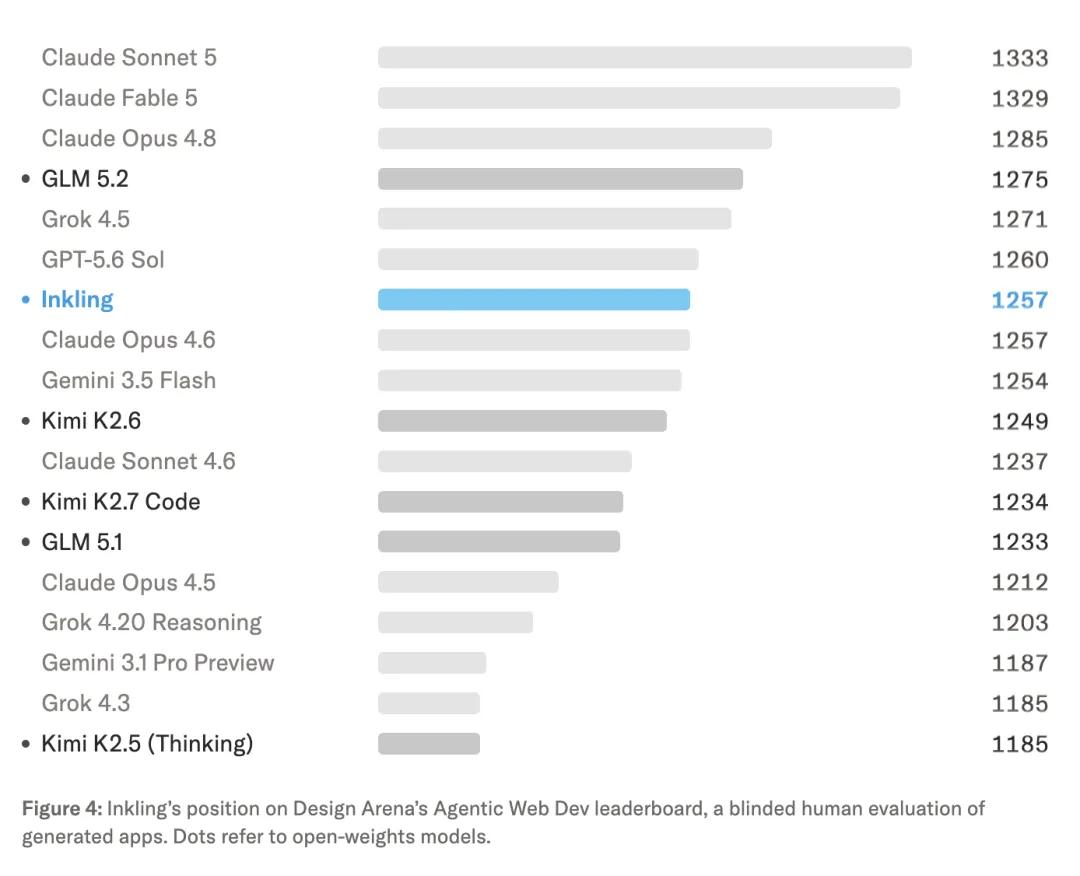
Large language models often suffer from "style drift" or "instruction forgetting" in long-form generation, but Inkling maintains consistent visual style and reliable information across multi-page applications. This proves that its 1 million-token context window is not just a theoretical specification, but backed by real-world engineering implementation.

Objectively, while Inkling leads the U.S. open source ecosystem, it still lags behind China's GLM 5.2 and Kimi K2.6 in "hardcore reasoning" benchmarks such as HLE and advanced code agent tasks — a gap TML clearly does not prioritize.
To demonstrate how this "breadth-first" strategy benefits fine-tuning, TML ran a bold experiment: letting Inkling participate in its own fine-tuning process.
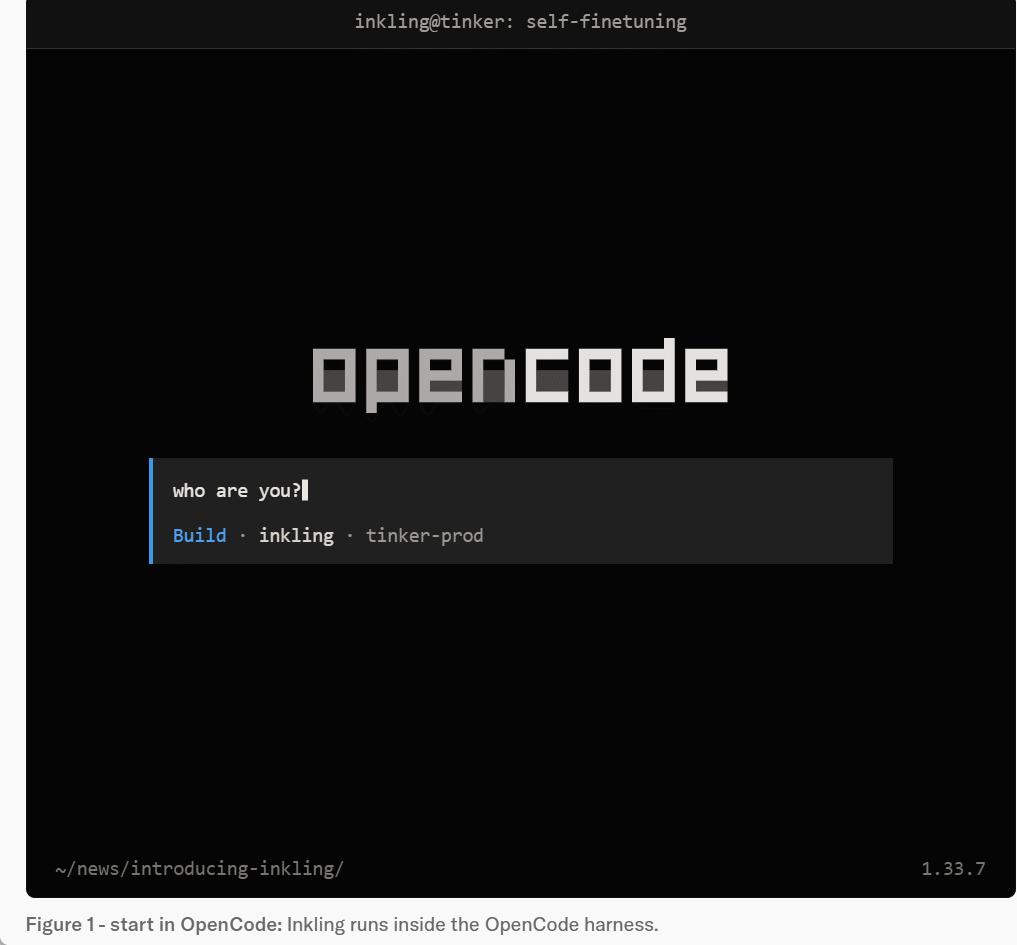
In this demo, the model uses the Tinker platform to write fine-tuning tasks by itself, run training workflows, and evaluate results. This shows that Inkling is a highly malleable foundation model that can even act as the infrastructure for shaping itself and other models.
1/3 Token Cost to Match Nemotron 3 Ultra Performance
If its all-round capability is Inkling's ticket to the top of the U.S. open source ranks, what truly builds its competitive moat in the B2B market is its relentless focus on low deployment costs and high adaptability.
On the Terminal Bench 2.1 (agent programming benchmark), Inkling achieves the same performance level as Nvidia's Nemotron 3 Ultra while generating only about one-third as many average tokens.
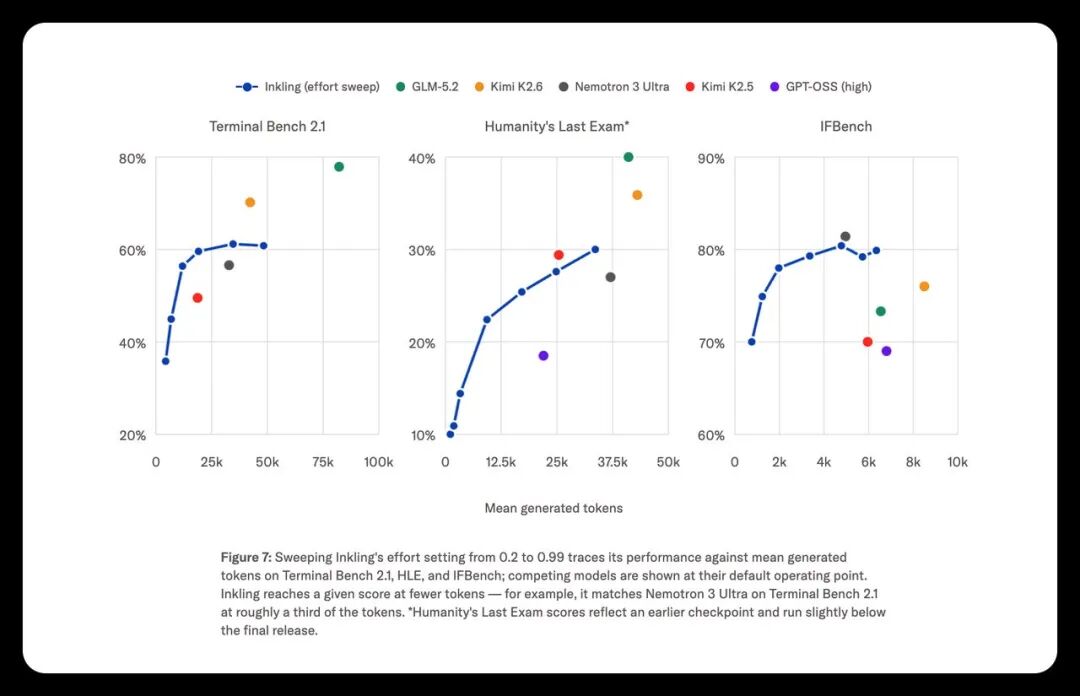
Caption: As reasoning intensity increases from 0.2 to 0.99, Inkling can dynamically select different operating points between task performance and generated token volume.
Test results show that Nemotron 3 Ultra scores 56.4% on this benchmark, while Inkling reaches 63.8% at its maximum reasoning intensity. When TML reduces Inkling's reasoning intensity to match Nemotron's performance level, it only consumes about one-third of the tokens.
In other words, Inkling reaches the same task success rate through a much shorter reasoning path. For enterprises that embed models into long workflows and run millions of calls daily, this not only drastically cuts API expenses, but also directly reduces end-user perceived latency.
Notably, Inkling's token efficiency is not achieved by artificially truncating the chain-of-thought through a post-processing interface — it is deeply embedded into the model itself via reinforcement learning.
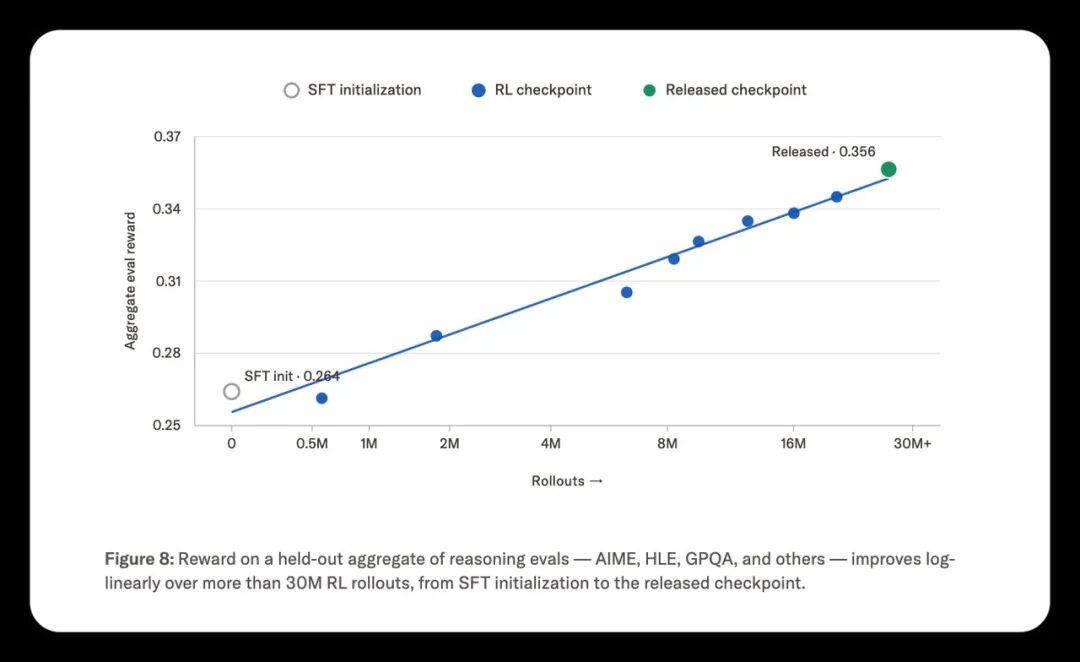
Caption: Inkling maintains stable training across more than 30 million reinforcement learning rollouts, with steady improvements in inference benchmark scores.
During the post-training phase, TML deployed massive computing resources for large-scale asynchronous reinforcement learning, completing over 30 million rollouts. Instead of blindly maximizing reasoning depth, the team introduced a refined mechanism: by modifying system prompts and assigning different per-token costs to different tasks, the model is allowed to fully expand reasoning for some tasks while being forced to strictly control its computational budget for others.
After repeated training, Inkling gradually learns to adapt its reasoning strategy to different tasks: identifying which problems are worth deep exploration, which tasks can be concluded early, and whether additional reasoning steps bring meaningful performance gains.
This means developers no longer simply set a hard maximum output length limit, but adjust different reasoning "gears" the model has already learned through reinforcement learning (controllable via output_config.effort to set reasoning intensity between 0 and 1; higher values typically encourage more thorough reasoning, though not guaranteeing longer or more accurate outputs every time).
More interestingly, as reinforcement learning progresses, Inkling's chain-of-thought begins to exhibit spontaneous compression.
Early versions of the model used complete grammatical structures and repeatedly restated conditions and reasoning intentions. In later training stages, it started omitting redundant articles, conjunctions, and repetitive expressions, gradually condensing its reasoning process into a near-shorthand notation. TML never explicitly rewarded this style — pure token cost pressure drove the model to find shorter, more efficient reasoning paths.
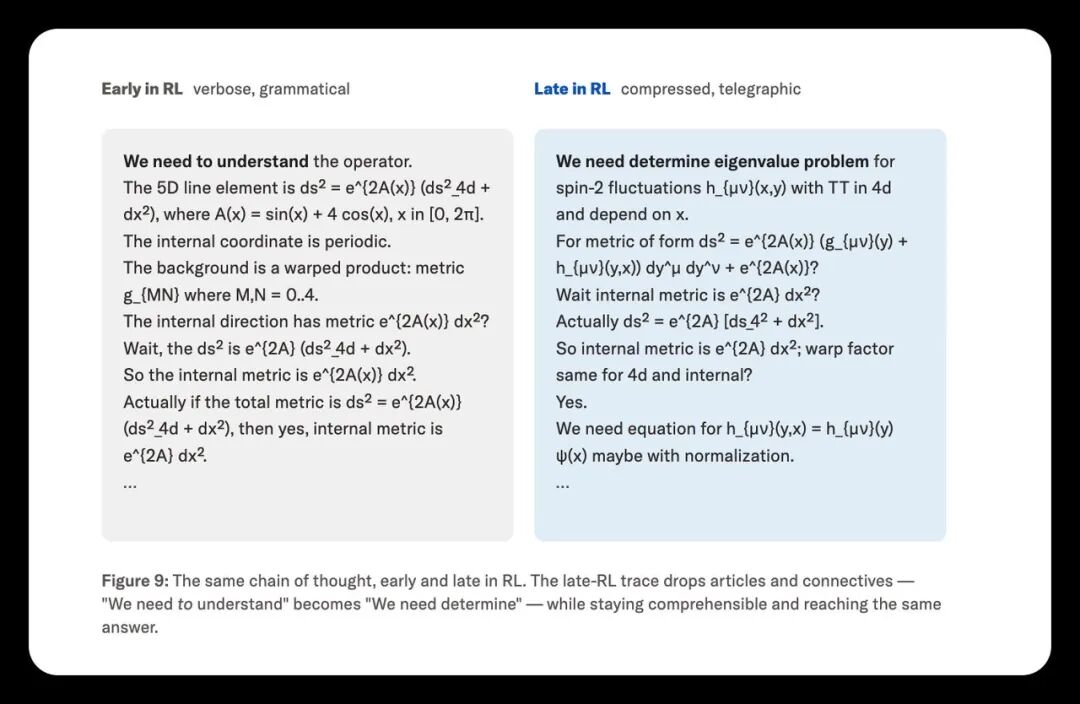
Caption: A side-by-side comparison of chain-of-thought for the same problem before and after reinforcement learning, showing how later reasoning omits unnecessary grammatical elements. The Cognition team observed similar patterns while training SWE-1.7.
This gives Inkling an inherent, built-in reasoning intensity control capability. It is not a model that always "thinks less and cuts corners", but rather a fully adjustable performance-cost curve.
Simple tasks do not need to pay the cost of maximum reasoning intensity, while complex tasks can still allocate additional computational budget. For enterprises, this is far easier to deploy than a high-scoring model that only runs at fixed settings, and enables precise cost control tailored to different workflows.
A model that learns to optimize resource efficiency also tends to absorb new knowledge far more effectively during fine-tuning.
Completing the Post-Training Closed-Loop for Large and Small Model Collaboration
To make this high adaptability fully usable, TML did not stop at releasing open weights — it built a complete full-stack toolchain. The Tinker platform natively integrates Inkling fine-tuning support, updated a detailed cookbook, and provides three complete audio customization examples. Most critically, the team released the tml-renderer component.
